Container Gardening Ideas: 15 Picks That Fit Your Space
First, draw the space you actually have
A compact tomato generally needs about 20–30 litres (5–8 US gallons) of potting mix; an 8-litre (2.1-gallon) pot is undersized for a productive plant. That mismatch explains why so many container gardening ideas look possible on a balcony but fail once roots, sun, wind and watering compete for the same small space.
Treat sunlight as a budget, not as a vague description such as bright or sunny. Direct sun means the growing area receives the sun’s beam and throws a defined shadow. Light bouncing off a pale wall can make a balcony look bright without supplying a fruiting plant with the same usable light.
Before buying anything, put a strip of masking tape on the floor, ledge or sill to mark the exact growing footprint. Check that strip in the morning, around midday and again in the afternoon. Note when a defined shadow disappears and when it returns, then total the hours of direct sun. The fuller method is covered in How to measure balcony sunlight before buying plants, but the planning bands are straightforward:
- With roughly one or two hours of direct sun, choose microgreens, salad leaves, green onions, herbs or a quick radish crop. These are mainly leaf and root crops, so a modest harvest is more realistic than a heavily fruiting plant.
- With about four to six hours, peas, beans, strawberries, carrots and some compact crops become more workable. Harvests may be smaller or slower in a position that receives the lower end of that range.
- With six or more hours, a warm, exposed position can support peppers, cucumbers and compact tomatoes if the pot is large enough and watering is consistent.
Record the less glamorous details too. Measure the width and depth available, distinguish a railing box from a floor position, and note whether wind reaches the leaves from two sides. Check how far a watering can must travel from the tap. A pot that looks easy to carry when empty can become awkward once filled with wet mix, a plant and a trellis.
On a balcony, check your building’s load, waterproofing and runoff rules before concentrating large containers in one spot. Read local building authority, strata or landlord guidance rather than assuming that a strong-looking concrete floor answers every question. Keep heavy pots near approved load-bearing areas, and don’t put a large, wet container on a narrow railing unless the fitting is designed for it.
Here’s a useful paper test. Imagine a 90-centimetre-wide ledge with two hours of direct sun. A 30-litre tomato pot may physically fit, but it could shade the ledge, block access and demand more water than you can conveniently carry. Three 5-litre salad or herb containers use less root volume, can be lifted for cleaning and give you a better first experiment in that particular spot.
The best container gardening ideas are not the ones that fit on a shopping trolley. They’re the ones that fit the plant’s roots, the balcony’s weight limit and the routine you can actually repeat.
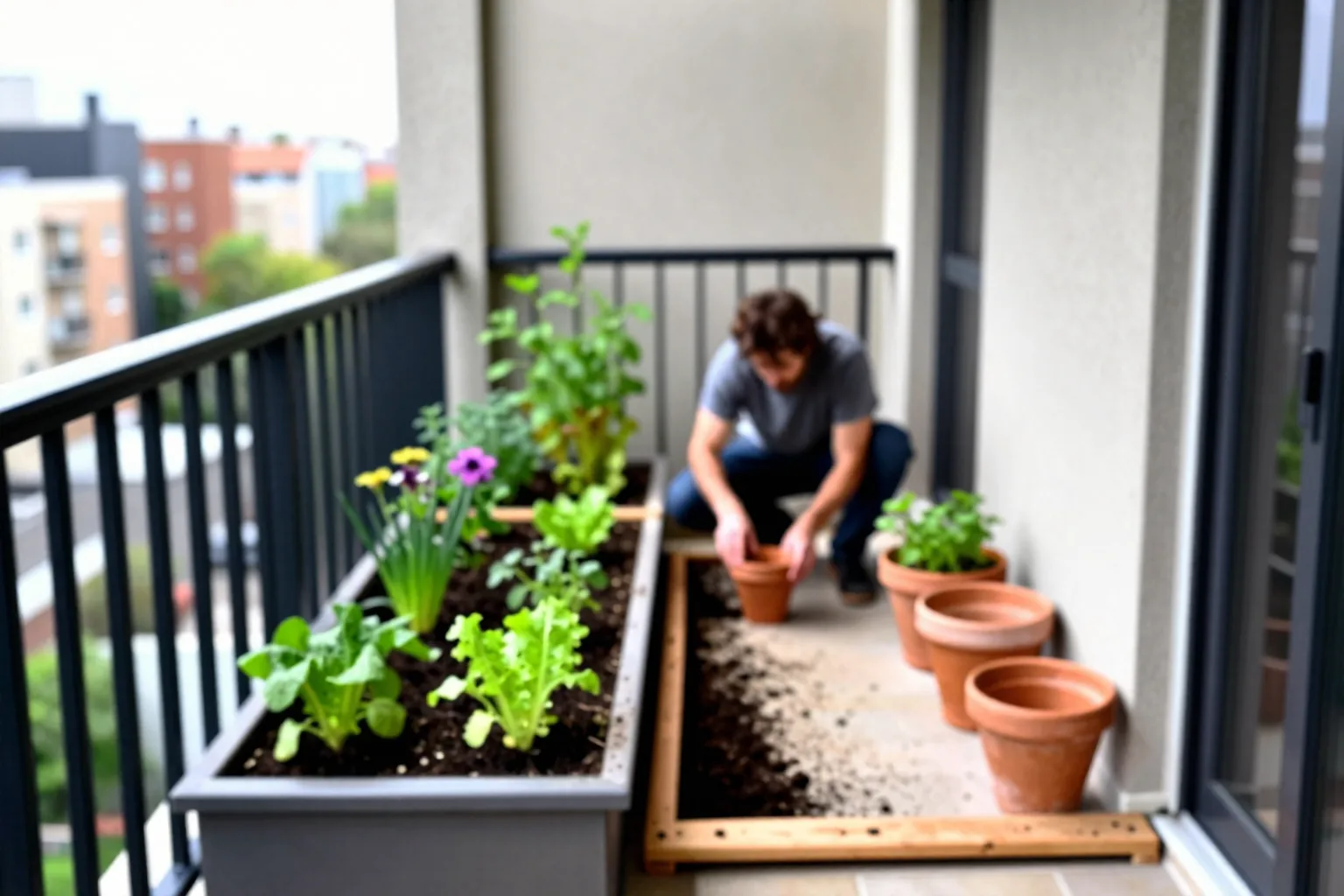
Fifteen ideas, sorted by the space they consume
The list below is a set of crop-and-container combinations, not fifteen decorative concepts. Each pick gives you a usable space, a working minimum volume, a direct-sun range, a realistic harvest and a predictable way to waste your effort. Treat the volumes as starting specifications rather than guarantees: a black plastic pot in reflected afternoon heat can need more attention than the same volume in a pale glazed pot in part shade.
A plant can fit its leaves into a corner and still fail underground. Roots, support, airflow and watering access count as part of the footprint.
Windowsill and shallow trays: microgreens, salad, herbs, radishes and green onions
Microgreens in a shallow tray. Use roughly 2.5–5 centimetres (1–2 inches) of mix in a tray holding about 1–3 litres (0.25–0.8 US gallons). A bright window or around one to three hours of direct sun can suit this short crop. Scatter seed evenly, dampen the surface without washing seed into one corner, and leave enough air movement for the dense seedlings to dry slightly between waterings. The harvest is a quick cut of young stems and leaves, not a plant that needs a deep root system. A fuzzy surface, sour smell or collapsed stems points to persistently wet, stagnant conditions; long, pale stems point toward insufficient usable light.
Cut-and-come-again salad leaves. A 5–8-litre (1.3–2.1 US gallon) container with 15–20 centimetres (6–8 inches) of depth is a sensible small-space fit. Aim for about two to four hours of direct sun, with brighter ambient light helping when direct sun is limited. Harvest the outer leaves above the crown so the centre can continue growing. The crop’s common failure is a pot that goes from dry to drenched: leaves wilt, then roots lose air after heavy watering. In warm weather, lettuce can also bolt, meaning it sends up a seed stalk and turns sharper in flavour before many leaves are picked.
A compact herb trough. A 5–10-litre (1.3–2.6 US gallon) trough about 15–20 centimetres (6–8 inches) deep can hold chives, parsley and coriander if you leave enough space for air to move between plants. Give the trough around three to five hours of direct sun where possible. Mint belongs in its own container because its spreading stems and roots can crowd slower herbs. Basil is the different case here: it wants the warmer, brighter end of the range, and a dim, cool sill produces soft, stretched growth rather than a sturdy harvest.
Radishes in a tray. Choose a 5–8-litre (1.3–2.1 US gallon) tray around 15 centimetres (6 inches) deep, with loose mix and roughly four to six hours of direct sun. Short varieties are more forgiving of this depth, but compacted mix forces the swelling root against resistance and can make it misshapen. Moisture swings are the other trap. If the developing root repeatedly dries hard and then receives a flood, it can become woody or split. Check below the surface with a finger rather than waiting for the leaves to droop.
Green onions for repeated leaves. A 3–5-litre (0.8–1.3 US gallon) container about 15 centimetres (6 inches) deep suits a tight group of green onions. Two to four hours of direct sun can produce usable leaves, although stronger light helps the stems stay upright. The realistic harvest is repeated snipping of green leaves, not a large dry bulb from a shallow windowsill pot. Leave a few centimetres of leaf above the base when cutting, and don’t let the container sit in runoff. Weak, floppy growth usually points toward low light or crowding; yellow, soft bases suggest excess moisture rather than thirst.
Shallow containers deserve a separate warning. They hold little water reserve, and a sunny sill above a radiator or heat vent dries from the top and sides at the same time. That is why a 5-litre trough can need checking more often than a deeper 10-litre pot in a cooler position.
Railing, hanging and small floor containers: strawberries, peppers, beans, nasturtiums and tomatoes
This group suits a sunny balcony or patio where horizontal space is limited but the railing, wall or air above the pot can be used. Secure hanging and climbing equipment before the plant becomes heavy. A pot that sways at the root line can lean farther in wind, and a late-installed support may disturb roots or snap a stem.
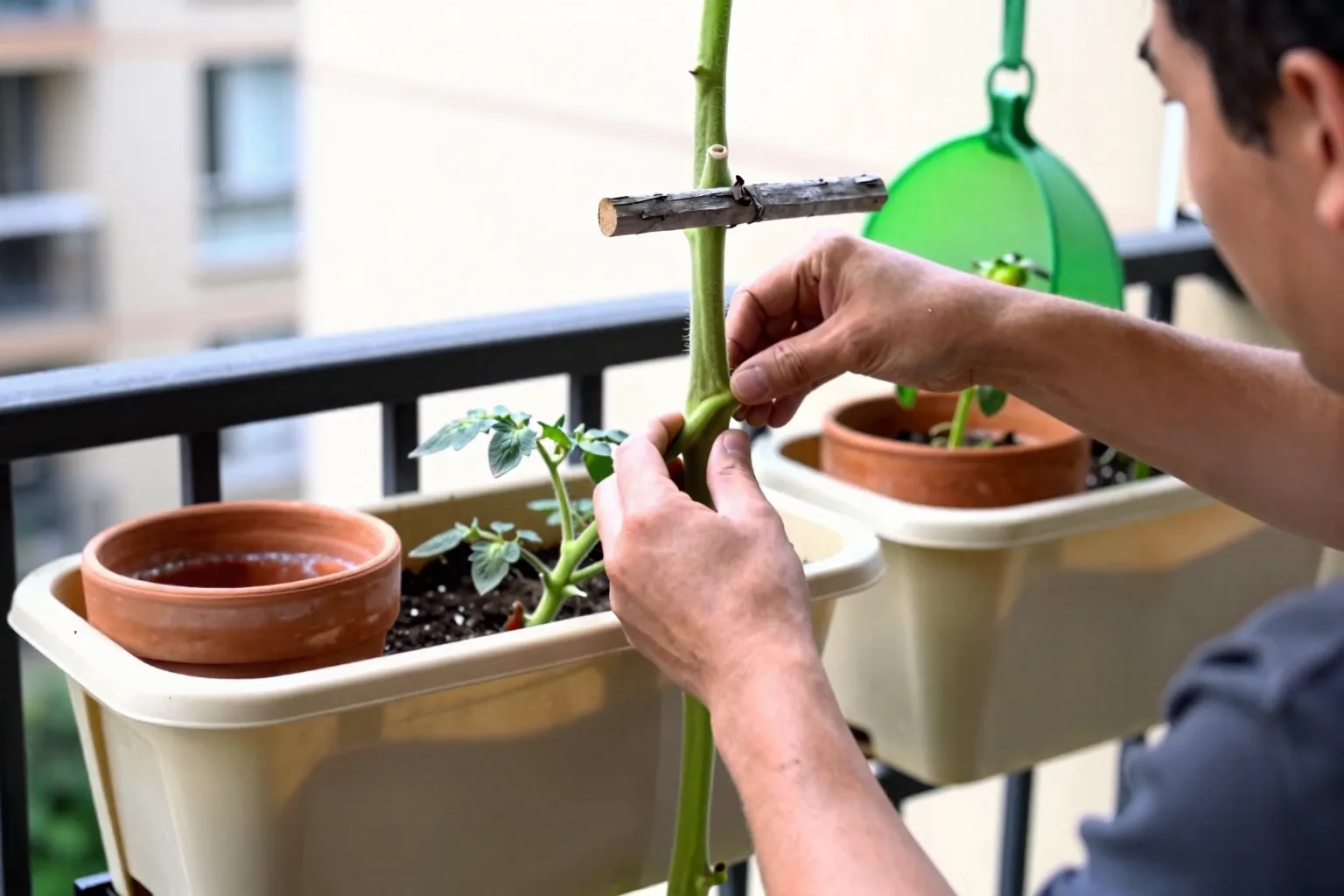
Strawberries in a railing box or pot. Allow roughly 8–12 litres (2.1–3.2 US gallons) of mix per plant, or use the planter’s spacing instructions instead of packing plants into every available gap. Give fruiting plants about four to six hours of direct sun. The harvest is usually a handful of berries at a time rather than a bowlful from one small planter. Hanging baskets are attractive but dry quickly because their exposed sides and top lose moisture; the failure appears as crisp leaf edges, limp runners and berries that stay small. Keep the crown, the short central stem where leaves emerge, at the mix surface instead of burying it.
One compact pepper. A single compact pepper plant fits a 10–15-litre (2.6–4 US gallon) container, but good fruiting depends on six or more hours of direct sun and steady moisture. The leaves may look healthy after a dry spell, yet repeated wilt-and-flood cycles can interrupt flowering and leave fruit small or uneven. Put the pot where you can reach it daily during hot weather, not where it is merely visible. The sensible harvest is a series of fresh peppers over the season, assuming the plant receives enough warmth, light and time; a shaded railing position is better used for leaves.
Bush beans in a small floor pot. Use about 15–20 litres (4–5.3 US gallons) for a bush type, with roughly four to six hours of direct sun. Follow the seed packet’s spacing rather than creating a dense mat of seedlings. Beans repay regular picking with more pods, so the container needs an accessible position and a watering routine that won’t be abandoned behind a chair. Crowding is the usual mistake: dense leaves dry slowly after watering, airflow drops and the container becomes difficult to inspect. A pot that is technically large enough can still be overplanted.
Nasturtiums for edible flowers and leaves. An 8–12-litre (2.1–3.2 US gallon) container is enough for a compact display, with about three to five hours of direct sun. The harvest is a modest supply of peppery leaves and flowers, not a replacement for a salad bed. Grow them in a food-safe container without ornamental pesticides. Too much high-nitrogen fertility can produce a mass of leaves with fewer flowers, so start with a normal container mix rather than pushing this plant with extra feed.
A compact or determinate cherry tomato. Give one plant 20–30 litres (5–8 US gallons) of mix and 30–40 centimetres (12–16 inches) of depth. It needs a bright position, ideally six or more hours of direct sun, and a support installed before planting. Determinate means the plant makes a more limited, bush-like framework; it is a better container choice than an unrestricted vine when height and access are limited. The common failures are predictable: an undersized pot dries rapidly, a late cage disturbs roots, and exposed stems suffer wind damage. Twenty litres can work as a practical minimum; thirty litres gives a larger water and nutrient buffer.
Put the crop you’ll inspect most often closest to the doorway. A pepper or tomato hidden behind a hanging basket can miss the one wilted afternoon that turns a manageable watering problem into a damaged plant.
Trellises and deep floor pots: peas, cucumbers, carrots, potatoes and blueberries
These choices consume more than their rim diameter suggests. Their leaves spread, their supports catch wind, or their roots need a deeper and more stable growing environment. Put them on the floor or another approved load-bearing surface rather than treating a full pot as a lightweight balcony ornament.
Peas on a small trellis. A 15–20-litre (4–5.3 US gallon) container and a 1–1.5-metre (3–5-foot) trellis suit compact pea varieties. Install the support before sowing because pushing stakes through an established root ball is needlessly disruptive. Give peas roughly four to six hours of direct sun. They’re cool-season plants, so a crop that starts well in mild weather may finish as summer heat arrives. The harvest is a run of tender pods over a limited season; hot, dry conditions and a neglected support are the usual ways to lose the crop.
A patio cucumber climbing upward. Use about 25–30 litres (6.6–8 US gallons) of mix, six or more hours of direct sun and a trellis that is anchored to something more stable than the pot rim. Cucumber leaves present a large surface to drying wind, so the container needs a reliable watering routine and a position where you can check it often. The harvest can be a small succession of fruits when light, warmth and moisture line up. Limp leaves in the afternoon that recover by evening indicate heat stress; limp leaves that remain collapsed after the mix is watered call for a root and drainage check.
Short-rooted carrots. Use a 20–30-litre (5–8 US gallon) pot at least 25–30 centimetres (10–12 inches) deep, with about four to six hours of direct sun. Choose a short or round-rooted variety if the container is at the lower end of that depth. Loose, stone-free mix lets the root swell in a predictable path; compacted mix produces forks, stubs and twisted shoulders. The harvest is a set of individual roots pulled when their shoulders reach the expected size, not a leafy crop that can be cut repeatedly.
Potatoes in a grow bag. Start with a 30–40-litre (8–10.5 US gallon) grow bag and a floor position receiving about five to seven hours of direct sun. Hilling means adding more mix around the rising stems as the plant grows, so buried stem sections can form more tuber-bearing space. Add mix in stages rather than burying a tall plant all at once, and leave foliage above the new layer. A soggy bag produces weak roots, while a bag that dries through its sides can stop growth before tubers size up. The realistic reward is a modest tuber harvest and the fun of lifting the bag, not a substitute for a field crop.
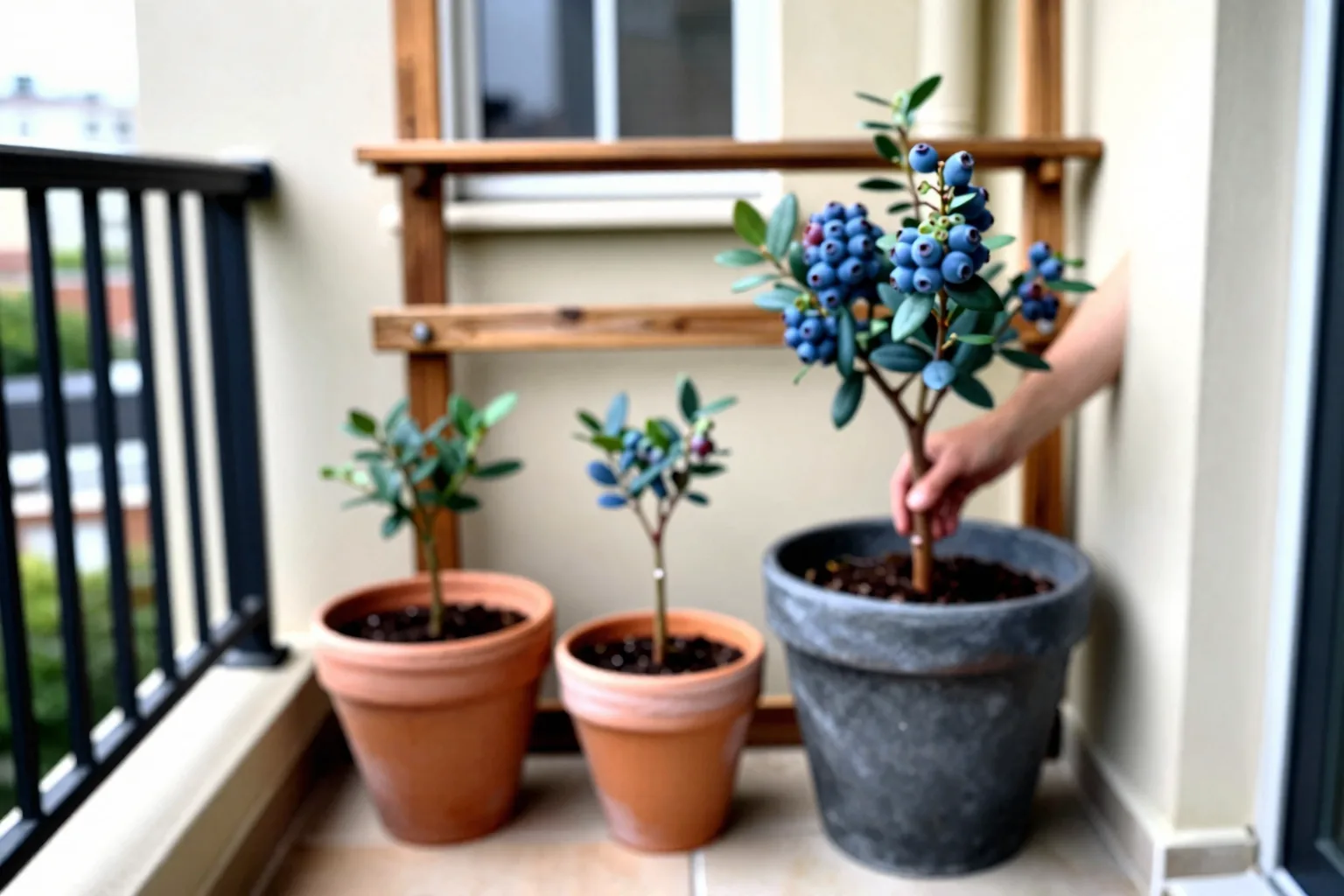
A blueberry as the space-intensive perennial. Plan on roughly 40–60 litres (10.5–16 US gallons) of mix, at least 35–45 centimetres (14–18 inches) of depth and a stable floor position. Use an acidic container mix around pH 4.5–5.5 rather than ordinary multipurpose mix. Unlike annual salad or radish crops, a blueberry remains in the same root zone for several seasons, so the pot must hold a larger, stable reserve and the chemistry must remain suitable for an acid-loving perennial. If alkaline mix or irrigation water gradually raises the root-zone pH, some nutrients become harder for roots to take up. Pale new growth and weak fruiting can follow even when the mix is damp, because moisture cannot correct a nutrient-availability problem caused by unsuitable acidity.
Check the cultivar’s pollination needs before buying one blueberry plant. Some plants set fruit more reliably with a compatible partner, while some cultivars can crop alone; a second pot may improve fruit set but also adds another 40–60 litres of mix, another root zone to water and a substantial extra load.
Use the pot-size filter before you buy anything
Use the Container pot size and soil volume chart for vegetables as a shop-aisle check, but don’t rely on the printed diameter alone. Two pots both labelled 30 centimetres (12 inches) wide can hold different amounts of mix if one is tapered, shallow or thick-walled. Internal volume matters more than the rim measurement.
| Crop or group | Mix volume | Minimum mix/root depth | Direct sun | Non-negotiable constraint |
|---|---|---|---|---|
| Microgreens | 1–3 L (0.25–0.8 gal) | 2.5–5 cm (1–2 in) | 1–3 hours or bright window | Airflow and even surface moisture |
| Salad leaves | 5–8 L (1.3–2.1 gal) | 15–20 cm (6–8 in) | 2–4 hours | Don’t let the shallow mix swing from dust-dry to saturated |
| Herb trough | 5–10 L (1.3–2.6 gal) | 15–20 cm (6–8 in) | 3–5 hours | Separate mint; give basil the brighter, warmer position |
| Radishes | 5–8 L (1.3–2.1 gal) | About 15 cm (6 in) | 4–6 hours | Loose mix and steady moisture |
| Green onions | 3–5 L (0.8–1.3 gal) | About 15 cm (6 in) | 2–4 hours | Plan for leaf harvest, not large dry bulbs |
| Strawberries | 8–12 L (2.1–3.2 gal) per plant | 20–25 cm (8–10 in) | 4–6 hours | Keep the crown at the mix surface |
| Compact pepper | 10–15 L (2.6–4 gal) | 20–25 cm (8–10 in) | 6+ hours | Steady moisture during flowering and fruiting |
| Bush beans | 15–20 L (4–5.3 gal) | 25–30 cm (10–12 in) | 4–6 hours | Respect spacing and inspect the foliage |
| Peas | 15–20 L (4–5.3 gal) | 20–25 cm (8–10 in) | 4–6 hours | Secure the trellis before sowing |
| Compact tomato | 20–30 L (5–8 gal) | 30–40 cm (12–16 in) | 6+ hours | Support, root volume and reachable watering |
| Patio cucumber | 25–30 L (6.6–8 gal) | 30 cm (12 in) or more | 6+ hours | Anchored trellis and reliable watering |
| Short carrot | 20–30 L (5–8 gal) | 25–30 cm (10–12 in) | 4–6 hours | Loose, stone-free mix |
| Potatoes | 30–40 L (8–10.5 gal) | 30 cm (12 in) before hilling | 5–7 hours | Add mix around stems in stages |
| Blueberry | 40–60 L (10.5–16 gal) | 35–45 cm (14–18 in) | 6+ hours | Acidic mix, stable placement and cultivar-compatible pollination |
For a rectangular box, use the internal measurements: length in centimetres × width in centimetres × filled depth in centimetres ÷ 1,000 = litres. A box measuring 60 × 30 × 25 centimetres holds about 45 litres before allowing for tapering, thick walls and headspace. Fill the pot to about two fingers, or 3–5 centimetres (1–2 inches), below the rim so watering doesn’t immediately wash mix over the edge.
Choose a container mix sold for pots rather than garden soil. A pot needs a balance of air spaces, water retention and structure in a confined root zone. Dense soil can stay wet at the bottom while looking dry on top, especially when a container has too few holes or sits flat against a surface.
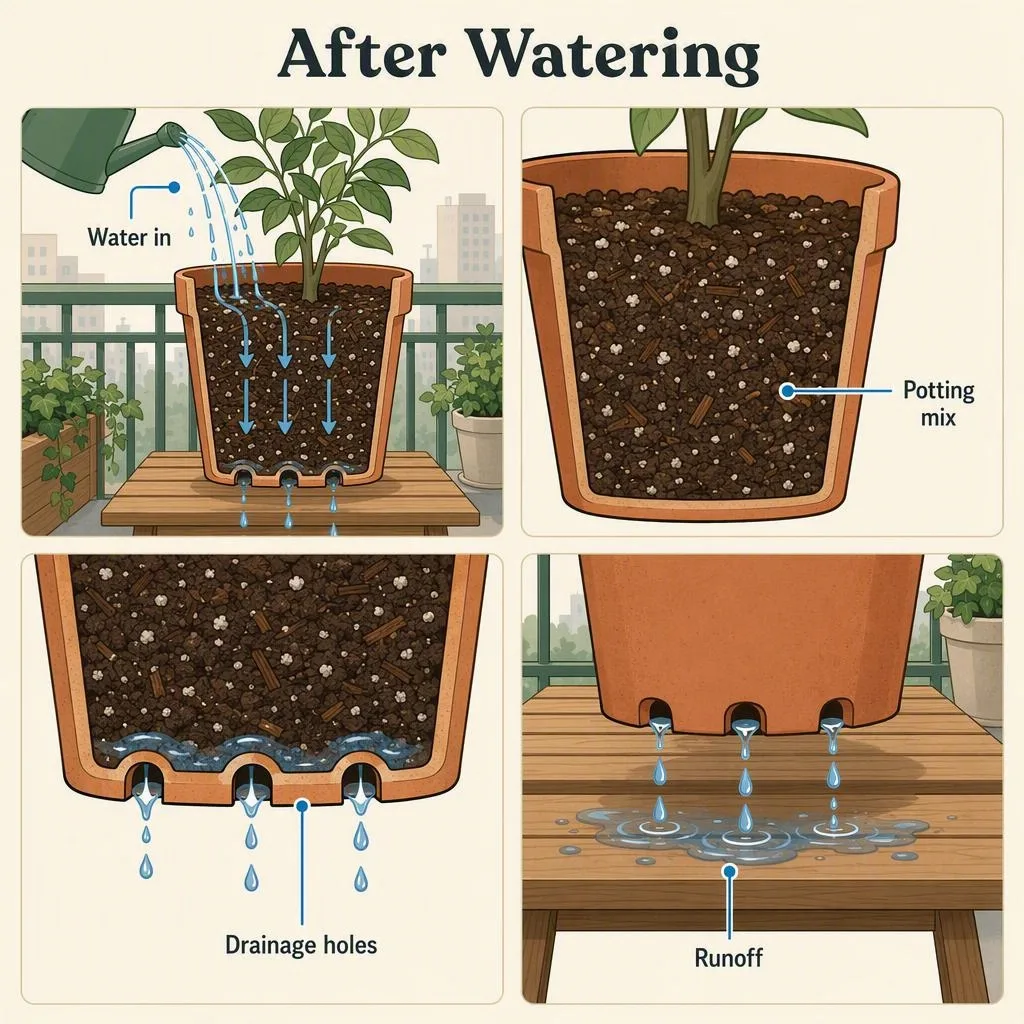
Drainage holes are the exit route; they aren’t decoration. After watering, the mix doesn’t drain as if it were an empty pipe. Fine particles hold water above the outlet until gravity and evaporation allow air back into those spaces. That lower wet band is the perched water table: the surface can look dry while the bottom of the pot is still saturated. A blocked hole makes the problem worse, and a gravel layer doesn’t pull water through the mix. The abrupt change from fine mix to coarse gravel can leave the wet zone higher rather than creating more usable root space. The mechanism is explained in Why gravel in the bottom of a pot does not improve drainage.
Before planting food, check the material as carefully as the volume. Ordinary glazed or painted containers may be fine, but unknown reclaimed pots, decorative glazes and treated timber need a food-safety check before edible planting. Don’t use a container simply because it is attractive or free; a food-safe liner or a purpose-made planter may solve a stated material concern, while a random coating creates a question that the plant can’t answer.
The first-week setup: place, plant and test before adding more
Start with one low-risk leafy crop and one experiment that matches the available light. Fifteen containers create fifteen watering decisions, so adding everything on the first shopping trip makes it harder to tell whether a failure came from the crop, the pot or the position.
- Tape the footprint. Mark the pot’s final position and leave a clear route to the door, tap and drain. Include the space occupied by a trellis, hanging bracket or mature leaves, not just the circular base.
- Move empty containers first. Place the pots, trays and supports where they will live before filling them. Wet mix is substantially harder to shift than dry mix, and moving a tall, top-heavy container across a narrow balcony can damage the plant or the person carrying it.
- Check the escape route for water. Clear every drainage hole. Set the container on a stable tray or feet if the surface blocks the holes, and confirm that runoff won’t stain or drip onto the space below. Building rules may specify how balcony water must be managed.
- Install support before planting. Fit the tomato cage, pea trellis or cucumber frame while the pot is empty or before roots spread through it. The support should resist a sideways push rather than merely stand upright on a calm day.
- Fill and plant in the right order. Use container mix, leave headspace below the rim, then plant or sow at the depth suited to the crop. For potatoes, leave room for later hilling instead of filling the grow bag to its final level immediately.
- Water slowly and watch the result. Apply water in passes so the mix absorbs it, then stop when a little excess appears below. Empty or adjust the catch tray after the flow stops; don’t leave roots standing in stagnant runoff.
For the first week, check moisture below the surface, wind lean, new growth and access to the watering route. A healthy setup should have a root zone that is moist rather than saturated, an upright support and no container blocking the doorway. If the pot is dry again shortly after watering, move it out of reflected heat or wind before buying a larger collection. The practical follow-up is covered in How to water balcony plants during a heatwave or holiday.
Can I grow more than one crop in the same container?
Yes, but group plants only when their light, watering and root-depth needs are similar. Salad leaves and green onions can share a shallow box more sensibly than a tomato and a blueberry. The first pair can be harvested as leaf crops from a comparable root zone; the second pair differs in size, acidity preference, feeding pattern and long-term root-space demand. If one plant needs a much larger pot or a different mix, separate containers usually make the care easier rather than wasting space.
Are fabric grow bags practical on a balcony or rooftop?
They can be practical on a stable floor position with a waterproof tray or mat beneath them. The porous sides allow air to contact the mix through more of the container wall, and moving air can increase evaporation, so a fabric bag can dry faster than a similarly sized solid plastic pot, especially in wind or full sun. That good airflow also means messy runoff and more frequent checks. A grow bag on an exposed railing is a poor match if it can flex, tip or drain over the edge.
How do I stop container water from running onto the balcony below?
Water away from the edge, use a stable catch tray that can handle ordinary runoff, and test the setup with an empty pot before planting. A tray is not permission to let the pot stand in water: once the excess has drained, tip out stagnant runoff or raise the pot so air can reach the drainage holes. If the building has a rule about balcony discharge, follow that rule before choosing a large planter.
Before the weekend, tape the growing footprint, place one empty pot in the sunniest workable spot and check its holes and runoff path. By the end of the first week, the right container should be easy to reach, dry at a rate you can manage and supported without leaning. Add the next crop only after that physical test passes.
Frequently Asked Questions
Can I grow more than one crop in the same container?
Group plants only when their light, watering and root-depth needs are similar; explain why salad greens and green onions can share space more safely than a tomato and a blueberry.
Are fabric grow bags practical on a balcony or rooftop?
Cover their good drainage and low cost against rapid drying, messy runoff, wind exposure and the need for a waterproof tray or mat beneath them.
How do I stop container water from running onto the balcony below?
Recommend checking building rules, watering away from edges, using a stable catch tray that can overflow safely, and never leaving pots standing in stagnant runoff.