Growing Vegetables in Pots on a Balcony: Pot Sizes, Sun & Yield
For growing vegetables in pots on a balcony, plan on 5–10 litres (1.3–2.6 US gal) for salad crops, 15–20 litres (4–5.3 US gal) for peppers and beans, and 20–30 litres (5.3–7.9 US gal) for one compact tomato or cucumber. Those figures are the useful starting point; your direct-sun hours, wind exposure and watering access decide whether the pot produces or merely holds a plant.
I’d audit the balcony before buying a single container. Count the sun that actually reaches leaves, calculate the wet weight in the places you want to use, and leave yourself enough room to reach every pot without knocking one over.
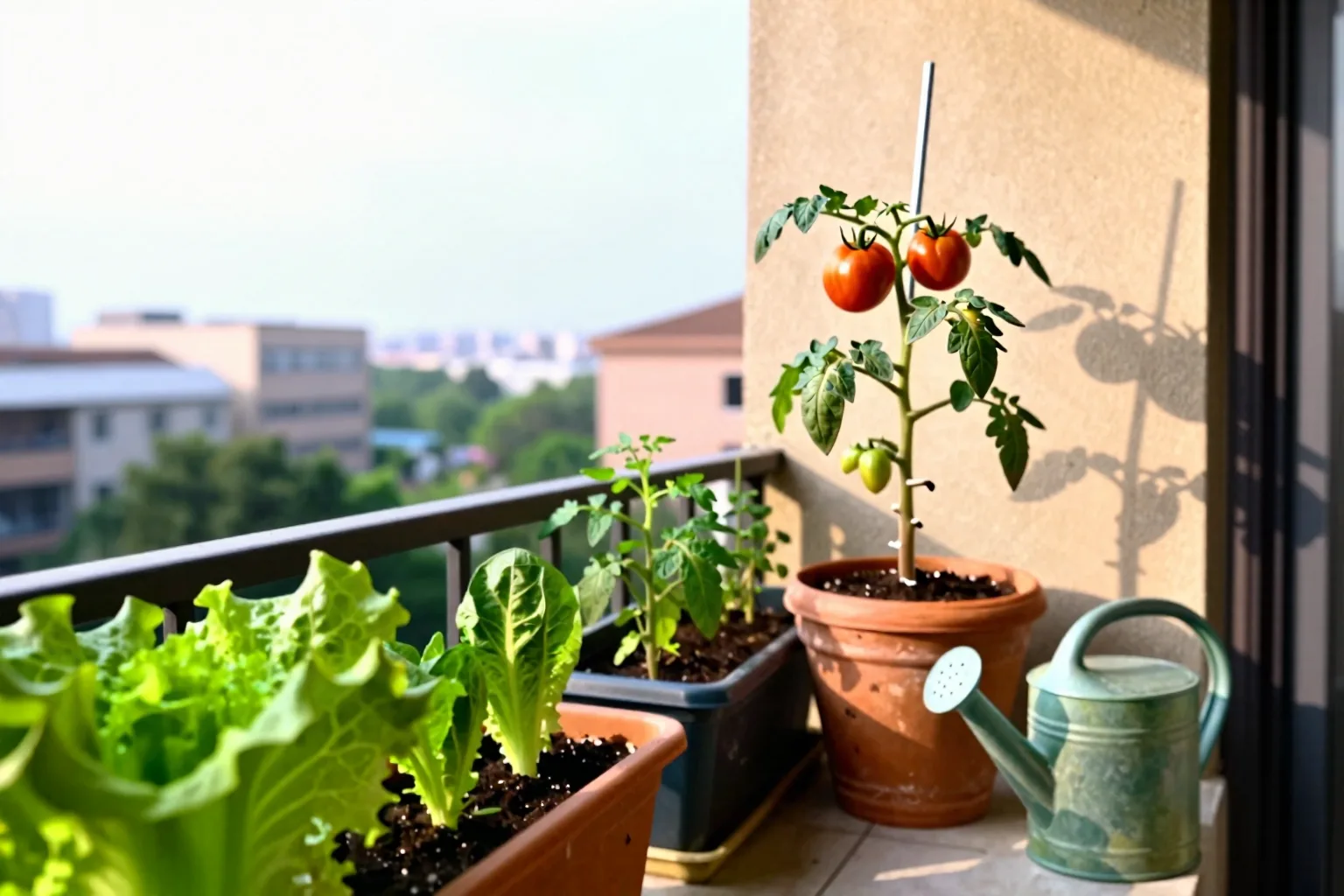
The balcony audit: count sun, weight and floor space before buying pots
Begin with direct sunlight rather than general brightness. A bright balcony under an overhang may receive reflected daylight while the leaves get little uninterrupted sun. Pick a clear day and check the proposed growing area every hour from morning until late afternoon. Mark the first and last time the sun lands directly on the floor or leaves, then repeat the check in a different season if your planting date is still several weeks away.
Look up as well as out. A balcony above yours, a neighbouring building, a solid railing and a nearby tree can remove an hour of light without making the space look dark. Pale walls can also reflect heat and light back at a plant. That may help in cool weather, but in a hot spell the same wall can raise the temperature around leaves and containers.
Next, measure usable floor space, not the whole balcony. A 30-litre pot may occupy only 35 centimetres (14 inches) of floor at its base, but its foliage, support and access space occupy more. Leave a route for watering and harvesting. A productive arrangement that cannot be reached is a maintenance problem disguised as efficient planting.
Weight needs a separate calculation. One litre of water weighs about one kilogram (2.2 pounds), so a 20-litre container can carry roughly 20 kilograms (44 pounds) of water before you add the pot, wet mix, plant and saucer. Several containers concentrated in one small area create a different loading pattern from the same containers spread across the balcony. Before you concentrate wet pots, check local building, strata, landlord and manufacturer guidance on balcony live loads and railing attachments. Do not hang a heavy planter from a railing simply because the bracket fits.
Turn your direct-sun hours into a crop shortlist
Direct sun means unobstructed sunlight reaching the leaves, not a space that feels bright to your eyes. As a planning guide, tomatoes, peppers, cucumbers and beans deserve roughly 6–8 hours of direct sun for useful fruit production. Carrots, beets, kale and chard can work with about 4–6 hours, although growth and harvest size can fall as the light drops. Lettuce, Asian greens, spinach, radishes and many herbs are the more sensible choices at roughly 2–4 hours.
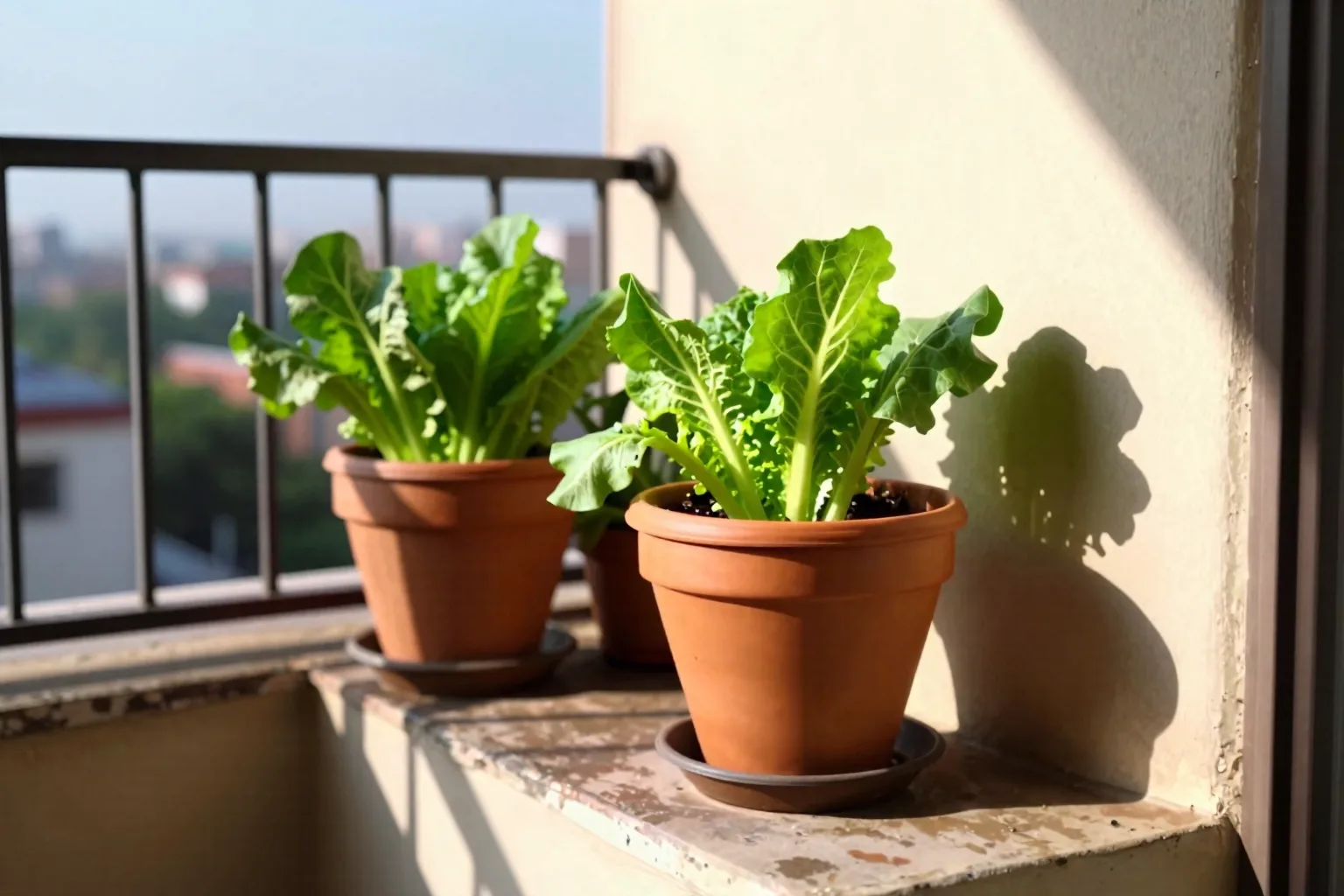
Those bands are not an on-off switch. A lettuce pot may still grow with two hours of sun, but it will usually take longer to fill and may produce smaller leaves. A tomato in the same location has to make leaves, stems, flowers and fruit from a much smaller daily supply of light. That is why fruiting vegetables are often a poor use of scarce balcony floor space when the direct-sun window is only one or two hours.
Use a simple light audit rather than guessing from compass direction. Set a reminder at 9 a.m., noon, 3 p.m. and 6 p.m., and note whether the growing spot is in full sun, broken shade or full shade at each check. Repeat the observation at the height of your growing season. Seasonal sun angles can move a sunny patch behind a railing or under an overhang, so the result from a winter inspection may not describe a summer planting area.
Choose crops by the lowest reliable light period, not by the brightest ten minutes of the day. If only the outer corner gets six hours, reserve it for one pepper or tomato and put greens in the less exposed area. A balcony can grow more food by assigning its best light carefully than by filling every position with the same crop.
Pot-size table: litres first, diameter second
Shop by volume first and shape second. Diameter tells you how much space a pot takes on the floor; litres tell you how much root room, moisture reserve and nutrient-holding mix the plant receives. A pot labelled 12 inches (30 centimetres) may be broad and shallow, tall and narrow, tapered, or rounded. Those forms do not give a crop the same root zone.
| Crop | Starting mix volume | Useful depth or shape | Starting plant count |
|---|---|---|---|
| Lettuce, arugula or radishes | 5–10 litres (1.3–2.6 US gal) | 15–20 cm (6–8 in) deep | Several plants, spaced for the harvest size |
| Carrots | 10–15 litres (2.6–4 US gal) | 30–45 cm (12–18 in) of root depth for long varieties | One spaced sowing rather than a crowded clump |
| Bush beans, peas, kale or chard | 10–15 litres (2.6–4 US gal) | About 20–30 cm (8–12 in) deep | One small group, thinned to the variety’s spacing |
| Peppers | 15–20 litres (4–5.3 US gal) | About 25–30 cm (10–12 in) deep and stable | One plant |
| Compact or determinate tomatoes | 20–30 litres (5.3–7.9 US gal) | About 30 cm (12 in) deep or more, with support | One plant |
| Cucumbers | 20–30 litres (5.3–7.9 US gal) | Deep enough for a stable pot and a secured trellis | One plant |
| Zucchini | 30–40 litres (7.9–10.6 US gal) | Broad, stable container with room for the crown | One plant |
These are starting specifications, not a licence to squeeze extra plants into a larger pot. A big container does not create more light, and crowded leaves compete for water and air. For a small first setup, the table’s volume is the more useful number to take into a garden centre.
For a rectangular planter, multiply length × width × height in centimetres, then divide by 1,000. A box measuring 60 × 20 × 20 cm works out at 24 litres before allowing for taper, curved corners and the unfilled space below the rim. That sounds suitable for a tomato, but its 20-centimetre depth is a weak fit for a plant that needs a deeper, more stable root zone. A 40 × 30 × 25 cm container calculates to 30 litres and gives a compact tomato a more credible starting shape.
If you’re comparing a nursery pot with a bag of mix, the question How many litres of soil does a 12-inch or 20-litre pot hold? is worth treating as a volume calculation, not a label assumption. The best pot size for growing tomatoes on a balcony is the one that supplies enough mix and can hold the plant upright in wind, not merely the one with the widest rim.
A shallow 12-inch pot can fail a tomato because restricted roots have less water and nutrient reserve between checks. The mix also contains less air after drainage when the root ball is crowded, and the plant has less ballast against a trellis or heavy crop. Width helps, but depth and total litres decide more of the outcome.
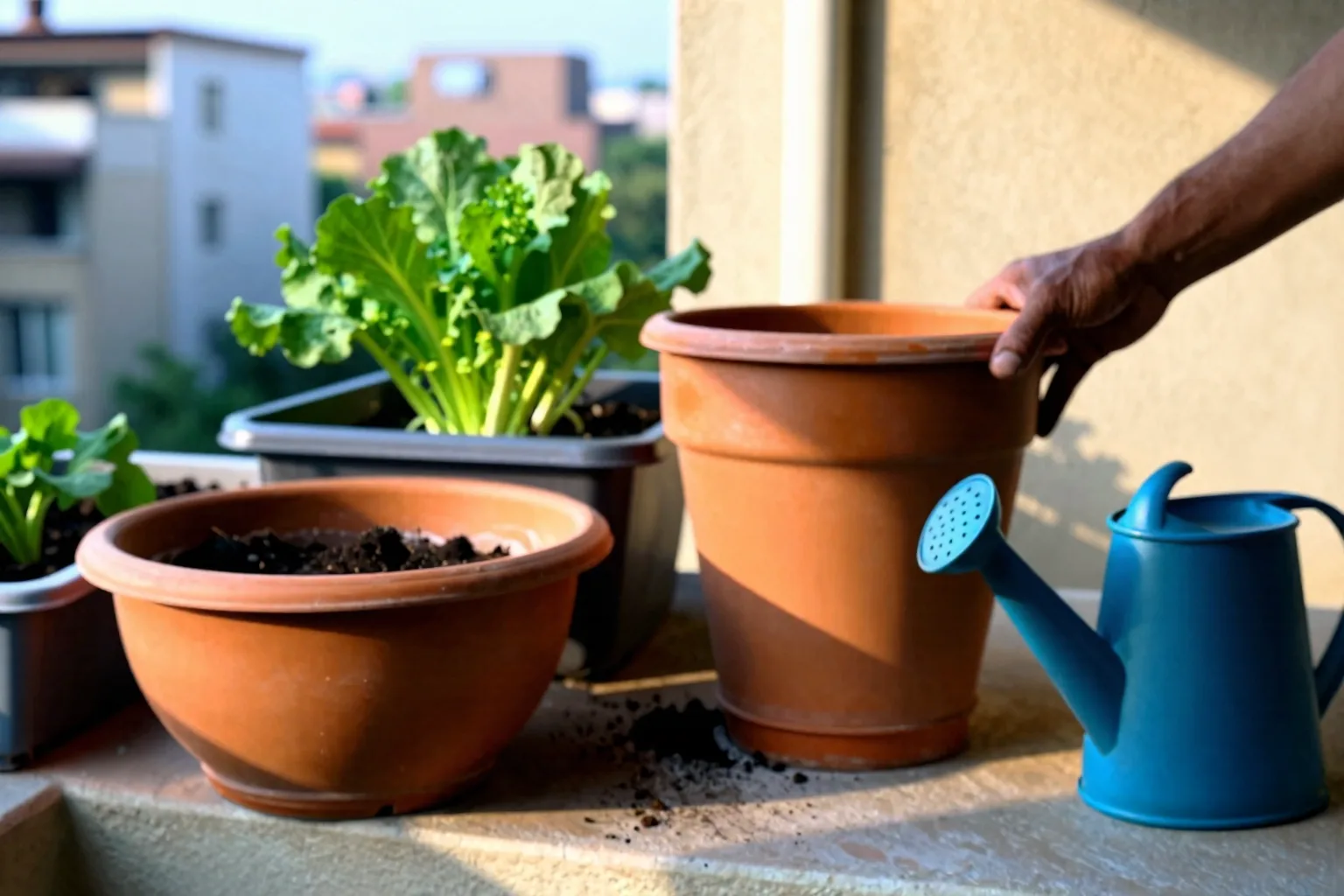
Drainage is a hole-and-mix problem, not a gravel problem
After watering, a fine container mix can hold a saturated band above the drainage holes. That retained band is called a perched water table: water stays in the small spaces of the mix until gravity and capillary forces allow it to leave. Put a layer of coarse gravel under the fine mix and the change in pore size can make water pause above the gravel–mix boundary instead of lowering the wet zone.
That is why gravel, broken pottery and stones do not reliably improve a pot that drains poorly. They take up root volume and can leave the mix above them wetter than expected. The useful drainage work is done by open holes, an appropriate container mix and a route for runoff to escape.
Use this order when preparing a pot:
- Turn the empty container over and confirm that every intended drainage hole is open.
- If a hole is large enough to lose mix, place a small piece of mesh over that opening. Do not line the whole base with fabric or stones.
- Fill with a quality container mix rather than garden soil, which can compact in a pot and leave fewer air spaces around roots.
- Raise the pot slightly on feet or narrow supports so runoff is not trapped against the base.
- Water until some runs from the holes, let the pot finish draining, then empty the saucer.
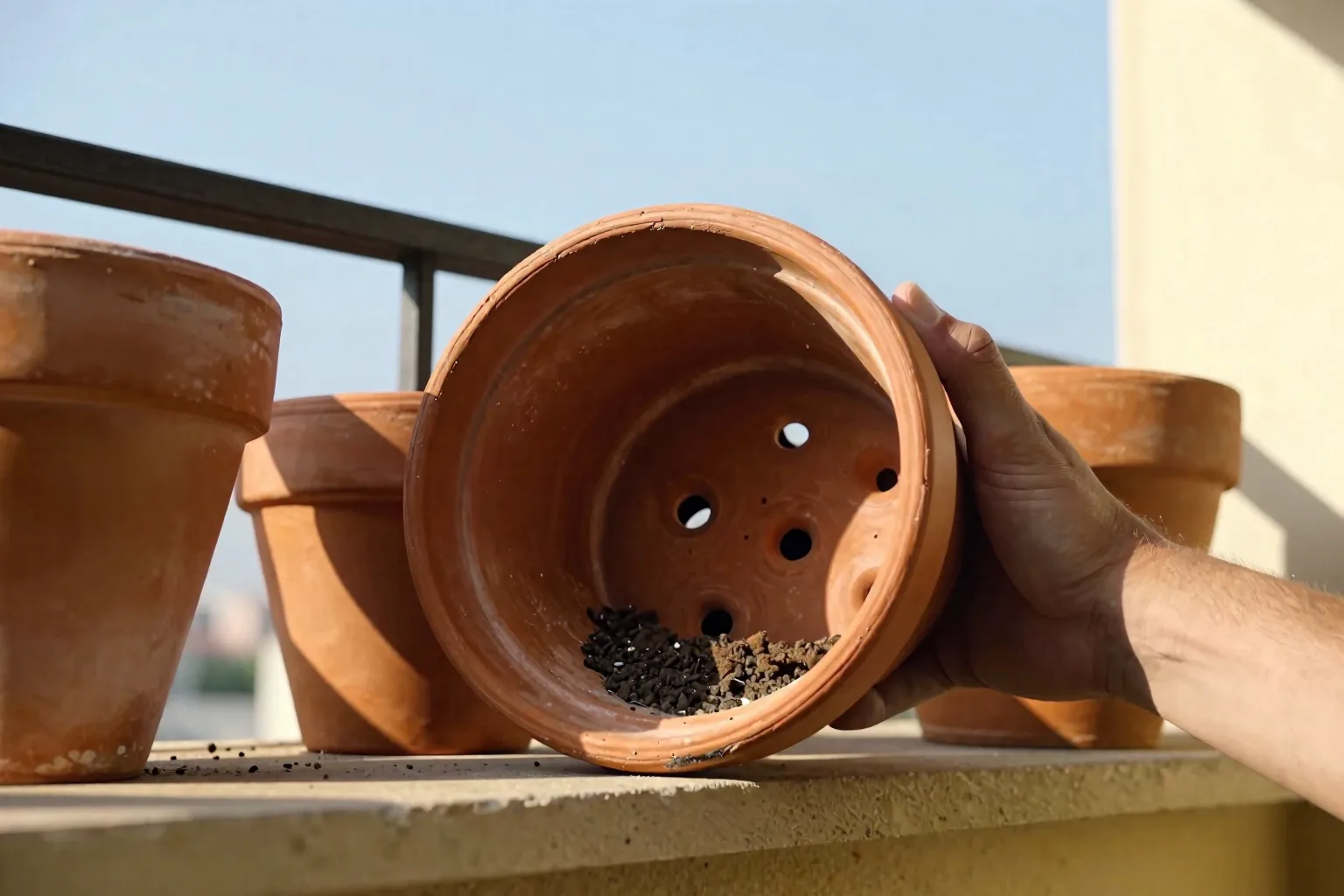
Plastic pots are light and hold moisture longer, which is useful on a windy balcony but can punish a heavy-handed watering routine. Glazed ceramic usually loses moisture more slowly than unglazed porous material, but it adds weight and may be harder to move. Fabric pots can improve air exchange at the sides, yet their exposed surface can dry quickly in sun and wind. The condition flips the choice: fabric is attractive for a sheltered patio, while a small fabric pot on an exposed high balcony may need more frequent checks than you can provide.
For edible crops, treat reused containers as a separate safety decision. Before using an old bucket, tub or painted vessel, compare it with food-contact safety guidance for reusing buckets, tubs and other containers. The planting instructions cannot tell you what a previous chemical residue, treatment or glaze may have contained.
If you still doubt the gravel question, the short version is in Why gravel in the bottom of a plant pot makes drainage worse. It is the same principle in a smaller package: make the holes and mix work before adding anything underneath the roots.
Build a crop plan that fits the balcony, not the catalogue
A restrained first season is easier to water and more likely to teach you something useful. On a sunny balcony, I’d begin with one compact tomato or one pepper, add one pot of beans or one cucumber only if a trellis can be secured, then reserve one or two smaller pots for greens or radishes sown in succession. Succession sowing simply means starting a new small batch after the first batch is harvested, rather than planting every pot on one day.
With limited sun, shift the floor space toward lettuce, Asian greens, spinach, chard, kale, herbs and radishes. Roots such as carrots and beets can be worthwhile where the pot is deep enough, but their foliage still needs light. A fruiting crop that stretches toward a bright gap may use the same footprint for weeks before producing anything useful.
Look for bush, dwarf, compact, determinate or patio descriptions, while treating patio as a selection clue rather than a guarantee. Bush beans stay shorter than climbing types; a determinate tomato has a more limited vertical growth pattern than an indeterminate vine; and a compact cucumber still needs support and room for leaves. For a second check, compare the packet or plant label with authoritative horticultural guidance on container vegetable spacing, direct-sun requirements and cultivar selection.
Plant count is a decision, not a reward for buying a large pot. Start with one pepper, tomato, cucumber or zucchini per container. In a 10–15-litre pot, a small group of bush beans or peas may fit, while kale and chard usually need enough space for each plant’s mature leaves. Thin seedlings when they begin to compete instead of waiting for weak growth to identify the overcrowding.
Put tall crops at the back or on the side that casts the least shade on shorter plants. In the Northern Hemisphere that often means the north side of a rectangular arrangement; south of the equator, reverse the sun-shadow logic. The right position is the one that keeps a trellis from stealing the best light.
Yield is a planning range, not a promise
A pot can supply fresh ingredients without supplying a household. The bands below are conservative horticultural planning ranges, not results from an original trial and not guarantees. They separate one-time harvests, such as radishes, from crops that can be picked repeatedly.
| Crop and pot | Planning result | What changes the result |
|---|---|---|
| Greens in 5–10 litres | Several small cuttings or a few heads | Harvest size, sowing interval, heat and direct sun |
| Radishes in 5–10 litres | A modest batch from one well-spaced sowing | Spacing, root depth, even moisture and temperature |
| Bush beans in 10–15 litres | Repeated handfuls rather than a household supply | Variety, pollination, picking frequency, light and feeding |
| Peppers in 15–20 litres | Several usable fruits, with a long warm season sometimes reaching the low teens | Variety, heat, season length, light and water stress |
| Compact tomato in 20–30 litres | Anything from a light crop to a few kilograms | Plant type, direct sun, disease, feeding, water consistency and season length |
| Cucumber in 20–30 litres | A run of fruits when the variety and pollination conditions fit | Light, trellis support, heat, water and whether the variety needs pollination |
| Zucchini in 30–40 litres | Potentially several fruits, but from a plant that occupies substantial space | Canopy width, container stability, pollination, heat and harvest timing |
The surprising balcony calculation is not yield per pot; it is yield per square metre of floor and access space. A zucchini may produce generously under good conditions, yet its broad leaves can shade several smaller pots. A compact tomato can be the better choice if your aim is a varied harvest from a narrow balcony. My judgement is that zucchini belongs in a dedicated corner or a large shared patio, not in a first balcony shopping basket unless you particularly want to grow it.
Light is the first yield lever because fruiting plants use leaves to make the sugars that support flowers and fruit. Root volume is next: a larger reserve gives you more time between watering and leaves more room for roots to remain both moist and oxygenated. Plant count, pollination, heat, feeding and harvest frequency then decide how much of that potential becomes edible produce.
Harvesting changes the crop’s workload. Pick beans while the pods are still usable rather than leaving every pod to swell with mature seed. Remove ripe tomatoes and peppers so the plant can continue supporting newer fruit. With greens, take outer leaves or cut above the crown rather than uprooting every plant at once when the variety tolerates repeated harvest.
Water and feed by pot signals, not by calendar
Check moisture at root depth before reaching for the hose. Push a finger 3–5 cm (1–2 inches) into a small pot and 5–8 cm (2–3 inches) into a larger one, or use a clean wooden skewer and inspect the mix that clings to it. Lift the pot when its size allows; a noticeably lighter container is useful evidence, but do not make lifting a heavy ceramic planter a safety test.
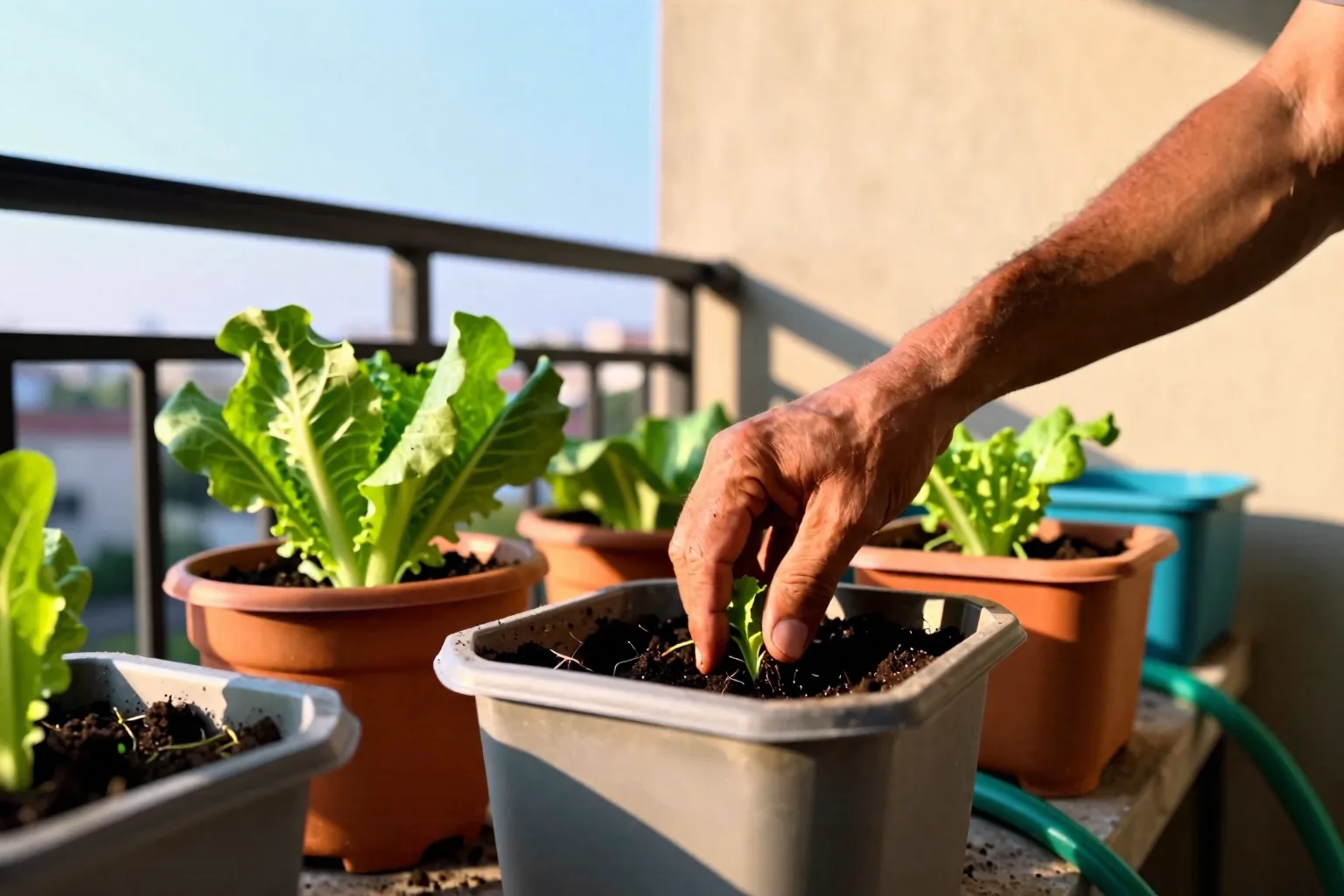
If the mix is dry where the roots are, water slowly until a little drains from the holes. Pause, then water again if the first pass has only wetted the surface. Let runoff finish and discard standing water from the saucer. Small daily sips can wet the edges or top layer while the centre of a dried root ball remains dry, particularly when the mix has pulled away from the pot wall.
Frequency belongs to the conditions. A small plastic pot in full sun and wind may need checking daily and may need water daily during hot weather. A larger glazed pot in part shade may go two or three days between checks. The same pot can change from every third day to daily after a plant fills out, because more leaves increase water loss and a warm balcony can dry the container from the sides.
Once a seedling is established and growing, feed according to the label of a fertiliser intended for edible container crops. Slow-release products reduce the number of feeding decisions; liquid feed gives you more control when a crop is actively flowering, but it is easier to overapply. Repeated watering carries soluble nutrients out through the drainage holes, while constantly wet roots can look pale and hungry because they cannot take up nutrients efficiently.
For a heatwave, follow this order: check the root zone, water deeply if it is dry, move the pot away from a heat-reflecting wall if possible, and add temporary afternoon shade only if the leaves show heat stress. For a short holiday absence, water thoroughly, group pots where they receive suitable light, protect them from the strongest wind, and arrange a person to check small containers. A reservoir or self-watering system can help, but it still needs an overflow route, a suitable mix and a check that the reservoir is not keeping the root zone saturated.
The practical companion to this routine is How to water container vegetables during a hot, windy week. Use it as a conditions checklist, not as a fixed timetable.
Read the failure in the leaves before you change the pot
Container problems often look similar from the balcony railing. Before buying a larger pot or another fertiliser, feel the mix, inspect the holes and look at the newest growth. This symptom-first order prevents you from treating a wet root ball for hunger or moving a sun-starved plant into even hotter reflected light.
| What you see | Check first | Practical response |
|---|---|---|
| Leaves wilt at midday but recover by evening | Heat and temporary water demand; then check the root zone | Check again when cool. If the mix is damp, improve heat and wind exposure before adding water. |
| Leaves stay limp and the mix is dry below the surface | Underwatering or a dried, shrunken root ball | Re-wet slowly in two passes, then reassess drainage and pot size. |
| Yellow leaves with heavy, wet mix | Airless roots or poor drainage | Stop routine watering, clear the holes and let the container drain before feeding. |
| Pale new growth with a reasonably airy, moist root zone | Possible nutrient shortage after repeated runoff | Use a label-directed feed rather than adding a concentrated dose. |
| Long, weak stems and wide gaps between leaves | Insufficient direct light | Move the crop to the brightest safe position; do not solve weak growth with more feed alone. |
| Flowers appear but fruit does not develop | Low light, high heat, still air or a pollination mismatch | Identify the crop and variety, then improve light or pollination only where the diagnosis supports it. |
| Water runs straight down the pot sides | Water-repellent, shrunken mix around the root ball | Water in repeated slow passes or briefly re-wet the container from below, then return to normal deep watering. |
| Brown, crisp leaf edges | Heat, wind, reflected light or salts left by repeated evaporation | Check moisture and feeding, move from reflected heat, and flush excess salts only when drainage is reliable. |
Pollination deserves a closer look on cucumbers and zucchini. On these monoecious cucurbits, the female flower has a small swelling behind it, while the male flower sits on a plain stem. Pollen must move from the male flower to the female flower before a normal fruit can develop. If a tiny cucumber forms and then shrivels, inspect the flower structure and the variety label before blaming the pot.
Tomato flowers carry male and female parts in the same flower, so a second tomato plant is not normally required for pollen to be available. Gentle movement of the plant can help release pollen in a still balcony setting, but it cannot compensate for a crop receiving almost no direct light or suffering severe heat and water stress.
Tomato blossom-end rot is the dark, sunken damage that develops at the fruit’s far end. It is commonly linked to uneven water movement rather than a true soil calcium shortage: calcium moves with the plant’s water flow, so irregular moisture can disrupt delivery to fast-growing fruit tissue even when total soil calcium is adequate. The framing remains contested in some growing discussions, which is another reason I would correct watering and root stress before reaching for a calcium product.
Give the balcony one inspection week. Check every drainage hole, feel below the surface in each pot, look for fresh growth and count new flowers. Move or shade a plant only when the observed problem supports that change. If the leaves are healthy but the crop is simply slow, the missing ingredient may be direct sun rather than a new container.
Do balcony vegetables need hand pollination?
Tomatoes generally have both reproductive parts in each flower, while cucumber requirements depend on the variety. Some greenhouse or parthenocarpic cucumbers can set fruit without pollination; other cucumber types need insects or hand-pollination. If hand-pollination is appropriate, touch pollen from a male flower to the centre of a freshly open female flower with a small dry brush, then watch whether the swelling begins to enlarge over the following days.
Are self-watering planters suitable for balcony vegetables?
They can reduce drying for thirsty crops and make a short absence easier, but they are not a cure for a saturated root zone. Use a container with a clear overflow route, a mix designed for containers and a reservoir you can inspect. If the mix remains wet and leaves turn yellow or limp, treat the oxygen shortage as the problem rather than topping up the reservoir.
Can I use a balcony railing planter for vegetables?
Use a railing planter only when the railing and attachment system are approved for its wet weight and wind exposure. Shallow railing boxes suit greens, herbs and radishes better than heavy tomato, cucumber or zucchini containers. Nothing should be able to fall onto people below, and the planter should remain secure after watering rather than only when it is empty.
Before the weekend, buy or measure only the containers that match your audited light: one 20–30-litre pot for a compact fruiting crop, smaller pots for greens, and a stable support if a climbing plant made the shortlist. In a week, the mix below the surface should be evenly moist rather than slick or dusty, drainage holes should be clear, and new growth should tell you whether the balcony plan is working.
Frequently Asked Questions
Do balcony vegetables need hand pollination?
Tomatoes are self-pollinating but may set better with gentle movement of the plant; cucumber requirements depend on the variety, because some greenhouse or parthenocarpic types do not need pollination while others need insects or hand-pollination.
Are self-watering planters suitable for balcony vegetables?
They can reduce drying for thirsty crops and short absences, but they still need an overflow route, a suitable container mix and regular reservoir checks; a constantly saturated reservoir can create the same oxygen-starved root problem as overwatering.
Can I use a balcony railing planter for vegetables?
Use one only if the railing and attachment system are approved for the wet weight and wind exposure; shallow railing planters suit greens, herbs and radishes better than heavy tomato, cucumber or zucchini containers, and nothing should be able to fall onto people below.