How Deep Do Containers Need to Be for Vegetables? Chart
A usable mix depth of 15–20 cm (6–8 in) covers most leafy vegetables and annual herbs; tomatoes, cucumbers, eggplants, potatoes and full-size root crops are safer at 30–45 cm (12–18 in). A pot sold as 30 cm (12 in) tall may offer less soil than that once you leave headspace and lose room to a rounded base, so measure the cavity rather than trusting the label.
I use the chart below as a buying specification, not a promise of yield. The minimum column is where a crop can be grown with careful watering; the target column gives the roots more moisture and temperature buffer.
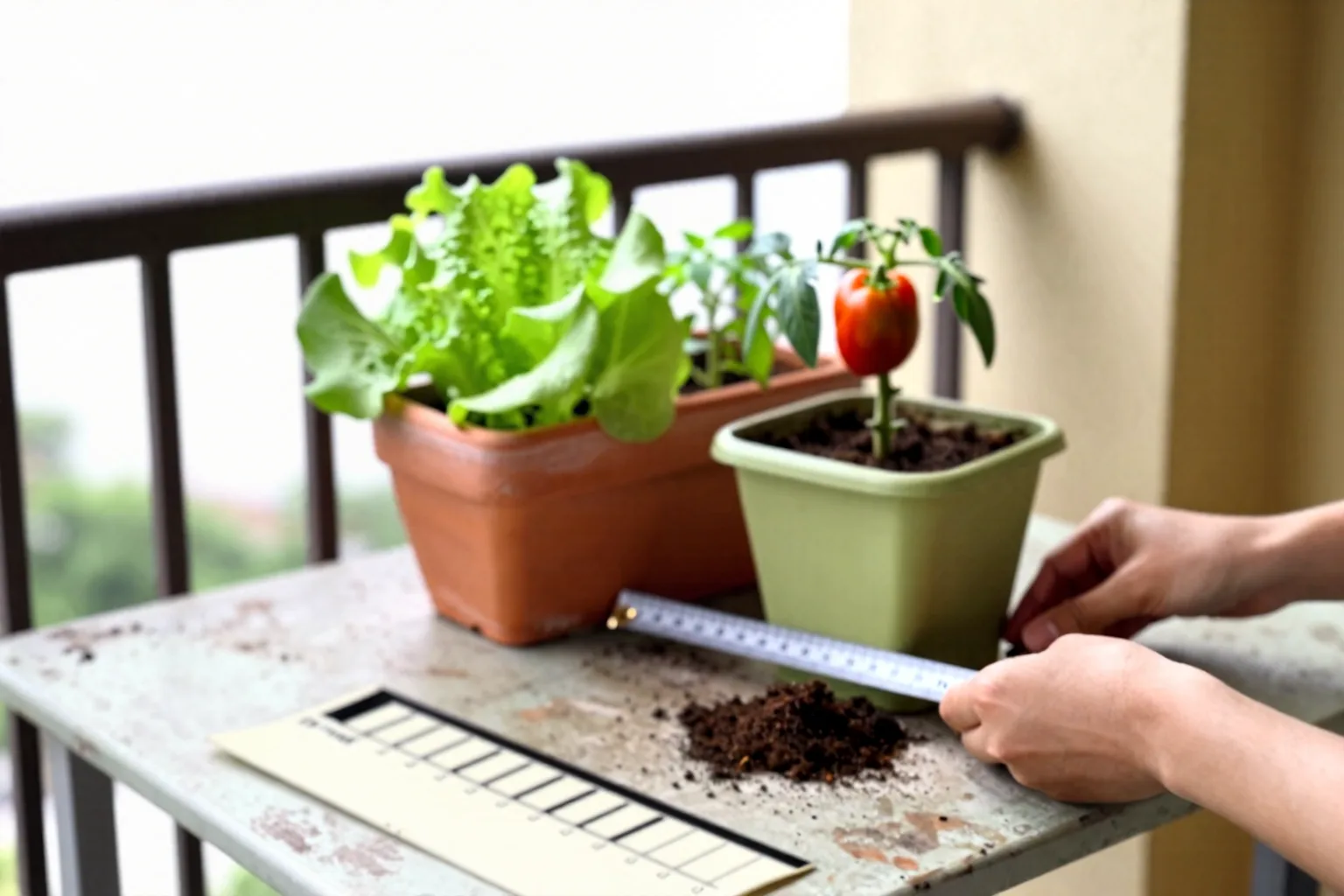
The vegetable container depth chart: start with usable mix depth
Usable depth means the distance from the planned soil surface to the lowest accessible point inside the pot. For potatoes, the figure means total working height because you’ll add mix around the stems later.
| Vegetable | Practical minimum | More reliable target | Condition to check |
|---|---|---|---|
| Lettuce, spinach, arugula | 15 cm (6 in) | 20 cm (8 in) | Width for spacing |
| Annual herbs | 15 cm (6 in) | 20 cm (8 in) | Rosemary is different |
| Round radishes | 15 cm (6 in) | 20 cm (8 in) | Long radishes need more |
| Short carrots | 20 cm (8 in) | 30 cm (12 in) | Choose a short variety |
| Full-size carrots, daikon | 30 cm (12 in) | 40–45 cm (16–18 in) | Root length and straightness |
| Beets | 20 cm (8 in) | 25–30 cm (10–12 in) | Baby or full-size harvest |
| Bush beans | 20 cm (8 in) | 25–30 cm (10–12 in) | Width and plant count |
| Peas | 20 cm (8 in) | 30 cm (12 in) | Trellis and wind |
| Kale and chard | 20 cm (8 in) | 30 cm (12 in) | Mature leaf size |
| Peppers | 25 cm (10 in) | 30–40 cm (12–16 in) | Compact or full-size plant |
| Cucumbers | 30 cm (12 in) | 40 cm (16 in) | Support and water demand |
| Tomatoes | 30 cm (12 in) | 40–45 cm (16–18 in) | Variety and support |
| Eggplant | 30 cm (12 in) | 40–45 cm (16–18 in) | Top-heavy growth |
| Zucchini | 30 cm (12 in) | 40 cm (16 in) | Broad container preferred |
| Potatoes | 30 cm (12 in) total | 40–45 cm (16–18 in) total | Reserve height for hilling |
These ranges answer the search for the minimum soil depth for vegetables, but variety and harvest size can move a crop between rows. A baby beet, compact pepper or short carrot is not asking the same thing of a pot as a full-size version.
For a second crop-by-crop reference, an extension guide to growing vegetables in containers can help you compare variety and spacing advice. I’d still measure the actual pot: a general chart cannot account for your container’s taper, wall thickness or balcony heat.
Measure the soil, not the number printed on the pot
Container height is not automatically root depth. Put the empty pot on a flat surface, measure from the inside base to the level where the mix will stop, and ignore the external foot, decorative rim and saucer. Then leave 3–5 cm (1–2 in) below the rim so watering doesn’t send potting mix over the edge.
A rounded or heavily tapered pot loses usable volume faster than its outside dimensions suggest. A thick-walled glazed pot can also have a surprisingly narrow cavity. If the base curves upward, measure to the lowest part but remember that the curved section contributes less evenly distributed mix than a straight-sided box.
Drainage holes remove excess water; they don’t make the entire soil column instantly dry. After watering, fine potting mix can hold a saturated layer above the holes because water is pulled into small spaces between particles. That retained wet layer is called a perched water table.
Gravel does not act like a drainpipe beneath the mix. At the boundary between fine mix and coarse gravel, water can remain higher in the fine layer, while the gravel also takes away space that roots could use. If you want the longer explanation, see Why gravel in the bottom of a pot does not improve drainage. The practical purchase is simpler: choose a container with open drainage holes and keep one continuous column of potting mix above them.
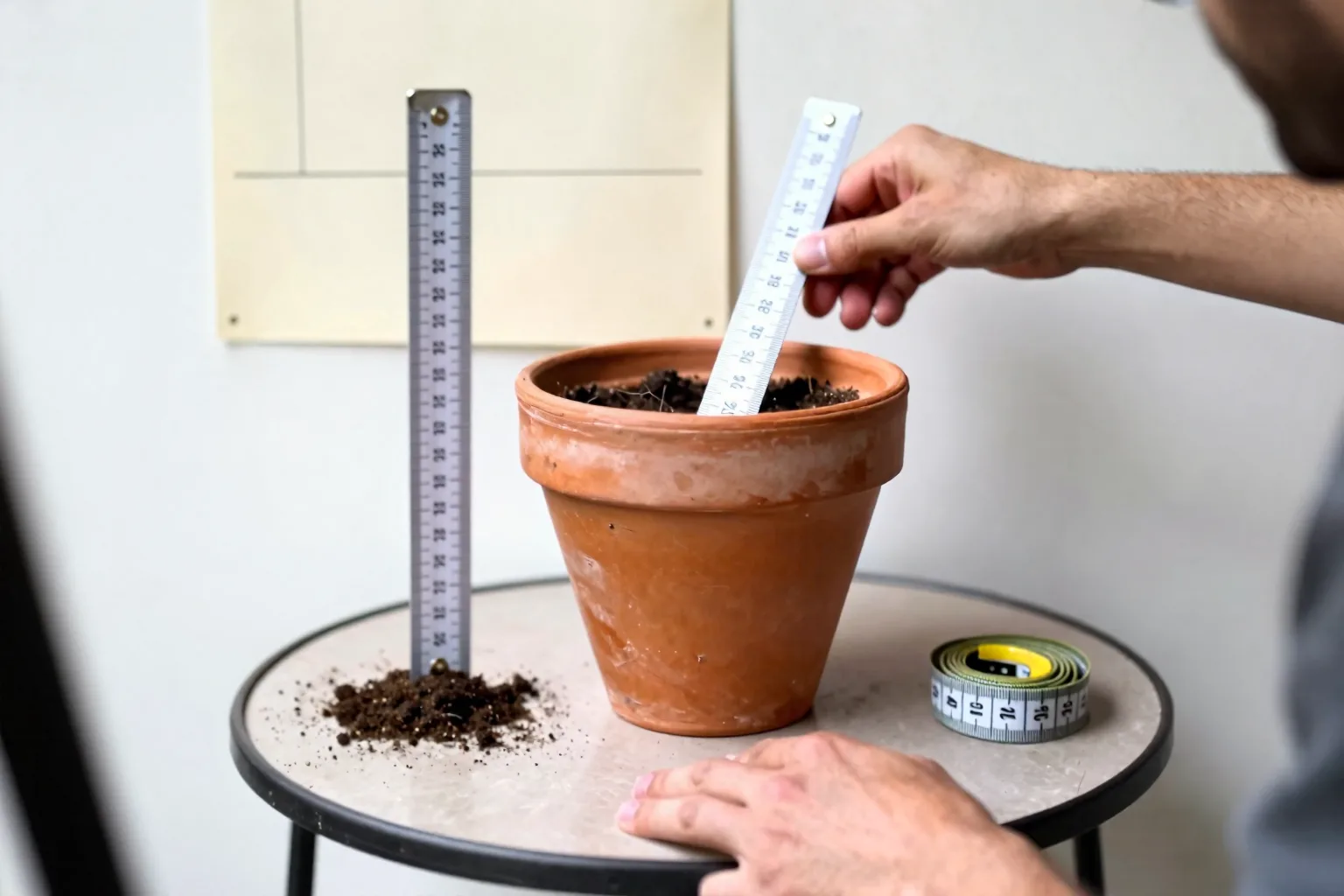
If the term still feels abstract, a plain-language explanation of a perched water table is useful for seeing the cross-section. The mechanism matters because a deeper pot with a permanently wet lower section may give less healthy root space than a slightly shorter pot filled with an airy, well-draining mix.
The 15–20 cm tier suits greens, herbs and quick roots
The shallow tier works best for plants whose harvest is mostly leaves rather than a large underground structure. Lettuce, spinach, arugula, spring onions, basil, coriander and parsley can fit here, provided the container is wide enough for the mature plants rather than just the seedlings.
Width becomes the limiting measurement quickly. A 24 cm (9.5 in) bowl with 18 cm (7 in) of usable depth is a sensible home for a small leafy grouping or round radishes, but it is not a sensible home for a long carrot. Space plants according to their final size; a shallow box crowded with seedlings can use water faster than a deeper box with fewer plants.
Round radishes and short-rooted carrot varieties belong to different depth decisions. Round radishes can swell in roughly the 15–20 cm tier, while a short carrot still deserves about 20 cm (8 in) as a practical minimum and around 30 cm (12 in) as a more forgiving target. Full-size carrots and daikon move into the deeper tier because the edible root has to extend downward without hitting the base.
Shallow-pot failure has a recognisable pattern: leaves wilt during the warm part of the day, the surface becomes dry soon after watering, growth stalls, and roots may circle tightly at the base. If the bottom remains wet while the top dries, adding water on a fixed schedule is not the answer; inspect the mix, drainage and root crowding first. Rosemary and other woody perennial herbs are exceptions I’d put in a deeper, more stable pot because they stay in the container longer and develop a larger permanent root mass.
At 20–30 cm, beans, peas and leafy brassicas become easier to manage
Twenty to thirty centimetres (8–12 in) gives bush beans, peas, beets, onions, kale and chard a useful middle ground. It holds more water than a small herb pot without forcing you to carry the weight of a very deep planter.
Harvest size changes the recommendation. Baby beets and young onions can use the lower end, but full bulbs need room sideways as well as below. A 30 cm (12 in) square pot is a safer starting point for one full-size kale or chard plant than for several plants packed shoulder to shoulder. More leaves mean more transpiration, which means more water leaving the pot on a sunny or windy balcony.
Peas and climbing beans add a structural problem. Install the trellis or support before filling the container, because pushing a stake through established roots is needlessly disruptive. A tall vine also acts as a lever in wind, so a wide, heavy container can be more secure than a narrow pot with the same depth. Group these crops with plants that have similar watering needs rather than assuming that extra depth permits extra planting.
Use 30–45 cm for tomatoes, cucumbers and full-size roots
The deep tier is where undersized containers expose themselves quickly. Tomatoes, cucumbers, eggplants, full-size carrots and potatoes benefit from 30–45 cm (12–18 in) of working depth because their foliage and, in several cases, their fruit keep drawing water through the season.
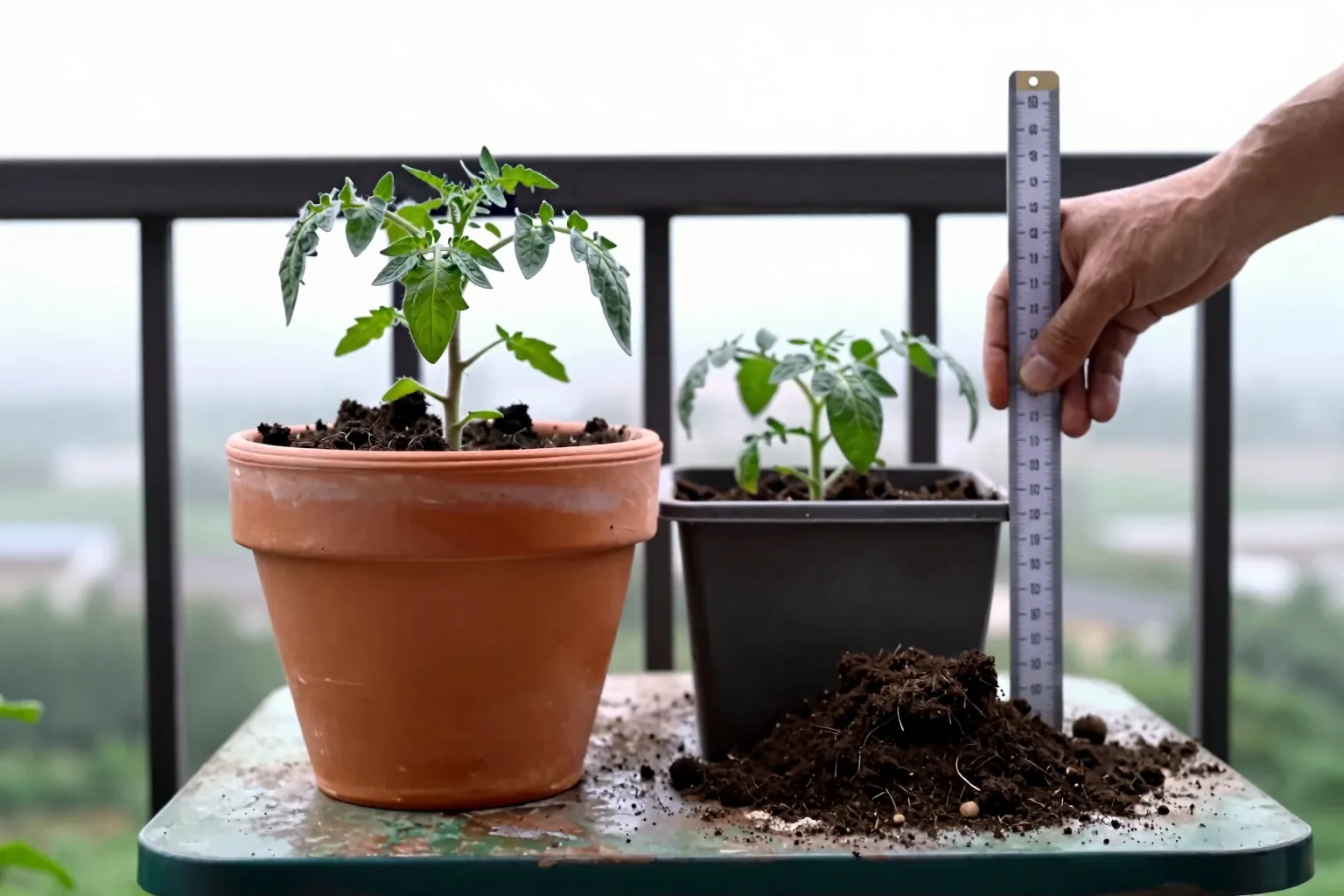
Peppers are the useful exception: a compact plant can work at about 25–30 cm (10–12 in), while a large plant with a heavy crop is easier to manage closer to 30–40 cm (12–16 in). Tomatoes and eggplants are less forgiving of a tiny root zone, particularly when the container sits against a hot wall. Cucumbers need depth, but they also need a support arrangement that keeps the vine and fruit from turning the pot into a sail.
Potatoes need spare height rather than a container filled to the rim on planting day. Hilling means adding mix around the lower part of the growing stems as the shoots rise. In a 40 cm (16 in) container, you might begin with about 10 cm (4 in) of mix, place the seed potato, and add roughly 5–8 cm (2–3 in) of mix in stages while leaving the growing leaves exposed. The point is to provide more covered stem and room for tubers without burying the leafy tips.
Zucchini shows why depth is not the whole specification. Its sprawling leaves need a broad, high-volume container with a stable footprint; a narrow tower can be deep enough on paper and still tip or dry unevenly. For carrots, daikon and potatoes, check the edible part or hilling method first. For tomatoes and cucumbers, check the canopy, support and water demand as well as the roots.
A deep pot can still be too small
Depth is a root-zone minimum, not a yield guarantee. Compare two straight-sided cylinders that are both 30 cm (12 in) deep: one 20 cm (8 in) wide holds about 9.4 L (2.5 US gal) before deductions, while one 30 cm (12 in) wide holds about 21.2 L (5.6 US gal). The second container has more than twice the geometric volume, a broader base and more room for a support stake.
As practical starting volumes, I’d allow about 3–5 L (0.8–1.3 US gal) for one leafy grouping, 10–20 L (2.6–5.3 US gal) for one pepper or compact bean plant, and roughly 20–40 L (5.3–10.6 US gal) for a tomato, depending on variety, pruning and support. These are not promises; they are purchasing ranges that give the roots and the watering routine a reasonable margin.
Inadequate volume can look like several unrelated problems: wilting even though the mix is wet, short growth, a top-heavy plant and fruit-end disorders associated with uneven water uptake. Before watering a wilted plant again, check whether the roots are healthy, whether the pot is hot and whether the mix is actually wet throughout. More water cannot compensate for roots sitting in stale, airless mix.
My judgment call is to buy width before chasing extreme depth once the crop’s minimum has been met. A stable 30 cm (12 in) pot with enough litres is usually a better balcony tomato proposition than a tall, narrow vessel that needs constant watering and a separate weight to stop it rocking.
Turn the chart into a shopping measurement
You can estimate capacity without a special calculator. For a straight-sided cylinder, use π × radius² × height. For a rectangular box, use length × width × usable depth. Keep every measurement in centimetres, then divide the cubic-centimetre result by 1,000 to get litres.
For example, a container with an internal diameter of 30 cm (12 in) has a 15 cm (6 in) radius. At 30 cm (12 in) internal height, the calculation is π × 15² × 30, or about 21,200 cubic centimetres, which is about 21.2 L (5.6 US gal) before headspace and taper are deducted.
| Approximate geometric capacity | US liquid gallons | Simple comparison |
|---|---|---|
| 6.3 L | 1.7 US gal | 20 cm diameter × 20 cm height cylinder |
| 21.2 L | 5.6 US gal | 30 cm diameter × 30 cm height cylinder |
| 37.7 L | 10.0 US gal | 40 cm diameter × 30 cm height cylinder |
The gallon column is rounded shopping shorthand, not an additional crop rule. A nominally 25 cm (10 in) pot may provide less than 25 cm of mix because the outside measurement includes the wall, rim and sometimes a raised base. Buy slightly taller than the chart minimum, measure the inside, and do not fill above the drainage holes or right to the rim.
If bag quantities are confusing, How many litres of potting mix does a container need? is the useful companion calculation. It also helps you allow for settling: the bag volume printed on a package is loose mix, while the pot’s capacity is the space you’re trying to fill.
The five-minute balcony check before you plant
Before buying seedlings, run this short inspection. It catches the expensive mismatch between a crop’s root depth and the actual balcony conditions.
- Check the holes. Look for open drainage holes and a saucer that can catch runoff without sealing the outlet. A decorative cachepot with no outlet needs an inner pot rather than a layer of gravel.
- Measure usable depth and width. Write both figures on masking tape. Calculate the approximate litres if the pot is straight-sided, then reduce your expectation for a strong taper or rounded base.
- Plan the support and wet weight. Leave room for a tomato stake, cucumber trellis or pea frame. Water-saturated mix and a mature plant weigh more than the empty container, so check your building’s local balcony load-limit guidance instead of relying on a generic pot chart.
- Audit direct sun. If the balcony receives only one or two hours of direct sun, extra soil depth won’t manufacture the light that fruiting crops need. Leafy greens, herbs and some quick roots are more realistic candidates; use Which vegetables produce in one or two hours of balcony sun? to narrow the list.
- Match the watering pattern. Wind, dark plastic and small pots can speed drying by increasing evaporation or heating a smaller soil volume. Glazed containers behave differently: their walls lose little water, so the surface may look dry while the centre remains wet. Probe below the surface and group crops with similar needs. For the maintenance routine, see How often should you water vegetables in containers?
I would make the final purchase this way: choose one crop, measure the empty pot’s interior depth, calculate its litres, and write both numbers on the masking tape. Before the weekend is over, buy the mix and seedling only if that label matches the crop’s chart row; by the following week, the pot should be draining freely and the plant should be holding its leaves without a daily rescue watering.