How Often to Water Potted Plants in Winter: The Finger Test
A potted plant in a warm, bright room may be ready for water after 5–7 days, while the same kind of plant on a cool, dim windowsill may still be wet at day 10 or 14. Those are checking intervals, not a winter watering schedule: insert a finger 2–5 cm (1–2 in) into the potting mix and water only when that layer is dry and the mix below is no longer cool and wet.
Outdoor pots use a different trigger. Check them whenever the container thaws, and never force water into frozen mix. The useful question is not “What day is it?” but “What is happening around this root zone today?”
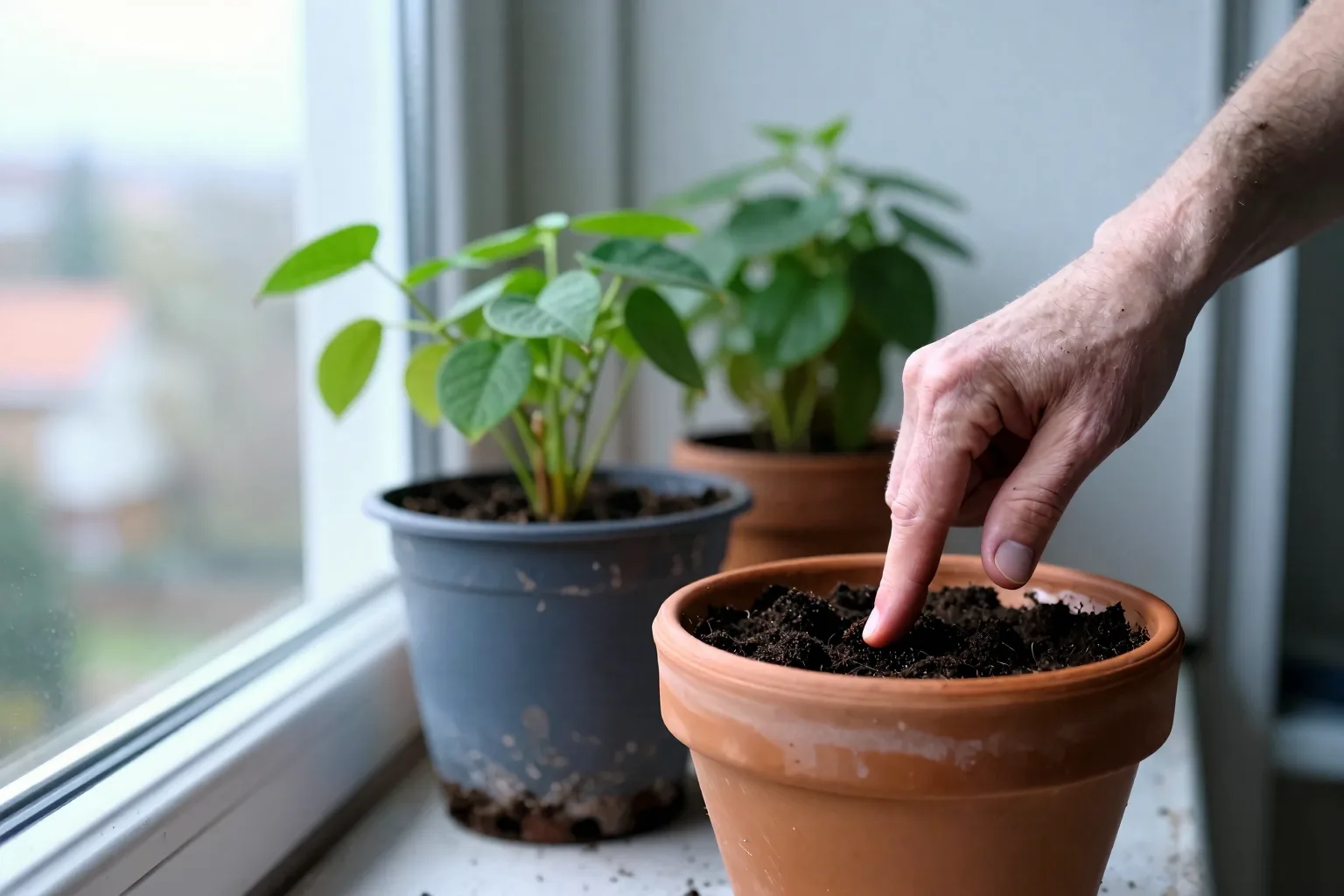
Start with the finger test, not a winter watering calendar
Winter does not make every plant thirsty at the same rate. Shorter days can reduce the plant’s growth and water use, while a radiator, heat vent, bright window or dry wind can pull moisture away faster. Pot size and material then decide how much mix is available to buffer those changes.
For most leafy houseplants, start by checking the top 2–5 cm (1–2 in) every 5–7 days in a warm, bright room. In a cool, dim room, start with a check every 10–14 days. If a plant is on an outdoor balcony, check after a thaw rather than following either indoor interval. In each case, the interval tells you when to inspect the root zone. It does not tell you to water automatically.
Push your finger into the mix. If the upper layer is dry but the material below feels cool and damp, wait. If the upper layer is dry and the deeper mix is no longer cool or wet, water thoroughly when the pot is above freezing. Cacti and succulents need a deeper dry-down than many leafy plants because their roots are poorly served by staying damp between drinks.
The finger test works because the surface is exposed to air and can dry before the root zone does. A calendar sees only the date; your finger checks the part of the pot the roots are actually using.
Three winter setups need three different starting rules
Use the table as a place to begin, not as permission to pour. A plant can move from one category to another if you change its position, turn on a grow light or bring it indoors.
| Setup | Starting check | Mechanism and adjustment |
|---|---|---|
| Heated indoor room | Every 5–7 days | Heating and bright light can speed drying. Check sooner for a small terracotta pot near a radiator; check later if the room is dim and the pot is large. |
| Cool windowsill or enclosed porch | Every 10–14 days | Low light and cool conditions can leave the mix wet longer. A sunny pane or a draft can move the pot toward earlier checks. |
| Exposed outdoor container | Whenever it thaws | Wind and shelter matter more than the season name. A balcony overhang may keep the mix dry despite rain, while an open position may lose moisture on a mild, windy day. |
Pot material changes the starting point too. Unglazed terracotta allows some moisture to leave through the pot wall, so it often dries sooner than a similar plastic pot. Plastic holds moisture more effectively around the root ball. Glazed ceramic behaves more like plastic because its surface is sealed, although a narrow pot can still dry quickly simply because it contains little mix.
Plant type adds another modifier. A dormant deciduous shrub without leaves usually uses much less water than a leafy plant in active growth. An evergreen shrub can still lose water through its foliage during mild, dry weather. A succulent generally needs the root zone to dry more deeply than a tropical foliage plant. These are reasons to adjust the checking depth and timing, not reasons to ignore the pot.
One change that gets missed in heated homes is relocation. Move a pot away from a bright window to a cooler, dimmer spot and its watering category can change within a day or two, because light, warmth and air movement have all changed. Treat the next check as a new observation rather than carrying the old schedule across the room.
My strongest winter-watering opinion is simple: the calendar is the least useful instrument in the room. Root-zone moisture comes first; the date is only a reminder to look.
Run the test properly: depth, texture and pot weight
The finger test is not a quick touch of the surface. Run it in an order that prevents the dry crust on top from making the decision for you.
- Check the pot before moving it. Look for a saucer full of water, a cachepot holding runoff, algae on the surface or water collecting under the drainage holes. A cachepot is an outer decorative container that may not have holes of its own.
- Push a clean finger into the mix. Reach the first knuckle, roughly 2–5 cm (1–2 in), without stabbing through a thick cluster of visible roots. For a small pot, this may reach most of the root zone. For a deep container, it is only a reading from the upper portion.
- Compare the layers. Dry mix feels loose, crumbly or dusty. Damp mix tends to hold together and feels cooler. Saturated mix can feel heavy, slick or muddy, though a coarse mix may feel springy rather than muddy. Coolness alone is not proof of wetness, so use texture and weight together.
- Lift the pot if you can do so safely. A pot that feels unusually light after the mix has dried is a useful second signal. Compare it with the same pot after watering rather than relying on an imagined standard weight.
- Use a skewer or meter only to settle an awkward case. Push a clean bamboo skewer farther into a deep container and inspect whether mix clings to it or leaves it nearly clean. A moisture meter can add another reading, but different mixes, salts and root density can make a single number misleading. It should support your understanding of the root zone, not replace it.
Here is a concrete example. Imagine a 15-cm (6-in) plastic pot sitting 20 cm (8 in) from a radiator. On day six, the top 3 cm (1¼ in) feels crumbly, but the mix below is cool and holds together; the plant does not need another drink yet. On day ten, the upper layer is still dry, the deeper mix no longer feels cool or damp, and the pot is noticeably lighter. That is the point to water, provided the drainage holes are open and the plant is not sitting in cold runoff.
Deep pots deserve extra caution. A dry surface can coexist with a wet lower half, especially where the container is narrow at the top or the mix is fine-textured. If the finger cannot reach the likely root zone, use the skewer, pot weight and the plant’s recent watering history together.
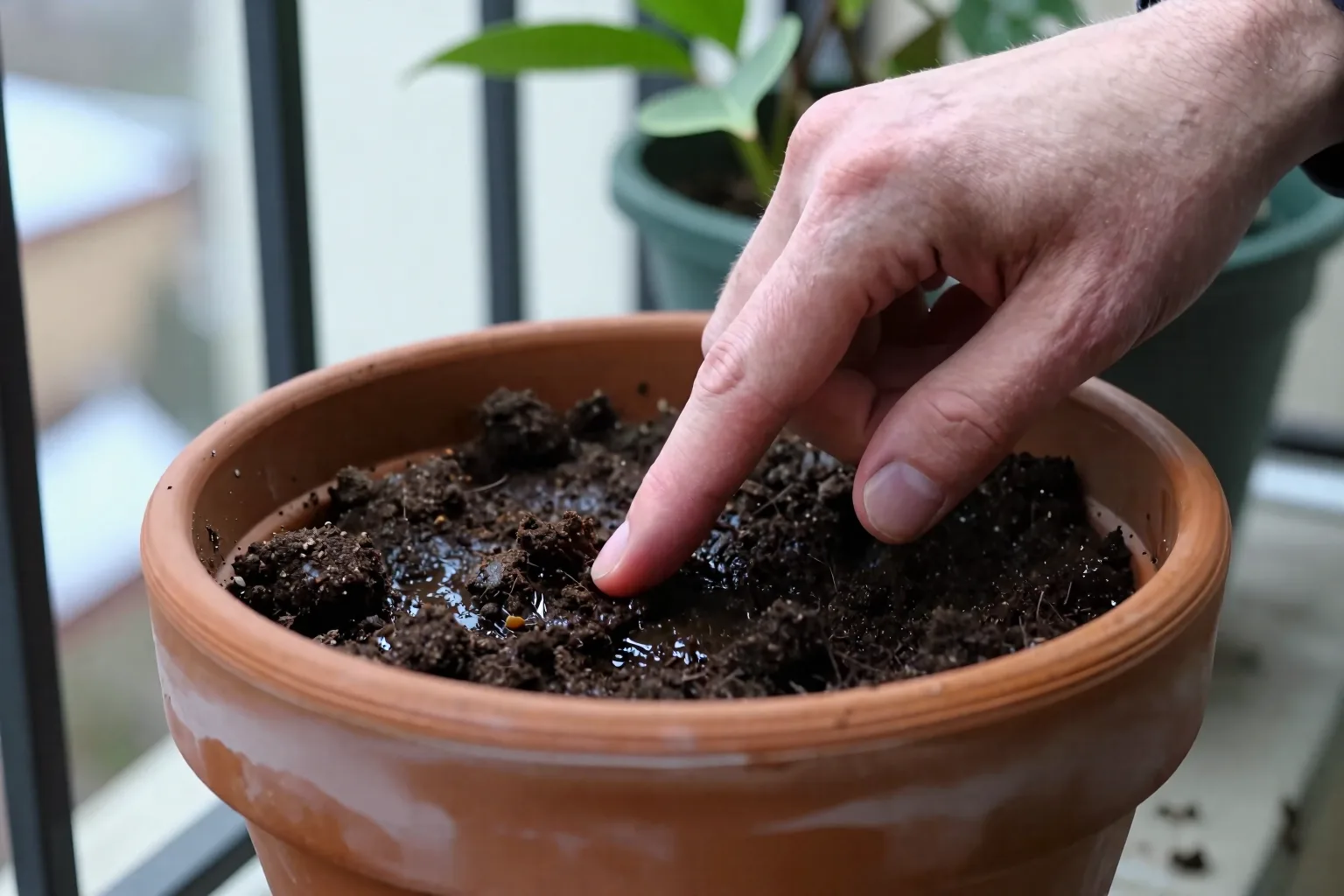
Why a full soak is safer than a daily sip
When the pot is above freezing and the root zone is genuinely dry, water slowly at the soil line. Apply enough to wet the whole mix, allowing a little water to emerge from the drainage holes. Then empty the saucer or the cachepot. The goal is an even rewetting of the root zone, not a puddle under the plant.
If dry peat-based mix has pulled away from the pot wall, the first water may run straight down the gap and out of the holes. Pause, let the mix absorb what it can, and repeat the slow application. Pouring faster in this situation can make the drainage look excellent while the centre of the root ball remains dry.
That lower, wetter band has a useful name: the perched water table. In a fine potting mix, gravity drains the largest spaces first, but smaller spaces can retain water lower in the container. The result is not a literal table or a layer of gravel; it is a zone that stays wetter after drainage than the mix above it. In winter, slow evaporation and slow root activity make that wet zone matter more.
Daily surface sips create two problems. They may wet only the top few centimetres while leaving the inner root ball dry, or they may keep the surface and lower band continually damp without allowing a useful air exchange. A full soak followed by a real dry-down gives you a clearer cycle to measure.
For the drainage mechanism, see How Much Drainage Does a Plant Pot Need? If you want the terminology behind water retention in containers, horticultural soil-science references on container-substrate drainage and the perched water table are a useful background read, but they cannot tell you whether this particular pot is dry today.
Use this decision tree when the surface is dry
A dry surface is the beginning of the check, not the conclusion. Follow this order so a recently watered pot, a succulent and a frozen outdoor container do not receive the same treatment.
- Is the top 2–5 cm (1–2 in) dry? If no, leave the pot alone and check again at the next interval. If yes, continue deeper.
- Is the mix below that layer cool, damp or clinging together? If yes, wait. The surface has dried faster than the root zone. Retest rather than adding a small drink.
- Is the likely root zone dry and the pot light? If the plant is leafy and actively growing, water slowly until a little drains, then empty the saucer. New leaves or other active growth support this branch, but moisture still decides it.
- Is it a succulent or cactus? Test deeper and wait for a more complete dry-down through the main root zone. A dry top layer alone is not enough evidence.
- Is the plant dormant? A leafless deciduous plant or a houseplant that has sharply slowed in a cool room may need much less water. Test the mix, but do not use limp leaves as an automatic watering signal.
- Is the outdoor pot frozen? Do not water it while frozen. Wait for a thaw, then test again. Frozen mix cannot accept water evenly, and runoff may freeze around the container.
- Has the weather been wet? Check the pot anyway. A roof, balcony slab or wall can create a rain shadow, leaving the mix dry even while the surrounding pavement is wet. Conversely, a sheltered pot may remain saturated because rain cannot evaporate quickly.
There is one common false alarm: a pot watered yesterday may have a dry-looking crust today. If the mix below is cool and damp, that crust does not justify another drink. Scratching the surface or adding a thin top-up only makes the next reading harder to interpret.
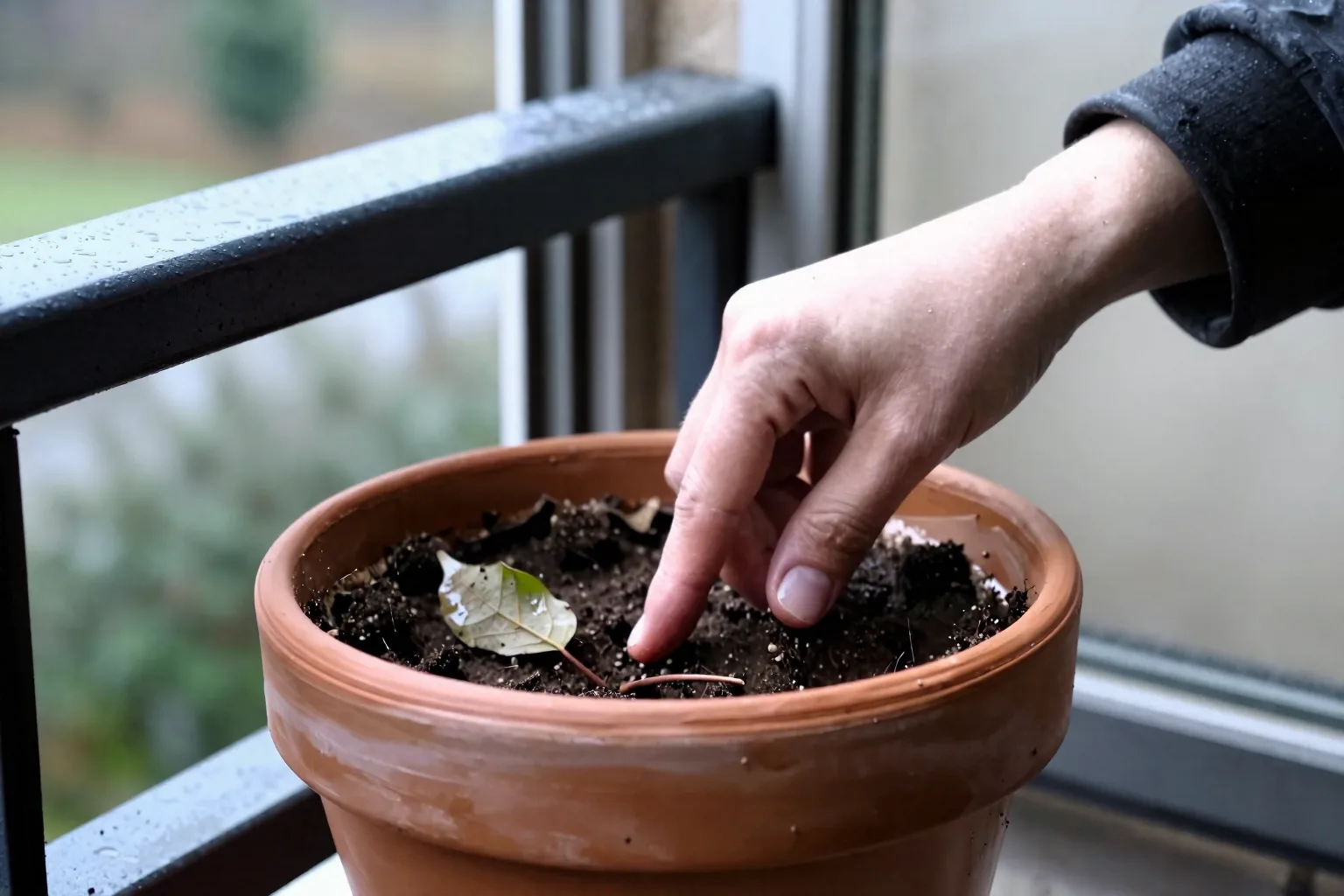
In a heated room, light matters as much as the calendar
Indoor winter conditions can produce contradictory clues. A radiator or heat vent may dry the side of a pot facing the warm air, while a cold window slows the roots and leaves the opposite side damp. Check the centre of the root zone, and rotate the pot only if doing so does not disturb a tall or top-heavy plant.
Bright supplemental light can move a plant toward more active growth and greater water use. Short, dim days usually justify longer checks, but a grow light, sunny glass or warm room can change that. A pot moved from a window into a dark corner should not inherit the window’s watering rhythm.
When water is needed indoors, use room-temperature water and apply it in the morning. That gives excess water time to drain and lets you notice a saucer that has filled. Keep water off the foliage where possible, particularly in a cool room with little air movement. If a cold sill is causing condensation or chill, keep the saucer from holding water against that surface.
Dry air and dry potting mix are separate problems. Grouping plants or using a humidifier can change the air around leaves, but misting the leaves does not rehydrate the root zone. Persistently wet foliage can also leave spotting-prone plants with a new problem. Extension advice on indoor winter plant care can help you think through light and room temperature; use it as background, then make the watering decision from the pot in front of you.
Outdoor containers: frost, wind and rain shadows change the rule
Outdoor watering is a thaw-day job. Check the container when the mix has thawed, and if it is dry, water in the morning while the air and pot are above freezing and the forecast gives excess water time to leave. Avoid watering a frozen pot, and don’t let a container sit in collected rainwater.
Wind can remove moisture from leaves and exposed potting mix even when the day feels cold. An open rooftop or balcony may therefore need a closer inspection than a sheltered patio. The opposite mistake happens under an overhang: rain is visible on the railing, but the pot has received almost none. Feel the root zone instead of using the pavement as your weather report.
Evergreen plants can continue losing water through leaves during mild, dry winter weather, although cold roots may not replace that loss quickly. A deciduous plant that has dropped its leaves uses less water while dormant, but its container still must not be left bone-dry for long periods if the roots remain alive and the mix is unfrozen.
A cold, unfrozen pot with a dry root zone is different from a frozen pot. The first may need a careful morning soak; the second needs time to thaw. Move outdoor containers out of strong wind when possible, using a wall or sheltered corner without blocking the light the plant still needs. For the rest of the cold-weather setup, see How to Protect Balcony Container Plants From Frost.
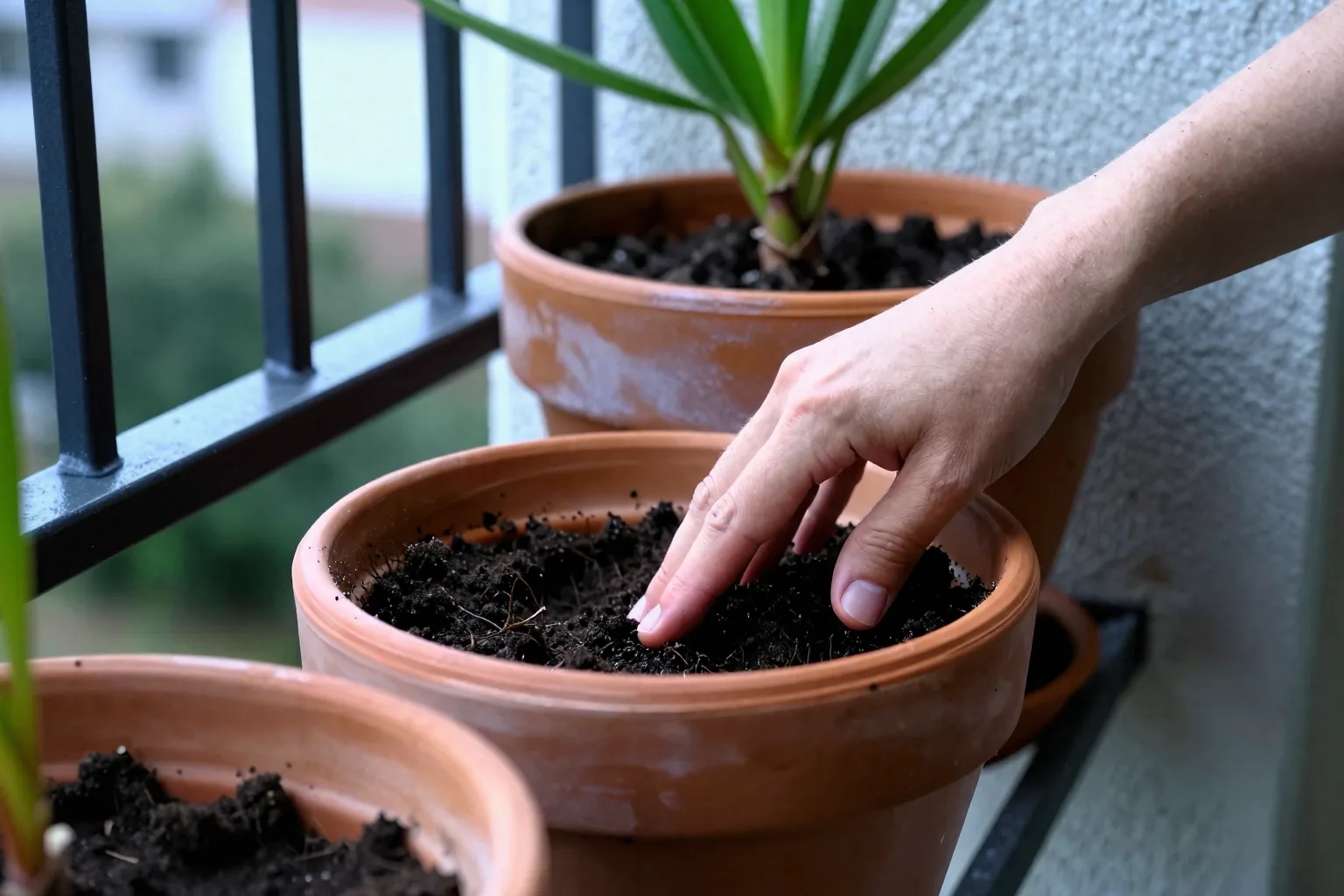
Can I water potted plants with ice cubes in winter?
Ice cubes are not a substitute for checking the root zone. Melting ice can cool and wet one small area before spreading through the rest of the mix, so it is a poor general method for a pot that actually needs an even soak. Use room-temperature water slowly when the test says water is needed. Some orchid-specific advice is built around very small measured amounts, but that does not make ice cubes a general rule for larger pots or other plants.
Should I mist houseplants instead of watering them in winter?
No. Misting wets the leaves briefly; it does not put water around the roots. If dry indoor air is the concern, grouping plants or using a humidifier addresses the air separately. Avoid leaving foliage wet for long periods in cool, poorly ventilated rooms, especially on plants that develop spots easily.
Do self-watering pots need fewer winter checks?
The reservoir changes how water reaches the mix, not the need to inspect the plant. Check the reservoir and the root-zone condition. Low light and cool temperatures can leave a self-watering pot wet for too long, while different wicks and reservoir designs deliver water at different rates. Do not refill the reservoir simply because it is empty if the upper root zone is still damp, and do not assume a full reservoir proves the roots are hydrated.
When the leaves disagree with your finger, diagnose the roots
Leaf symptoms overlap, so pair the plant’s appearance with moisture, pot weight, drainage and temperature. A limp leaf is not a watering instruction by itself.
Limp leaves, bone-dry mix and a light pot
This combination points first toward thirst. Check that the dry feeling extends into the root zone, then water slowly enough to wet the whole mix. If water runs down a gap between the mix and pot wall, pause and repeat rather than pouring faster. After watering, keep checking the mix; do not add another drink just because the leaves remain limp immediately.
Yellowing leaves, wet mix and slow growth
Wet mix, algae on the surface, a sour smell or stalled growth points toward a root-zone problem such as excessive moisture or poor drainage. Stop adding water, inspect the drainage holes and empty any saucer or cachepot. Move the plant to suitable light, but do not try to fix a wet pot by placing it beside a hot radiator. For a fuller symptom comparison, see How to Tell Overwatering From Underwatering in Container Plants.
Wilt with wet, cold mix
Wilt in wet soil is a warning not to reach for the watering can automatically. Cold, damaged or oxygen-starved roots may be unable to take up water even though plenty is present. Check for standing water, improve the pot’s drainage path and move the plant away from a freezing pane. If the mix remains wet and the plant continues to decline, the roots need investigation rather than another surface drink.
A seven-day reset for winter watering
Today, choose three representative pots: one warm indoor pot, one cool or dim pot and one outdoor pot if it is thawed. Test each at the relevant depth, note dry, cool, damp or saturated beside the date, lift the pot, and empty any standing water. At the next check, compare what changed instead of watering by habit. If a pot has moved, the weather has shifted or a grow light has been added, start the moisture assessment again from the root zone.
Put a finger into those three pots today and write down what it actually feels like. In seven days, test the same depth again; the notes will give you a useful interval for those pots, not a calendar rule for every plant in the building.
Frequently Asked Questions
Can I water potted plants with ice cubes in winter?
Explain that melting cubes do not replace a root-zone moisture check and may cool the mix unevenly; when water is needed, room-temperature water applied slowly gives a more even soak. Mention that advice sometimes marketed for small orchids is not a general rule for larger pots.
Should I mist houseplants instead of watering them in winter?
Clarify that misting wets leaves briefly but does not hydrate the root zone. Address humidity separately, including grouping plants or using a humidifier, while noting that persistently wet foliage can encourage spotting on susceptible plants.
Do self-watering pots need less frequent winter checks?
Explain that a reservoir changes the watering method, not the need to inspect moisture. Low light and cool temperatures can leave the mix wet for too long, while different wicking designs behave differently, so check both the reservoir and the root-zone condition.