How Often to Water Potted Plants Outdoors: A Simple Check
How often to water potted plants outdoors depends on one quick observation, not a fixed weekday. Push a finger or wooden skewer 2–5 cm (1–2 in) into the potting mix, then lift or tilt the container. If the mix is dry at that depth and the pot feels noticeably light, water slowly; if only the surface is dry but the pot still feels heavy, check deeper before adding more.
The tactile clue matters. A 10 cm (4 in) black plastic herb pot in exposed sun can move from damp to dry in a day, while a 40 cm (16 in) glazed tub in sheltered part shade may stay moist for several days. Those are different watering problems sitting on the same balcony.
Use the calendar as a reminder to inspect, not as permission to water automatically. Here is the simple check, followed by the conditions that change its answer.
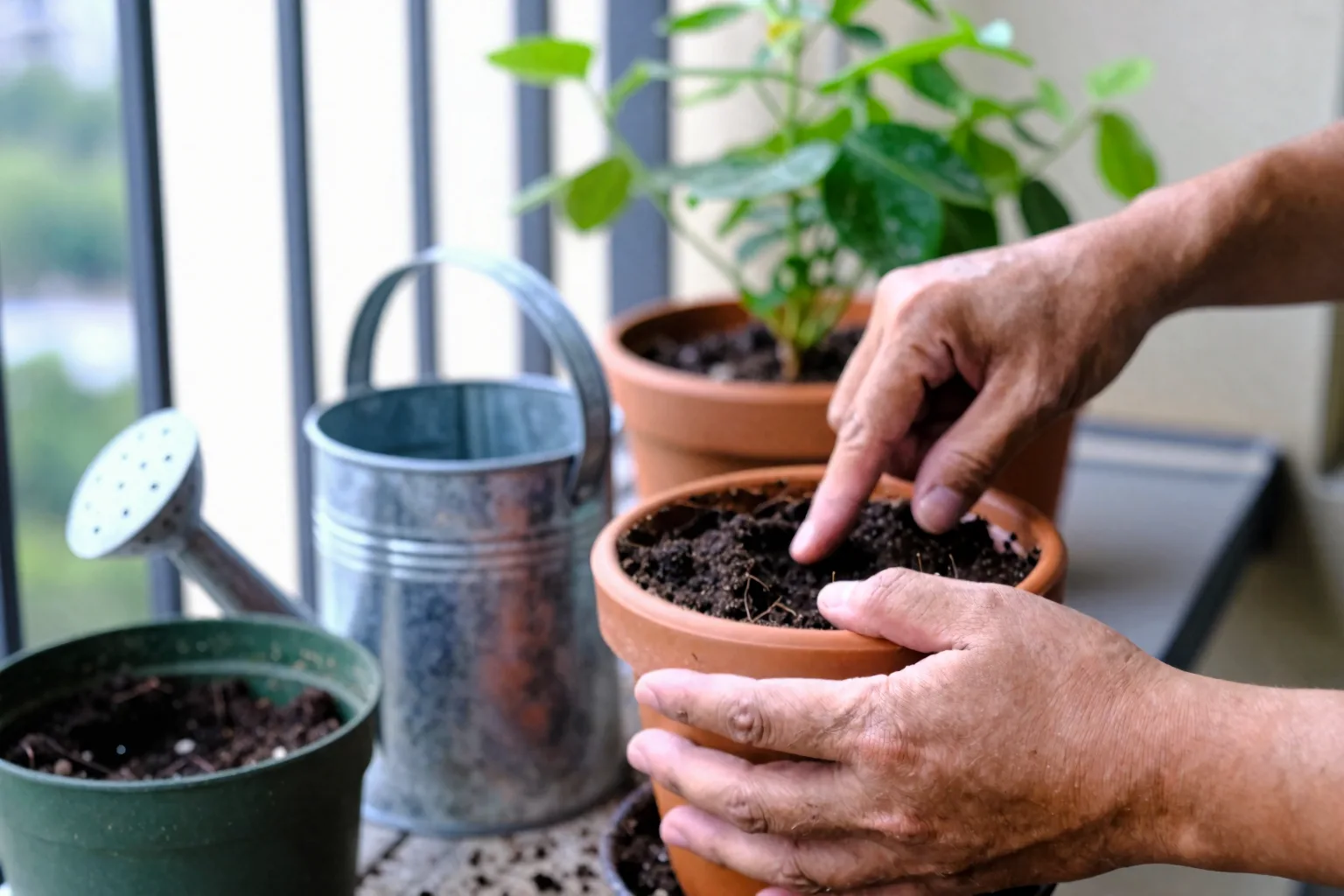
Start with the two-minute moisture check
I start with three clues together: moisture below the surface, the weight of the pot, and the plant’s current condition. One clue on its own can mislead you, particularly after a hot afternoon or a heavy shower that wet the leaves but barely reached the roots.
- Test 2–5 cm (1–2 in) down. Push your finger into a small pot, or use a plain wooden skewer when the container is narrow or the mix is uncomfortable to touch. A skewer that comes out with damp mix clinging to it points to moisture at that depth. One that comes out clean and dusty is a reason to inspect further, not an automatic order to flood the pot.
- Feel the weight. Lift the container if you can do so safely, or tilt it slightly from the base. A recently watered pot should feel heavier than the same pot after several days of drying. You don’t need to know the exact weight; you’re building a comparison with yesterday’s feel.
- Check deeper in a large container. A dry crust at the top of a 35 cm (14 in) tub tells you about the top layer, not necessarily the root zone. Push a skewer farther down in an open area, avoiding the main stem, and compare what comes out at different depths.
- Read the plant last. Leaves add useful evidence, but they don’t overrule a wet, heavy pot. Water only when the moisture check and the plant’s likely demand point in the same direction.
Seedlings, shallow-rooted herbs and small salad crops can genuinely need the shallower 2 cm (1 in) check because their usable mix is close to the surface. A deep-rooted tomato, shrub or citrus plant needs a deeper inspection. A newly planted container also deserves more frequent checks until roots spread through the surrounding mix; the plant may be thirsty even though unused mix lower down remains wet.
Watering is not a calendar task; it is a measurement followed by a decision.
A calendar gives a starting range, not the rule
The table below is a starting range for a container with drainage holes, ordinary weather and a free-draining potting mix. The first column says how often to inspect. The second says how often you might water after the inspection says the root zone is dry enough. In hot, windy conditions, check frequency can increase before watering frequency does.
| Container | Mild and sheltered | Hot, windy or exposed |
|---|---|---|
| Small pot: 10–15 cm (4–6 in) | Check daily; water about every 1–3 days | Check morning and late afternoon; water daily, sometimes twice |
| Medium pot: 15–25 cm (6–10 in) | Check daily; water about every 2–4 days | Check daily; water about every 1–2 days |
| Vegetable container: 25–35 cm (10–14 in), roughly 15–30 L (4–8 US gal) | Check daily or every other day; water about every 2–5 days | Check daily; water about every 1–3 days |
| Large tub: 30–45 cm (12–18 in), roughly 30–60 L (8–16 US gal) | Check every 1–2 days; water about every 3–6 days | Check daily; water about every 1–3 days |
| Hanging basket: 25–35 cm (10–14 in), shallow mix | Check daily; water about every 1–2 days | Check morning and evening; water daily or more often |
These are deliberately broad intervals. A crop with a dense canopy can use water faster than an empty pot of the same size, and a newly planted container can dry unevenly because roots occupy only part of the mix. If the pot is dry a day earlier than the table suggests, the plant has given you better information than the table.
The pot itself sets the pace
Every pot has a finite water reserve. A larger volume of mix usually stores more available water, but the plant can use that reserve only where its roots are active. Pot depth, width, material and colour then decide how quickly water leaves that reserve.
A 10–15 cm (4–6 in) pot has little margin. Its top layer makes up a large share of the container, and the exposed sides are close to the roots. In full sun and moving air, that small volume can dry enough to need a daily check or a daily drink. A broad, shallow planter has the same issue: more of its mix is close to the evaporating surface compared with a deeper pot holding the same amount.
Unglazed terracotta is porous, so moisture can move through its walls and evaporate into the surrounding air. Plastic and glazed ceramic usually hold water inside the mix for longer because their walls are less permeable. That doesn’t make either material automatically better. Terracotta can suit a plant that dislikes staying wet, while plastic is easier to manage on a windy, sunny balcony where drying is the main problem.
Oversizing creates the opposite risk. If a small root system sits in a very large pot, the lower or outer mix may remain wet long after the top looks dry. The plant has not yet used the water, and the roots may have less air around them. This is why How much soil does a container vegetable need? is a better shopping question than simply asking for the biggest pot available.
My judgment call for an elevated space is to choose the smallest container that meets the crop’s actual root-volume need, then manage exposure with shade, grouping and a saucer. An oversized tub reduces some watering checks, but it adds weight and gives a small root system a wetter margin for error.
Don’t try to create extra drainage by putting stones or gravel under the mix. The boundary between a fine potting mix and a coarse layer can hold water above the coarse material before gravity draws it through. For the mechanism, see Why gravel in the bottom of a plant pot does not improve drainage. A clear drainage hole and a suitable mix are more useful than a false drainage layer.
Sun, wind and weather can halve the interval
A west-facing balcony can change the answer before the forecast calls it a heatwave. Afternoon sun heats the pot and the upper mix. A pale wall or concrete floor can reflect additional heat, while wind removes the humid layer of air sitting around leaves and pot surfaces. Low humidity makes that drying effect stronger.
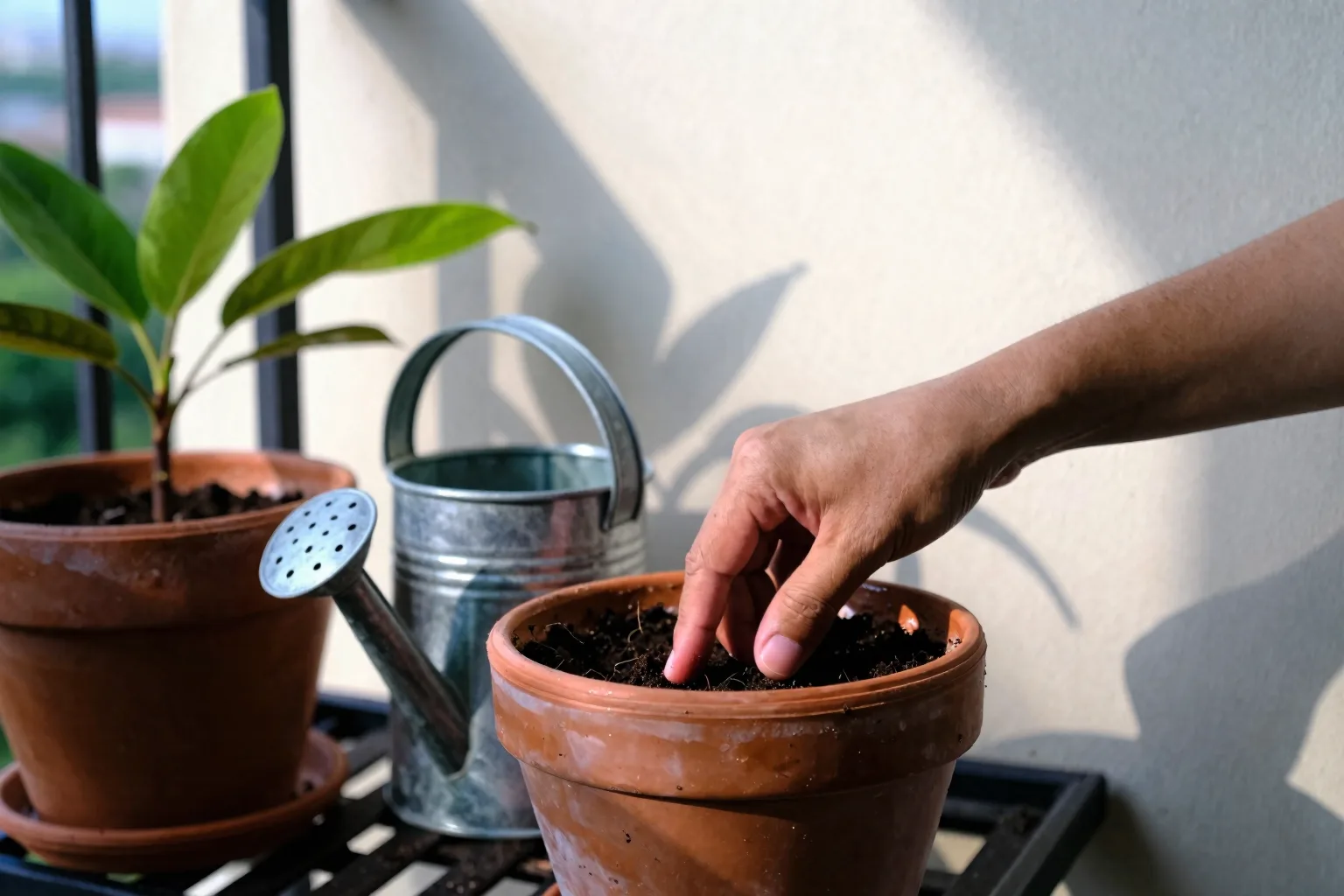
Exposure is cumulative. A plastic pot in full afternoon sun may need checking twice in one day even if the air temperature seems comfortable. The same crop in a glazed pot against a sheltered wall may keep moisture for another day or two. A hanging basket often dries faster than a floor-standing container because air reaches its sides and its shallow mix has less stored water.
Rain replaces watering only when enough rain reaches the mix and wets it to the active root depth. Leaves can intercept a light shower, and an awning, balcony above or wall can keep the pot almost dry. After rain, tilt the container or push a skewer below the surface. Don’t count millimetres of rain as useful irrigation until the potting mix confirms it.
During a hot spell, check vulnerable pots early in the morning and again in late afternoon. Move a heat-sensitive container into temporary afternoon shade where the crop allows, but don’t put a sun-loving fruiting plant into deep shade for a week and expect the same growth. Check your local forecast for heat, wind and rainfall, then use it to decide how often to inspect rather than to predict an exact watering time. For a more focused preparation list, see How to protect balcony plants during a heatwave.
Midday wilting deserves a pause. Leaves may lose water faster than the roots can replace it during the hottest part of the day, then recover as the air cools. Check the pot before watering. If it is light and dry, water; if it is heavy and wet, provide shade and wait for cooler conditions while you investigate the roots and drainage.
Give one thorough watering, then stop at the right point
Once the mix is dry enough, the aim is to wet the whole root ball, meaning the block of roots and potting mix that the plant is actually using. A quick splash can wet the top crust and run down a gap at the pot wall without reaching the centre. Use this order:
- Set the pot where it can drain. Don’t begin with a full saucer underneath. If the pot sits on a balcony surface, protect the surface without blocking the holes.
- Pour slowly at the soil line. Use a narrow stream and move around the surface rather than dumping water beside the stem. Stop if water immediately channels down the side or appears at the holes.
- Pause for two to five minutes. This gives dry mix time to absorb some water instead of shedding it through cracks. The larger and drier the pot, the more useful the pause becomes.
- Make a second pass. Pour again until the surface is evenly damp and a small amount of water begins to leave the drainage holes. Runoff is a sign that water has travelled through, not proof that every dry pocket is gone, so recheck the pot weight later.
- Let the pot finish draining. Empty a saucer after drainage has stopped. A pot that stands in collected water can stay wetter than the plant’s roots require, even if the top looks ordinary.
If the potting mix has shrunk away from the sides, aim the first pass at the gap and use a slower stream. Once the gap is damp, the next pass is more likely to move through the mix rather than straight down the wall. Keep drainage holes open; they provide an exit for excess water, but they cannot force a water-repellent or compacted mix to absorb.
This is also why I don’t water by a fixed number of cups. The right amount is enough to re-wet the root zone with a little drainage, and that amount changes with pot size, dryness and mix condition.
Separate thirst from drowning and heat stress
Wilting is a symptom, not a diagnosis. A plant can wilt because the mix is dry, because wet roots are not functioning well, or because hot leaves are losing water faster than the root system can supply it. The pot-weight and moisture checks tell you which direction to investigate.
The quickest way to avoid overwatering is to compare the leaves with the mix before reaching for the can.
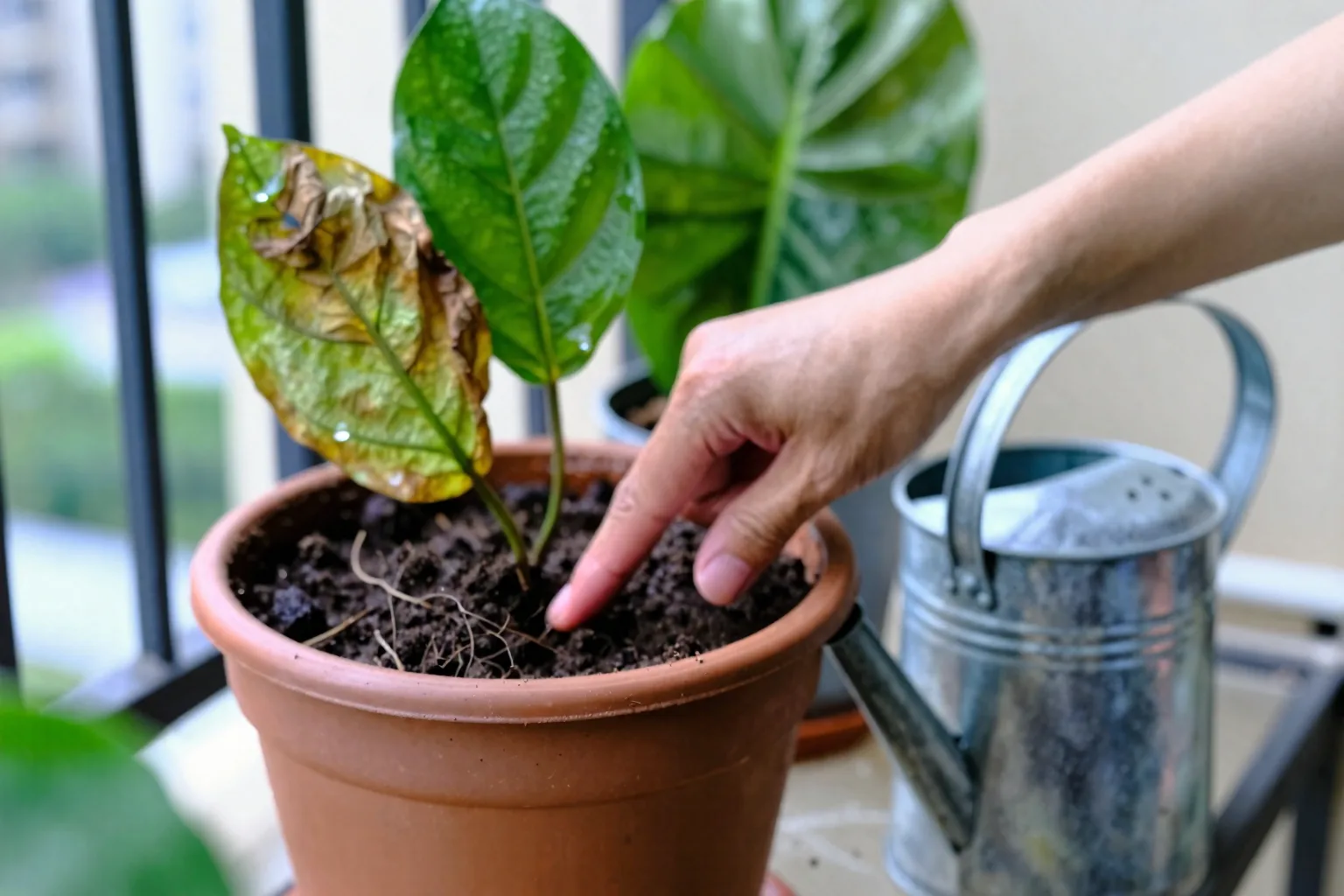
| What you see | Check the pot | First response |
|---|---|---|
| Limp leaves and a light pot | Mix is dry 2–5 cm (1–2 in) down, or dry deeper in a large tub | Water slowly in two passes, then shelter briefly from the hottest exposure |
| Limp leaves and a heavy pot | Mix is wet at the tested depth and drainage is slow | Do not add water; improve airflow and check the holes and saucer |
| Yellowing leaves with persistently wet mix | Pot remains heavy between checks | Let the mix dry to the crop’s appropriate depth and correct the drainage problem |
| Crispy edges or a dry, papery surface | Pot is light; salts may also be visible as a pale crust | Rehydrate gradually, then review exposure and feeding rather than adding more fertiliser immediately |
| Leaves wilt at noon but recover by evening | Check at dawn; compare the pot weight before and after the hot period | Provide temporary afternoon shade and water only if the root zone is genuinely dry |
Yellow leaves are not exclusive proof of excess water; ageing leaves, low nutrients and root disturbance can look similar. Likewise, crispy edges can follow heat, drought or concentrated salts left behind after repeated small waterings. If the leaves and mix tell different stories, use How to tell if a potted plant is overwatered or underwatered as a longer symptom comparison, but still begin with the physical pot check.
One useful rule is to trust wetness before wilt. Adding water to a heavy, wet pot because the leaves look sad can make the original problem harder to separate from the new one. Shade the plant for a few hours, inspect the drainage and check again when the temperature drops.
If the pot is already bone-dry, change the method
A severely dried pot needs patience, not a single hard pour. Move it out of hot wind first. Then wet the surface with a small amount, wait five to ten minutes, and repeat until water begins to soak into the mix rather than disappearing down the sides.
When potting mix has dried so far that water beads, runs around the edge or exits almost immediately, it has become hydrophobic. That simply means the dry mix is temporarily repelling water instead of absorbing it. A slow top-watering sequence can restore contact between the mix particles and water.
For a small container with clear drainage, a brief bottom soak can help when top watering keeps bypassing the mix. Stand the pot in a shallow tray of water for roughly 15–30 minutes, then lift it out and let it drain completely. Don’t use this method on a pot without holes, and don’t leave a container sitting in water for hours or overnight. The purpose is to re-wet the mix, not to keep the roots submerged.
Delay feeding until the plant has rehydrated and the pot has returned to a normal watering cycle. Fertiliser added to a severely dry root zone can add to the concentration of dissolved salts around stressed roots. If the plant stays limp while the mix is now wet, stop watering. That pattern points away from simple thirst and towards heat damage, root injury or another problem that more water will not fix.
Calibrate the interval after seven days of observation
Seven days is long enough to reveal a useful pattern in many exposed small pots, although it is not a magic number. Check at roughly the same time each day, preferably before the strongest heat, and write down four things: the weather, the pot’s relative weight, the dry depth and whether you watered.
Here is a concrete balcony example. Suppose a 30 cm (12 in) plastic tomato pot is thoroughly watered on Monday morning. On Tuesday it feels heavy and the mix is damp at 5 cm (2 in). On Wednesday the surface is pale but the pot is still heavy. On Thursday the pot feels lighter and the skewer is dry at 5 cm, so Thursday becomes the useful watering day. The following week, Wednesday becomes the inspection day; Monday is not an automatic watering day just because it was last week’s date.
Adjust the interval one day at a time. If the mix reaches your dry threshold on day three, check on day two next time. If it is still damp on day four, keep checking rather than watering early. A seven-day log should reveal whether the pot is drying at a steady pace or whether one windy afternoon is responsible for the change. If that prediction fails, the next morning’s moisture and weight check corrects it.
Newly transplanted plants, recently divided herbs and containers with a small root system need closer observation than established plants in the same pot. Roots gradually occupy more of the mix, changing how quickly water is removed. The calendar is a useful reminder to look; the pot decides whether you pour.
For holidays, automate the backup—not the guess
Before leaving for several days, group containers by similar light and water needs. Move the most vulnerable pots out of hot afternoon exposure without placing sun-loving crops into deep shade. Grouping makes a wick or drip line easier to adjust because one system is not trying to serve a thirsty hanging basket and a slow-drying shrub at the same setting.
Test any wick, drip line or reservoir three to four days before you leave. A wick may deliver too little water if its contact with the mix is poor, while a drip emitter may deliver more than a small pot can drain. Watch the pot weight and moisture depth through the trial rather than judging the system by a wet surface.
The useful backup maintains a suitable moisture level; it does not keep every container permanently saturated. Before buying hardware, compare the design with authoritative horticultural references on self-watering containers and authoritative horticultural references on drip irrigation for pots. Look for advice that explains flow, drainage and crop demand rather than promising that one setting suits every pot.
Tomorrow morning, lift each pot before watering, mark the one that dries fastest, and test only the watering aid that solves that specific gap. If you’re staying home, the same check is all the automation you need.
Can rain replace watering outdoor potted plants?
It can, but only when enough rain reaches the potting mix and wets it to the active root depth. Foliage, an awning, a balcony above or a wall can intercept a surprising amount. Check beneath the surface after the shower instead of assuming the pot is watered.
Are moisture meters accurate for outdoor container plants?
Treat a meter as a comparison tool, not an absolute answer. Insert it in the same part of the pot each time and compare its reading with the finger, skewer and weight checks. Coarse, compacted or extremely dry mixes can make a reading less useful, so calibrate the instrument against what the pot actually feels like before relying on it during a heat spell.
Is morning or evening better for watering outdoor pots?
Morning is usually the easiest timing because the plant has moisture available as the day warms. Evening is preferable to leaving a genuinely dry plant until morning, though water should still go onto the mix rather than sit on the foliage. The moisture check decides whether either timing is needed.
Your next physical action: check one pot tomorrow at the same time, 2–5 cm (1–2 in) below the surface, and lift it before you water. Write down what you felt. That single note is the beginning of a watering schedule built for your balcony rather than borrowed from a calendar.
Frequently Asked Questions
Can rain replace watering outdoor potted plants?
Only when enough rain reaches the potting mix and wets it to the active root depth; check beneath the surface because foliage, awnings and balcony walls can keep containers surprisingly dry.
Are moisture meters accurate for outdoor container plants?
Treat a meter as a comparison tool rather than an absolute answer, and calibrate it against the finger, skewer and pot-weight checks because coarse or dry potting mixes can produce misleading readings.
Is it better to water outdoor pots in the morning or evening?
Morning is usually the easiest timing because the plant has water available during the heat of the day, but watering in the evening is preferable to leaving a genuinely dry plant until morning; keep water directed at the mix.