Can Vegetables Grow in 1-Gallon Containers? Yes—For These Crops
A nominal 1-US-gallon pot holds about 3.8 litres of mix, which is enough for a useful crop of radishes or baby leaves but not enough to make a full-size tomato comfortable. If you’re asking, can vegetables grow in 1 gallon containers, the practical answer is yes: choose shallow roots, compact plants, or crops you’ll harvest young.
Put radishes, leaf lettuce, arugula, spinach, green onions and short carrots on the dependable list. Treat one bush bean, compact chard and a micro-dwarf tomato as conditional experiments. Full-size tomatoes, cucumbers, courgettes or zucchini, eggplants and potatoes may stay alive in that volume, but a one-gallon pot is usually a poor bargain for their full-season crop.
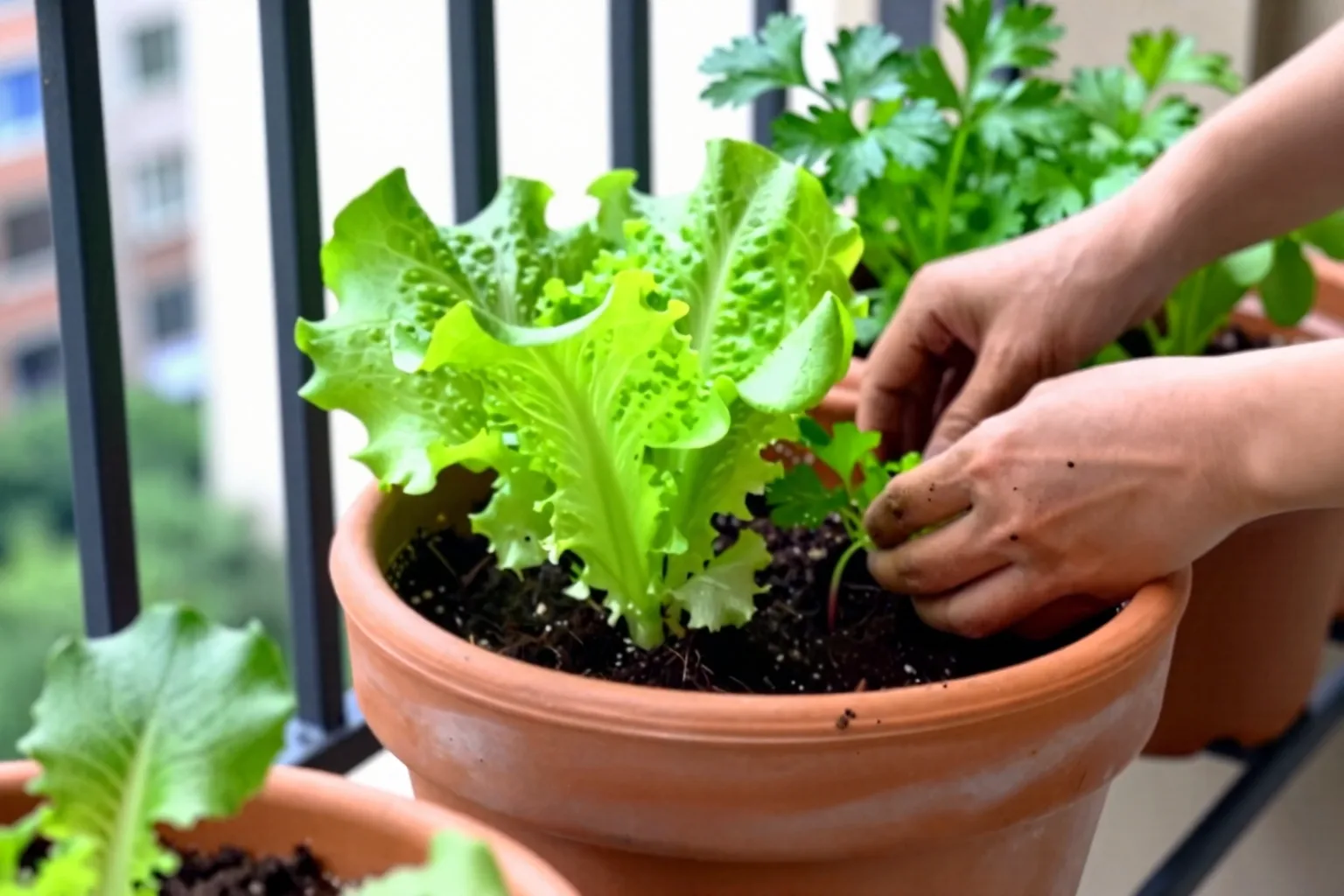
Yes—but a 1-gallon pot is a short-season crop filter, not a miniature garden bed
The word nominal matters. A pot sold as one US gallon is labelled for roughly 3.8 litres, but its usable fill may be lower after you allow for a tapered shape, drainage space and the 2–3 cm (about 1 inch) you should leave below the rim. Outside North America, an Imperial gallon is about 4.5 litres, so check which gallon the label means before comparing pots.
A one-gallon container works best when the plant has a small root system, a low canopy, or a short wait between sowing and harvest. Radishes fit all three conditions. A tomato does not: even a compact plant must keep a leafy canopy supplied while carrying fruit, and the small root zone has very little water reserve when the sun and wind arrive together.
My useful distinction is this: can the plant survive in one gallon? is a weaker question than will the pot repay the space and attention? A stunted bean that produces a few pods is technically a success. A quick crop of radishes or cut-and-come-again greens is a better use of the same balcony footprint.
Use three tests before putting a seed packet in the basket
I screen a vegetable for a small pot with three questions. They are more reliable than choosing by the picture on the seed packet.
1. Does the usable soil depth match the root shape?
Look at the depth inside the pot, from the mix surface to the drainage opening, rather than the outside height. A round radish needs a modest vertical root zone. A short carrot needs a longer, uninterrupted column. The difference is not just size: a carrot’s storage root thickens downward, so a shallow container forces it to fork, stop, or press against the base.
2. Can the mature canopy fit without becoming a sail?
A seedling can look perfectly suited to a small pot and still become awkward later. Leafy crops stay relatively close to the mix. A bush bean spreads above it, while a tomato or cucumber adds height and may need a stake or trellis. That extra foliage catches wind, and the support has to be anchored in a small, light container.
3. Can you keep up with the water demand and harvest window?
A fast crop can finish before a one-gallon pot becomes a daily chore. A long-season fruiting crop keeps drawing water and nutrients after the first flush of growth. In a small volume, the margin between adequately moist and dry is narrow, especially on a sunny exposed balcony.
Use this as a first screening table. The depths are approximate internal soil depths, not claims that every variety has an identical root system.
| Usable internal depth | Good one-gallon candidates | What the depth screen means |
|---|---|---|
| 10–15 cm (4–6 in) | Radishes, baby-leaf lettuce, arugula, spinach, green onions | Shallow or frequently harvested crops have room to start and finish. |
| 15–20 cm (6–8 in) | Baby turnips, baby beets, bush bean, compact chard | These are conditional choices; spacing and watering matter more as the canopy grows. |
| About 20 cm (8 in) | Short or round carrots | Choose a short-rooted variety and harvest at a smaller size. |
| About 20–25 cm (8–10 in) | Micro-dwarf tomato | Possible as an experiment, but fruiting and watering leave little spare capacity. |
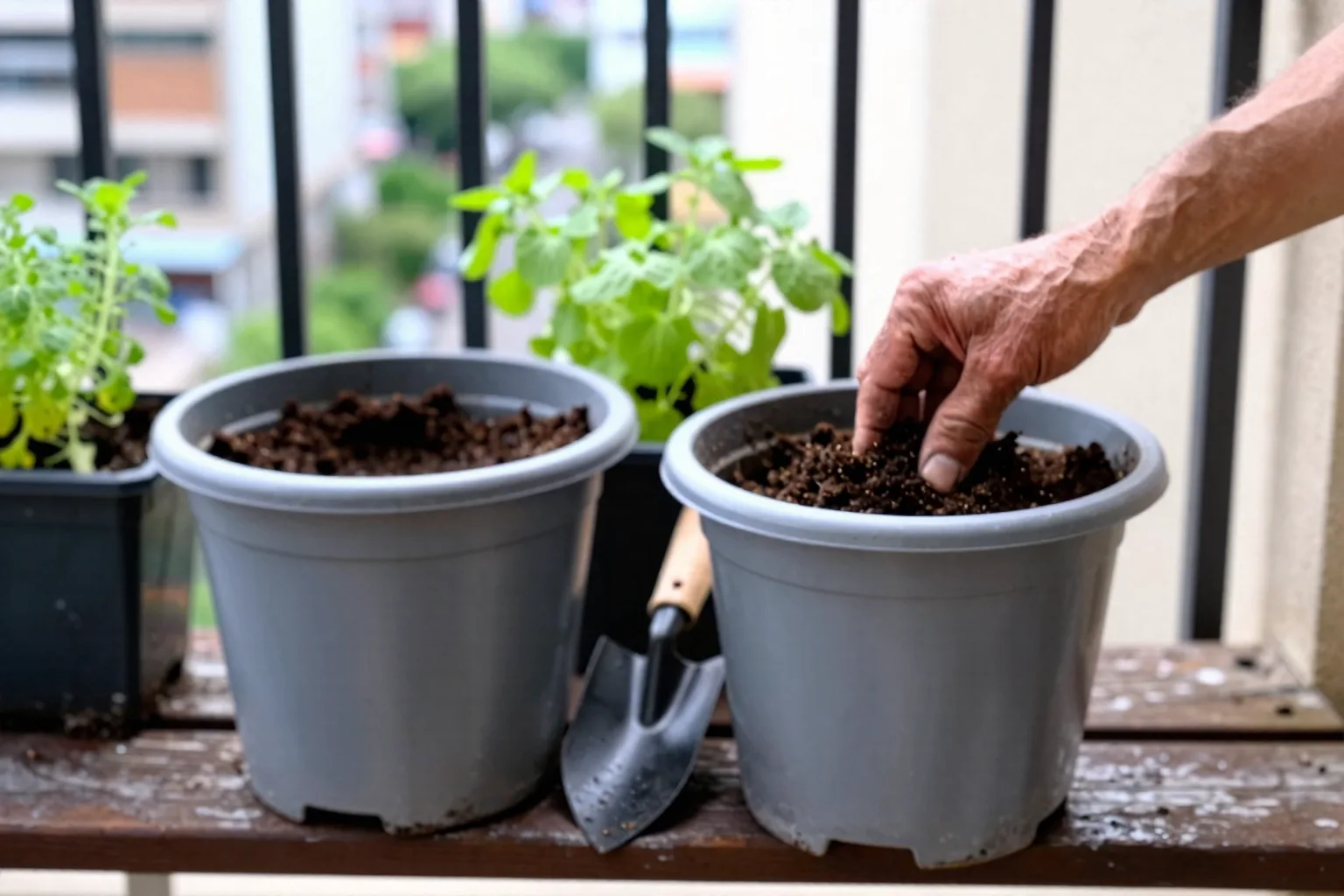
Two pots can hold nearly the same amount of mix and behave differently. A tall, narrow 4-litre pot can provide carrot-friendly depth, while a wide, shallow 4-litre container gives more surface area for evaporation and may suit baby leaves better. Volume tells you how much water and root room exist in total; shape tells you where that room is.
The one-gallon crop chart: reliable wins, conditional bets and poor choices
Here is the aisle-ready version. “One plant” means one plant in the entire container, not one plant per handful of mix. For dense baby-leaf crops, the harvest style matters more than counting mature plants.
| Crop | Starting internal depth | Planting approach | Harvest to expect | Verdict |
|---|---|---|---|---|
| Radishes | 10–15 cm (4–6 in) | Direct sow; thin seedlings | A small batch of roots harvested young | Reliable |
| Leaf lettuce | 15–20 cm (6–8 in) | Direct sow or set out one small transplant | One small head or repeated baby leaves | Reliable |
| Arugula or spinach | 15–20 cm (6–8 in) | Direct sow in a patch | Several handfuls of young leaves, depending on weather | Reliable in cool conditions |
| Green onions | 15 cm (6 in) | Direct sow or plant small starts | A small bunch of slender onions | Reliable |
| Short or round carrots | About 20 cm (8 in) | Direct sow in the final pot | A small batch of short roots | Conditional but worthwhile |
| Baby beets or turnips | 15–20 cm (6–8 in) | Direct sow; thin early | Small roots and edible young leaves | Conditional |
| One bush bean | 15–20 cm (6–8 in) | Direct sow one plant | A modest picking of pods rather than a bean row | Conditional |
| One compact chard plant | 15–20 cm (6–8 in) | One transplant or carefully thinned sowing | Young leaves picked a few at a time | Conditional |
| Micro-dwarf tomato | 20–25 cm (8–10 in) | Transplant one plant | An experimental fruit crop with modest expectations | Possible, not dependable |
| Full-size tomato | Outside the useful one-gallon range | Transplant | More root volume, water and support are needed | Poor choice |
| Cucumber | Outside the useful one-gallon range | Transplant with support | Long vines and sustained water demand | Poor choice |
| Courgette or zucchini | Outside the useful one-gallon range | Transplant | A broad plant with a heavy water and nutrient demand | Poor choice |
| Eggplant or standard pepper | Outside the useful one-gallon range | Transplant | A long-season fruiting plant with little drought margin | Poor choice |
| Potatoes | Outside the useful one-gallon range | Sprouting tuber and added mix | Too little room for a useful hilling cycle | Poor value |
The reliable crops share a useful trait: you can harvest them before they have to support a large, permanent canopy. Lettuce and spinach can be cut as young leaves. Radishes and baby turnips do not need to reach their packet’s largest advertised size. Green onions can be pulled individually while the remaining plants continue.
That is why I’d favour a crop that gives one small serving quickly over a heroic attempt at a full tomato plant. The one-gallon pot is not a small garden bed; it is a small harvest slot.
Build the pot around the roots: depth, mix, holes and spacing
For shopping purposes, plan on roughly 3–4 litres (0.8–1.1 US gallons) of container mix per nominal one-gallon pot. Buy by the bag’s litre rating, then allow a little extra if the pot is wide, the mix settles, or you are filling several containers. The actual amount is controlled by the pot’s inside dimensions, not by the printed diameter alone.
For most of the dependable crops, choose at least about 15–20 cm (6–8 in) of internal depth. Give short carrots around 20 cm (8 in) or more. Fill the pot to two fingers below the rim, or about 2–3 cm (1 inch). That small gap gives you room to water without washing mix over the edge.
A container mix is the more reliable choice here because it is made to keep air spaces around roots while holding enough moisture for a restricted root zone. Straight garden soil tends to compact in a pot. Once its pores collapse, water can sit in the root zone while the surface looks deceptively dry.
Check the drainage holes before you buy the plant. A hole that is present but blocked by a label, plastic film or a flat surface is not functioning drainage. Set the container on feet or a shallow saucer if needed, but don’t let the base sit in a permanent puddle.
Skip the gravel layer. The fine container mix above it can hold a perched water table, which is a band of wet mix that remains above a coarse layer instead of draining neatly into it. The gravel occupies root volume without removing that wet band. For a fuller explanation, see Why gravel in the bottom of a pot makes drainage worse.
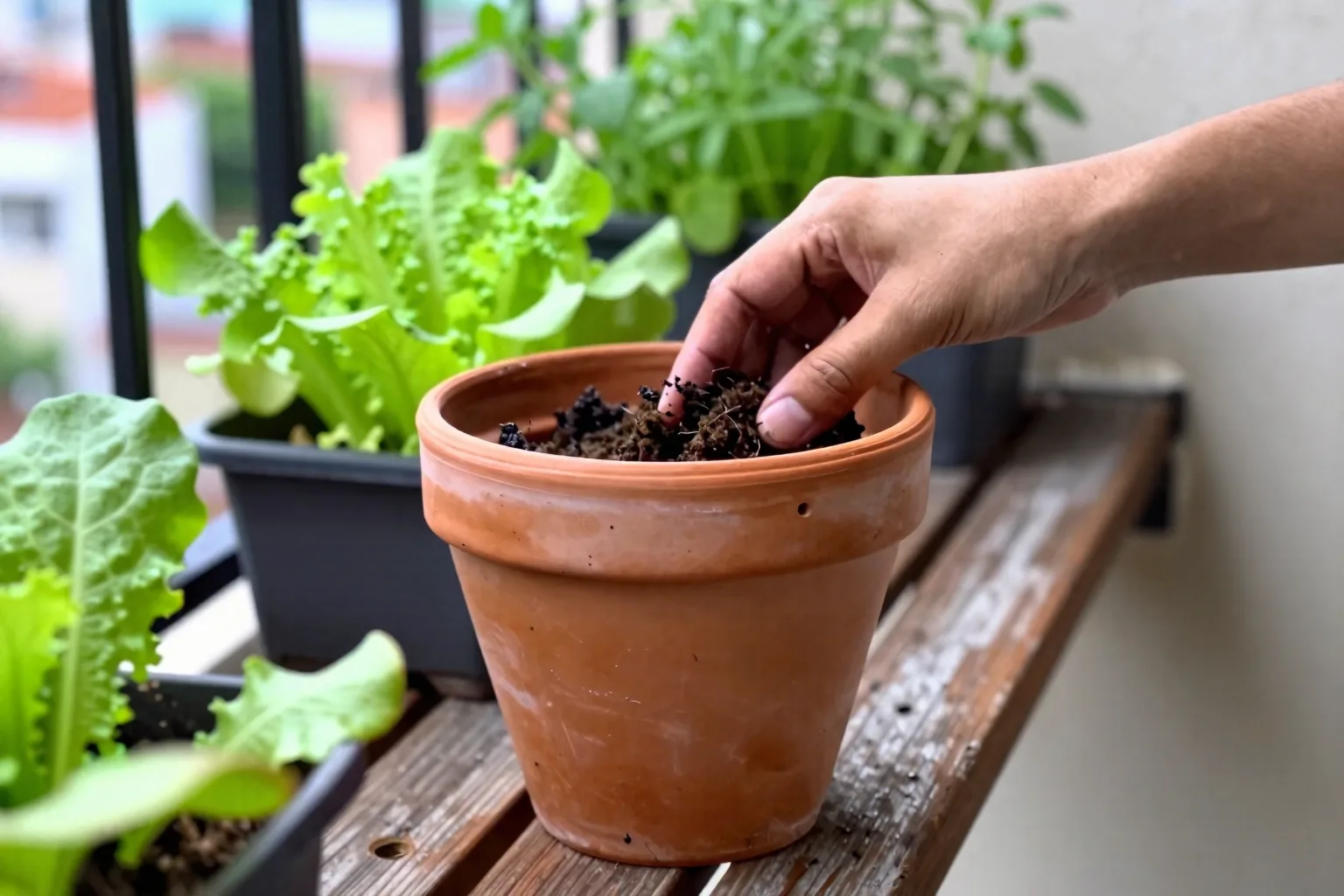
Here is a practical measuring example. Suppose the inside of a pot is about 19 cm (7.5 in) wide and 18 cm (7 in) deep. Treating it as a cylinder gives roughly 5.1 litres of gross space before taper and headroom are allowed for. After leaving room below the rim and accounting for the shape, a fill near 3.8–4 litres is a sensible expectation. The measurement to take in the shop is the internal depth, then the inside width; the outer lip can mislead you.
Thin crowded seedlings while they are small. For radishes, greens and baby roots, snip the extras at the mix surface instead of pulling hard beside the seedlings you want to keep. Pulling can disturb the remaining roots. The final spacing should follow the packet’s baby-harvest guidance, with enough room for air to move between leaves.
Plant by harvest window: a compact season plan
Start with the cool-season group when local conditions suit it: radishes, leaf lettuce, spinach and arugula can be direct-sown into their final containers. Direct sowing means placing the seed where the plant will finish, rather than moving a seedling later. That is particularly useful for carrots and radishes because their developing storage roots can be misshapen by rough transplanting.
Sow a small patch, thin it early, and make another sowing two or three weeks later while the crop still prefers the weather. This is succession sowing: replacing or overlapping small batches instead of putting every seed in at once. In a one-gallon pot, it also prevents a single harvest day from emptying your entire edible space.
Lettuce and chard tolerate a carefully handled transplant better than carrots do, but the first watering matters. Apply water gently around the root plug so the mix closes around it without exposing or floating the seedling. Keep the transplant evenly moist while new roots move into the surrounding mix.
When the warm-season window arrives, switch one pot to a single bush bean if you want to test a fruiting crop. Use the timing on your local packet and check local agricultural extension frost dates and soil-temperature guidance rather than copying a calendar date from a different climate. A late cold spell can stall a warm-season plant; an early heatwave can push spinach, arugula and lettuce into bolting, meaning they send up a flower stalk and their leaves often become sharper or more bitter.
The moisture decision tree for a pot that can dry out overnight
Don’t water a one-gallon container by the calendar alone. Check the pot, then choose the action.
- Feel 2–3 cm (about 1 inch) below the surface. If that zone is dry and crumbly, move to the next check. A damp surface after a light shower does not prove that the lower root zone is moist.
- Lift the pot if you can do so safely. A pot that feels noticeably light compared with one watered thoroughly is a useful warning. This works best if you learn the difference immediately after watering and again after the mix dries.
- Look at the plant and the drainage. A wilted plant in light, dry mix points first toward underwatering. A plant in heavy, wet mix with yellowing lower leaves or a sour smell points first toward oxygen-starved roots; yellow leaves can have other causes, so use the soil condition to choose the first fix.
- Water slowly across the surface. Continue until a little water exits the holes, then empty the saucer. A fast pour can run down the gap between mix and pot wall while leaving the centre dry.
A plastic pot in full sun and wind may need a moisture check every day, and during a heatwave it may dry enough to require more than one check in a day. A glazed pot in part shade may hold usable moisture for two or three days, depending on temperature, plant size and airflow. Those are checking examples, not a fixed schedule.
Small containers also lose dissolved nutrients whenever water passes through them. Once seedlings have established roots and are actively growing, use a measured, label-directed feed rather than guessing from leaf colour. A heavy dose in a small amount of mix can make the solution around young roots too concentrated; repeated plain watering can then carry soluble nutrients out of the drainage holes. The practical compromise is gentle feeding at the product’s stated dilution, followed by ordinary watering habits rather than repeated strong applications.
For the same inspection routine in a sunnier exposure, see How often should you water container vegetables in full sun?.
Where one gallon stops being sensible—and what changes the answer
My red line is not whether the plant can remain green. It is whether the pot can support the plant’s mature canopy, roots, fruit load and watering demand without turning every hot afternoon into an emergency.
As a starting point, I’d move many compact fruiting crops into roughly 19 litres (5 US gallons) or more. For a large tomato, courgette or zucchini, or a potato container that needs repeated hilling, roughly 38 litres (10 US gallons) or more gives a more workable root and moisture reserve. These are starting ranges, not guarantees; variety, climate, pot shape and the amount of sun can move the decision.
Depth screens explain the red line. A full-size tomato deserves at least about 30 cm (12 in) of internal soil depth, and its total volume should also rise with the canopy and fruit load. A cucumber or courgette/zucchini benefits from around 30–40 cm (12–16 in) of usable depth plus enough width for its roots and foliage. Eggplant and standard pepper are better screened at roughly 25–30 cm (10–12 in) of internal depth.
A micro-dwarf tomato is the exception worth trying. One plant may set fruit in a one-gallon pot if the variety stays genuinely small, the pot is deep enough, moisture is checked closely and the stem has modest support. I’d call that a novelty crop with a possible snack-sized harvest, not a dependable tomato plan.
A one-gallon pot is also easy to tip. A tall stake or wind-catching trellis can shift the centre of gravity above a narrow, light base. If you want to grow a climber, use a larger, heavier container or attach the support to the balcony structure without putting unsafe loads on a railing. For the special case of tubers and hilling, see Can potatoes grow in containers? Pot size, hilling and realistic yield.
Treat the harvest as a serving, then replant the space
Set expectations at serving scale. One pot may give a small batch of radishes or short roots, one small lettuce head, several handfuls of baby spinach or arugula, or a modest bunch of green onions. A bush bean or compact chard plant may provide a few pickings rather than a continuous supply.
Exact counts are a poor target here because pot width, thinning, sowing date, heat and harvest size all change the result. I’d track servings per sowing instead. That measure encourages you to replant the space after a crop finishes instead of judging a small container against the output of a garden bed.
Before the weekend, use this starter sequence:
- Measure the pot’s internal depth and check that the drainage holes are open.
- Buy about 4 litres (1 US gallon) of suitable container mix for each nominal one-gallon pot.
- Choose one reliable crop, such as radish, leaf lettuce, arugula, spinach or green onion.
- Fill to 2–3 cm below the rim, sow at the packet depth, and label the date.
- Check moisture within seven days. Look for emergence according to the crop’s packet window rather than assuming every seed will appear on the same day.
Start with one pot, not six. If the mix is still evenly moist at the first check and the seedlings are not crowded, add a second crop; if the pot is dry or the leaves wilt between checks, move the next planting to a larger container or a less exposed spot.