Container Gardening Vegetables: 12 Crops for Small Spaces
A 30 cm (12 in) decorative pot may hold only about 10–15 litres (2.6–4 US gallons), while a compact tomato or cucumber usually needs roughly 20–30 litres (5–8 US gallons) of mix. That mismatch is why a plant can look healthy at the garden centre and stall two months later: the roots run out of water, air, or feeding room before the harvest arrives.
I start with the pot and the balcony, not the seed packet. The 12 vegetables below are a selective menu, ranging from shallow salad crops to hungry fruiting plants, so you can spend your limited floor space on crops that fit your light, weight and watering capacity.
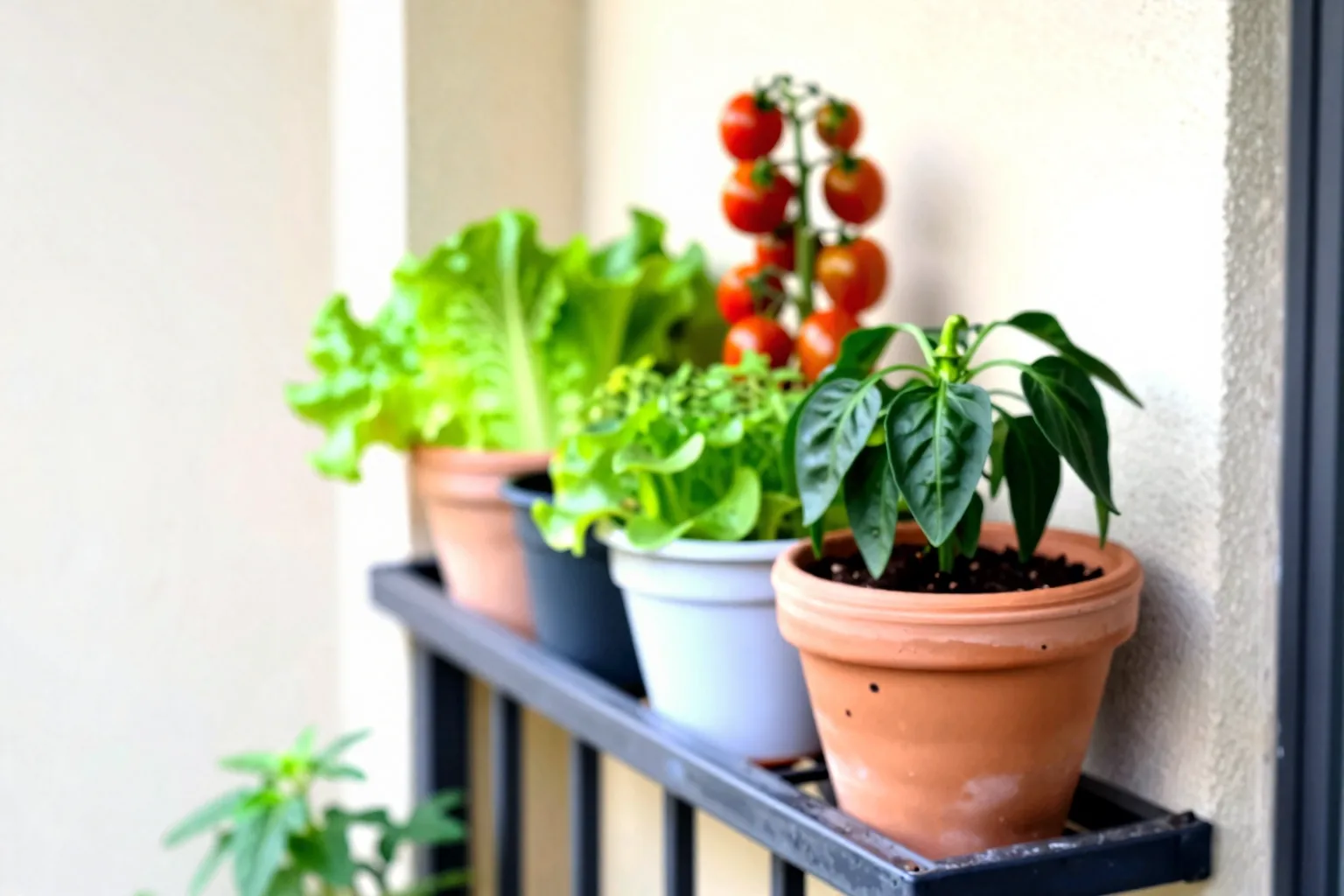
The balcony test: sun, wind and weight before a single seed
First, audit direct sun. Bright sky through an open doorway is not the same as sunlight falling on leaves. Watch the proposed growing spot through a representative day and note when a clear beam reaches the pot, when it disappears behind a neighbouring building, and whether a railing or wall casts a moving shadow. A phone photograph taken at breakfast, midday and mid-afternoon can reveal a pattern that is easy to miss while you are standing there.
For tomatoes, peppers and cucumbers, I would plan around 6–8 hours of direct sun if you want a useful crop rather than a decorative plant with a few fruits. Leaf lettuce, scallions and Swiss chard are more forgiving with roughly 3–5 hours, although their growth can still slow in deep shade. Peas and roots sit between those groups: they can manage a less intense position, but low light usually stretches stems or reduces the amount you pull from the pot.
With only one or two usable hours of direct sun, choose leaves first. Lettuce, scallions and chard are sensible bets; radishes may produce small roots if the spot is bright for the rest of the day, but tomatoes, peppers, cucumbers and potatoes are poor uses of that square footage. Fruiting plants need enough light to make and fill flowers. A plant can remain green in weak light without having the energy to repay its pot.
Then check wind. An exposed balcony dries a pot from the surface and from the foliage, while a tall plant or trellis shifts the centre of gravity above the rim. A bush bean may tolerate a short support, but a cucumber on a large mesh panel can act like a sail. Put supports against a wall or railing only where the structure and local rules permit it, and anchor the pot itself rather than assuming the plant will hold everything upright.
Weight deserves the same attention as sunlight. Potting mix becomes heavier as it takes up water, and the container, saucer, cage and mature plant all add to the load. Place a filled container before you water and plant it; moving a wet 20–30 litre pot across a balcony is an avoidable strain on you, the pot and the paving. Before grouping several large tubs overhead, check local balcony live-load guidance and make sure drainage water cannot run onto a neighbour's space or damage the surface below.
Every pot also needs an unobstructed drainage hole. Use a saucer to catch runoff, but empty it after the pot has finished draining rather than leaving the container standing in water. The aim is a root zone that holds moisture while excess water can leave, not a sealed bowl.
A 12-crop container chart: pot size, sun and harvest window
Use this as a shopping-aisle specification, not a promise. The container depth is a starting point for the crop and variety named; the mix volume is the useful volume around the roots, not the size printed on a decorative pot's rim. First harvest means the first reasonable thing to pick, such as baby leaves or new potatoes, rather than the largest possible mature crop.
| Crop | Container starting point | Preferred direct sun | Support | Approximate first harvest | Main pot limitation |
|---|---|---|---|---|---|
| Lettuce | 15–20 cm (6–8 in) deep; 3–5 L (0.8–1.3 gal) | 3–5 hours | No | 4–8 weeks | Heat and drying |
| Radishes | 15–20 cm (6–8 in) deep; 3–5 L (0.8–1.3 gal) | 3–6 hours | No | 3–6 weeks | Roots turn pithy if left too long |
| Scallions | 15–20 cm (6–8 in) deep; 3–5 L (0.8–1.3 gal) | 3–6 hours | No | 6–10 weeks | Weak light and crowding |
| Carrots | 25–30 cm (10–12 in) for short types; 30–40 cm (12–16 in) for long types | 4–6 hours | No | 10–14 weeks | Obstructions and compact mix |
| Beets | 20–25 cm (8–10 in) deep; 5–10 L (1.3–2.6 gal) | 4–6 hours | No | 7–10 weeks | Crowding reduces root size |
| Swiss chard | 20–25 cm (8–10 in) deep; 5–10 L (1.3–2.6 gal) per plant | 3–6 hours | No | 6–10 weeks | Dry mix and depleted nutrients |
| Peas | 20–25 cm (8–10 in) deep; 8–12 L (2.1–3.2 gal) | 4–6 hours | Yes | 8–12 weeks | Heat shortens the cool season |
| Bush beans | 25–30 cm (10–12 in) deep; 10–15 L (2.6–4 gal) | 5–8 hours | Short support helps | 7–10 weeks | Fast drying during flowering |
| Compact cucumbers | About 30 cm (12 in) deep; 15–25 L (4–6.5 gal) | 5–8 hours | Yes | 8–12 weeks | High water demand and wind |
| Cherry tomatoes | 20–30 L (5–8 gal) per compact or determinate plant | 6–8 hours | Cage or stake | 10–14 weeks | Root volume, feeding and heat |
| Peppers | 10–15 L (2.6–4 gal) per plant | 6–8 hours | Optional stake | 10–16 weeks | Temperature swings and slow filling |
| Potatoes | 30–40 cm (12–16 in) eventual depth; wide container | 5–8 hours | Container must stay stable | 10–14 weeks for new potatoes | Volume-to-harvest trade-off |
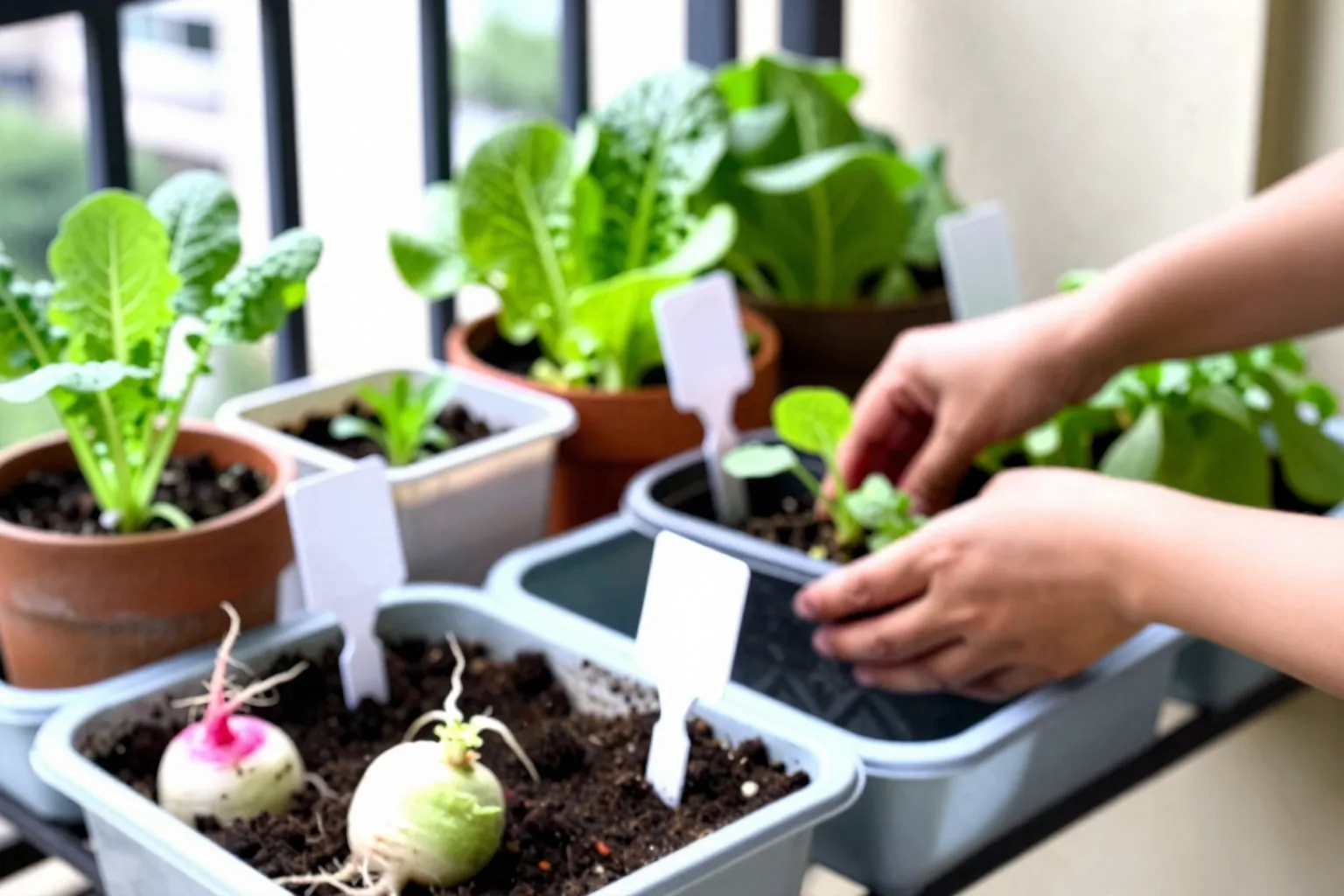
The figures shift with variety, spacing, temperature, harvest size and whether you sow or transplant. A mini cucumber is not the same plant, in practical terms, as a full vine in a 10 litre pot. If a packet gives a different mature size, use that information to adjust the container rather than forcing the crop into the smallest listed volume. For a reusable way to check your shopping estimate, keep How Much Potting Mix Does a 5-Gallon Bucket Hold? A Container Volume Chart beside your list.
For a second opinion on pot depth and feeding, compare the packet with public extension guidance on container vegetable pot depth and feeding. Guidance can help with the broad range; the balcony's wind and the variety's mature size decide where inside that range you should land.
Quick wins in shallow pots—lettuce, radishes and scallions
A 15–20 cm (6–8 in) trough can produce more useful food than a deep pot occupied by one undersized tomato. Fill it with a loose potting mix, leave the surface a couple of centimetres below the rim, and sow only part of the space at one time. Re-sowing a short section every two or three weeks gives you a succession instead of one glut followed by an empty container.
Lettuce
Choose loose-leaf or baby-leaf varieties if the pot is small. Pick the outer leaves when they are large enough for a meal and leave the central growing point intact. In warm weather, lettuce may stretch upward, develop a raised centre and become sharper-tasting. At that stage, harvest what is usable and sow a cooler replacement rather than waiting for a perfect head that may never form.
Radishes
Radishes are quick because the edible root is harvested young. Pull one test plant when the shoulder at the mix surface looks rounded and firm. If the root is left through heat or after it has reached its useful size, the inside can become hollow, dry or spongy even while the leaves remain impressive. Uneven moisture can also make the roots split or grow irregularly, so the shallow pot needs checking more often than its depth suggests.
Scallions
Sow scallions in a row or small clumps, leaving enough space for the stems to thicken. Cut leaves a few centimetres above the base when you need them; varieties that retain a living base can push out more foliage, though regrowth is slower when the roots are disturbed. Thin, floppy leaves point me first toward weak light and crowding, then toward a pot that dries before the next watering.
Root vegetables need a straight-sided box: carrots and beets
Root depth is useful only when the mix is loose from top to bottom. A deep but tapered pot can pinch roots near its base, and one lump of bark, stone or compacted mix can make a carrot fork around the obstacle. Choose a straight-sided box or bucket with holes, and use a fine-textured potting mix without large chunks.
The fill-and-thin sequence
- Fill the container nearly to its final level with fine, stone-free mix. Do not plan to add a gravel layer underneath.
- Sow carrots and beets directly. Their young roots are easily bent during transplanting, so direct sowing avoids an unnecessary kink.
- After seedlings emerge, thin them to the spacing required by the chosen variety. Crowded tops can look vigorous while the edible roots remain small.
- Water gently and regularly enough that the root zone does not swing from dusty to saturated. Letting the surface crust harden can interfere with small seedlings.
Short or round carrots fit roughly 25–30 cm (10–12 in) of mix; long carrots need closer to 30–40 cm (12–16 in). Pull a carrot when its shoulder has filled to the size you want, testing one rather than uprooting the whole row. Beets need about 20–25 cm (8–10 in). Their roots can be harvested while young or left to enlarge, but spacing and uninterrupted moisture decide whether they become round and tender or small and woody.
Forked carrots, split roots and misshapen beets are not mysterious container problems. Look for the physical interruption: compacted mix, a hard object, roots packed too tightly, or a dry spell followed by a flood of water. Fix the cause in the next sowing; pulling damaged roots will not repair the rest of the crop.
Swiss chard earns its space through repeat harvests
Swiss chard is a useful middle ground between shallow salad crops and demanding fruiting plants. Give one mature plant about 5–10 litres (1.3–2.6 gallons) of mix in a container at least 20–25 cm (8–10 in) deep. Several hours of sun or bright partial shade can produce a steady supply of leaves, although the plant will not fill a household's vegetable drawer from one small pot.
Harvest the outer leaves first, cutting them close to the base while leaving the central leaves growing. Pulling the entire plant ends the repeat-harvest advantage. If plants are crowded, new leaves stay small. Heat and a dry root zone can make leaves tougher or more bitter, while pale growth after repeated watering can point to nutrients leaving the pot or roots struggling in wet mix. Feed according to the product label once the mix's initial charge is being used, and treat the pot as a source of repeated meal additions, not an endless crop.
Use height, not floor area: peas, bush beans and compact cucumbers
Vertical crops can make a small balcony productive, but height does not remove the need for root volume. Peas prefer the cool part of the growing season, beans want warmer conditions, and cucumbers combine a large leaf area with rapid water loss. Give each crop its own container so you can move it, water it and replace it without disturbing a neighbouring plant.
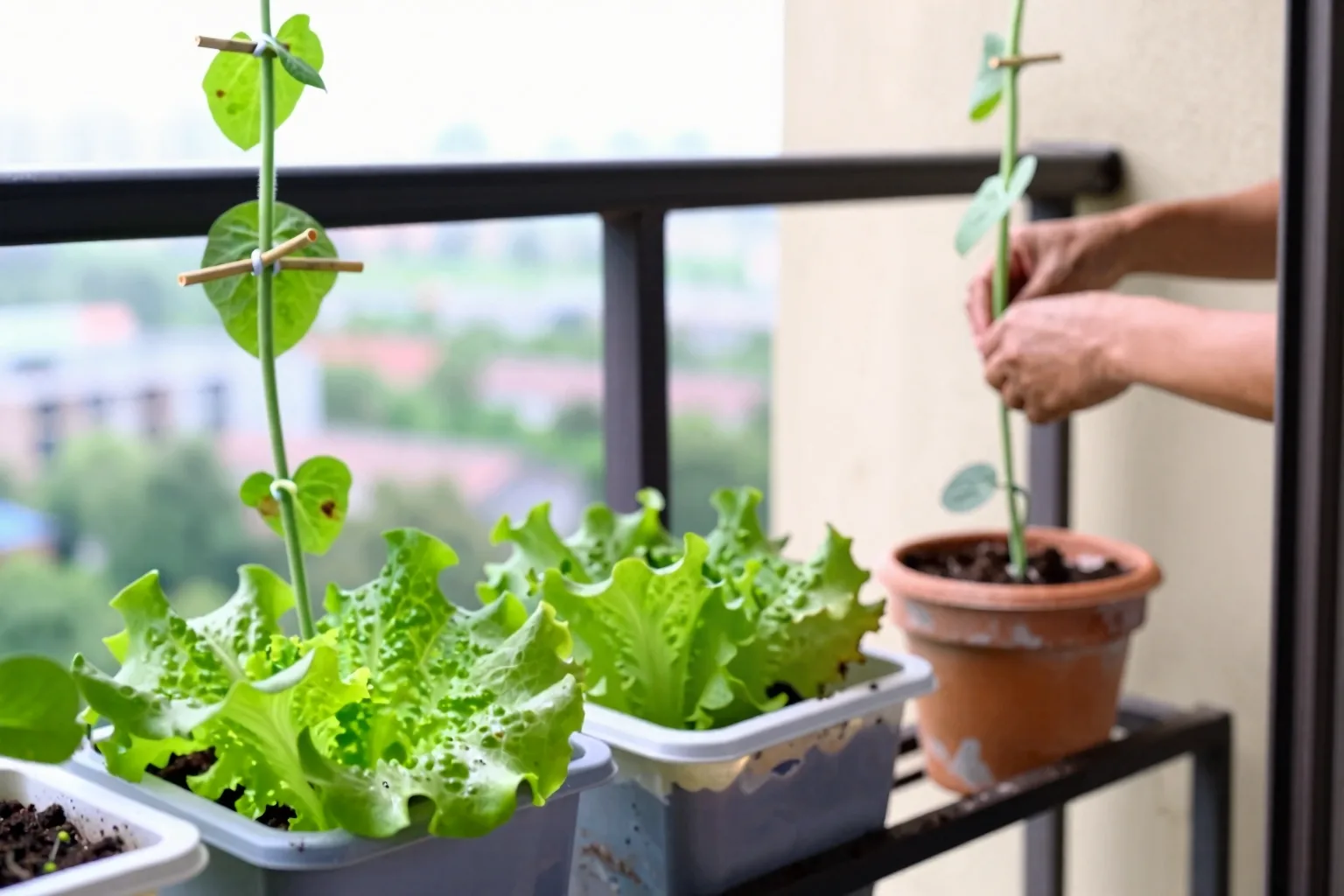
- Choose the right variety. Look for compact, bush, patio or container wording. A full-size cucumber or indeterminate tomato can outgrow the support and the pot even if the seedling label calls it compact at the start.
- Install the support before sowing. Push a trellis or short frame into the empty pot, then test it for wobble. Adding it later risks tearing roots and leaves little room to press the base firmly into the mix.
- Place the container carefully. Put vines at the back or edge of the growing area so their leaves do not shade lettuce, roots or chard. Leave a clear route for stems to climb without crossing a walkway.
- Sow at the packet spacing. A few well-spaced plants usually outperform a crowded tangle in a finite root zone. Thin seedlings while they are small rather than trying to separate established roots.
- Guide stems early. Tie peas and cucumbers loosely or direct tendrils onto the trellis before they become heavy. A bush bean may need only a short cane or mesh to stop a loaded stem flopping across the pot.
Peas can be sown for a cool-season crop in about 20–25 cm (8–10 in) of mix. Their flowers and tender pods suffer once warm weather arrives, so a late sowing may produce foliage without a worthwhile picking window. Bush beans are warm-season plants; keep their 25–30 cm (10–12 in) pot evenly supplied with water once flowers appear, because a small dry container can interrupt pod filling.
Compact cucumbers need around 15–25 litres (4–6.5 gallons) of mix in a pot about 30 cm (12 in) deep. Their broad leaves can lose water quickly in sun and wind, which is why a cucumber can wilt by afternoon even when a smaller-leaved crop beside it looks fine. Check a few centimetres below the surface before watering, and inspect the underside of the pot as well; a wet top layer does not prove that the full root ball is moist.
A trellis is a weight problem as well as a growing aid. Wind catches the frame and the leaves, then twists the pot at its base. A healthy vine in a tipped container is still a failed setup, so choose a low, wide pot where possible and anchor the support before the plant adds its sail area.
Tomatoes and peppers are hungry, sunny pot plants
Tomatoes and peppers are the crops most likely to tempt a small-space grower into an undersized pot. Choose a compact or determinate cherry tomato, meaning a plant that finishes at a more manageable size than a long-running indeterminate type, and allow roughly 20–30 litres (5–8 gallons) of mix per plant. Peppers can begin in about 10–15 litres (2.6–4 gallons) per plant, though a large variety or a hot, exposed balcony earns more volume.
Give both crops 6–8 hours of direct sun where possible. Use a free-draining potting mix, water slowly enough to wet the whole root ball, and let excess drain from the holes. Once the nutrients already in the mix are being used, feed at the rate and interval on the product label. More fertiliser is not a substitute for more root room; salts can accumulate in a small pot when feeding is heavy and watering is too light to flush through.
The failure patterns are easier to read if you inspect the plant and pot together:
- Pale overall growth: depleted mix, weak light or damaged roots can all reduce green colour. Check light and moisture before increasing feed.
- Flowers dropping without fruit: temperature stress, sudden drying or a plant carrying more flowers than its conditions can support are plausible starting points. Look at the weather and the root-zone moisture rather than blaming pollination immediately.
- Split cherry tomatoes: fruit skin can stretch after a dry period followed by heavy water uptake. More even moisture is the practical correction, not a promise that every split fruit can be prevented.
- Blossom-end rot: the dark, sunken patch at the bottom of a tomato or pepper is linked to a water-transport problem in the developing fruit. Adding calcium alone may not solve it if roots are dry, damaged, waterlogged or exposed to excess salts; steady root conditions come first.
My judgment call is to grow one well-supported tomato rather than three cramped plants if the balcony has only room for one deep pot. A single plant can still give a satisfying succession of fruit, while several undersized plants compete for the same water and feeding reserve. If the site gets less than about six hours of direct sun, I would spend that container on chard, scallions or a root crop instead.
Potatoes are a volume problem disguised as a depth problem
A tall, narrow planter does not automatically make a good potato container. Tubers need usable horizontal space, the mix must stay moist without becoming stagnant, and the plant needs enough leaf area to turn light into carbohydrates for the underground crop. Start with a wide grow bag or container with drainage, about 30–40 cm (12–16 in) of eventual mix, and roughly 20–30 litres (5–8 gallons) per seed potato as a practical starting point.
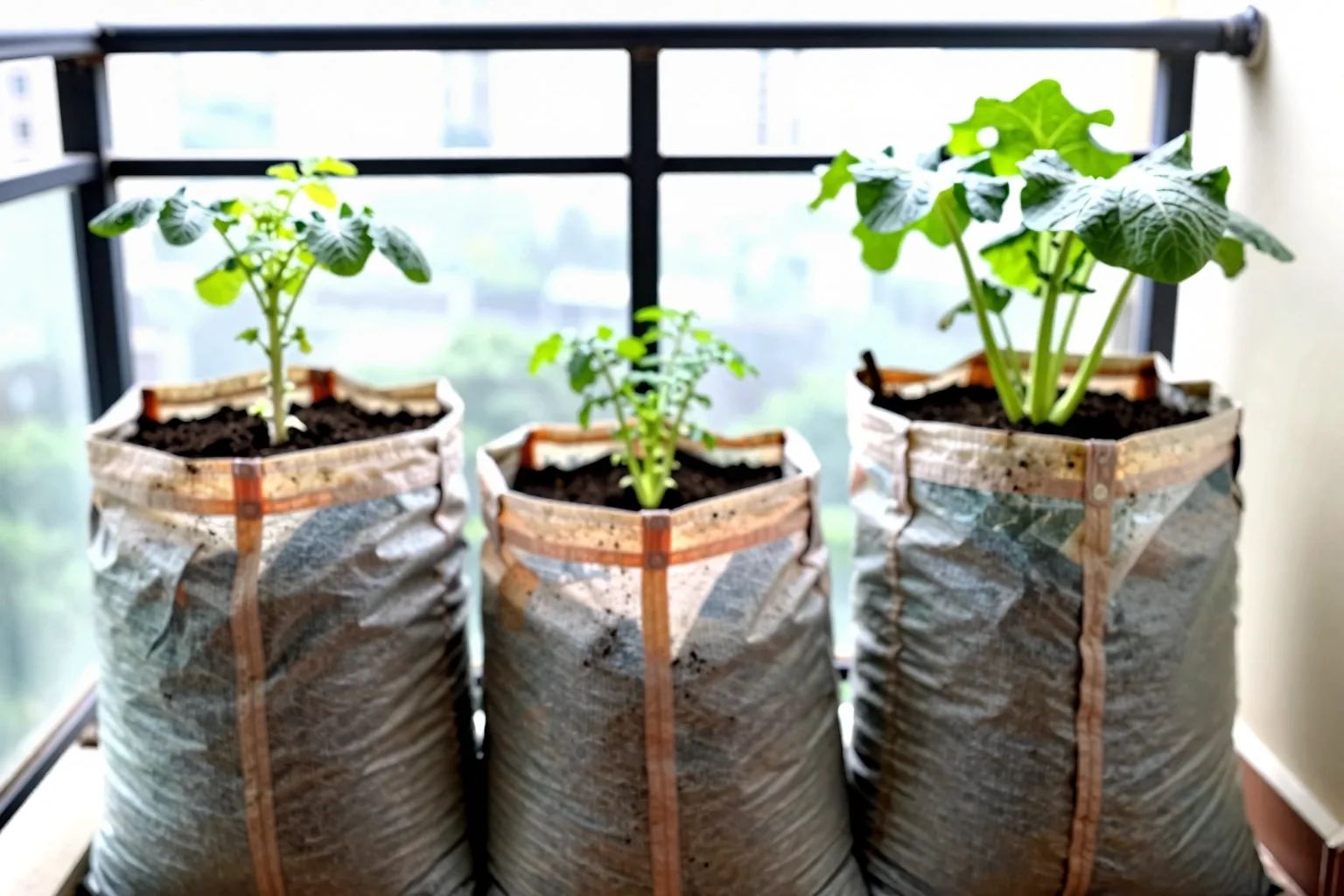
The planting order matters:
- Add an initial 10–15 cm (4–6 in) layer of potting mix.
- Place certified seed potatoes with the eyes facing up, leaving room between them for stems and roots.
- Cover with another layer of mix and water it through gently.
- As stems emerge, add more mix around them in stages while leaving the growing tips exposed.
That process is called hilling: adding mix around emerging potato stems so developing tubers remain covered. Tubers exposed to light can turn green, and green portions are not something to eat. Hilling also gives the plant more covered stem from which it may form tubers, but it does not turn a small pot into a field. In a narrow container, extra layers can simply reduce airflow and make watering uneven.
New potatoes are harvested before the plant reaches full maturity. Wait for mature tubers until the foliage naturally yellows and dies back, then let the mix dry somewhat before emptying the container so the skins are less easily scraped. A healthy hilled plant can plausibly provide new potatoes in 10–14 weeks; that is a partial-size harvest window, not a claim that mature tubers will be ready at the same time.
Turn the chart into a small-space planting plan
Let the sun audit choose the crop group:
- One or two hours of direct sun: use a shallow trough for leaf lettuce and scallions, or a deeper pot for Swiss chard. Expect slower growth and smaller harvests, and reserve the brightest edge for anything you are testing.
- About four to six hours: leafy crops, roots, peas and some bush beans are reasonable choices. Radishes and beets can fit well here; peas should be timed for cool weather rather than pushed into summer heat.
- About six to eight hours: this is the useful range for compact tomatoes, peppers, cucumbers and potatoes. Even here, a wind-exposed, fast-drying pot can reduce the harvest compared with a sheltered one.
I would begin with four containers rather than trying to fit all 12 crops onto a small balcony: one 20–30 litre (5–8 gallon) pot for a tomato or pepper, one 15–25 litre (4–6.5 gallon) pot with a stable support for a cucumber or seasonal pea and bean, one shallow salad trough, and one 25–30 cm (10–12 in) root box. Put the tall pot and trellis at the back or outer edge, with the low trough in front. If you have only one or two hours of sun, replace the fruiting pot with chard and leave the cucumber, tomato, pepper and potato for another site.
Separate pots are useful because crops with different root depths and water demands can be managed differently. A cucumber may need attention while a carrot box is still adequately moist. A tomato cage can shade a lettuce trough even when the pots are not touching. For the low-light choice, The Best Vegetables for a Balcony With Only Two to Four Hours of Sun is a better companion than a generic list of sun-loving vegetables.
Keep wet-container weight in mind as you arrange the plan. Use saucers to protect the surface below, empty them after drainage, and keep the heaviest pot where it can remain for the season. In hot or windy weather, use How to Water Container Vegetables in Hot, Windy Weather as a separate check rather than following a calendar watering rule.
Set-up order and the first seven days
Do the physical setup in this order:
- Confirm the container has drainage holes and place the saucer where runoff will not stain or damage the surface.
- Choose a quality potting mix rather than garden soil. Garden soil can compact in a pot, reducing the air spaces roots need.
- Put the empty container in its final position, then fill it. Do not wait until it is wet and planted to discover that it is too heavy to move.
- Install cages, stakes and trellises before sowing or transplanting. Roots and stems have more room to establish when the support is already stable.
- Sow or transplant at the depth and spacing for the variety. Label the crop, variety and planting date so a slow seedling is not mistaken for a failure too early.
- Water slowly until excess appears at the drainage holes. This wets the whole root zone and shows that the holes are functioning.
- For the next week, check below the surface with a finger or moisture probe, observe the pot's weight, and look for stretched seedlings that are reaching for light.
Do not add stones or gravel to the bottom as a drainage cure. The change in texture can leave a wetter zone sitting above the layer, while also taking away root volume. Why Gravel in the Bottom of a Pot Does Not Improve Drainage explains the perched water table in plain terms and is worth reading before you fill the next container.
Before buying another plant, press a finger a few centimetres into each pot, check whether the support rocks when you push it gently, and look underneath for blocked holes. Those three checks will tell you more about the first week than a fixed watering schedule.