30 Best Vegetables to Grow in Buckets: Who They're For
A US 5-gallon bucket holds about 19 litres, but the roots don't get all 19: after leaving headroom for watering, a typical setup offers closer to 17–18 litres of usable mix. If a balcony gets only 1–2 hours of direct sun, lettuce, spinach, chard, radishes, scallions and garlic greens are better first bets than a tomato, cucumber or zucchini.
The bucket test comes before the seed packet
I don't treat the 30 vegetables below as a universal ranking. I treat them as a matching exercise: the best crop is the one whose roots, light needs and maintenance fit the bucket and the person looking after it.
Four filters decide whether a bucket crop is worth the space:
- Usable volume: the loose potting mix available after you leave headroom below the rim.
- Mature root depth: whether the crop needs a shallow layer, a deep column or a broad mass of mix.
- Direct sun: unfiltered sunlight landing on the leaves, not merely a balcony that looks bright.
- Maintenance: whether you can water, feed, prune, harvest or anchor the plant through its season.
The order matters. Choose a clean container first, make drainage holes second, fill it with a lightweight potting mix third, and only then choose a plant that fits. Buying a large seedling and searching for a bucket afterwards is how a modest sizing mistake becomes a daily watering problem.
For volume maths, see How Much Soil Does a 5-Gallon Bucket Hold? Litres, Depth and Usable Volume. For mix structure, see The Best Potting Mix for Container Vegetables: Drainage Without Gravel. Before buying seed, use How to Measure Balcony Sunlight Before Buying Plants, then keep How Often to Water Vegetables in Containers in Heat, Wind and Shade nearby once the weather turns hot.
A practical bucket should have several drainage holes spread across the base rather than one opening in the middle. When the container sits on a flat surface, more than one exit gives water a route out if part of the base is pressed against the floor. The mix should look damp after watering, not glossy with standing water. A bucket without drainage is a water reservoir wearing a garden label.
For edible crops, a new container sold for food growing or horticultural use is the straightforward choice. A reused bucket that held paint, solvents, pesticides or an unknown chemical is not a sensible place to grow food; check government food-safety guidance on food-contact plastics if the material or previous use is unclear.
My one-bucket rule for this list is simple: give one large fruiting, climbing or heading plant its own bucket. Small greens, radishes, scallions and baby roots can share when you thin them to the spacing their mature size needs. Several seedlings in a pot do not become several harvests if their roots spend the season competing for the same small reservoir of water.
Tomatoes, peppers, cucumbers, eggplant and sweet potatoes appear here because people buy and cook them as vegetables, even though some are botanical fruits. The kitchen category is useful for a bucket shopping list; the plant's root and light requirements still decide the container.
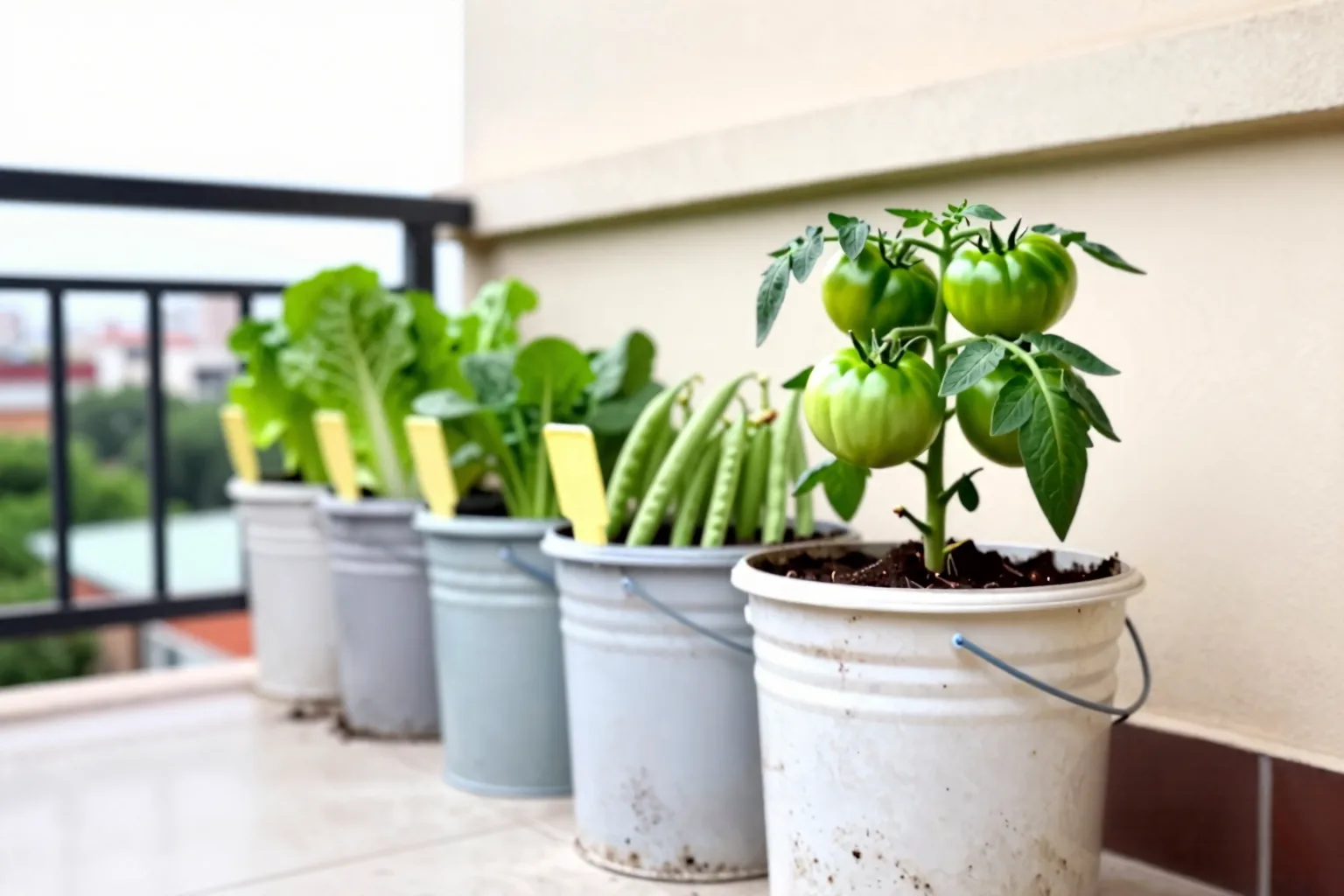
A 30-vegetable shortlist, matched to the person and the pot
The table uses the smallest practical starting point I would consider, not the size that makes every crop easy. Depth means the vertical depth of loose mix available to roots. A 5-gallon bucket is often a minimum for a warm-season crop, while a 10-gallon container gives more moisture buffer and room for roots. Bucket shape matters too: a narrow, tall vessel can meet a depth figure while still offering too little surface area for a broad plant.
| Vegetable | Smallest practical bucket | Who it's for | Main limitation or harvest reality |
|---|---|---|---|
| Lettuce | 2–3 gal (8–12 L); 15–20 cm (6–8 in) deep | First-time growers and part-sun balconies | Outer leaves or a small head; heat shortens the useful window. |
| Spinach | 2–3 gal (8–12 L); 15–20 cm (6–8 in) | Cool, bright sites with modest space | Repeated leaves in cool weather; heat encourages flowering. |
| Swiss chard | 3–5 gal (11–19 L); 20–25 cm (8–10 in) | Growers wanting repeat harvests | Pick outer stalks; a mature plant occupies more surface than its depth suggests. |
| Kale | 3–5 gal (11–19 L); 20–25 cm (8–10 in) | Patient beginners and cool-season growers | Harvest leaves rather than expecting a single large head. |
| Mustard greens | 2–3 gal (8–12 L); 15–20 cm (6–8 in) | People who like fast, peppery leaves | Leaves become hotter and plants may flower in warm conditions. |
| Arugula | 2–3 gal (8–12 L); 15–20 cm (6–8 in) | Small balconies and quick cut-and-come-again harvests | Cut above the crown; heat can make the leaves sharp and the plant bolt. |
| Bok choy | 3–5 gal (11–19 L); 20–25 cm (8–10 in) | Cool-season growers willing to watch temperature | A small head or baby leaves; heat can send it to flower before heading. |
| Collard greens | 5 gal (19 L); about 25–30 cm (10–12 in) | Growers with room for one broad plant | Long-lived outer-leaf harvest, but the canopy needs width. |
| Radishes | 2–3 gal (8–12 L); 15–20 cm (6–8 in) | Children, impatient beginners and short seasons | A small root crop; crowding gives leafy tops and poor roots. |
| Scallions | 2 gal (8 L); 15–20 cm (6–8 in) | Low-space cooks and windowsill growers | Useful seasoning harvests; bulbs stay small if crowded or light-starved. |
| Garlic | 2–3 gal (8–12 L); 20–25 cm (8–10 in) | Growers happy to use garlic greens | Greens are the reliable small-space target; full bulbs need time and sun. |
| Carrots | 3–5 gal (11–19 L); 25–30 cm (10–12 in) | People who can provide loose, stone-free mix | Use short varieties for buckets; long roots need more depth. |
| Beets | 3–5 gal (11–19 L); 20–25 cm (8–10 in) | Growers wanting edible roots and leaves | Thin seedlings; crowded plants make small, misshapen roots. |
| Turnips | 3–5 gal (11–19 L); 20–25 cm (8–10 in) | Cool-season growers wanting a quick root crop | Harvest size depends on thinning, temperature and variety. |
| Potatoes | 10 gal (38 L); 30–45 cm (12–18 in) | Growers with floor space and patience | Needs staged hilling; the bucket is a fun crop, not a guaranteed bulk supply. |
| Sweet potatoes | 10–15 gal (38–57 L); 25–35 cm (10–14 in) | Warm, sunny sites with room for vines | Needs a broad container, warmth and a long season. |
| Onions | 3–5 gal (11–19 L); 20–25 cm (8–10 in) | Sunny growers willing to wait for bulbs | Bunching onions repay small pots more quickly than large storage bulbs. |
| Peas | 5 gal (19 L); 20–30 cm (8–12 in) | Cool-season growers with a trellis | Small but worthwhile pickings; vines need support and cool conditions. |
| Beans | 5 gal (19 L); 20–30 cm (8–12 in) | Sunny balconies with a deliberate bush or pole variety | Pole beans need a tall support; bush beans need spacing and steady picking. |
| Tomatoes | 5 gal (19 L); about 30 cm (12 in), with 10 gal (38 L) more forgiving | Sunny growers who can stake and water often | One compact plant per bucket; large vining plants outgrow small pots. |
| Peppers | 5 gal (19 L); 25–30 cm (10–12 in) | Sunny growers wanting one compact warm-season plant | One plant is the sensible starting count; fruiting slows with low light. |
| Eggplant | 5 gal (19 L); about 30 cm (12 in), with 10 gal (38 L) easier | Hot, sunny patios and attentive growers | Needs space, warmth and support if the plant becomes top-heavy. |
| Cucumber | 5 gal (19 L); 25–30 cm (10–12 in) | Vertical growers with a safe trellis point | One compact plant or vine; foliage dries quickly in wind. |
| Zucchini | 10–15 gal (38–57 L); 30–40 cm (12–16 in) | People with a wide, stable patio footprint | Large leaves dominate a balcony; choose a compact variety if available. |
| Okra | 5 gal (19 L); about 30 cm (12 in) | Hot, sunny sites and regular harvesters | Needs strong light and warmth; plants can become tall and wind-prone. |
| Broccoli | 5–10 gal (19–38 L); 25–30 cm (10–12 in) | Cool-season growers with room for one plant | Usually one main head plus possible side shoots, not a continuous leafy crop. |
| Cabbage | 5–10 gal (19–38 L); 25–30 cm (10–12 in) | Growers who can spare a whole bucket for one head | One heading plant takes most of the container's usable space. |
| Brussels sprouts | 10 gal (38 L); 30–45 cm (12–18 in) | Patient growers with a long cool-season window | Occupies the bucket for a long time before a modest harvest. |
| Celery | 5 gal (19 L); 20–25 cm (8–10 in) | Attentive growers who can keep mix evenly moist | Missed watering produces stringy, stressed stalks; it is a high-attention crop. |
| Kohlrabi | 3–5 gal (11–19 L); 20–25 cm (8–10 in) | Cool-season growers wanting a compact swollen stem | Thin plants so the stem has room to develop. |
The central trade-off is easy to miss: volume is not just a root measurement. More mix also slows changes in moisture and nutrient concentration. Losing 1 litre of water from a 19-litre bucket changes the root-zone conditions more sharply than losing the same amount from a 38-litre bucket. That is why a larger container can be easier to manage even when the smaller one technically holds the roots.
The table is therefore a starting specification, not a promise of yield. Use the smallest size for quick greens and short roots when space is tight. Size up warm-season plants whenever the floor area, wind exposure and building load allow it.
Start here if your light is short or your patience is shorter
The easiest bucket crops for a first season are lettuce, spinach, Swiss chard, kale, mustard greens, arugula, bok choy, collard greens, radishes, scallions and garlic. They let you harvest leaves, roots or seasoning before a large plant has occupied the entire container for months.
For planning, the useful working threshold is roughly 3–5 hours of direct sun for productive leafy crops. Fruiting crops deserve a different target: roughly 6–8 hours of direct sun is the planning range for dependable flowering and fruit development. These are working thresholds, not guarantees. Bright reflected light can help a leaf crop look healthy, but it does not replace the energy a tomato, bean or pepper spends making flowers and fruit.
With only 1–2 hours of direct sun, a leafy crop may still grow, but growth is more likely to be slow, thin or loose. Treat that light level as an experiment for greens rather than committing every bucket to a cucumber that may spend the season producing foliage without a useful crop. Measure the site before buying with How to Measure Balcony Sunlight Before Buying Plants; a bright-looking wall can hide a surprisingly short period of direct light.
Lettuce, spinach, mustard greens, arugula, radishes, scallions and garlic greens fit the shallow group of roughly 2–3 gallons (8–12 litres) and 15–20 cm (6–8 inches) of mix. Chard, kale, bok choy and collards are more comfortable closer to 3–5 gallons (11–19 litres), mainly because their leaves occupy more surface and stay productive longer.
Harvesting changes the mathematics. Take the outside leaves from chard, kale, collards and mustard greens while leaving the central growing point intact. Pick lettuce leaves before the plant becomes a crowded, mature head if heat is approaching. Cut arugula above its crown rather than pulling every plant. For scallions, remove a few stems at a time; the bucket stays useful as a seasoning supply rather than becoming a one-day harvest.
For a continuing supply, sow a small batch every 2–3 weeks instead of filling every bucket on one day. That interval is a planning rhythm, not a fixed appointment. Cool weather can delay germination and leaf expansion; warm weather can compress the harvest window and push spinach, arugula or bok choy toward flowering.
The failure modes are visible. Radishes that make a dense forest of leaves but barely swell at the base were usually crowded, light-starved or left too long in warm conditions. Spinach and bok choy can bolt, meaning they send up a flower stalk before making the leaves or head you wanted. A shallow bucket that stays wet may produce yellow, stalled plants because roots need air as well as water.
Match the choice to the person. Radishes and baby greens give quick gratification. Chard and kale suit someone who wants repeat picking rather than one dramatic harvest. Scallions and garlic greens are the low-space seasoning crops for a windowsill or a balcony where a full vegetable plant would be an awkward use of room.
Put the sunniest, safest floor space under fruiting and climbing crops
Peas, beans, tomatoes, peppers, eggplant, cucumber, zucchini and okra earn their place when the site is bright, the support is stable and watering can be checked frequently. Aim for about 6–8 hours of direct sun for this group. A one- or two-hour site is not where I would spend a whole summer waiting for dependable fruit set.
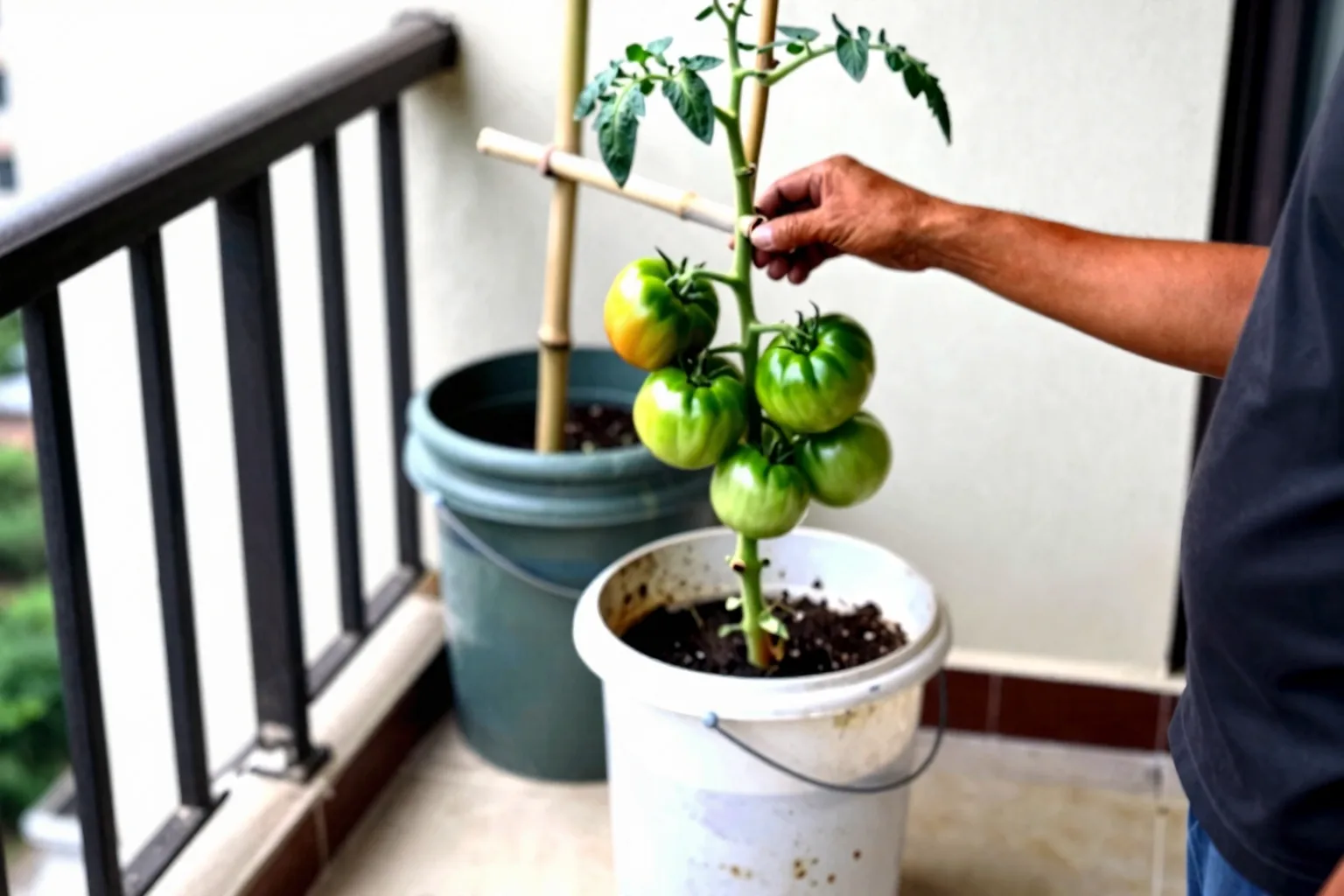
Peas and beans. A 5-gallon (19-litre) bucket gives either crop a workable starting volume, but the variety changes the design. Peas need a support and prefer a cool growing period. Bush beans need room across the surface and regular picking. Pole beans use vertical space efficiently, but their trellis must be tall enough and firmly anchored before the vines become a sail.
Tomatoes. Give one compact or bush tomato its own 5-gallon bucket with about 30 cm (12 inches) of mix. A 10-gallon (38-litre) container is the more forgiving choice for a vigorous plant because it dries more slowly and gives the roots a larger reservoir. Large vining tomatoes are a poor match for a small bucket unless the grower is prepared to prune, stake and water often.
Peppers and eggplant. One pepper in a 5-gallon bucket is a sensible starting count. Eggplant also fits that volume as a minimum, but a 10-gallon bucket is easier to keep balanced once the plant becomes tall or carries fruit. Both crops need warmth and strong light; a plant can remain alive in a dim location without producing the harvest that justified its floor space.
Cucumber. Use one compact plant or vine in a 5-gallon (19-litre) bucket and provide a trellis or other safe climbing point. Put that support in place before planting. Driving a stake through an established root zone later can cut roots precisely when the plant is becoming thirsty and top-heavy.
Zucchini and okra. Zucchini usually deserves 10–15 gallons (38–57 litres) and a wide, stable footprint. Its leaves, not just its roots, are the space problem. Okra can start in 5 gallons but needs strong light, warmth and a container position protected from being rocked by wind.
A tall trellis acts like a sail: the higher the foliage rises, the more leverage wind has on the bucket. A wet 38-litre container is also a substantial load, and the exact weight depends on the mix, water content and container itself. Place it on stable floor space, not perched on a balcony rail, and check the building, landlord or strata rules before concentrating heavy pots in one spot.
Consider a 19-litre bucket on a west-facing balcony. If a sun audit records four direct hours and the owner can water during hot afternoons, a compact pepper is a more sensible trial than a large cucumber. If the same bucket receives seven hours and has a fixed trellis point, cucumber becomes a reasonable project. The bucket did not change; the light and support did.
The return for the extra work is a chance at a more substantial harvest than a few salad leaves, but the downside is sharper failure. Heat raises water loss, wind enlarges the leaf's drying demand, and poor light, irregular moisture or unsuitable temperatures can prevent flowers from setting fruit. Anyone who cannot provide strong sun, stable support and regular checks should start with the leafy section instead.
Use depth, width or patience for the remaining eleven
The final group is not difficult because it is exotic. Each crop simply has one constraint that a bucket makes impossible to ignore: carrots need loose depth, potatoes need staged filling, sweet potatoes need width and warmth, onions need time, brassicas need space and cool timing, and celery needs consistently moist mix.
Carrots, beets and turnips. Root crops expose the mix more honestly than leafy crops do. A stone, compacted patch or abrupt change in texture can make a carrot fork, split or stop swelling. A shallow container can deform a root even when the foliage looks healthy. Short carrot varieties are the sensible bucket choice; long varieties need more depth than the 25–30 cm (10–12 inches) starting figure in the table. Beets and turnips are more forgiving of depth but still need thinning. Leaving every seedling in place produces a full canopy and undersized roots.
Use fresh, loose mix rather than garden soil dug from a bed. The roots need to push through it without hitting clods, stones or a dense layer at the bottom. Fill the bucket nearly to its final level before sowing these crops; unlike potatoes, carrots and beets do not benefit from repeatedly burying their stems.
Potatoes are the bucket crop with the clearest sequence, and the sequence matters more than the bucket's label.
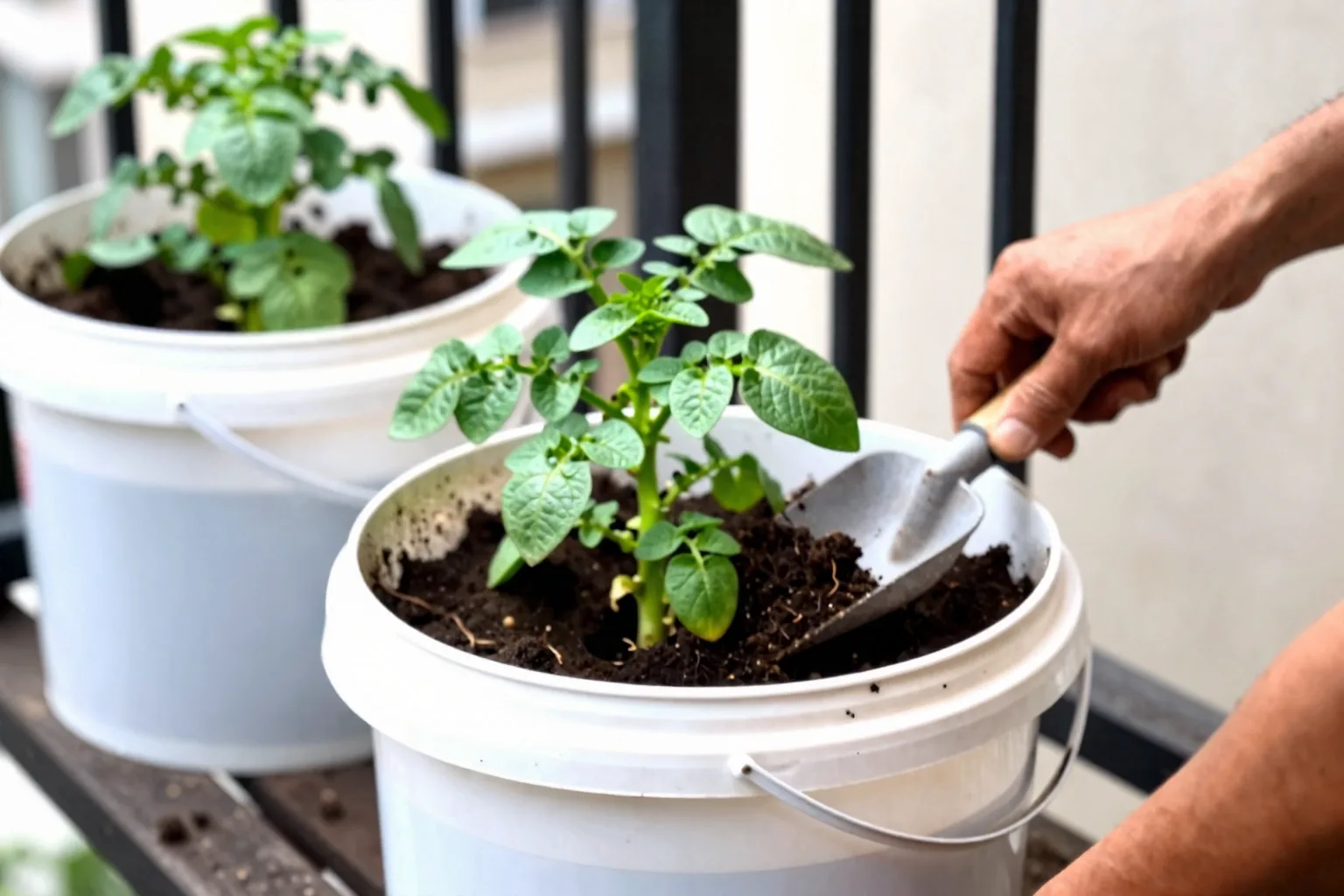
- Choose a 10-gallon (38-litre) container with about 30–45 cm (12–18 inches) of usable depth and proper drainage.
- Start with roughly 10–15 cm (4–6 inches) of potting mix. Set a seed potato, meaning a planting-sized tuber or piece with buds called eyes, on the mix and cover it.
- As the green stem rises, add roughly 5–10 cm (2–4 inches) of mix around the lower stem, keeping the top leaves exposed. Repeat the addition as the plant grows rather than burying the whole plant in one heavy layer.
- Stop when the container is nearly full and allow the plant to finish. When the top growth has completed its season and begins to yellow, emptying the bucket is a practical way to inspect for mature tubers.
This process is called hilling: adding mix around the lower stems as a potato plant grows. It gives developing tubers covered space and keeps them out of light, but hilling is not a magic yield switch. Poor seed pieces, low light, drought, waterlogged mix or a short season can still produce a disappointing bucket of foliage and small tubers.
Sweet potatoes are a different project. They need a broad, warm container of roughly 10–15 gallons (38–57 litres), room for vines to spill or be guided, and a long enough season for underground storage roots to enlarge. A tall narrow potato bucket is not automatically a good sweet-potato container; width and warmth matter more than simply adding height.
Onions suit a sunny grower who can wait. Bunching onions are a better small-bucket return than large storage bulbs because they can be used as green seasoning before a full bulb has formed. Variety and day length change bulb formation, so choose a type suited to the local season rather than assuming every onion will size up in the same container.
Broccoli, cabbage, Brussels sprouts and kohlrabi belong in the cool-season planning group. One broccoli or cabbage plant can occupy most of a 5–10-gallon (19–38-litre) bucket once its leaves spread. Kohlrabi is more compact, but it still needs thinning so the swollen stem has room. Brussels sprouts are for patient growers: the plant occupies its container for a long time before the small sprouts along the stalk become a harvest worth picking.
Seasonal timing matters more for this group than a generic calendar date. Check local agricultural extension or meteorological guidance on frost dates and seasonal planting windows, then count backward from the period when your crop prefers cool or warm conditions.
Celery is the high-attention outlier. Its 5-gallon (19-litre), 20–25 cm (8–10-inch) starting specification is manageable, but the mix needs to stay evenly moist. A missed watering can leave stalks stringy and the plant visibly stressed; repeated wet-dry swings are a poor match for a grower who wants a low-maintenance bucket.
Before buying seed or seedlings, do this physical selection exercise:
- Measure the bucket's inside depth and widest inside diameter, not the outside label.
- Record direct-sun hours at several points during the day rather than judging brightness once.
- Decide whether a trellis, stake or cage can be anchored before planting.
- Choose one crop whose volume and maintenance demand both fit; do not choose a crop that passes one test and fails the other.
That last rule is the useful one to save or share: the smallest bucket that holds roots is not always the smallest bucket that holds a manageable season.
Four bucket questions worth settling before checkout
Can I use a regular 5-gallon (19-litre) bucket for vegetables? Yes, if it is clean, intended for food-growing or horticultural use, and fitted with several drainage holes. Use one bucket for one large crop, and move potatoes, zucchini, large tomatoes and Brussels sprouts to a larger container when possible.
How many vegetable plants can go in one bucket? Base the count on mature size, not the number of seedlings in the tray. One large fruiting or heading plant is the sensible starting count. Several small greens, radishes, scallions or baby roots can share when you thin them so the remaining plants have room.
What vegetables grow with only two hours of direct sun? Try lettuce, spinach, arugula, mustard greens, bok choy, kale, chard, collards, scallions, garlic greens and radishes for modest harvests. Tomatoes, peppers, eggplant, beans, cucumber and zucchini are poor planning choices for that light level.
Should I put gravel in the bottom of a vegetable bucket? No. Use drainage holes and a porous potting mix instead. A gravel layer does not remove the saturated zone that can sit above an abrupt change from fine mix to coarse material, and it takes away root volume.
Before the weekend, place the empty bucket where the plant will live. Measure its inside depth, check that water can leave through the base, and record the direct-sun hours. In a week, choose the crop whose row you can meet without pretending that a small, dim, windy bucket is a miniature garden bed.
Frequently Asked Questions
Can I use a regular 5-gallon (19-litre) bucket for vegetables?
Yes, provided it is clean and intended for food-growing or horticultural use and has several drainage holes; use one bucket for one large crop and move potatoes, zucchini, large tomatoes and Brussels sprouts to a larger container when possible.
How many vegetable plants can go in one bucket?
Base the count on mature size rather than the number of seedlings: one large fruiting or heading plant per bucket, while several small greens, radishes, scallions or baby roots can share a container if they are thinned to prevent competition.
What vegetables grow with only two hours of direct sun?
Try lettuce, spinach, arugula, mustard greens, bok choy, kale, chard, scallions, garlic greens and radishes for modest harvests; tomatoes, peppers, eggplant, beans, cucumber and zucchini are unlikely to crop well with so little direct light.
Should I put gravel in the bottom of a vegetable bucket?
No. Drainage holes and a porous potting mix work better; a gravel layer does not remove the saturated zone above it and reduces the soil volume available to roots.