Growing Vegetables in Pots: 10 Crops That Earn Their Space
A 30 L (7.9 US gal) pot can give a compact cherry tomato a proper season; an 8 L (2.1 US gal) pot may keep the same plant alive but turns every hot, windy afternoon into a watering problem. That is the dividing line in growing vegetables in pots: I want each container to repay its footprint with repeated harvests, compact roots or growth that goes up rather than out.
So this isn't a list of vegetables that can merely be kept alive in a bucket. It is a shortlist for a balcony vegetable garden, patio or rooftop where every pot competes for light, floor space and carrying capacity. The ten crops below are sensible choices, but a balcony with only 1–2 hours of direct sun will favour lettuce, chard, green onions and perhaps radishes over tomatoes, peppers and cucumbers.
Before you buy seeds, run the three-pot test: sun, root volume and weight
I count direct sun as unobstructed light falling on the leaves, not the pale brightness a sheltered balcony receives all day. Fruiting crops such as tomatoes, peppers and cucumbers usually need about 6–8 hours of direct sun for a worthwhile crop. That is a working target rather than an on-off switch: six bright hours in a hot western exposure is not identical to six weak winter hours behind a railing.
With only 1–2 hours, leafy crops can still grow, but I would plan for slower growth and smaller harvests. Tomatoes may make leaves without setting much fruit; peppers may flower and then stop; cucumbers may stretch toward the brightest patch. If you aren't sure how much light reaches the proposed spot, use How to audit balcony sunlight before buying plants before ordering seeds.
A pot also removes the plant's escape routes. In the ground, roots can move into cooler or moister soil. In a container, the available root volume ends at the pot wall, so a warm afternoon can move the plant from adequately moist to visibly stressed much faster. Wind adds to that problem by moving air across the leaves and drying the exposed sides of the container. Every watering that drains away can also carry some soluble nutrients out of the mix.
Then there is the load. The weight comes from the pot, saturated mix, plant, support and water held in saucers or trays. A tall trellis can make a modest container unstable even before a cucumber vine becomes heavy. Before filling anything, check your own balcony load limits and wind-safe placement guidance; building rules and safe locations vary by property.
Here is the three-pot test I use before shopping:
- Count the sun. Watch the proposed location at several points in the day and record the hours when leaves would receive unobstructed light. A sunny window, wall or railing can change the answer across the season.
- Measure real volume. Use the manufacturer's litre figure where it is available. A diameter alone is not enough: tapered pots hold less mix than a cylinder with the same rim width. If you have a similar empty pot, compare it with a measured bucket rather than guessing from the word large.
- Check the position empty. Put the pot where it will live, look for gusts, make sure drainage water has somewhere to go, and confirm that you can reach it without leaning over a railing. Do not wait until a 35 L pot is full to discover that it cannot be moved safely.
A crop earns scarce square footage in one of three ways: it gives several harvests, it stays compact, or it uses a support to turn floor space into height. A vegetable grown for one small picking can still be enjoyable, but it has a tougher claim on a balcony than a plant you can harvest every few days.
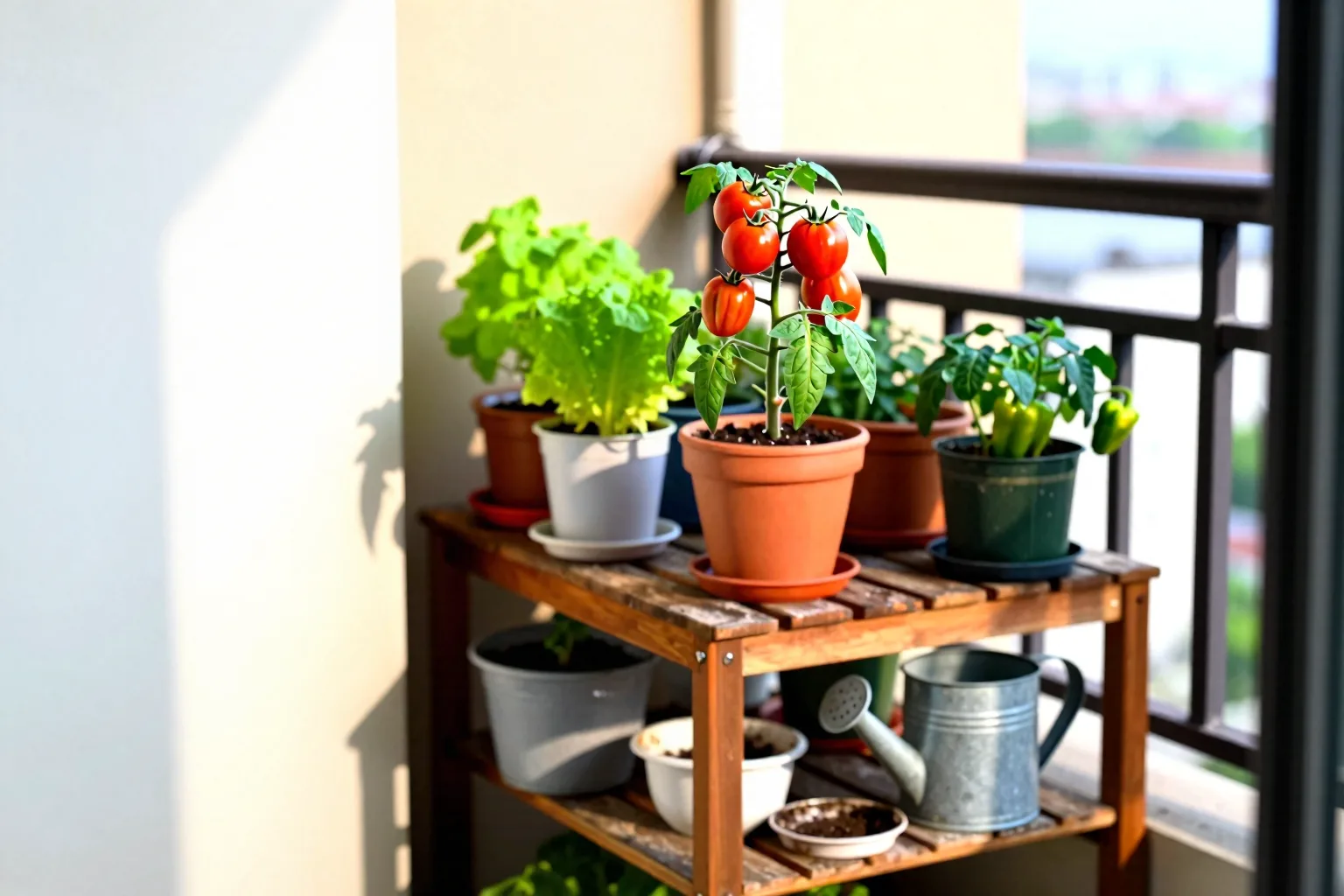
The 10-crop shortlist, with the pot size each one actually needs
The table uses a working volume, not a biological survival guarantee. The low end can work in a mild, partly shaded position with attentive watering; the upper end is the easier shopping choice in sun and wind. The depth column is the minimum useful depth I would look for, not the outside height of a decorative pot with a thick rim or hollow base.
| Crop | Working volume per plant or sowing unit | Minimum useful mix depth | Direct-sun preference | Harvest pattern | Main failure mode |
|---|---|---|---|---|---|
| Compact cherry tomato | 20–30 L (5.3–7.9 US gal) | 30 cm (12 in) | 6–8 hours | Repeated ripe fruit | Dry swings and weak support |
| Compact pepper | 10–15 L (2.6–4 US gal) | 25 cm (10 in) | 6–8 hours | Repeated fruit | Flower drop in cold or heat |
| Bush cucumber | 20–30 L (5.3–7.9 US gal) | 25–30 cm (10–12 in) | 6–8 hours | Frequent young fruit | Thirst and poor support |
| Bush bean | 10–15 L (2.6–4 US gal) | 20 cm (8 in) | At least 6 hours | Concentrated picking period | Leaves without pods |
| Loose-leaf lettuce | 5–8 L (1.3–2.1 US gal) | 15 cm (6 in) | 3–6 hours; brighter shade is possible | Outer leaves, then replacement sowings | Bolting after heat or drought |
| Swiss chard | 10–15 L (2.6–4 US gal) | 20 cm (8 in) | 3–6 hours | Outer leaves over a long period | Crowding and repeated drying |
| Radish | 5–8 L (1.3–2.1 US gal) per sowing unit | 15–20 cm (6–8 in) | 3–6 hours; less means slower roots | One root per plant, sown again | Splitting or pithy roots |
| Green onions | 4–6 L (1.1–1.6 US gal) per sowing unit | 15 cm (6 in) | 3–6 hours | Stems harvested as needed | Thin stems from crowding or shade |
| Short carrot | 15–20 L (4–5.3 US gal) | 25–30 cm (10–12 in) | 4–6 hours | Roots pulled when usable | Forking from stones or compaction |
| Potato | 30–40 L (7.9–10.6 US gal) per seed potato | 30–40 cm (12–16 in) of staged fill | 6–8 hours | One main lifting | Light-exposed tubers or wet mix |
Read the ranges as a choice between effort and forgiveness. A 20 L tomato pot is not equally forgiving as a 20 L potato container, because the tomato carries a leafy, fruiting canopy for weeks while the potato is managed in layers. Likewise, 6 L is generous for a radish sowing but cramped for a pepper. If the label gives only diameter, the litre figure matters more than the marketing word compact. For a second check before you fill the trolley, use How much soil do vegetables need in pots? A litre-by-litre chart.
Give the brightest, heaviest pots to crops that keep paying: tomato, pepper and cucumber
These are the tempting crops in a container vegetable garden because one healthy plant looks productive. They are also the least forgiving group when light, water or support is short. I would reserve the brightest, most sheltered position for them rather than spreading them across every available corner.
Compact cherry tomatoes need volume and a plan for the stem
Choose a compact or determinate cherry type, meaning a plant bred to finish at a more bounded size than a long, continuously extending vine. Give one plant roughly 20–30 L (5–8 US gal) of mix. The 20 L end is a workable lower edge; 30 L is the more relaxed choice because the root volume buffers a sunny day's moisture loss.
Set the stake or cage in place before planting. Pushing a support into a filled pot later can cut through roots that are already occupying the container. Water thoroughly after planting, then let the top few centimetres of mix begin to dry before checking again. Once new growth is active, feed with a vegetable fertiliser according to its label rather than adding a strong dose to a newly planted, waterlogged pot.
A wilted tomato on a hot afternoon is first a moisture and root-volume question, not an invitation to keep adding fertiliser. Erratic watering can show up as limp leaves, cracked fruit or fruit with a dark, sunken patch at the blossom end. If the plant stays wilted after the mix is moist, inspect drainage, roots and heat exposure instead of repeating the watering automatically. Pick cherry tomatoes when they have reached their mature colour and come away with a slight give.
Peppers stay smaller, but they still charge rent for sunlight
A compact pepper can use about 10–15 L (2.6–4 US gal) per plant and a minimum useful depth of about 25 cm (10 in). That is a better space bargain than a full-size tomato, but it still needs a bright position and even moisture. Pick green fruit once it has reached usable size, or leave it longer if you want the variety's mature colour and stronger sweetness.
Flowers dropping before fruit swells is the failure to watch. Cold nights, a sudden heat spell, dry mix and root disturbance can all interrupt flowering. Move the pot only if the new site genuinely improves its conditions; repeatedly shifting a flowering plant can create another stress swing. Keep the mix moist but aerated, and feed after growth resumes.
Bush cucumbers earn space only when they climb
A bush or compact cucumber belongs in about 20–30 L (5–8 US gal), with roughly 25–30 cm (10–12 in) of useful depth. It is space-efficient only if its leaves and fruit use a secure trellis. A standard cucumber allowed to sprawl can occupy more floor area than its label suggests, while a compact vine trained upward can leave the ground below available for walking and watering.
A trellis changes cucumber from floor space into vertical space. Install it before sowing or planting, anchor the lower end so a gust cannot pull the pot over, and check the combined weight of the pot, support and wet foliage. Cucumbers are quick to show thirst: leaves droop, fruit can stop swelling and misshapen young cucumbers may yellow or abort. Harvest young fruit regularly rather than waiting for oversized, seedy cucumbers, and never treat a small pot as a reason to let the mix swing from bone-dry to saturated.
Harvest by the handful, not the head: bush beans, lettuce and Swiss chard
These crops make a strong case for limited space because the harvest can be spread across several days or weeks. A pot that gives a handful of leaves every few days often earns its position more convincingly than a bulky plant that produces one brief crop.
Bush beans suit a sunny 10–15 L (2.6–4 US gal) pot. Sow them directly, and consider a small replacement sowing every 2–3 weeks while the temperature and daylight suit growth. The first pot may produce a concentrated picking period; succession sowing keeps the balcony from becoming empty all at once. Pick pods while they are slim and firm. Heavy nitrogen feeding or insufficient light can produce a leafy plant with few flowers and pods.
Loose-leaf lettuce works in about 5–8 L (1.3–2.1 US gal) and Swiss chard in about 10–15 L (2.6–4 US gal). Both tolerate brighter shade better than fruiting crops, though growth slows as direct light falls. Harvest lettuce and chard from the outside, leaving the central growing point intact. Lettuce that suddenly stretches into a tall flower stalk has bolted; heat, drought and an overmature plant can all push it in that direction. Chard becomes coarse when it is crowded or repeatedly dried, and a collapsed crown usually points to severe stress or a persistently wet root zone rather than a need for more leaves to be removed.
Use shallow pots for the crops you can sow again: radishes and green onions
Radishes and green onions are useful for ledges, windowsills with strong light and the awkward narrow space beside a larger pot. Radishes need roughly 15–20 cm (6–8 in) of mix; green onions need about 15 cm (6 in). The container should have drainage holes and a fine, stone-free mix. Stones and clods interrupt a developing root, while a dense mix gives a short root nowhere to expand.
Sow both directly. Transplanting disturbs the young root that will become the radish, and it is an unnecessary step for onions grown for stems. Thin radish seedlings so neighbouring roots are not forced together; crowded plants make plenty of leaves but miss the round root you wanted. Keep moisture steady. A dry-and-flood cycle is a common route to split or pithy radishes, while cramped green onions stay thin rather than bulbing into useful stems.
Make a small sowing every 2–3 weeks when temperatures and daylight allow. Pull a radish when its shoulder is visible and has reached a useful size. Snip or pull green onions once the stems are large enough for the kitchen, leaving later plants to size up. With only 1–2 hours of direct sun, both can be attempted, but expect a longer wait and smaller harvests.
Depth is the whole bargain with carrots and potatoes
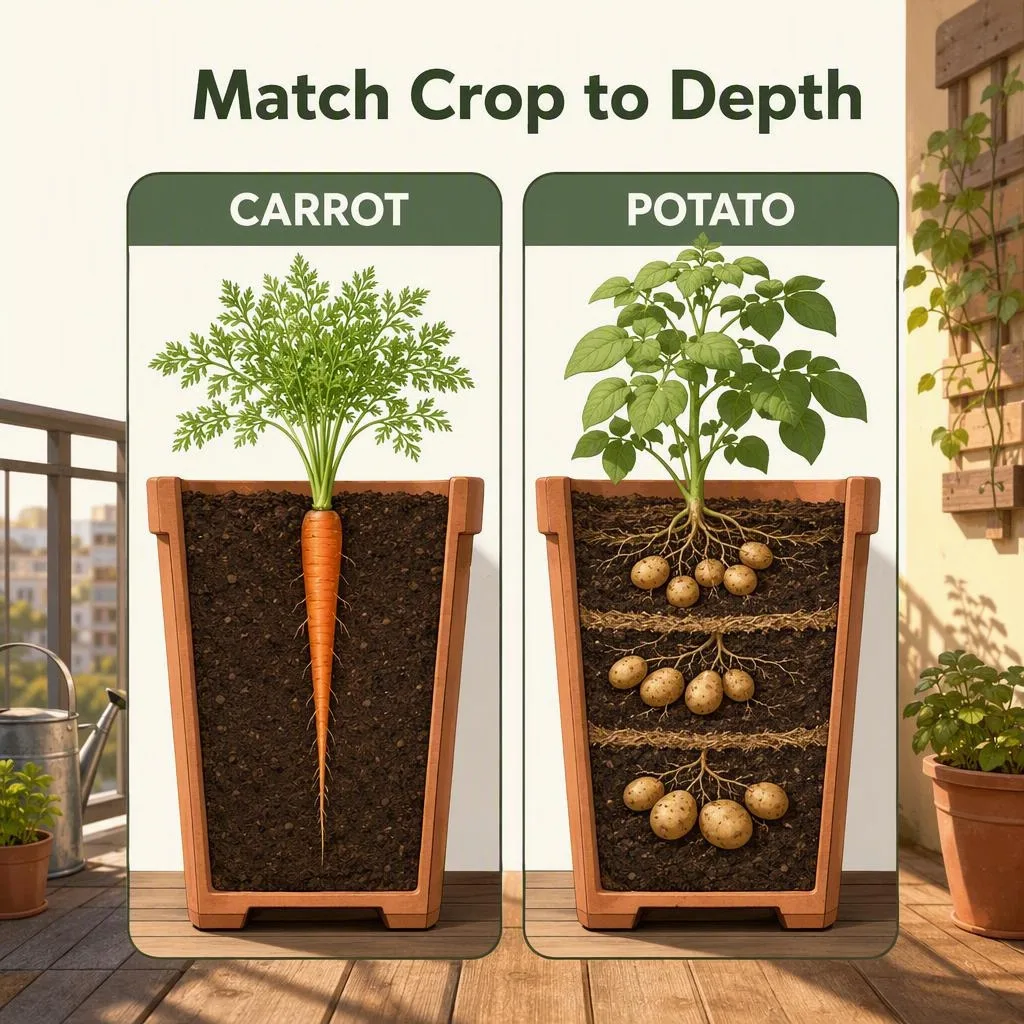
Carrots and potatoes ask for different kinds of container depth. Carrots need an uninterrupted column for a root; potatoes need enough room for a staged planting and developing tubers.
For carrots, choose short or round varieties rather than long types. Use approximately 15–20 L (4–5.3 US gal) of mix with 25–30 cm (10–12 in) of loose, stone-free depth. Sow directly and thin the seedlings. A pot can have a wide rim and still fail if the usable mix stops at 20 cm; the root meets the hard boundary, bends around an obstruction or stays short. Pull a test carrot when the shoulder looks filled out, then decide whether the rest need more time.
For potatoes, allow about 30–40 L (8–10.5 US gal) per seed potato. Begin with 10–15 cm (4–6 in) of mix, set the seed potato on it, and add more mix around the emerging stem as it grows while keeping the leaves above the surface. This process is called hilling: adding mix around the lower stem so developing tubers stay covered and the container's vertical space is used.
Some growers hill once; others repeat the process several times. The useful point is protection and access to more covered stem, not a promise of a larger harvest. Repeated hilling cannot compensate for a pot that stays saturated, a plant with too little light or a seed potato that is crowded. Keep drainage holes clear and don't leave the container standing in a full saucer. Green-exposed potato skins are a sign that tubers have met light and need covering; yellowing foliage can signal maturity, but it can also signal drought, disease or root trouble, so check the whole plant before lifting the pot.
The crops I would leave behind when square footage is the scarce resource
My space-efficiency judgement is not the same as saying these crops are impossible. Zucchini and pumpkins can be fun, but their leaves occupy a broad horizontal footprint for a relatively short harvest window. Corn uses height and a substantial root zone while one container usually gives a small, one-time harvest. Those are weak trades when the balcony has room for only a few pots.
Full-size indeterminate tomatoes also demand more support, root volume and tying than the compact cherry types in the shortlist. Standard cucumbers can sprawl in the same way. If the pleasure of growing one is the point, grow it. If the question is which vegetable earns scarce space through repeat harvests, compact growth or vertical training, I would choose beans, greens, peppers or a compact cucumber first.
Turn the shortlist into a balcony plan you can maintain
Here is a one-container-per-crop plan using about 170 L (45 US gal) of mix in total:
- 30 L (7.9 US gal) for one compact cherry tomato
- 15 L (4 US gal) for one compact pepper
- 25 L (6.6 US gal) for one bush cucumber and its support
- 15 L (4 US gal) for bush beans
- 8 L (2.1 US gal) for loose-leaf lettuce
- 12 L (3.2 US gal) for Swiss chard
- 6 L (1.6 US gal) for radishes
- 6 L (1.6 US gal) for green onions
- 18 L (4.8 US gal) for short carrots
- 35 L (9.2 US gal) for one potato plant
That 170 L is a volume total, not a safe load rating. Wet mix, containers, supports and mature plants add a substantial load, and the distribution matters as well as the total. Spread heavy pots over suitable supports where permitted, keep tall containers out of exposed gusts and check your building, landlord or strata rules before filling them. If you reuse a bucket or decorative pot, consult food-contact safety guidance for reused buckets and glazed ceramics rather than assuming an attractive or previously used container is suitable for edible plants. Treated timber and unknown glazes are not default food-growing materials.
Set the garden up in this order:
- Audit the sun and mark the brightest, most sheltered positions.
- Place empty pots, leaving access for watering and enough clearance for drainage.
- Check every drainage hole. Do not use a gravel layer as a substitute for holes; it takes away root volume without solving a saturated lower layer.
- Fill with a purpose-made container mix, water it so it settles, and top up without packing it hard.
- Install tomato stakes, cages and cucumber trellises before planting or sowing.
- Put fruiting crops in the brightest positions, greens in cooler or partly shaded spots, and radishes or onions in the shallowest containers.
For the medium itself, I would not use garden soil as the main fill. In a finite pot it can compact, lose air spaces and slow drainage; a container mix is designed to hold moisture while leaving pore space around the roots. The practical comparison is in Potting mix versus garden soil for containers.
Maintenance should begin with observation rather than a calendar. Check the top few centimetres of mix and compare the pot's weight when it is freshly watered with its weight as it dries. A small plastic pot in full sun and wind may need checking daily; a large glazed pot in part shade may go several days. In a heatwave, use the decision process in How to water container vegetables in hot weather, because a fixed every-other-day rule ignores pot material, canopy size and wind.
Three questions that can change the shopping list
Can I use garden soil in pots for growing vegetables? Usually not as the main fill. Its structure is suited to an open ground profile, while a container gives it little room to drain and re-aerate after watering. Use a purpose-made container mix, and don't add a gravel layer at the bottom to repair a poor one.
Are grow bags better than rigid pots for vegetables? Neither is universally better. Grow bags are often light and can drain well, but they may dry faster and may not hold a tomato cage or cucumber trellis securely. Rigid pots provide a firmer base but can become heavy when wet. Choose the format that solves your actual problem: carrying weight, stability, drainage or storage.
Can I grow these vegetables indoors on a windowsill? Lettuce, green onions and sometimes radishes are the realistic starting choices if the window gives strong direct light. Fruiting crops usually have less light, airflow and pollination indoors than they need for reliable production, so a sunny balcony is the better place for tomatoes, peppers and cucumbers.
This week, mark the sunniest spots on your balcony and measure the empty pots before buying seed. Put the required litres of mix on your shopping list first; the crop choices become much clearer once the containers, light and load have stopped being guesses.
Frequently Asked Questions
Can I use garden soil in pots for growing vegetables?
Usually not as the main fill: garden soil tends to compact in a finite container, reducing air space and slowing drainage. Use a purpose-made container mix with enough structure to hold moisture without staying saturated.
Are grow bags better than rigid pots for vegetables?
Neither is universally better. Grow bags are often lighter and can drain well, but they dry faster and may not securely hold a tomato cage or cucumber trellis; rigid pots are more stable but can be heavier when wet.
Can I grow these vegetables indoors on a windowsill?
Lettuce, green onions and sometimes radishes are the realistic choices, provided the window gives strong direct light. Fruiting crops usually lack enough light, airflow or pollination indoors to produce well.