Eggshells for Plants: What They Actually Do (and Don’t)
If you're asking whether eggshells for plants fix a weak tomato or yellow leaves, the honest answer is narrow: they add a slow source of calcium carbonate, not a balanced fertilizer. One dry chicken eggshell is roughly 4–6 g (0.14–0.21 oz) and may contain about 1.5–2.3 g (0.05–0.08 oz) of elemental calcium, but that calcium is not all available to roots this week.
That distinction matters even more in a pot. A 10-L (2.6-gal) container has a small root zone, so a handful feels like a large dose; yet the shell can sit in the mix as pale grit while the plant is actually short of nitrogen, the pH is wrong, or a dry-down has interrupted water movement. I use eggshells as a slow recycling material when the diagnosis fits, never as a universal plant tonic.
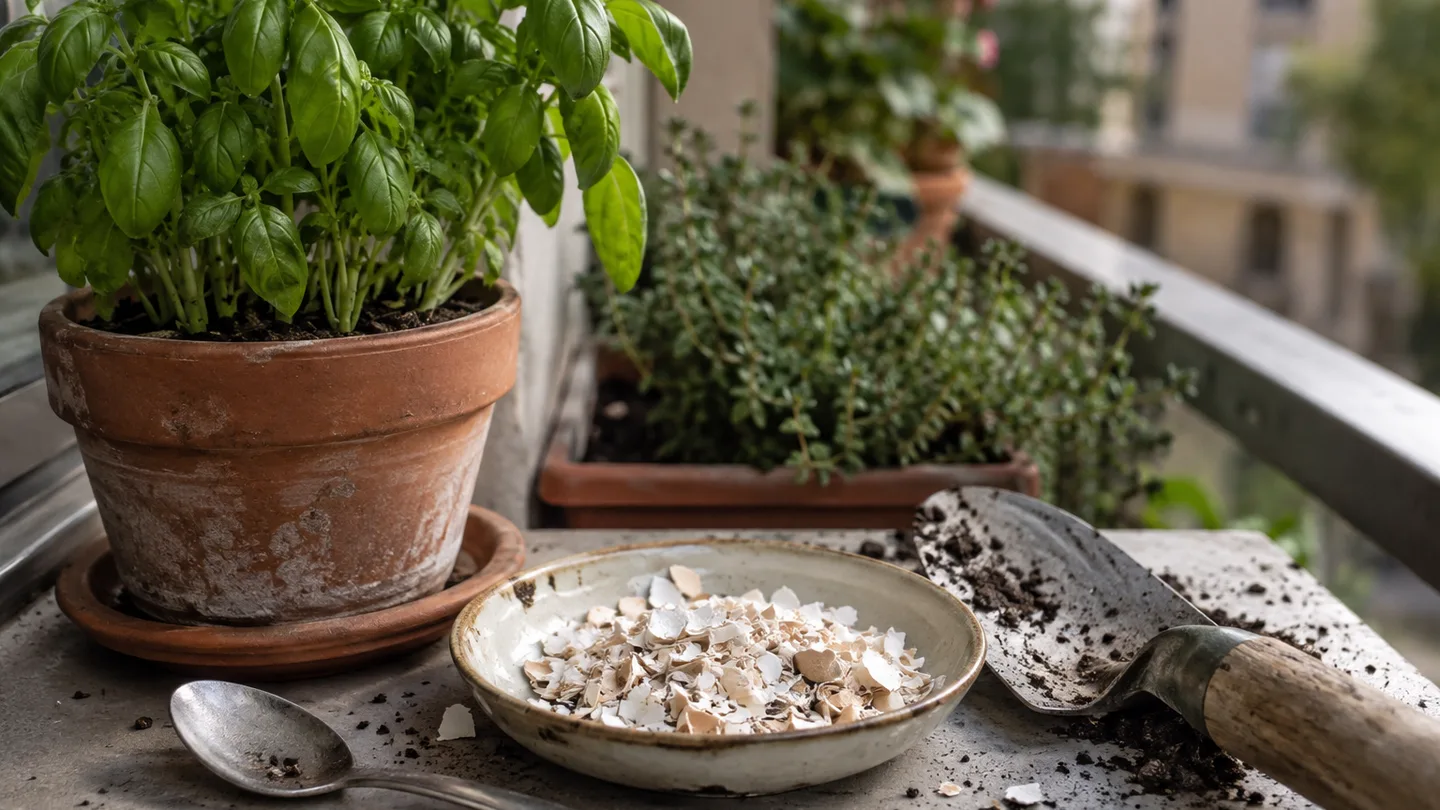
The honest answer: eggshells add slow calcium, not complete plant food
The useful material is mostly calcium carbonate, the same broad chemical family as agricultural lime. It contributes calcium only as the carbonate slowly dissolves. It does not supply a meaningful feed of nitrogen, phosphorus, or potassium, so an eggshell fertilizer is not a replacement for complete plant food.
Three conditions control the release. First, surface area: powder exposes more shell to water than a half shell. Second, acidity: acidic water or potting mix reacts with carbonate more readily than a near-neutral mix. Third, contact and time: shell buried through a damp root zone has more opportunity than shell scattered on a dry surface. Moisture alone does not turn it into a soluble fertilizer.
There is a fourth complication in containers: the mix has a limited volume and a chemistry of its own. If the potting mix already contains a pH-adjusting material, adding more carbonate may do little useful and may push the reaction in the wrong direction. If the mix is acidic, some shell can dissolve, but the reaction also consumes acidity. A pH number without context tells me less than the combination of pH, crop, root condition, and the amendment already present.
So what do eggshells actually do? They can add a slowly dissolving calcium-and-carbonate input, especially after fine grinding and thorough mixing. What don't they do? They don't deliver a quick calcium correction, they don't feed the whole plant, and they don't guarantee that calcium reaches a developing fruit. That last point is why the popular tomato advice is often too simple.
One shell in a 10- or 20-litre pot: the dose, chemistry, and time lag
Household quantities look bigger than they are. Ten dry shells may weigh roughly 40–60 g (1.4–2.1 oz) in total. Using the approximate elemental-calcium range above, that pile represents around 15–23 g (0.5–0.8 oz) of calcium before you account for how slowly or unevenly it dissolves. It is a calculation about total material, not a recommendation to add that amount to every pot.
Take a common balcony case: a 20-L (5.3-gal) tomato pot receives ten shells. The shell pile is only a few dozen grams, but the meaningful question is not whether it looks substantial beside the plant. The question is whether it changes the root-zone chemistry in a predictable way. Without a starting pH, a known mix, and a measured application rate, you cannot treat those shells as an equivalent dose of lime.
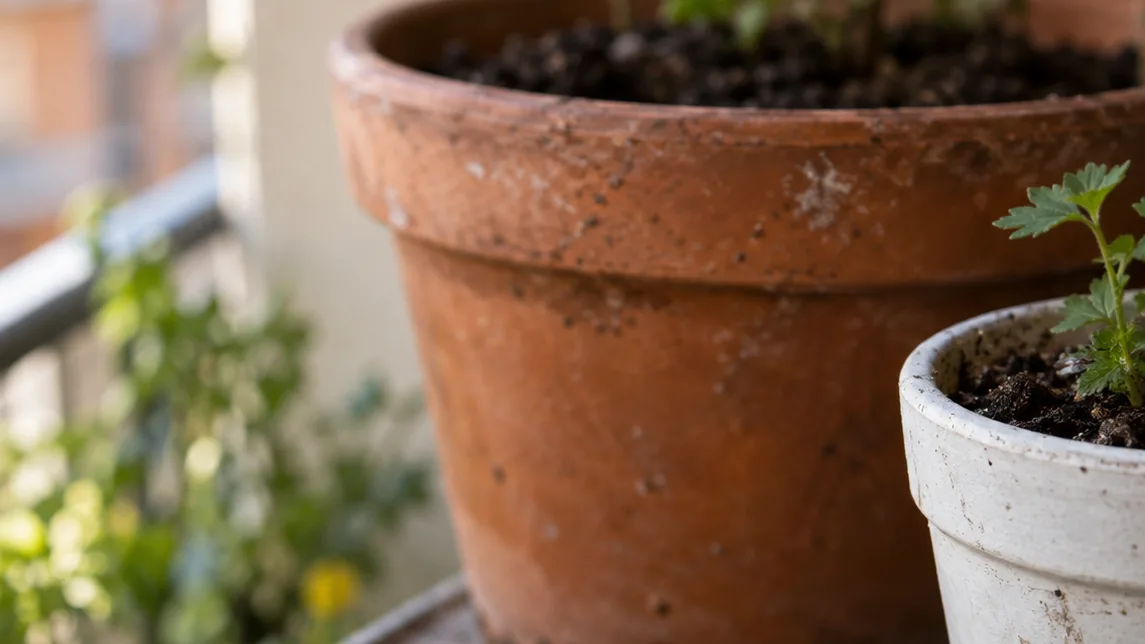
In a 10-L (2.6-gal) pot, the same shells are more concentrated by volume than in a 20-L pot. That does not make them twice as useful; it makes an unintended pH shift easier to create if the shell is fine and the mix is already near the crop's preferred range. In a larger container, the shell may simply remain as slow grit unless acidity and moisture reach it.
The same principle applies when you compare the best container size for vegetables: more volume does not make the plant immune to poor drainage, but it gives the root zone more room for slow changes. Shells cannot compensate for a pot that is too shallow, stays saturated, or dries out before the roots can take up water.
Particle size changes the clock. A shell half has a small exposed edge. A few-millimetre fragment has more edge, and a powder has vastly more surface area. Even powder is not the same as a soluble calcium feed, because each particle still has to react with the mix. This is why a reader can add eggshells in spring and see no obvious change in the plant by early summer without the shell having been useless; visible response and chemical contribution are not the same thing.
When I work through this at balcony scale, my check is deliberately boring: I look at the pot volume, feel the mix at root depth, and ask what the bagged mix was designed to do before I reach for a shell. If the top is dry but the lower root zone is wet, I correct the watering pattern first. If I don't know the pH, I don't use eggshells as a pH correction. I would rather put clean shells into compost than turn an unknown 10-L pot into an unmeasured lime experiment.
The blossom-end rot trap: calcium in the pot is not calcium at the fruit
Blossom-end rot is the trap that makes eggshells sound more useful than they are. On a tomato or pepper, the first sign is usually a pale, water-soaked or tan patch at the fruit end opposite the stem; it can enlarge into a dark, sunken, papery area. The fruit tissue already damaged will not be repaired by adding shell to the pot.
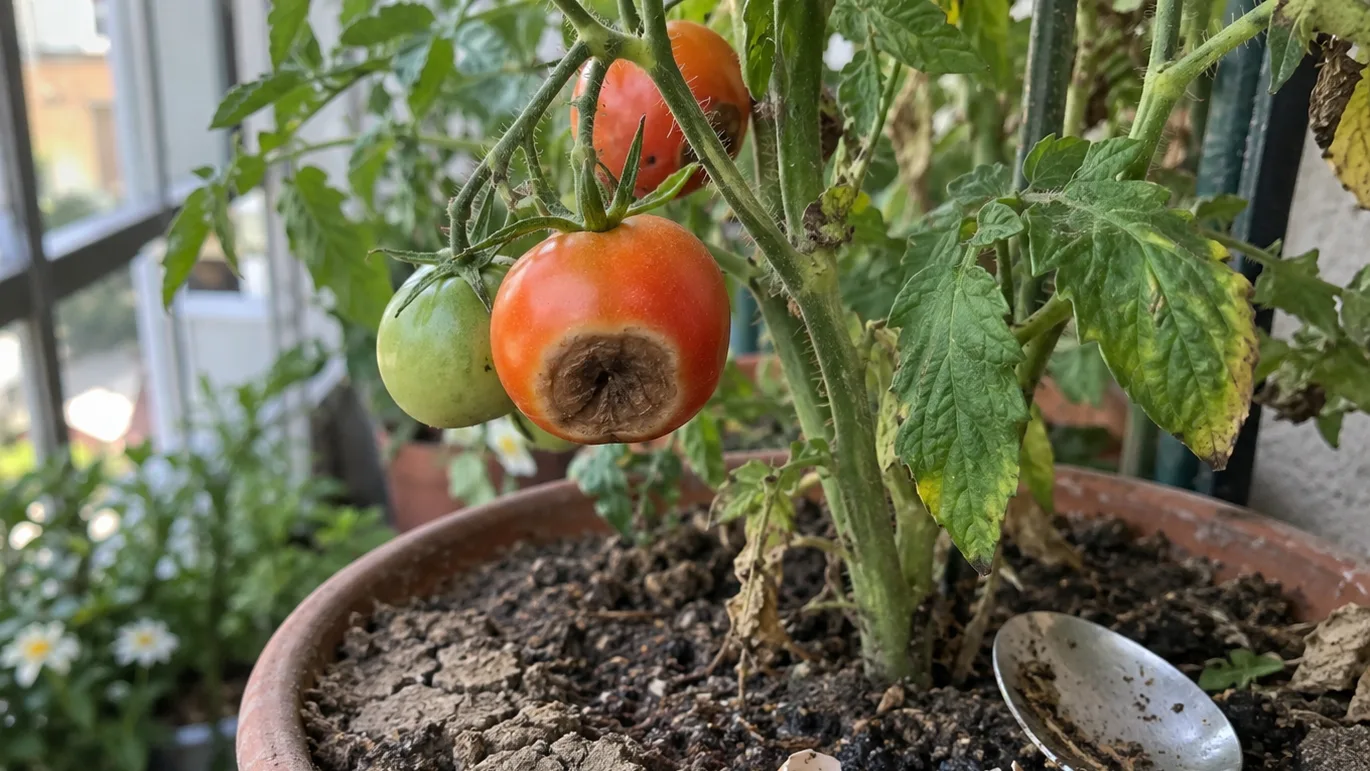
The name points to calcium, but the failure is often calcium delivery rather than an empty pot. Calcium moves with the plant's water stream from roots through stems into growing tissues. A root ball that swings from very dry to saturated, damaged roots in waterlogged mix, or a sudden burst of leaf and fruit growth can interrupt the supply to fast-expanding fruit even when calcium is present in the container.
If you're troubleshooting blossom end rot, this order keeps the symptom from dictating the treatment:
- Check moisture below the surface. Push a finger 2–3 cm (about 1 in) into the mix, close to but not against the stem. If it is dry at that depth, water slowly until the root ball is wetted through and a small amount reaches the drainage holes. If it is still wet, adding more water or shell is the wrong first move.
- Check the drainage path. Look for blocked holes, a pot sitting flat against a surface, or a saucer that stays full. A container can look dry on top while the lower root zone remains saturated.
- Inspect roots if the plant can be lifted safely. Mushy roots, a sour smell, or mix that stays wet for days points toward a root-zone problem. Fixing drainage and watering is more urgent than adding a slow mineral amendment.
- Review the recent pattern. Note whether the pot dried hard during a hot, windy spell and was then flooded, or whether the plant suddenly produced a lot of new growth. These swings matter more than a calendar reminder to add calcium.
- Consider pH and the wider feed. If the mix is already alkaline, more carbonate is a poor bet. If the plant is generally pale or weak, eggshells still will not provide the nitrogen and other nutrients a complete feed supplies.
For a tomato already carrying damaged fruit, remove badly affected fruit if you choose, stabilize moisture for new growth, and keep feeding according to the crop's needs. Future fruit may develop without the same symptom if the root zone stays evenly supplied, but I wouldn't promise that from shells alone. A handful of eggshells is not an emergency treatment and cannot transport calcium into tissue that has already collapsed.
Whole shells, coarse grit, powder, or eggshell tea: what changes
I keep four forms separate because the preparation changes the material's practical value, not because one is a magic version.
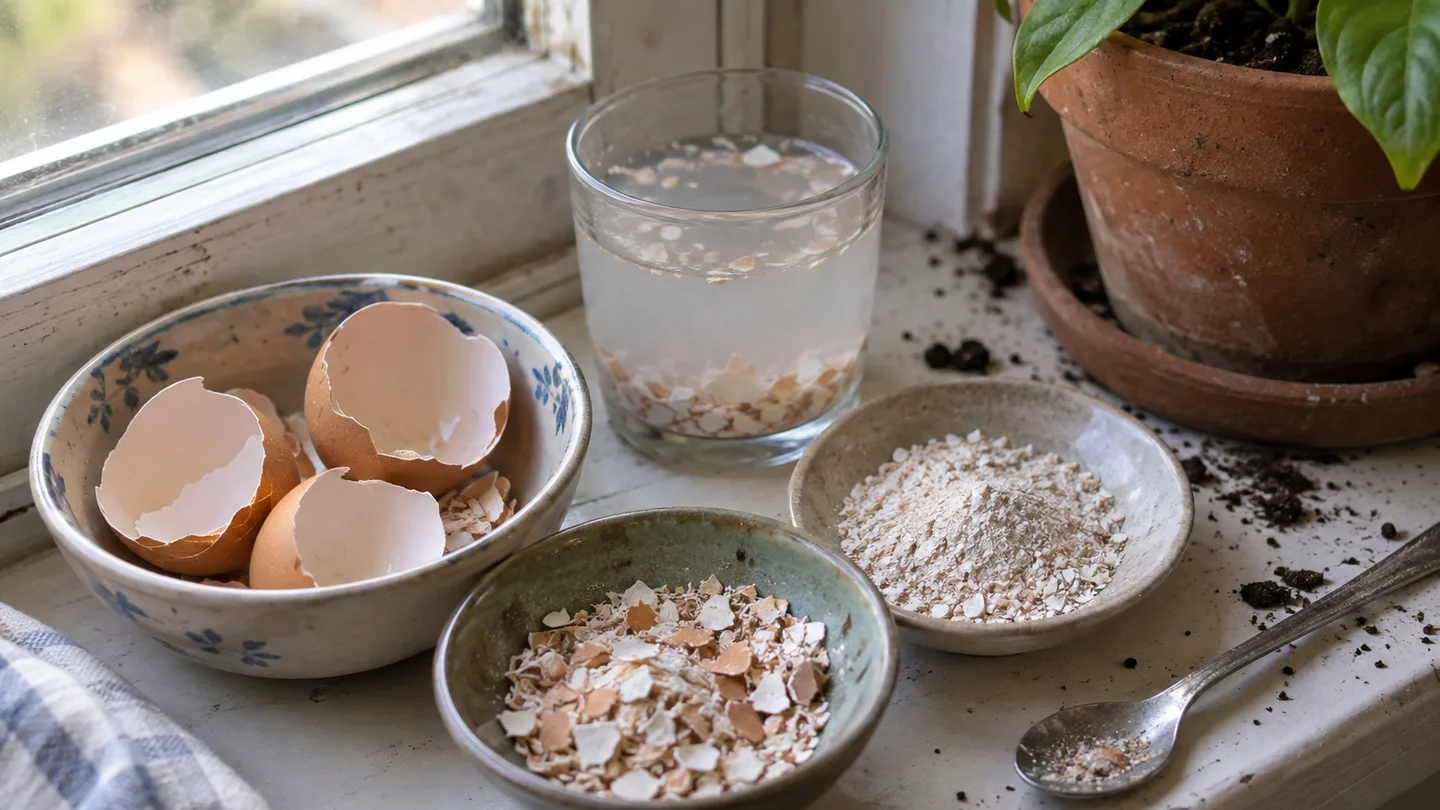
| Form | What changes | My practical verdict |
|---|---|---|
| Whole or halved shells | Very little exposed surface area; they can remain visible for a long time. | Fine for waste recycling, but too slow and uneven for a predictable calcium correction. |
| Coarse fragments, a few millimetres across | More edges contact damp mix, so reaction can begin sooner than with halves. | Reasonable in compost or a suitable mix, but still a slow amendment. |
| Fine powder | Much more surface area is exposed to water and acidity. | The fastest shell form, though still slower and less measurable than a soluble feed. |
| Plain-water eggshell tea | Water alone extracts little dependable calcium from a low-solubility carbonate. | Useful mainly as a kitchen experiment, not a reliable calcium feed. |
The preparation order is simple. Rinse away egg residue, dry the shells completely, then crush or grind them. I prefer to do that before mixing because dry shell is easier to handle, less likely to smell, and less likely to form a damp crust on the pot surface. If you grind shells to flour, avoid breathing the dust and wash your hands afterward.
Vinegar recipes are a different chemical step, not a stronger version of plain eggshell tea. Acid reacts with calcium carbonate and releases carbon dioxide, but the final calcium concentration depends on the shell mass, the vinegar's acidity, the reaction time, and the amount of water used for dilution. Fizzing proves that a reaction happened; it does not tell you whether the resulting solution is appropriate for a particular container. Without known acidity and dilution, I would not pour a homemade vinegar mixture onto an edible crop.
I also don't count sharp shell pieces as dependable slug control. Watering, wind, compost activity, and foot traffic can move the pieces, while weathering reduces the rough edges. If slugs are the problem, use a control method chosen for that problem instead of asking a calcium amendment to act as a barrier.
A balcony decision tree: when to reuse shells and when to buy a measured amendment
The decision gets easier if I ask what job I need done. Shells are sensible only when their limitations match the job.
- If the goal is kitchen-waste reuse: rinse, dry, and grind a modest amount before adding it to compost or a worm bin. Treat it as a slow mineral input, not plant food.
- If the plant needs nitrogen or broad nutrition: use a complete fertilizer intended for the crop and container situation. Eggshells cannot fill that gap.
- If the goal is to raise pH: test first. Calcitic lime adds calcium while raising pH; dolomitic lime adds calcium and magnesium while also raising pH. Neither belongs in an unknown pot merely because a tomato has a damaged fruit.
- If pH is acceptable but calcium is the specific concern: gypsum may be the better measured amendment because calcium sulfate can supply calcium without acting as a primary pH-raising material. It still needs a reason and a label rate.
- If the plant has blossom end rot: correct the moisture pattern and drainage first. Read how much to water container plants as a root-zone question, not as a fixed weekly number.
For a 10–20-L (2.6–5.3-gal) pot, take a small sample from several points around the root zone rather than scraping only the surface. Use a test intended for potting media, follow its instructions, and treat the result as one decision input alongside the crop, the mix, and the watering history. Reputable soil-testing guidance is more useful here than a handful of shells chosen by eye.
My judgment is that eggshells earn their place most often in compost, where slow breakdown is acceptable, rather than in a small pot that needs a predictable correction. Directly mixing clean, finely ground shell into a container is reasonable when the pH is suitable and the aim is modest recycling. It is the wrong tool for an urgent deficiency, an untested pH problem, or a plant already showing damage.
Three practical questions
Can eggshells go in a worm bin?
Yes, in small amounts, if they are clean, dry, and finely ground. The mineral grit can be useful in a worm bin, but it is not a complete fertilizer. Avoid adding wet shell with egg residue because the residue can create odour and attract unwanted pests.
Should I boil eggshells before using them for plants?
Boiling is not essential for the calcium question. Rinse away residue, dry the shells thoroughly, and then crush or grind them. The useful change comes from cleanliness and particle size, not from turning the shells into a hot-water extract.
Are eggshells useful for indoor plants?
Usually not as a quick calcium treatment. Indoor pots often have limited volume, slower evaporation, and less frequent mix replacement, so a slow, unmeasured carbonate addition is less predictable than a measured houseplant fertilizer or a tested amendment. Keep the shells for compost unless you have a clear reason to use them.
Before the weekend, choose one pot rather than treating the whole balcony. Confirm whether it is closer to 10 L or 20 L, push a finger 2–3 cm into the mix, and collect a small root-zone sample for a container-media pH check if calcium or lime is on your shopping list. Keep clean shells dry in a jar or send them to compost while you make that check. A week later, the useful sign is not a shell disappearing; it is a pot that stays evenly moist between waterings and a plant putting out sound new growth. If you cannot name the problem yet, buy the test before the amendment.
Frequently Asked Questions
Can eggshells go in a worm bin?
Small amounts of clean, finely ground shell can provide grit, but they are not a complete fertilizer; avoid adding wet shell residue that creates odour or attracts pests.
Should I boil eggshells before using them for plants?
Boiling is not essential. Rinse off egg residue, dry the shells thoroughly, and then crush or grind them so they store and handle cleanly.
Are eggshells useful for indoor plants?
Usually not as a quick calcium treatment: the small pot volume, slow dissolution, and risk of odour or surface residue make a measured houseplant fertilizer or tested amendment more predictable.