Banana Peels for Plants: Do They Really Add Potassium?
Yes, banana peels contain potassium. No, a peel buried in a pot is not a measured potassium feed: a 10 L (2.6 US gal) container gives you no reliable way to know how much potassium the peel will release, or when.
That distinction is the whole story. A banana peel can become useful compost material, but it is not a labelled fertilizer product. A 10 L herb pot and a 20 L (5.3 US gal) tomato container do not have the same root volume, moisture pattern or feeding demand, and one peel does not come with a dose matched to either crop.
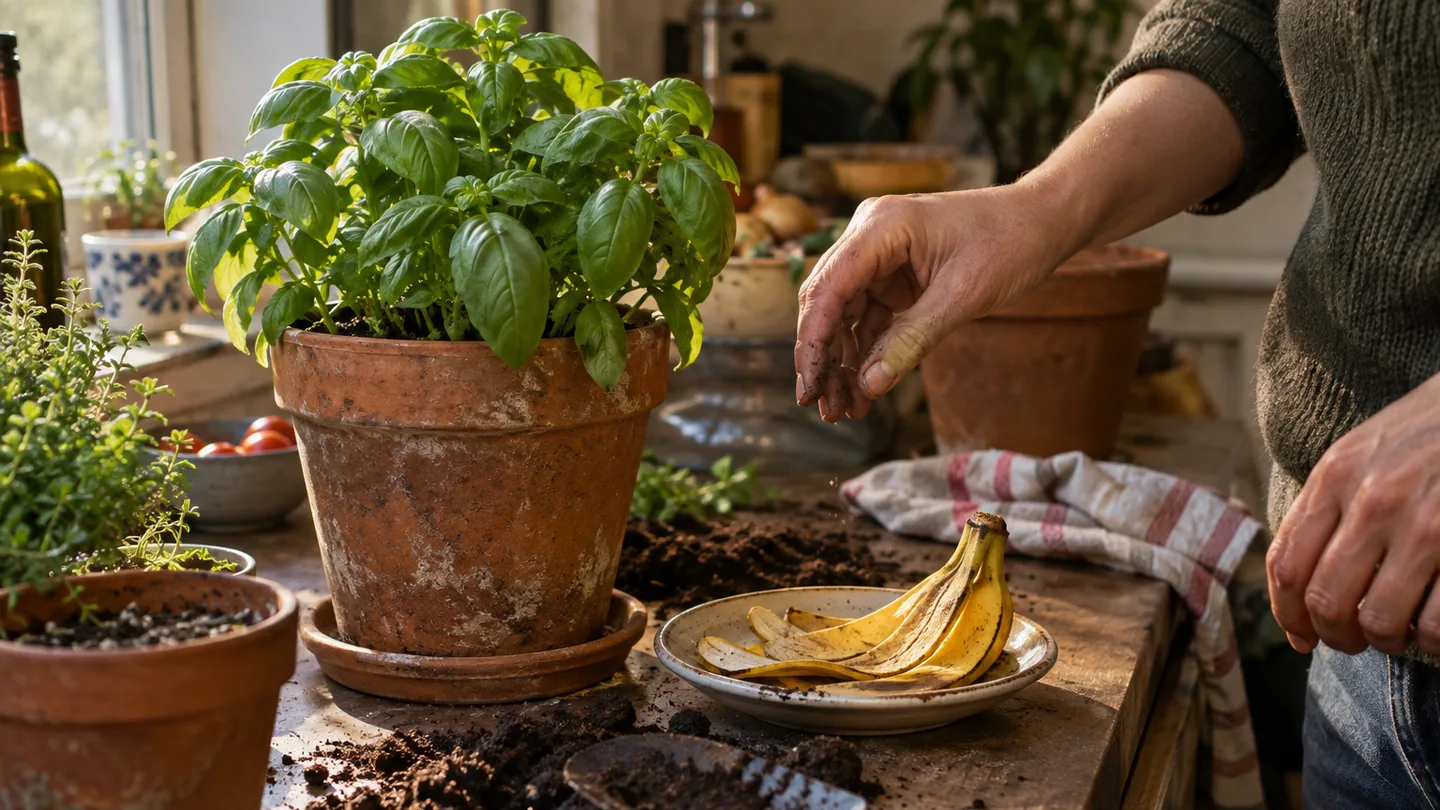
My practical rule is simple: put the peel in compost first. If a plant later needs potassium, use a fertilizer with a stated analysis rather than trying to guess how many peels equal one feed. I think of banana-peel fertilizer as a recycling idea, not a precision gardening technique.
The peel is not useless. Potassium held in plant tissue can become part of a compost mixture as the tissue breaks down. The useful question is not whether potassium exists in the peel. It is whether enough of it becomes available in the right place and at the right time for your potted plant. With raw scraps, that answer is too uncertain for me to base a container feeding plan on.
From peel to root: the four steps between potassium and plant uptake
Think of a banana peel as a small packet of organic material, not a slow-release fertilizer pellet. Roots cannot draw a useful dose straight through an intact peel. The material has to change first.
- Microbes colonise the peel. Bacteria and fungi begin working on the soft tissue, especially where the peel is damp and in contact with air.
- The tissue breaks down. Water, microbial activity and physical damage turn the peel into smaller organic fragments and soluble compounds. Mineral nutrients that were held in the tissue can then enter the surrounding compost or potting mix.
- Water carries dissolved material. Once potassium is in the soil solution, it can move through the thin films of water around mix particles. A dry pot interrupts that movement; a constantly saturated pocket creates a different problem by reducing air around roots.
- Roots absorb dissolved ions. Root surfaces take up potassium from the soil solution. They do not feed directly on a chunk of peel sitting beside them.
This is why a fresh peel does not behave like a liquid feed applied within hours. A peel may stay recognisable for weeks, and a large piece in cool, poorly aerated material can last longer. Chopping, warmth, steady moisture and oxygen usually make the breakdown process easier; a cold, dry or airless pocket slows it down.
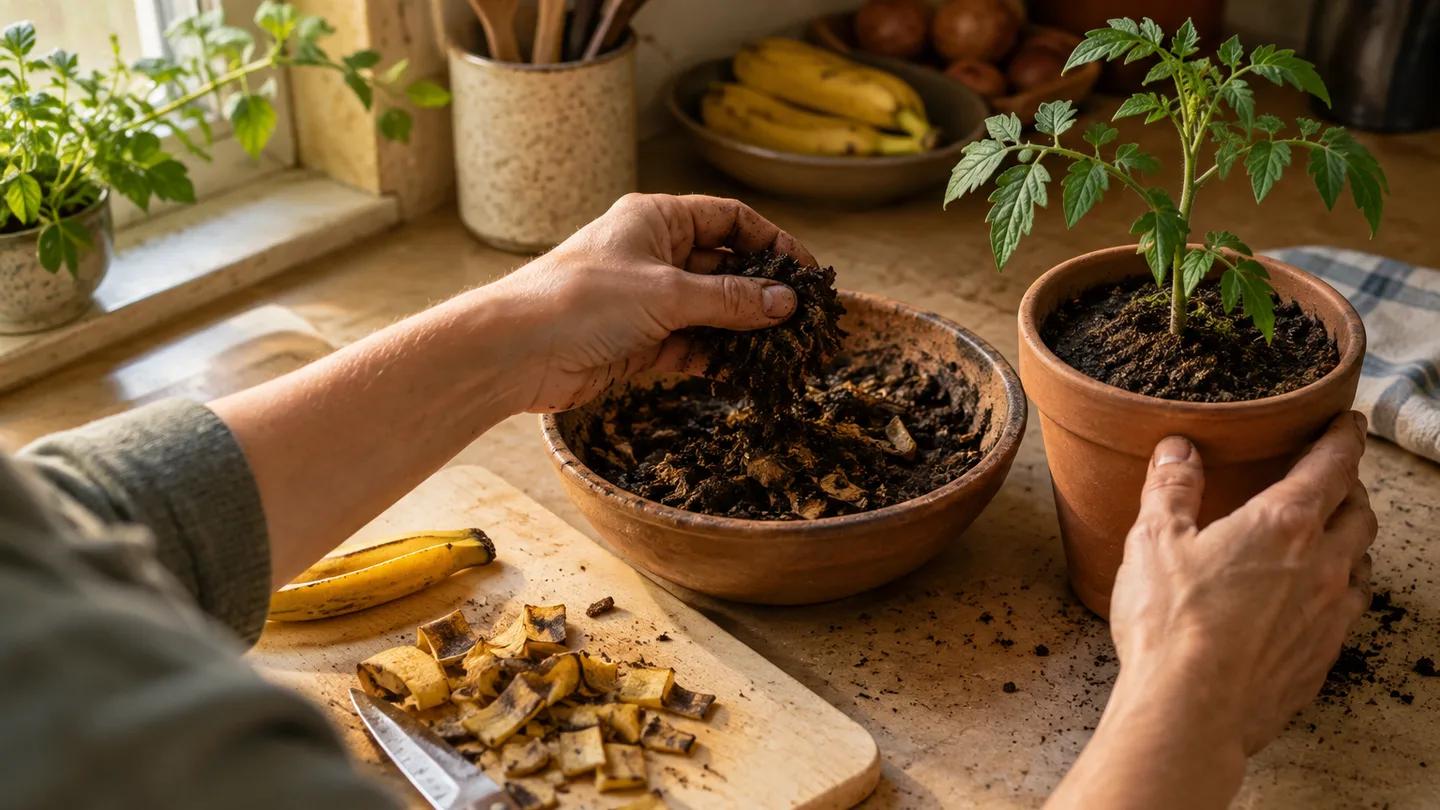
The important detail is that faster decomposition still does not equal a known potassium concentration. You can make a peel break down sooner without knowing how much potassium reached the root zone. Speed and dosage are separate questions.
Whole, chopped, dried or soaked: what each banana-peel method actually changes
The method changes the speed, surface area and mess. It does not turn kitchen waste into a measured fertilizer formula.
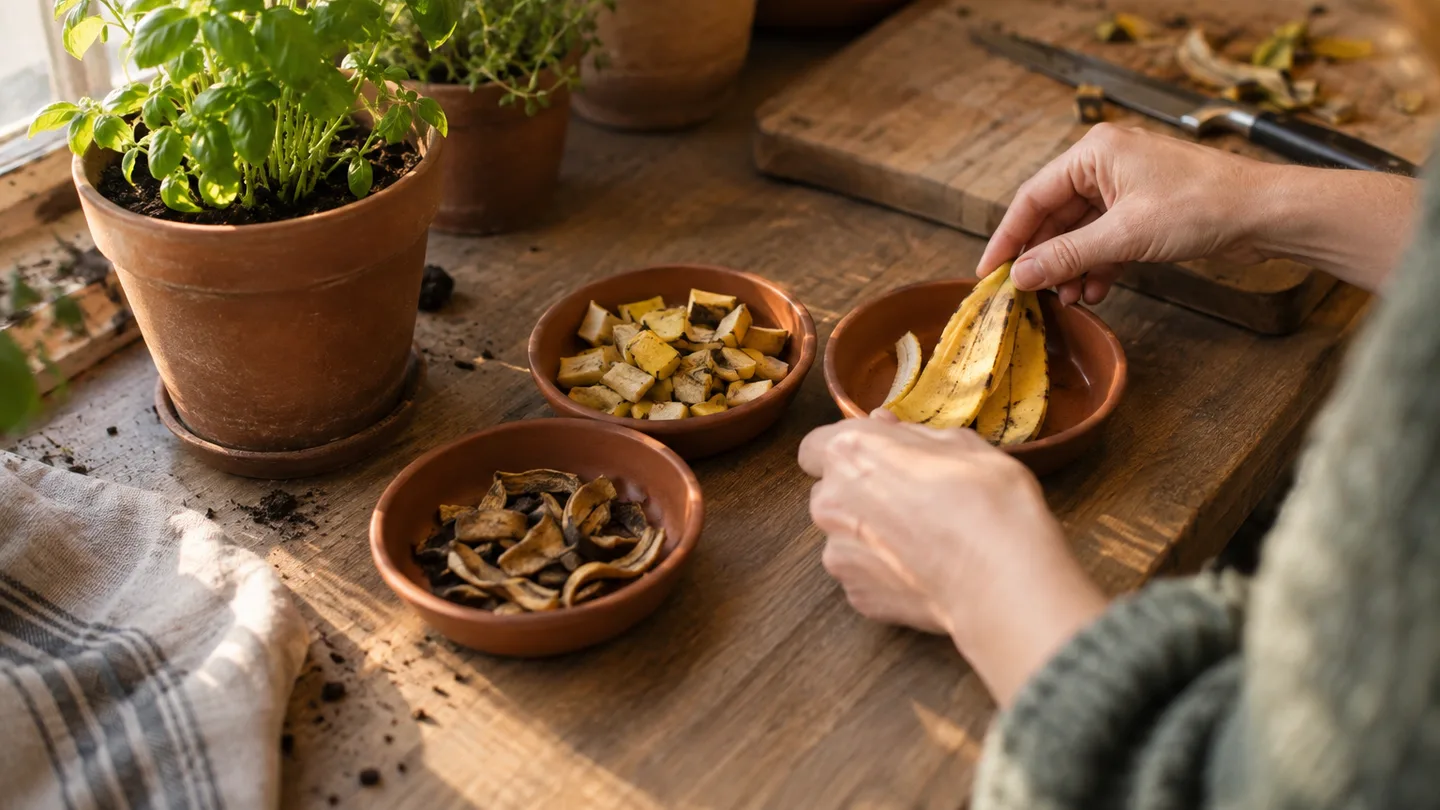
- Whole peel: This is the slowest and least controlled approach. A whole peel presents less exposed surface than small pieces, and it can create one damp organic pocket rather than spreading evenly through the mix. Burying it directly under a plant also puts the decomposing material close to roots.
- Chopped peel: Cutting the peel into pieces around 2–3 cm long increases the contact area available to microbes. It is easier to mix into compost, and it breaks down more readily than one intact strip. It still has no stated nutrient analysis.
- Dried and ground peel: Drying removes much of the water, while grinding increases surface area and makes the material easier to distribute. That may make it more convenient as a compost ingredient or dry organic amendment. It does not reveal how much potassium is present in the final powder, and it does not guarantee that roots can use it immediately.
- Peel soak: Water can pick up some soluble material from the peel. The amount depends on the peel, the water volume, the temperature, the soaking time and the exposed surface area. A soak therefore gives you a liquid of unknown strength, not a known potassium feed.
In my own balcony setup, I once tucked a whole peel under the surface of a basil pot because the shortcut seemed harmless. The basil did not suddenly perk up. After a few waterings, the mix around the peel stayed wetter than the surrounding mix and smelled sweet-sour when I disturbed it. I removed the peel and moved it to the compost bucket. That small failure is why I no longer bury food scraps in small edible pots.
I use the same judgement with coffee grounds for plants. They may be useful organic leftovers in the right compost system, but I would not use either coffee grounds or banana peel as a substitute for a fertilizer with a declared analysis.
If you want to experiment, change one thing at a time and keep the experiment out of the main root zone. A separate compost container is a better place to observe decomposition than the pot holding the basil you plan to eat.
Banana-peel water sounds like fertilizer; the missing number is the potassium dose
Suppose you put one peel in roughly 1 L (0.26 US gal) of water for a day or two. You have created a soak, but you have not created a fertilizer with a known potassium concentration. Some soluble material may move into the water, while other material remains in the peel. Without an analysis, you cannot tell how much potassium is in the finished liquid or how much of it is available to the plant.
The recipe also hides several variables. A large peel and a small peel are not equivalent. A chopped peel exposes more surface than a folded strip. Warm conditions change microbial activity. A longer soak changes the liquid again. Even the condition of the water and the cleanliness of the container can affect what grows in it.
I am especially wary of liquid that has been left until it smells rotten, sour or strongly fermented, becomes slimy, or develops a heavy film. That smell does not tell you the potassium dose, and it is not a sign that the mixture has become better plant food. I would not pour it routinely onto roots, particularly in an indoor pot with little airflow.
This is why I keep banana-peel water in the same cautious category as compost tea for plants. A homemade liquid can be interesting, but interesting is not the same as analysed. If the goal is to correct a nutrient shortage, an unknown liquid makes the diagnosis harder rather than easier.
A 3-litre herb pot is not a compost bin: the container-specific risks of burying peels
A raw peel behaves differently in a finite root volume than it does in a large compost heap. In a 3 L (0.8 US gal) herb pot, one peel represents a large addition to the moist upper layer. In a 10 L (2.6 US gal) pot, it is less dominant but can still sit among active roots. In a 30 L (7.9 US gal) container, there is more room for moisture and organic material to spread, but the potassium dose remains unknown.
The concern is not that banana peel is magically toxic. The concern is the local environment created while it decomposes. A buried peel adds wet organic matter in one place. The surrounding mix can stay wetter than the rest, air movement through that pocket can be reduced, and the surface may develop mould before the material is incorporated properly.
Food scraps can also attract insects. Fruit flies are drawn to fermenting fruit residues, while fungus gnats are associated with damp, organic-rich potting mix. Their larvae use fungal growth and decaying material in the upper layer as food. A peel is not the only way to get fungus gnats, but adding raw food to an already damp pot gives them a more inviting environment.
That matters most indoors, in seedling containers and in small pots that dry slowly. A mature outdoor container has more physical space and often better air movement, but I still would not place a raw peel directly beside the root crown. The plant gains no immediate, measurable benefit that justifies making the root zone harder to read.
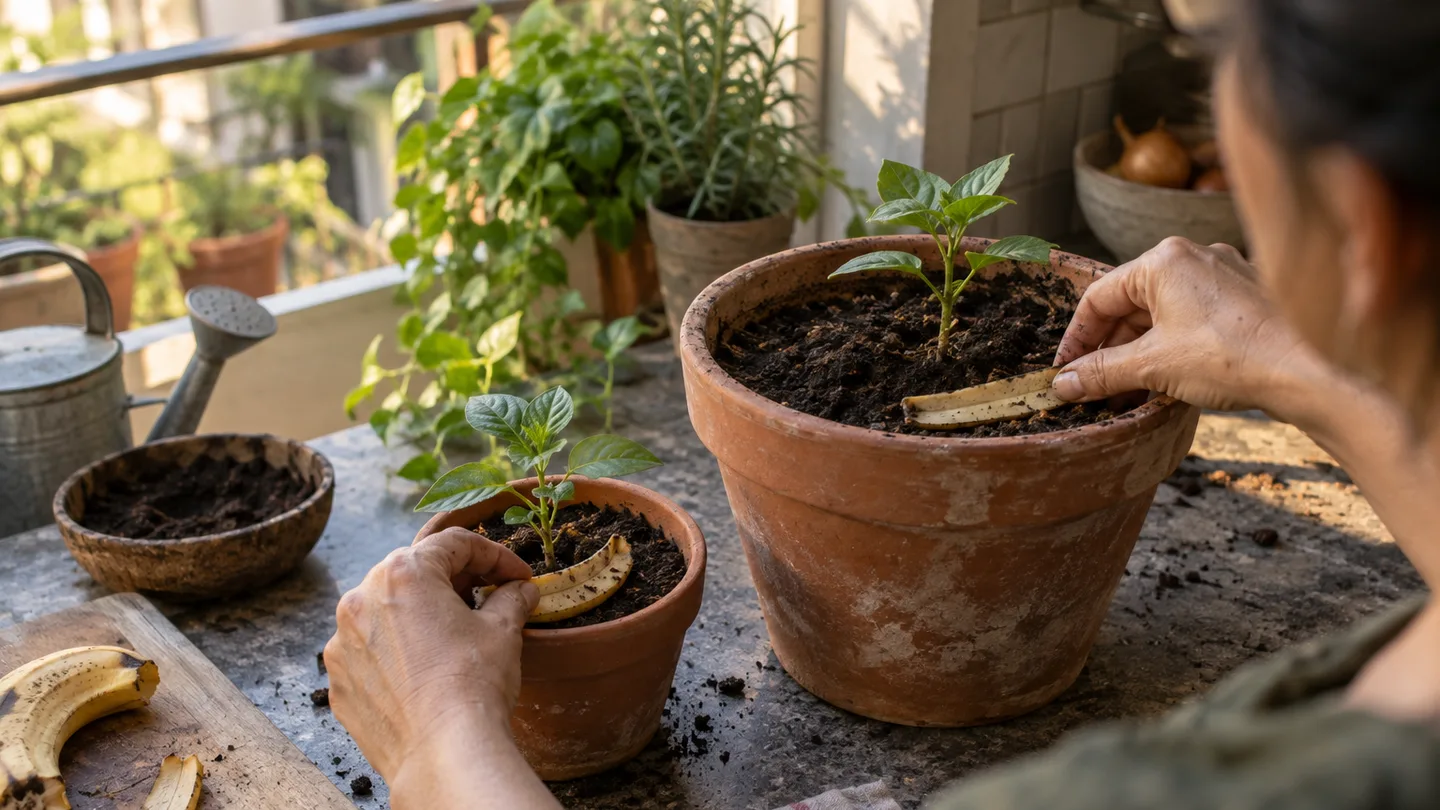
There is also a practical monitoring problem. If the plant wilts after you bury a peel, you have to separate water stress, root disturbance, poor drainage, decomposition and nutrient issues. Keeping raw scraps out of the pot leaves you with fewer unknowns. In container gardening, fewer unknowns are worth a great deal because the root volume is small enough for one wet pocket to affect the whole plant.
Compost first: the route that makes banana peels useful around containers
Composting gives the peel a place where moisture, air and decomposition can be managed together. I add wet food scraps to a mixture that also contains dry, carbon-rich material such as shredded untreated cardboard, dry leaves or other suitable brown material. The pile or bin should feel damp rather than dripping, and it should remain loose enough for air to move through it.
The basic logic is the same as the guidance commonly given for home composting food scraps: food waste supplies moisture and easily decomposed material, while dry material helps prevent a dense, soggy mass. If the mixture collapses into a wet lump, mix in more dry material. If it is dusty and inactive, add modest moisture. You do not need laboratory equipment to make that first correction.
I would wait until the compost is dark and crumbly, smells earthy rather than sour, and contains no obvious strips of recognisable banana peel. Those are practical signs that the material has moved beyond a fresh food scrap. They do not turn the finished compost into a precision potassium fertilizer, but they do make it a more stable amendment for containers.
Use finished compost as part of a potting mix or as a restrained surface amendment around an established plant. I would not fill a container with compost alone, and I would not use half-finished material around seedlings. A small pot needs a stable, airy root zone more than it needs a dramatic homemade nutrient source.
Compost can improve the organic character of a mix and recycle the peel instead of sending it to the bin. That is a worthwhile result on its own. I do not need to pretend that the compost has the same predictable analysis as a bag of fertiliser.
When the plant actually needs potassium, use a source with a stated analysis
If a plant genuinely needs potassium, I want to know what I am applying. A fertiliser label cannot tell me exactly what that individual plant will require, but it does give me a declared starting point. A banana peel gives me neither the amount nor the release schedule.
Read the three-number N-P-K grade as the label’s declared nitrogen, phosphate and potash components by weight. If a product is marked 3-1-2, the third number represents the potash component in that label system. It is an illustration of how to read the product, not a universal prescription for tomatoes, herbs or houseplants. Check the label’s application rate and interval for the crop and product you actually have.
If you want the formal background, look up fertilizer N-P-K label analysis for the regulator in your market. For day-to-day use, the instructions on the product in your hand are more useful than trying to convert one banana peel into an equivalent dose.
For a dry container, my order of operations is deliberate:
- Check the top 2–3 cm, or about 1 inch, of mix and feel whether the pot is unusually light.
- If the mix is dry, moisten it first and let excess water drain away. I do not put a concentrated feed onto a bone-dry root zone.
- Apply the labelled fertiliser rate rather than adding extra because the plant looks stressed.
- Mark the date so the next application follows the stated interval. That is more repeatable than guessing how often to fertilize container plants from leaf colour alone.
Small pots give overapplication less room to disperse. Repeated heavy feeding can leave soluble salts in the mix, which is another reason I prefer a measured product used cautiously over a pile of unmeasured kitchen material.
Yellow edges are not proof: diagnose the plant before adding potassium
Yellow or brown leaf edges can fit a potassium-deficiency pattern, especially when the older leaves show the damage first and the discolouration moves inward from the margins. That pattern is a clue, not a diagnosis. The same plant can show similar edges after drying out, staying wet, sitting in poor light, losing healthy roots or growing in a mix with an unsuitable pH.
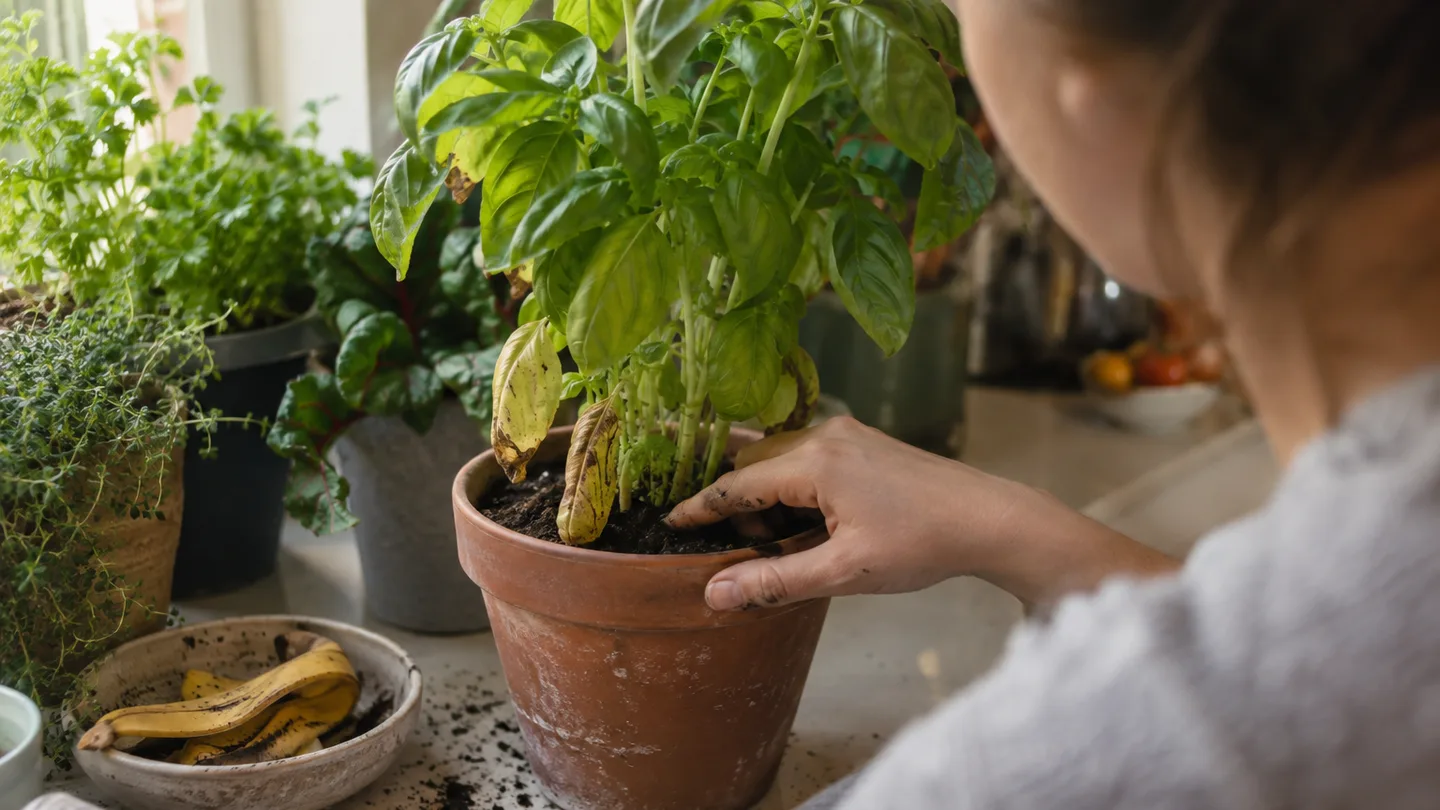
Before adding potassium, I work through the symptoms in this order:
- Look at the pattern. Is the damage on several older leaves, or is one leaf damaged where it touched a cold window, hot wall or wet surface? A single damaged leaf tells me less than a repeated pattern across the plant.
- Check moisture. Push a finger into the top 2–3 cm, about 1 inch, of mix. If it is dry and the pot feels light, water thoroughly and reassess. If it is still damp several days after watering, inspect drainage and read the overwatered plant symptoms before adding feed.
- Check the roots and light. A plant in low light may use water and nutrients more slowly. Damaged or oxygen-starved roots may fail to take up nutrients even when those nutrients are present in the mix.
- Review the recent history. Note the last feed, the potting mix, the water pattern and any recent repotting. If the mix is already receiving a complete fertiliser, adding potassium blindly may compound the problem.
- Feed only after the basic checks. If the pattern and growing conditions point toward a real nutrient shortage, use the product label and watch the new growth. Old brown edges will not become green again, so new leaves are a better sign of whether the correction helped.
This is also why I resist fixed watering calendars. The right answer to how often to water container plants changes with pot material, wind, heat, plant size and the amount of sun reaching the container. A peel cannot compensate for a root zone that is repeatedly too dry or too wet.
The balcony decision: compost the peel, feed the plant separately
For houseplants and seedling pots, I would keep raw banana peels out of the container. The root volume is small, the scraps are hard to monitor, and the plant usually benefits more from a clean, stable mix than from a decomposing food pocket.
For herbs and strawberries, compost the peel first and use finished compost sparingly. For tomatoes and larger outdoor containers, the same rule applies: use compost for organic matter, and use a labelled feed if the crop needs a predictable nutrient supply. Bigger pots reduce the local disruption, but they do not make an unknown potassium dose measurable.
My preferred sentence is this: a banana peel is an ingredient, not a dosage. That keeps the useful part of the idea, recycling food scraps, without asking a peel to do a fertilizer’s job.
This week, put the peel in your compost container, inspect the top 2–3 cm of the plant’s mix before the next watering, and check the third number on any fertiliser already in your shed. If it has no stated analysis or application rate, it is not the tool I would use to correct a suspected potassium problem.