Potting Soil vs Garden Soil: Which Belongs in a Pot?
If you're choosing between a bag labelled garden soil and one labelled potting mix for an ordinary closed pot, choose the potting mix. A 30 cm (12 in) container may hold roughly 15–20 L (0.5–0.7 cu ft), depending on its shape, and that volume has to hold both water and the air roots need after watering; the mix's structure decides whether that balance survives. Garden soil belongs in an open bed by default, while a container mix is built to stay workable inside pot walls.
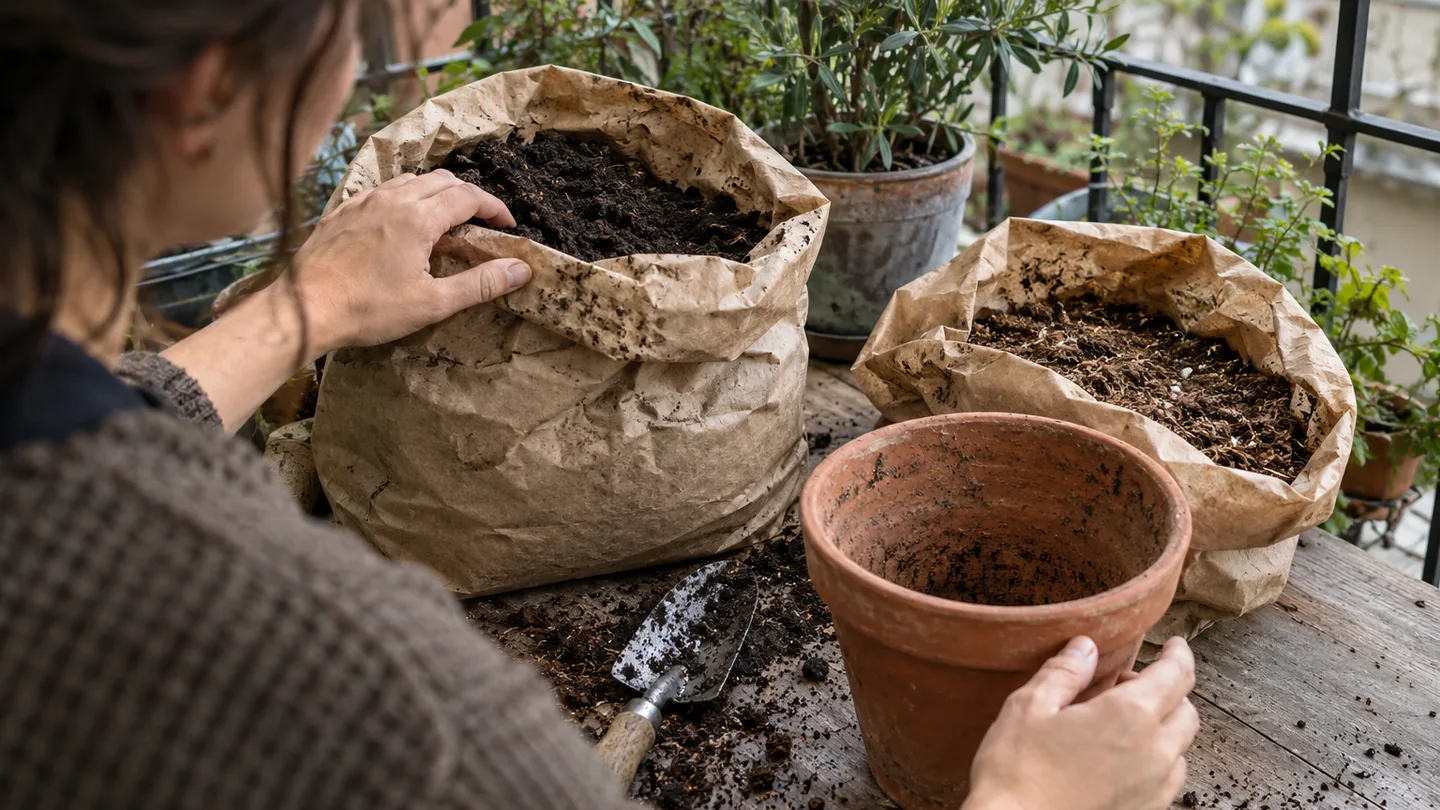
The aisle answer: potting mix belongs in a closed pot; garden soil belongs in a bed
For a balcony, patio, rooftop or windowsill pot with a solid base and one or more drainage holes, I would buy a product labelled for containers. Retailers often use “potting soil” as a friendly name for a soilless potting mix, so don't get hung up on whether the bag says soil or mix. Read the intended-use line and the ingredient list instead.
A closed pot has a different job from a garden bed. In the ground, roots can spread beyond one compacted patch, and water has somewhere to move sideways or downward. Pot walls stop that escape route. The plant is relying on a limited volume of medium to provide moisture, oxygen, anchorage and nutrients, all while the pot may be heating in the sun and drying from the sides.
That is why a cheap-looking bag of garden soil can be the expensive choice. It may fill the container, but filling space is not the same as creating a root zone that drains and breathes. A container mix can still fail if it is old, badly stored or too compost-heavy, but it starts with the right physical assignment.
I use garden soil in a pot only when the planter genuinely behaves like a small piece of ground. That means the bottom is open to the earth, or the planter is large enough and deliberately built as a raised bed with a suitable soil profile. A decorative tub sitting on a balcony remains a pot, even if it holds more soil than a small vegetable container.
Why the same soil behaves differently once you add pot walls
Field soil is a mixture of mineral particles, organic matter, living organisms and pore spaces. Its texture can be perfectly useful in a bed and still be awkward in a container. Once confined, fine particles settle into the gaps between larger ones. Repeated watering, the weight of the soil above and your hands pressing it during filling can reduce the larger air spaces that roots depend on.
The drainage hole doesn't cancel that physics. Water moves through a mix because of gravity, but it is also held by small spaces and capillary forces. In a fine layer above a coarse layer, water will not readily move into the coarse layer or out through the hole until the fine material is nearly saturated at the boundary. A saturated band therefore remains above the coarse layer. That trapped band is the perched water table: a wet zone held above the drainage opening by the structure of the medium.
This is also why adding gravel to the bottom is usually a poor repair. The gravel creates a sharp coarse layer beneath the finer soil, so the fine layer can hold its wet band above it. The hole may be completely clear while the root zone above the gravel stays wetter than you expected.
With the same mix, the perched band tends to form at a similar capillary height rather than shrinking in proportion to the pot. In a shallow container, that wet band takes up a larger share of the total root zone. A deeper pot gives the roots more room above it, although a deep pot filled with dense garden soil can still remain badly aerated.
The surface can mislead you. The top 2–5 cm (1–2 in) may feel dry because evaporation reaches it first, while the lower mix is still wet. If you respond by watering every time the surface looks pale, the plant can move from slightly dry-looking to chronically wet at the roots.
For a medium or deep container, push a finger or thin wooden skewer 5–8 cm (2–3 in) below the surface before watering. In a shallow or small pot, checking 3–5 cm (1–2 in) is enough. Those are the same rule, not competing depths: test below the fast-drying surface zone, then adjust for the size of the pot and the plant's roots.
The practical idea behind extension guidance on potting media is simple: after excess water drains, the mix still needs air-filled pores after drainage. Roots need water nearby, but they also need open spaces containing air. A mix that stays saturated loses that balance.
Here is the balcony example I trust more than a neat slogan. I once put a patio pepper into a 30 cm (12 in) plastic pot filled with garden soil from a bed. Within a few weeks, the surface developed a hard crust and looked dry by afternoon, but water ran around the edge and pooled before disappearing. The lower leaves yellowed even though the pot was rarely allowed to dry completely. When I tipped the plant out, the upper layer was dusty and the lower half came out as one dark, heavy clod. I moved it into a loose container mix, taking away the soil that came free without tearing the roots apart. The important change was not a magical ingredient; the new medium broke apart instead of holding together as a wet block.
That failed-pot pattern is worth remembering: a dry crust on top, a gap where the mix has shrunk from the pot wall, hard clods when the material dries, a sour smell from persistently wet pockets, yellowing lower leaves and fungus gnats around damp organic material. None of those signs proves one diagnosis by itself, but together they tell me to inspect the lower root zone rather than simply water again.
Use the bag as a specification sheet: ingredients, litres, and fill volume
Once I am standing in the soil aisle, I treat the front of the bag as advertising and the back as the useful part. I want to know whether the product is intended for containers, how much coarse material it contains, whether it includes compost or fertiliser, and whether the mix is likely to collapse after repeated watering.
| What to compare | Container potting mix | Garden soil |
|---|---|---|
| Particle structure | Usually blended from materials chosen to create both fine moisture-holding spaces and larger drainage spaces. | Often contains a finer mineral fraction that can settle and form clods when confined. |
| Air after watering | Designed to retain some open pore space after excess water leaves. | Depends heavily on the field soil's texture and how much it compacts in the pot. |
| Water retention | Varies with coir, peat, bark, perlite, pumice and compost; the label gives clues, not a guarantee. | Can hold water strongly when fine-textured, especially at the bottom of a container. |
| Wet weight | Often lighter per litre, though a saturated mix can still make a large planter heavy. | Usually brings more mineral solids into the container and can become very heavy when wet. |
| Settling | Can settle, especially if rich in fine compost, but a good container product is formulated for pot use. | May settle into a dense mass, shrink from the sides and leave a crust. |
| Intended use | Pots, planters, hanging baskets and other restricted root spaces. | Beds and open ground unless the planter is designed to behave like a bed. |
Bag volume is easier to compare than bag weight. A working guide looks like this:
| Bag volume | Approximate cubic feet | Useful way to think about it |
|---|---|---|
| 10 L | About 0.35 cu ft | A small pot, several herb containers or a top-up. |
| 20 L | About 0.7 cu ft | One medium container, depending on its shape and headspace. |
| 40 L | About 1.4 cu ft | A large planter or several smaller pots. |
Those are loose volumes, so allow for settling and don't fill right to the rim. I leave approximately 2–5 cm (1–2 in) below the edge. That headspace gives you room to water without immediately washing mix over the side, and it makes later top-dressing less messy.
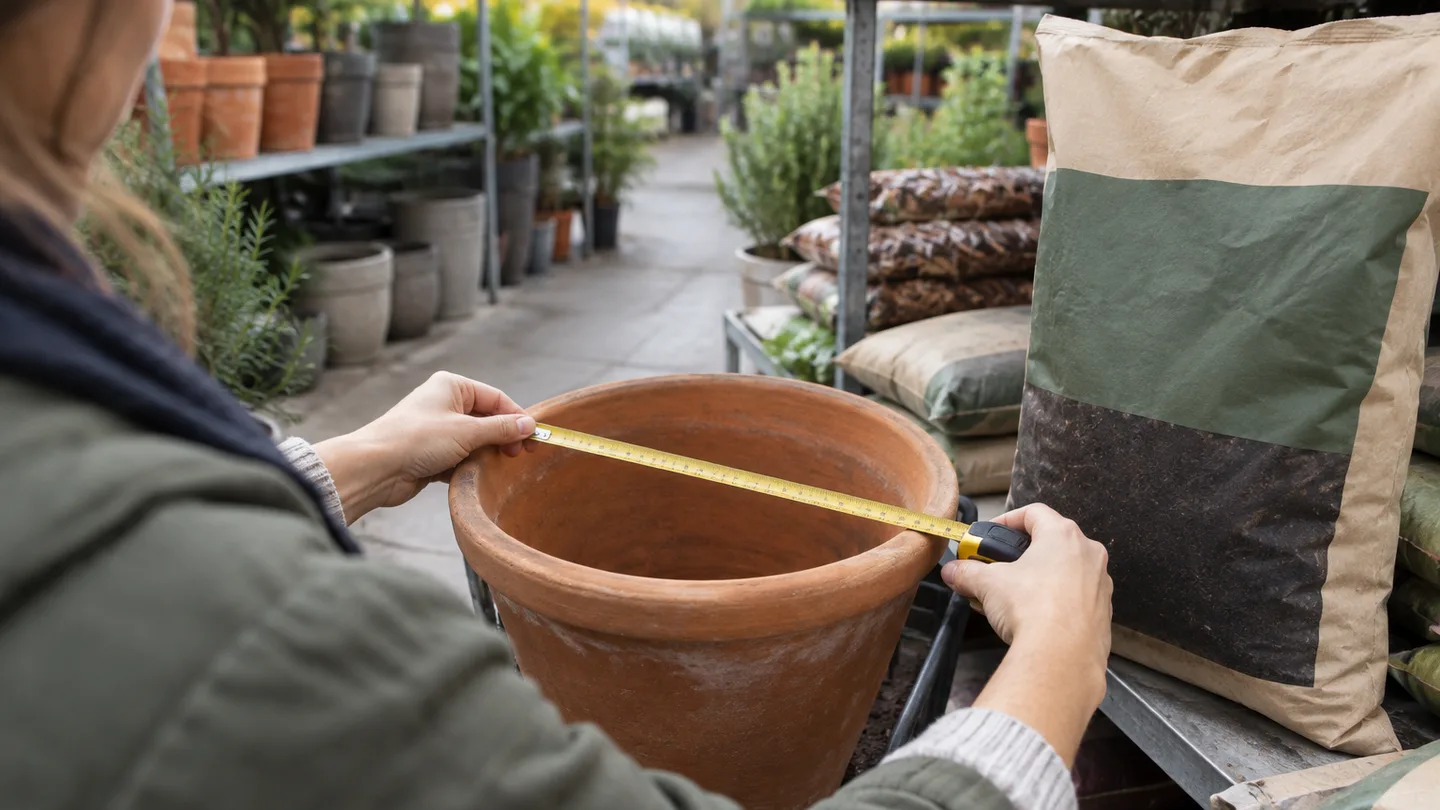
Diameter alone won't tell you how many litres a pot holds. A tapered pot, a shallow bowl and a tall cylinder can all have the same advertised width but very different volumes. For a simple cylinder estimate, start with radius, not diameter: a 30 cm wide pot has a 15 cm radius. If its inside height is roughly 25 cm, the calculation is 3.14 × 15 × 15 × 25, which gives about 17,700 cubic centimetres, or 17.7 L, before leaving headspace. The real fill volume changes with taper, thick walls, drainage shape and how high you actually fill it.
For a quick shop-floor check, use the companion guide on how much soil you need for a container, then buy by litres rather than by the apparent size of the bag. If the product label promises moisture retention but says little about drainage or structure, I would keep looking.
When the rule changes: the planter must behave like a garden bed
There is no single litre threshold that turns garden soil into potting mix. A 100 L (26 gal) container with a sealed base is still a pot. Its walls still stop roots and water from connecting with the surrounding ground, and its internal soil can still compact. Size gives you more root volume, but it doesn't rewrite the drainage conditions.
I separate containers into four practical types:
- Closed pot: The bottom is sealed except for drainage holes. Use a container mix as the default.
- Raised bed: The structure is open to the soil below or has enough depth and width to function as a bed. A bed-oriented soil blend can make sense here.
- Open-bottom planter: Roots and water can move into the ground beneath it. This behaves more like a raised bed, although the transition layer and local soil still matter.
- Large outdoor tub: It may hold a lot of medium, but it remains a closed container unless it genuinely connects to the ground.
In the pots I use, below roughly 30 L a single wet or compacted patch takes up a large share of the root zone. That is my rule of thumb, not a universal cutoff or a derived figure. The smaller the total volume, the less spare air and root space there is when one section settles badly.
Weight matters before you fill a balcony planter. Water only occupies the pore space between the solid particles; it does not fill every litre of the planter. A wet 50 L planter can still exceed 50 kg when the water in those pores is added to the mineral and organic solids, the container, the plant and the saucer. For rough arithmetic, I use 1 kg per litre of water as the water-to-mass conversion only. If the pot is manageable and safe to move, weighing it wet on a bathroom scale gives you a better estimate than guessing from the printed litre capacity.
On a balcony or rooftop, check the building's guidance, landlord's rules or a qualified professional before concentrating several heavy planters in one area. The question is not simply whether the soil is suitable for vegetables; it is whether the entire wet system is appropriate for the surface beneath it.
If garden soil is already in the pot, make this repair decision
If you've already filled a container with garden soil, don't automatically pull out a healthy plant just because the bag choice was wrong. First look at how the pot behaves after watering. Water pooling on top, a lower root zone that stays wet, a sour smell, stalled growth or wilting while the mix is still damp all justify a closer inspection.
Field soil also brings baggage that a potting mix bag may not: weed seeds, soil-borne disease organisms and pests carried in field soil. Those problems may never appear, but a container gives them a small, enclosed place to become obvious. A failed pot can show a surface crust, soil shrinking from the wall, hard clods when dry, yellowing lower leaves or fungus gnats hovering around persistently moist material.
- Check the drainage hole first. Turn off the saucer, lift the pot if you can do so safely and make sure the hole is open. Fresh mix cannot compensate for a blocked outlet.
- Choose enough container mix before disturbing the plant. Measure the pot's inside dimensions and leave 2–5 cm (1–2 in) below the rim. A half-filled replacement pot creates a different problem: the root ball dries quickly and the plant has little room for new roots.
- Pick a cooler, lower-stress moment. Morning or a cloudy day is kinder than repotting during a hot, windy afternoon. A small established plant can often be moved promptly when the root zone is clearly failing.
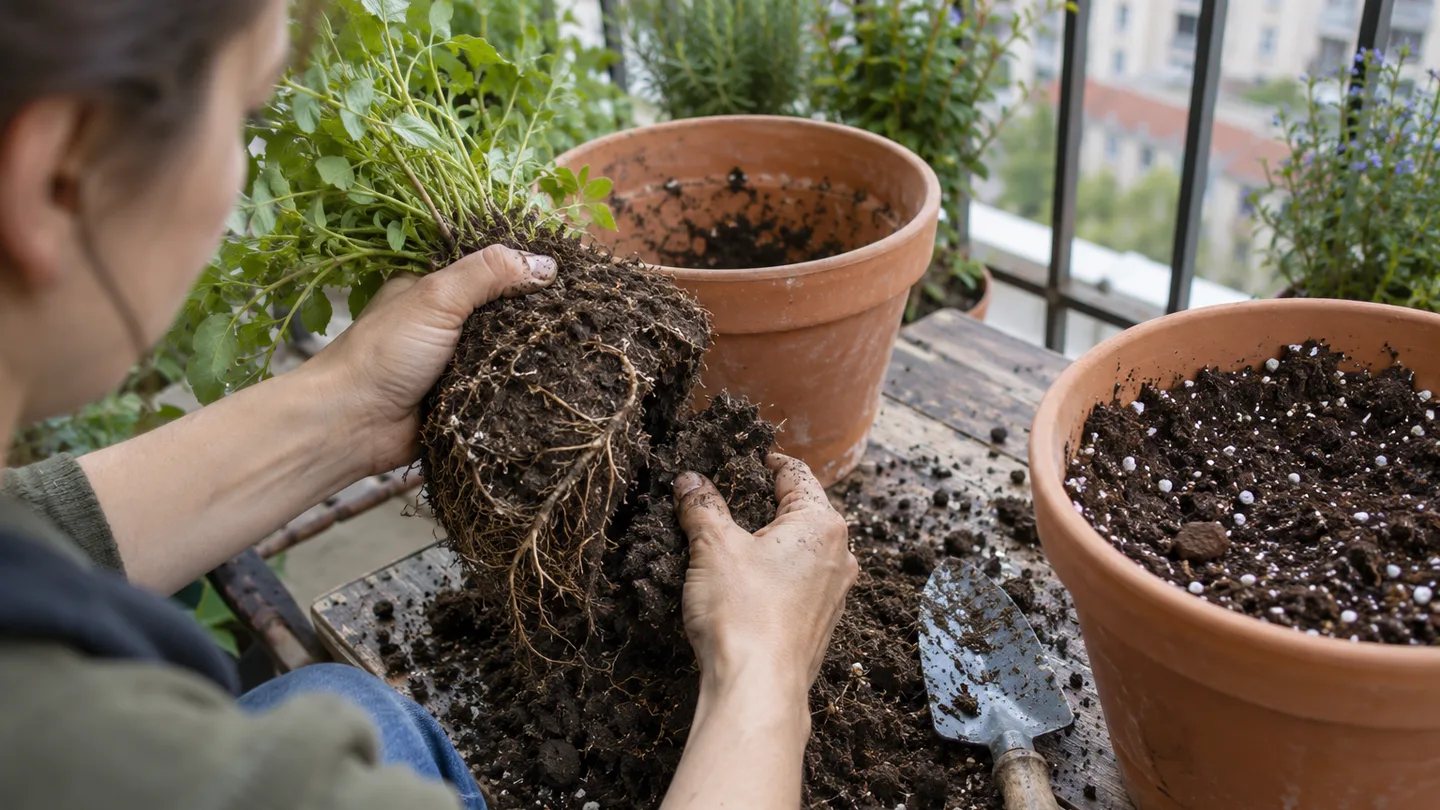
- Remove the compacted soil the roots will tolerate. Tip the plant out, loosen the outer material with your fingers and let the soil that falls away go. Don't turn a salvage job into aggressive root washing unless there is a clear reason; fine roots tear easily.
- Refill without a gravel layer. Put the plant at the same depth it was growing, add the fresh mix around the root ball and firm it only enough to remove large voids. The loose structure, not hard tamping, is what you need.
- Water once to settle the mix, then reassess below the surface. The first watering should wet the new root ball and produce drainage from the hole. After that, check at the appropriate depth instead of following a fixed daily schedule.
A large plant in flower or fruit needs a more careful timing choice. If it is growing steadily and the problem is mild, clearing the drainage hole and waiting for a cooler root-active period may be less disruptive than tearing apart the root ball immediately. If it is wilting in wet soil, smells sour or has visibly damaged roots, accepting some transplant shock may be the safer trade-off.
If you see brown, mushy roots, compare the symptoms with what root rot looks like before deciding that more water will help. And if you are tempted to save the old material, think carefully about whether you can reuse potting soil when the previous plant was diseased or the mix stayed sour and wet. I would rather discard a small amount of questionable medium than carry the same problem into a clean pot.
Three quick soil-aisle questions
Can I mix garden soil with potting soil in a container? For an ordinary closed pot, replacing the garden soil is more dependable than blending it in. A small amount may be tolerated in a large outdoor planter, but it still adds weight and can reduce air space, so the planter's design matters more than a universal ratio.
Is topsoil the same as garden soil? No. Retail labels vary, and neither product is automatically suitable for a closed container. Treat both as bed-oriented materials unless the bag specifically describes the product as suitable for pots.
Can I use compost instead of potting soil? Compost is usually an ingredient rather than a complete container medium. Used alone, it can settle, stay wet or create an uneven root environment; use a properly formulated potting mix unless the product is explicitly made for containers.
Before the weekend, measure the pot's inside width and depth, inspect the drainage hole with a finger or a thin stick, and buy enough container mix to leave headspace below the rim. After the first thorough watering, check the mix several centimetres down a few days later: the surface may be drying, but the lower zone should not smell sour or remain waterlogged.
Frequently Asked Questions
Can I mix garden soil with potting soil in a container?
For ordinary closed pots, replacing the garden soil is more dependable than blending it in. A small amount may be tolerated in some large outdoor planters, but it can still add weight and compaction, so the answer depends on drainage and planter design rather than a universal ratio.
Is topsoil the same as garden soil?
No. Retail labels vary, and neither product is automatically suitable for a container. Treat both as bed-oriented materials unless the bag specifically describes the product as suitable for pots.
Can I use compost instead of potting soil?
Compost is usually an ingredient, not a complete container medium. Used alone it can settle, stay wet or supply an unbalanced root environment; use a properly formulated potting mix unless the product is explicitly made for containers.