Easy Fruits and Vegetables to Grow in Pots: 12 Top Picks
The easiest fruits and vegetables to grow in pots are the ones that match your light, root volume and watering habits: radishes, leaf lettuce, Swiss chard, strawberries, bush beans, peas, compact tomatoes, peppers, patio cucumbers, carrots, potatoes and, conditionally, dwarf blueberries.
A 3–5 L (0.8–1.3 US gal) pot can produce a useful crop of radishes, but a compact tomato is a different proposition: start with about 20–30 L (5–8 US gal) of potting mix per plant. The list below is designed for a balcony, patio, rooftop or windowsill, where a plant has no spare ground to send roots into.
Save the shortlist before you reach the garden-centre aisle. The best crop is rarely the one with the biggest harvest claim on its label; it is the one your pot can keep adequately lit, watered and supported.
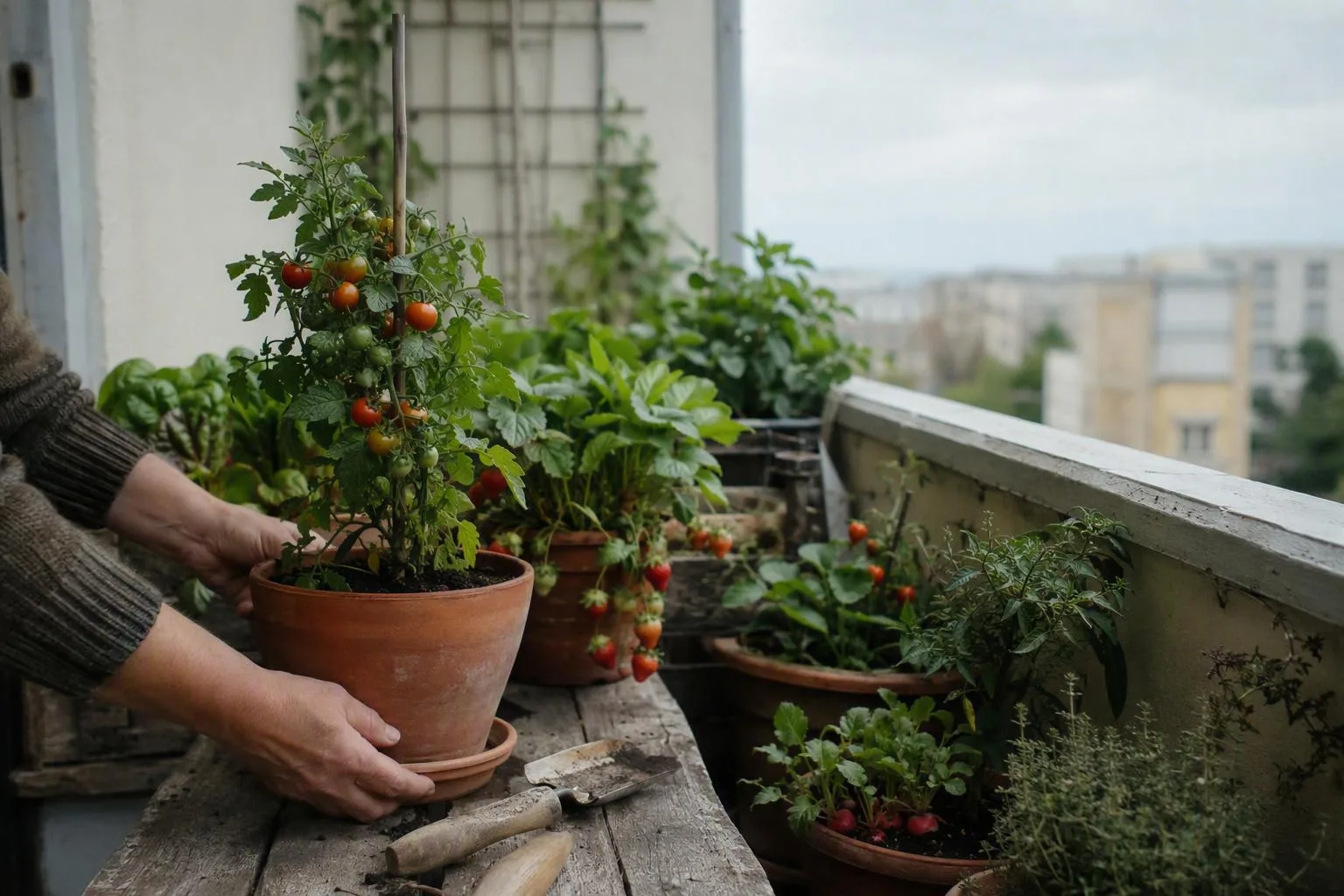
Start with the pot, not the seed packet
Use the table as a practical starting specification, not as a universal minimum. Depth means usable depth of potting mix, and the season column means the approximate time to a first usable harvest in suitable weather. A transplanted crop and a seed-grown crop will not follow exactly the same calendar.
| Crop | Practical mix depth | Approximate mix volume | Direct sun | First harvest | Support? |
|---|---|---|---|---|---|
| Radishes | 15 cm (6 in) | 3–5 L (0.8–1.3 gal) | 4–6 hours | 3–6 weeks | No |
| Leaf lettuce | 15–20 cm (6–8 in) | 5–10 L (1.3–2.6 gal) | 3–5 hours | 4–8 weeks | No |
| Swiss chard | 20–25 cm (8–10 in) | 10–15 L (2.6–4 gal) | 4–6 hours | 6–10 weeks | No |
| Strawberries | About 20 cm (8 in) | 5–10 L (1.3–2.6 gal) per plant | 6 hours or more | 8–16 weeks from an established plant | No |
| Bush beans | 20–25 cm (8–10 in) | 10–15 L (2.6–4 gal) | 6–8 hours | 7–10 weeks | Usually no |
| Peas | 20–25 cm (8–10 in) | 10–15 L (2.6–4 gal) | 4–6 hours | 8–12 weeks | Yes |
| Compact cherry tomato | 25–30 cm (10–12 in) | 20–30 L (5.3–7.9 gal) per plant | 6–8 hours | 10–16 weeks | Yes |
| Peppers | 20–25 cm (8–10 in) | 10–20 L (2.6–5.3 gal) per plant | 6 hours or more | 12–20 weeks | Optional |
| Patio cucumber | 20–30 cm (8–12 in) | 20–30 L (5.3–7.9 gal) | 6–8 hours | 8–12 weeks | Yes |
| Carrots | 25–30 cm (10–12 in) | 8–15 L (2.1–4 gal) | 4–6 hours | 8–14 weeks | No |
| Potatoes | 30–40 cm (12–16 in) | 20–40 L (5.3–10.6 gal) | 6 hours or more | 10–16 weeks | No, but the container must be stable |
| Dwarf blueberries | 30–50 cm (12–20 in) | 30–50 L (7.9–13.2 gal) per plant | 6 hours or more | One season or longer | No |
There are four checks I make before buying anything. Count usable direct sunlight rather than the brightness of the whole balcony; a spot that is bright for eight hours but receives only two hours of direct rays is a part-sun spot. Check wind, because a tall tomato cage or cucumber trellis can act like a sail. Check how far the nearest tap is, since a pot that needs a hose or watering can carried across the flat will eventually be missed. Finally, check the building or landlord rules for balcony loading and keep in mind that wet mix weighs more than dry mix.
A compact variety is bred or selected for a smaller canopy, shorter growth or a more manageable harvest window. It does not mean the roots have become optional. My useful rule is this: compact on the label is a canopy promise, not a pot-size waiver. A full-size indeterminate tomato, for example, keeps extending and fruiting along a long stem, so it needs more root volume, water and support than a compact determinate type that finishes its main growth sooner.
Give every pot real drainage holes. Water moves through the pore spaces in the mix and leaves at the lowest opening, but a saturated band can remain immediately above that opening. That band is the perched water table, meaning water held above the drainage level rather than freely moving through the whole pot. A layer of gravel under the mix does not create extra root space; it can move the saturated boundary upward and leave less well-aerated mix for roots. For the full mechanism, see Container Drainage Explained: Why Pots Need Holes but Not Gravel in the Bottom.
1–3: Radishes, lettuce and Swiss chard forgive small mistakes
1. Radishes
Radishes are my first choice when the pot is shallow or the season is short. Use at least 15 cm (6 in) of loose mix. Sow the seeds about 1 cm (⅜ in) deep, then thin seedlings to roughly 3–5 cm (1–2 in) apart. Thinning is not wasted fuss: crowded roots press against one another and make a swollen root less likely to develop evenly.
Check the top 2–3 cm (about 1 in) of mix. If it feels dry at that depth, water thoroughly until a little drains, then empty any runoff from the saucer. A 5 L pot spaced at about 4 cm can hold roughly 12–20 radishes, depending on its shape. Pull a test root when the shoulder is visible at the mix line; a crisp, rounded root is ready, while a large, hard root has probably stayed too long in heat or dry mix.
2. Leaf lettuce
Choose loose-leaf lettuce rather than a large heading type for the most forgiving harvest. A 15–20 cm (6–8 in) depth is enough for a practical container, and three to five plants can share roughly 10 L (2.6 gal) if they are spaced for outer-leaf picking. Sow about 0.5 cm (¼ in) deep, or press seed onto the surface and cover lightly.
Harvest the outside leaves once they are large enough to use, leaving the central growing point intact. In hot weather, move the pot into afternoon shade if possible. Bitter leaves and a sudden upright flower stalk are signs that the plant has been pushed toward flowering by heat, age or stress. Lettuce is particularly useful on a balcony because you can harvest a few leaves without waiting for a whole head.
3. Swiss chard
Swiss chard needs more room than lettuce but pays it back with repeated leaf harvests. Give it 20–25 cm (8–10 in) of mix and sow about 1.5–2 cm (½–¾ in) deep. The seed cluster can produce several seedlings, so thin to two or three strong plants in a 10–15 L pot rather than leaving every seedling in place.
Pick the outer leaves when they are around 15–20 cm (6–8 in) long. Leave the centre leaves to continue growing. Pale, thin plants usually point me first toward the root zone: check whether the mix has stayed waterlogged, whether the pot has been repeatedly flushed with heavy watering, and whether the crop needs a labelled feed. Chard gives more usable harvest from one container than a heading crop because the plant keeps its growing point after each picking.
4. Strawberries are the easiest fruit, if the crown stays at soil level
Strawberries are the safest first fruit for most container growers, but they have one planting detail that decorative strawberry pots often get wrong. Give each plant about 5–10 L (1.3–2.6 gal) of mix and around 20 cm (8 in) of usable root depth. A day-neutral or everbearing type is a sensible choice if you want flowers and fruit over a longer suitable season rather than one concentrated crop.
The crown is the short central stem between the roots and the leaves. Set it exactly at the mix surface: roots covered, leaves above, crown neither buried nor perched in dry air. A buried crown can stay wet and decay; an exposed crown leaves roots vulnerable to drying. Water when the upper mix begins to dry, and check more closely during flowering and fruit swelling.
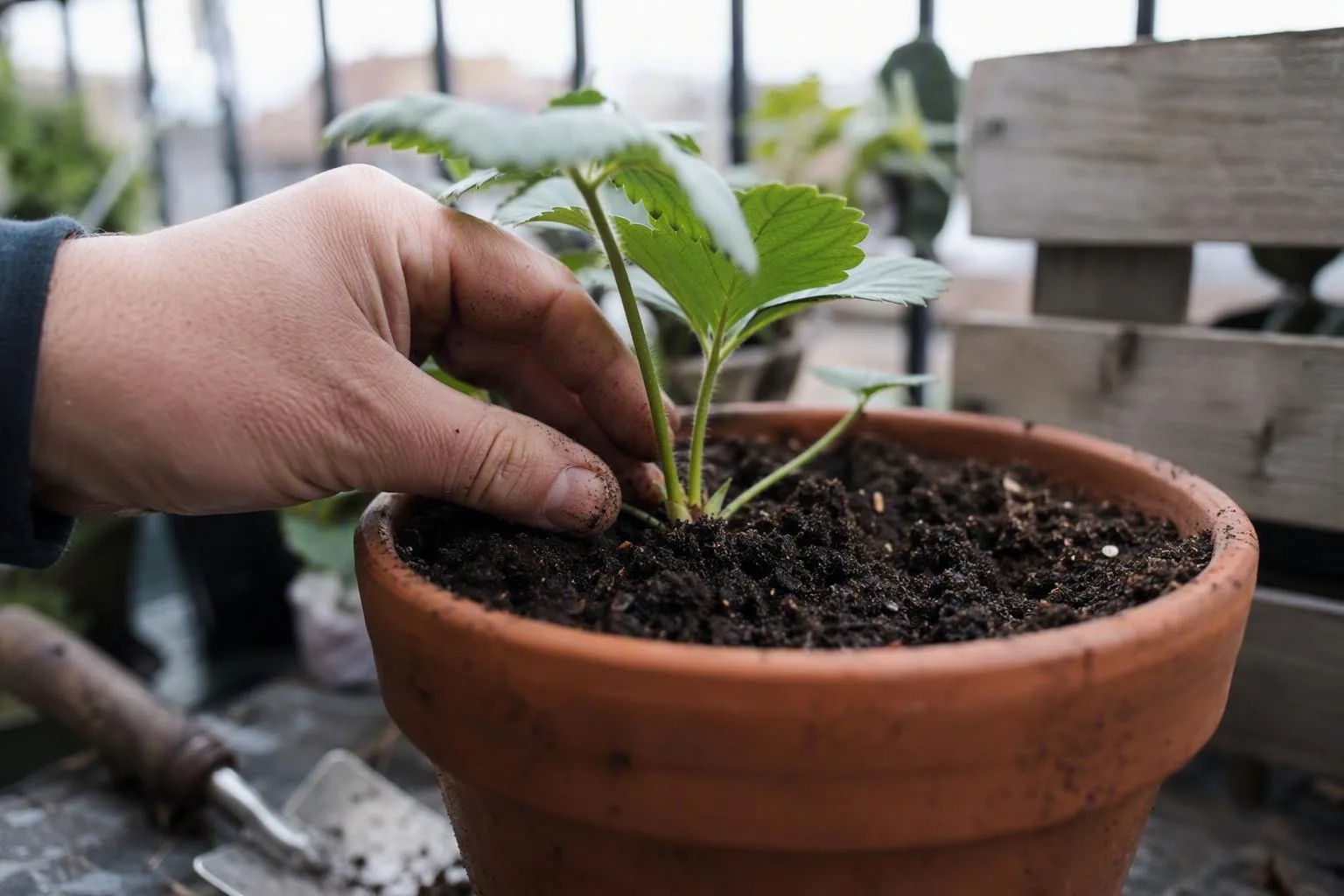
Six or more hours of direct sun is a useful target. If the balcony has only one or two hours, the plant may remain leafy but fruiting will be a weak bet. Keep berries off wet mix with clean straw, a small support ring or a layer of coarse mulch. If flowers appear but insects cannot reach the balcony, touch the centre of each open flower gently with a small, dry brush.
Remove runners after fruiting if the priority is berries. A runner is the long stem that makes a daughter plant; allowing several to root in a small pot diverts energy and quickly creates crowding. If you want new plants, pin one runner into a separate small pot and cut it away after it has rooted. An established plant may give several picking rounds, but a newly planted crown may spend much of its first season establishing. Pick berries when they have developed the cultivar’s full colour and pull away with a short piece of stem rather than expecting one large bowl from one small pot.
5–6: Bush beans and peas turn vertical space into food
5. Bush beans
Bush beans are a strong full-sun choice once nights and the mix have warmed. Use 20–25 cm (8–10 in) of mix in a 10–15 L pot. Sow directly into the final container, roughly 2–3 cm (¾–1¼ in) deep, because beans grow quickly and have little to gain from being moved. Space plants about 8–10 cm (3–4 in) apart, adjusting the count to the pot’s width so leaves can dry after watering.
Check the mix whenever the top few centimetres feel dry, especially as flowers become pods. Pick beans while the pods are slim and firm, before the seeds bulge. Leaving mature pods on the plant tells it to finish making seed; regular picking keeps the plant in production. Heat, wind and a missed watering can cause flowers to drop even when the plant still looks green.
6. Peas
Peas suit the cooler edge of the season, so they make a useful spring or autumn crop when beans would sulk. Give them 20–25 cm (8–10 in) of mix, sow 2–3 cm deep and install a trellis or net before the tendrils start searching. A 10–15 L pot can support a modest row if plants are spaced around 5 cm (2 in) apart.
For a renter, use a free-standing bamboo teepee, narrow obelisk or net fixed to a heavy base rather than attaching anything to the railing. Keep the support inside the pot footprint and place it where the prevailing wind will not twist the container. Pick snap or shelling peas according to the seed packet: snap peas are best while the pod is crisp, while shelling peas are ready when the peas inside have filled but before the pod turns tough.
7. Choose a compact cherry tomato, then give it more pot than you think
Tomatoes are easy only after their container specification is right. Start a compact or determinate cherry tomato in about 20–30 L (5–8 gal) of mix per plant. If the label describes a vigorous indeterminate plant, move toward a larger container, a stronger cage and more frequent moisture checks. Determinate means the main growth finishes within a defined shape; indeterminate means the plant keeps extending and setting fruit along its stem.
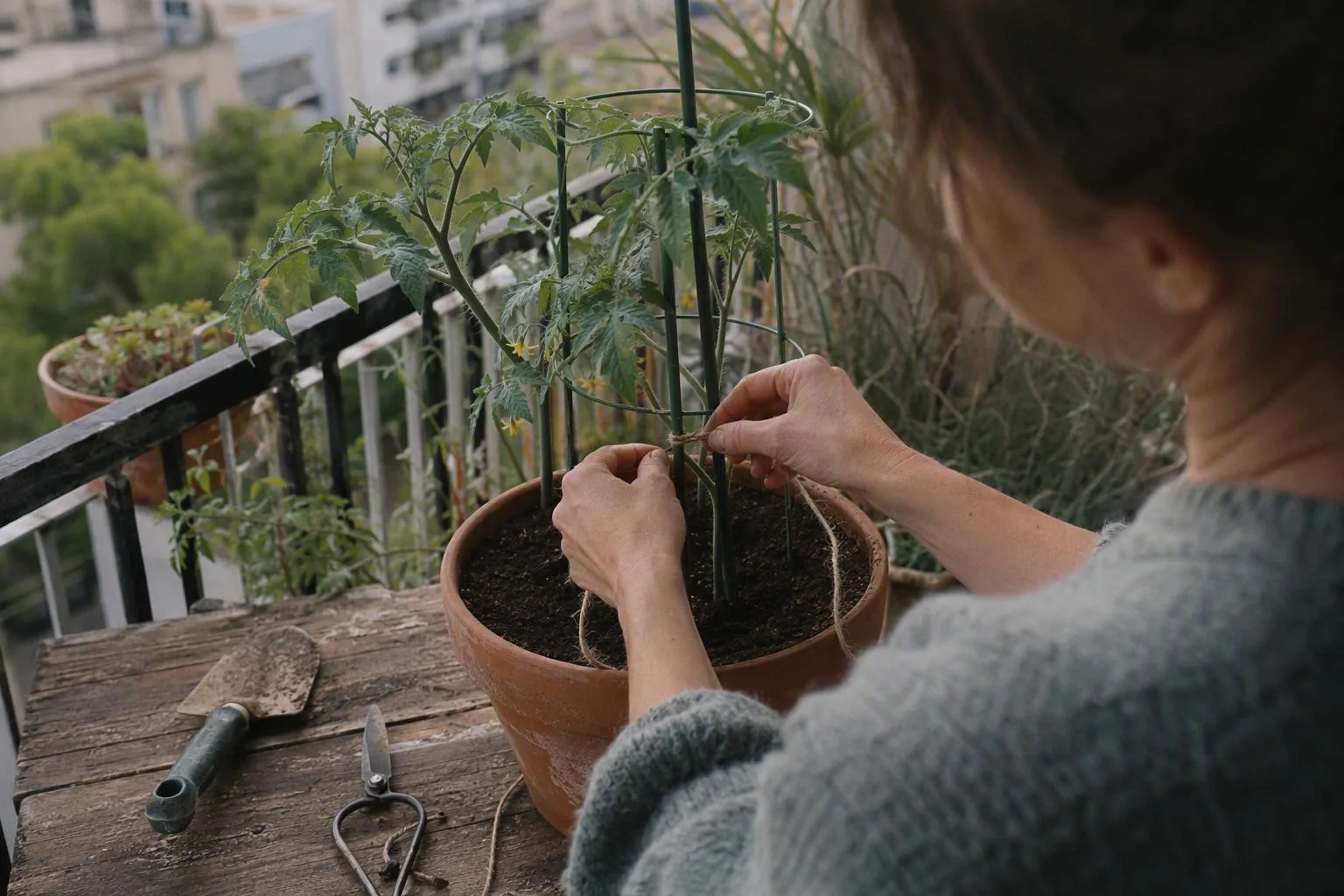
Plan on six to eight hours of direct sun. Install the stake or cage before the root ball fills the pot, because pushing a support through established roots is an avoidable injury. With an ungrafted plant, remove the lowest leaves and bury part of the stem so extra roots can form along it. Do not bury the graft union on a grafted plant.
Water deeply when the mix has begun to dry, then let the excess drain. Irregular wet-dry swings in a small, hot pot can interfere with calcium movement to developing fruit and produce blossom-end rot symptoms: a dark, sunken patch at the fruit’s blossom end. That symptom is not a reason to dump random calcium into the pot before fixing the watering pattern. Weak, stretched stems and few flowers point more toward insufficient direct light than toward a lack of tomato feed.
Feed after the first flowers or fruit set according to the product label, because the plant’s demand and the fertiliser concentration vary. Harvest cherry tomatoes when they have reached the colour shown for the variety and yield slightly to a gentle touch. A fixed yield figure would be misleading here; variety, light, pot size, weather and watering all change the result.
For the sizing calculation behind this recommendation, see How Much Soil Does a Tomato Need in a Pot?
8. Peppers are slower to start, but forgiving once warm
Peppers earn a place on an easy-pots list only when you can offer warmth. Choose a compact sweet or hot variety and use roughly 10–20 L (2.6–5.3 gal) of mix per plant, with at least 20 cm (8 in) of usable depth. Six or more hours of direct sun helps, but cold nights can stall a well-lit plant at the start of the season.
Keep the root ball evenly moist without leaving the pot sitting in runoff. Cold, saturated roots stay inactive, while repeated drying can cause flower drop and small fruit. Excess nitrogen can produce a leafy plant with fewer pods, so use a crop-appropriate fertiliser rather than repeatedly applying a high-nitrogen general feed.
Sunscald appears as pale, bleached or papery patches on fruit exposed to intense sun; underwatering usually shows first as limp leaves, dry mix or leaf-edge damage. Pick sweet peppers green for an earlier, firmer harvest or leave them to develop the variety’s mature colour for a sweeter flavour. Hot-pepper intensity varies with cultivar and growing conditions, so the colour alone is not a reliable measure of heat.
9. Patio cucumbers work when the roots stay cool and the vines go up
Look for bush, patio or compact cucumber on the label instead of an unrestricted vining type. Give one plant about 20–30 L (5–8 gal) of mix, a stable trellis or obelisk and as much direct sun as the balcony provides. Put the support in place before planting. Fast cucumber growth means a small root ball can move from adequately moist to stressed in a short time, especially in wind or heat.
Check the mix at flowering and while fruits are swelling rather than following a fixed calendar. Water at the base where possible, because leaves that stay wet overnight create a more favourable surface for disease than leaves that dry promptly.
Cucumber flowers make the pollination problem easier to read. A female flower has a tiny cucumber-shaped swelling behind the petals; a male flower does not. If female flowers open and then drop with no fruit, hand-pollinate by moving pollen from a male flower to the centre of a female flower. A misshapen fruit with a narrow or pinched end commonly points to incomplete pollination, while a plant that repeatedly wilts and produces bitter or stunted fruit needs its heat and moisture pattern examined. Harvest according to the variety’s suggested size, before seeds become large and the flesh turns coarse.
10–11: Carrots and potatoes need depth, but not the same kind of depth
These two crops are often placed in the same deep pot, but their useful depth works differently. Carrots need the full column of loose mix from sowing. Potatoes gain additional mix around their stems as they grow. That distinction determines whether the container is productive or merely expensive to fill.
| Carrots | Potatoes | |
|---|---|---|
| Container | 25–30 cm (10–12 in) deep, with no stones | 30–40 cm (12–16 in) usable depth; 20–40 L (5.3–10.6 gal) |
| Planting | Sow 0.5–1 cm (¼–⅜ in) deep and thin seedlings | Start with 10–15 cm (4–6 in) mix; plant seed potatoes 5–10 cm (2–4 in) deep |
| Watering | Keep the seed zone evenly moist until emergence | Keep the growing column moist, never permanently saturated |
| Harvest signal | Check shoulder size and pull a test root | For storage potatoes, wait for yellowing, dying tops; new potatoes can be earlier |
10. Carrots
Choose short or round-rooted carrots if the container is less than 30 cm (12 in) deep. Sow directly into a fine, stone-free mix; carrots dislike the root disturbance that comes with transplanting. Thin gradually until the roots have room to swell. Forked carrots usually reflect a stone, clod or compacted patch blocking the growing root rather than a simple shortage of fertiliser. Split carrots often follow a dry spell followed by abundant water, when the root expands faster than its outer tissue can accommodate.
A 10 L pot can hold a useful handful of short carrots, but the exact count depends on diameter and spacing. Harvest when the shoulders reach the size shown for the variety, loosening the mix before pulling. If the tops are tall but roots are thin, check crowding and light before adding more feed.
11. Potatoes
Use a tall pot or grow bag with 30–40 cm (12–16 in) of usable depth. A 20–40 L container suits a small planting of roughly two or three seed potatoes, depending on their size and the final spacing. Start with 10–15 cm (4–6 in) of mix, set the seed potatoes 5–10 cm (2–4 in) deep, and water enough to settle the mix without turning it into sludge.
As shoots grow, practise hilling: adding more mix around the stems in stages. The purpose is to cover lower stem sections where additional tubers can form, while keeping the growing tips and enough leaves above the surface. Add mix when the shoots are roughly 15–20 cm (6–8 in) tall, leaving the top foliage exposed. Burying the whole plant at once removes its working leaves and slows the crop.
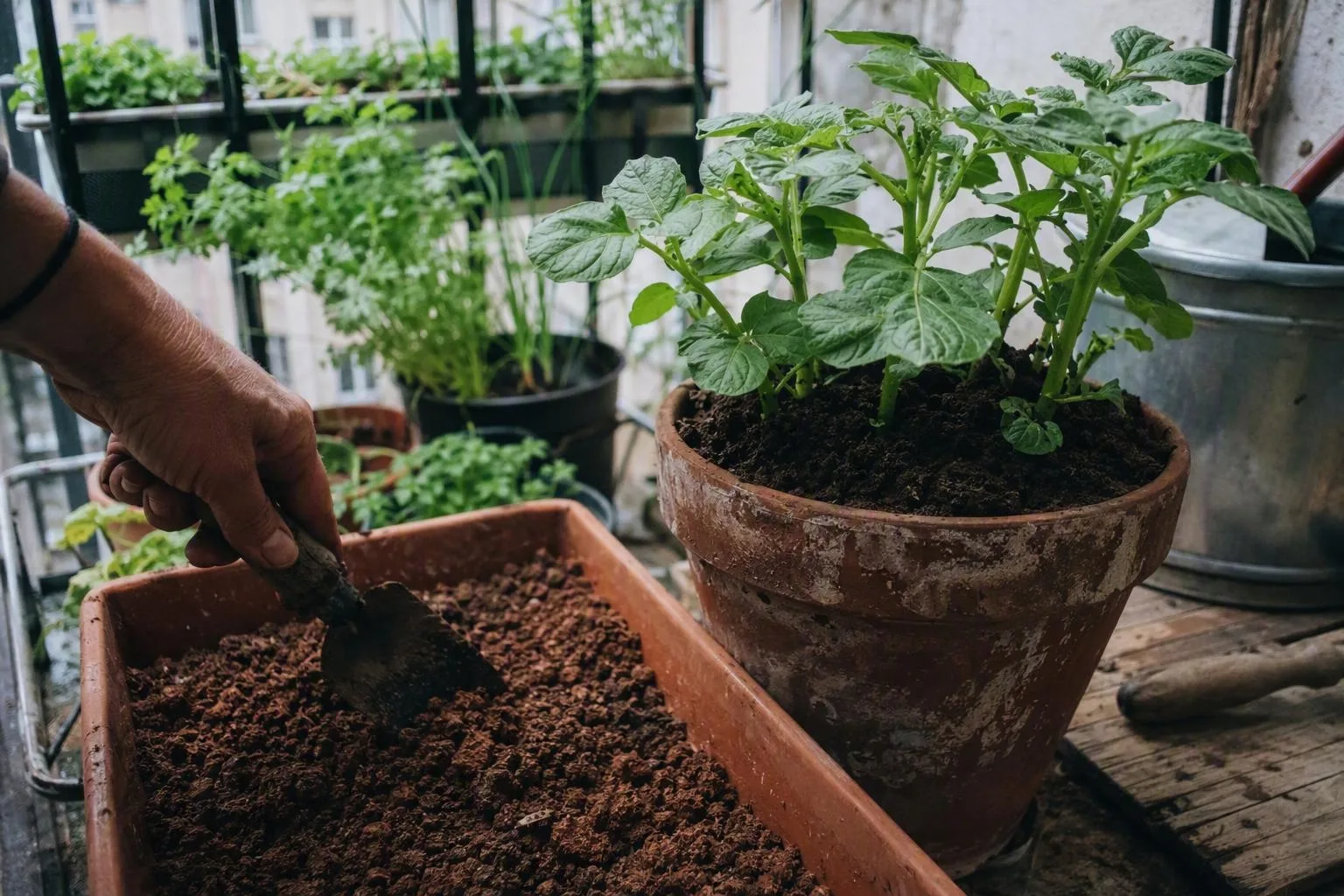
Low potato yields usually begin with too little healthy leaf growth, too many seed potatoes for the available volume or uneven moisture. Green tubers show that light reached the developing potato, often because mix settled away from the tuber or the container was not topped up. For storage potatoes, harvest after the tops yellow and die back; for new potatoes, the timing depends on the variety and the size you want. Potatoes are enjoyable in pots, but I would not choose them if the goal is the greatest amount of food per litre of mix.
12. Dwarf blueberries are a conditional easy win, not a universal beginner crop
Blueberries belong on this list only if you are willing to manage an acidic root zone. Choose a compact, container-suitable cultivar and provide roughly 30–50 L (7.9–13.2 gal) of acidic mix, 30–50 cm (12–20 in) of usable depth, reliable drainage and consistent moisture. A pH around 4.5–5.5 is a common working target for blueberry roots, but the cultivar label and the actual test result matter more than a guessed number.
Ordinary multipurpose mix can gradually move away from the preferred range as it breaks down and irrigation water adds dissolved minerals. Bark-based acidic mixes and fertilisers formulated for acid-loving plants are used to keep the root zone suitable; follow the fertiliser label rather than applying a stronger dose. Test the mix instead of diagnosing from leaf colour alone. Pale new leaves with veins that remain green can indicate poor iron availability at a high root-zone pH, while drought more often produces general wilting, dry edges or a pot that is light to lift.
Some blueberry cultivars set more reliably when a compatible second cultivar flowers nearby, so check the plant labels before buying one. Protect ripening fruit from birds and prune weak, crossing or very old stems according to the cultivar’s habit. If the label is vague, compare it with university or extension guidance on acidic mix and pollination. If you cannot source acidic mix and monitor it, strawberries are the safer first fruit.
My first-season shortlist: buy for your light, not for the biggest harvest claim
Choose one of these three plans rather than trying to squeeze all 12 crops onto a first balcony.
- One pot or part-sun starter: radishes, leaf lettuce and Swiss chard. Add peas in the cool season if you can give them a free-standing support. These crops let you harvest leaves or roots without waiting for a large fruiting plant to mature.
- Full sun with daily water access: strawberries, bush beans, a compact cherry tomato, peppers or a patio cucumber. Pick one fruiting plant first, then add another only after you know how quickly the pot dries.
- Higher-effort choices: potatoes, because of their staged hilling; cucumbers, because of their thirst and trellis; and blueberries, because of acidic mix and pH management. They are worthwhile, but they are not the crops I would use to learn every container lesson at once.
Your basic shopping list is short:
- Containers with open drainage holes, sized from the table. A shallow tray suits radishes and lettuce; a 20–30 L pot is the more useful tomato or cucumber purchase.
- Quality potting mix with a coarse structure. Garden soil is usually too dense and heavy for the restricted, aerated root space of a container.
- Saucers for catching runoff, used temporarily rather than as a permanent water reservoir. Let the pot drain, then empty the saucer.
- A free-standing stake, cage, net or obelisk for peas, tomatoes and cucumbers. Check that the support will not turn the pot into a wind sail.
- Labels and a crop-appropriate feed. Write the sowing or planting date on the label so a slow pepper is not mistaken for a failed one.
On an elevated balcony, check the building or landlord’s weight and placement rules before filling a large container. Spread heavy pots over the strongest area rather than concentrating several waterlogged containers at an exposed edge. For edible crops, do not assume treated timber or an unknown glazed ceramic is food-safe; check the material information. Food-safety guidance on lead in glazed ceramics and treated timber is worth consulting before using salvaged containers or building a planter.
Finish with a seven-day test before buying more plants. Put the empty pot in its intended spot and observe direct sun and wind. Fill it with the planned mix, water until it drains freely, and feel the mix at 24, 48 and 72 hours. If it is bone-dry by the second day, move to a larger or less exposed pot, add shade during the hottest period or plan a more reliable watering routine. If it is still sodden on day three, fix the drainage or mix before planting.
By the end of the first week, the chosen plant should have firm leaves and compact new growth rather than stretched stems. Your next physical action is simple: place one correctly sized, empty pot in the sunniest workable position and run that moisture test before spending on seeds or seedlings.