Growing Eggplant in Containers: The 20-Litre Starting Point
A 20-litre (5.3-US-gallon) pot is the practical starting point for one eggplant, not a licence to crowd several plants together. If you can manage 30 or 40 litres (7.9 or 10.6 US gallons), you’re buying more moisture and nutrient buffer, not replacing sunlight or good watering.
That distinction matters on a balcony. Eggplant is generous once it is warm and growing, but a small container gives you less room for a missed watering, a windy afternoon or roots that have filled the mix.
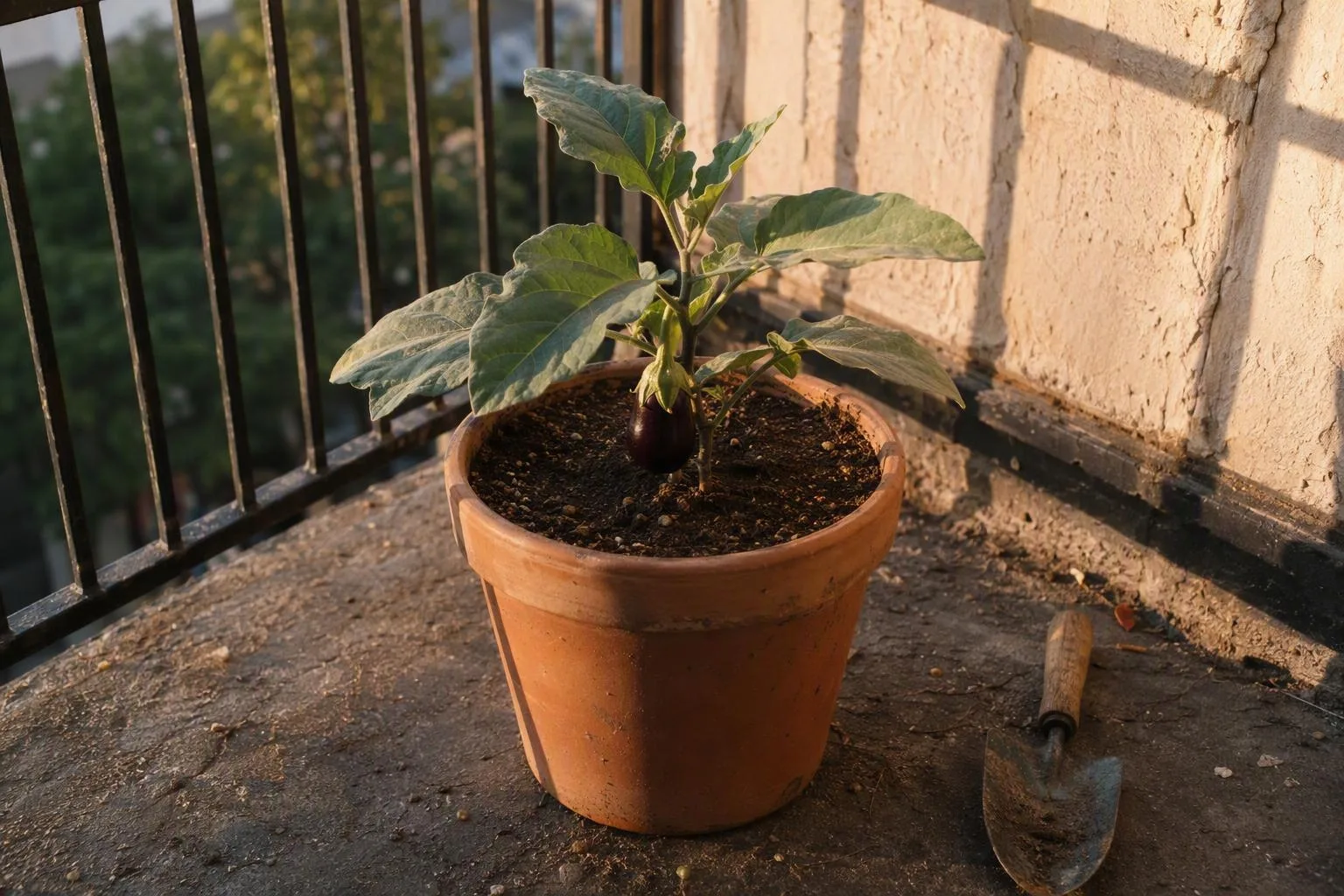
Start with one plant in 20 litres (5.3 US gallons), not a crowded pot
For a first container, I’d buy one sturdy 20-litre pot and one compact eggplant rather than a bigger pot containing two seedlings. One plant has access to the whole root volume, the foliage dries faster after watering, and you can actually see whether the pot is getting too dry before the plant begins dropping flowers.
In my own balcony setup, I grew the compact ‘Fairy Tale’ in a 20-litre black plastic pot against a south-facing wall. The spot received around six hours of direct sun. I transplanted it after a run of nights above about 10°C (50°F), watered the root ball thoroughly, and kept it beside the wall for its first week rather than leaving it exposed to the railing wind. On the ninth day, I missed a morning check during a hot, windy spell. The leaves sagged by afternoon, and a few open flowers dropped over the following week. After I returned to morning checks and added a loose surface mulch, the plant pushed on and set several slim fruits by late summer. It wasn’t a basketful of eggplants, but it showed me exactly where the 20-litre starting point works and where it leaves little room for sloppy watering.
| Container | Best use | Moisture margin | Balcony planning |
|---|---|---|---|
| 20 L / 5.3 US gal | One compact or small-fruited plant | Smallest useful buffer; check often in heat | Easiest of these sizes to position, though wet mix is still heavy |
| 30 L / 7.9 US gal | One vigorous compact plant or medium-fruited type | More forgiving between waterings | Heavier and harder to move once planted |
| 40 L / 10.6 US gal | One large-fruited plant with a substantial stake or cage | Best buffer of the three | Plan its final position before filling it |
Read the table as a margin guide, not a yield promise. A 30-litre pot won’t turn a shaded balcony into a productive one, and a 40-litre pot still needs one plant if the root system and canopy are to have useful room. My judgement is that 20 litres is enough to start with a compact variety, while 30 litres is the more relaxed choice if you’re likely to be away for a day or two.
I treat roughly 30 cm (12 in) of internal depth as a useful minimum. A container that is wide but shallow can dry across its full surface quickly and may tip when the plant becomes top-heavy. A roughly cylindrical or gently tapered pot at least 30 cm deep gives the root ball room below the stem and makes it easier to fit a stake without placing it directly against the main roots.
Use the volume printed for the container as a guide, but remember that the advertised capacity can be larger than the actual amount of mix you add. Drainage cones, thick rims and the empty space below the rim all reduce usable volume. Fill the pot to about two fingers below the rim. That small gap gives you somewhere to pour water without it immediately running over the sides.
Choose a light, quality potting mix rather than garden soil. Garden soil can settle into a dense mass in a pot, leaving less air around the roots after repeated watering. A container mix should hold moisture while still leaving air-filled spaces, because roots need both water and oxygen. I don’t add a layer of gravel to the bottom. Gravel may look like a drainage solution, but it doesn’t create extra room for water to leave; it can move the boundary between saturated mix and drier mix higher inside the pot.
Picture a cutaway pot after watering. The top can feel dry while the lower mix remains wet. That lower wet zone is sometimes called a perched water table: water hangs in the finer potting mix above the drainage holes instead of behaving like water moving through an open bucket of stones. Several unobstructed drainage holes, a pot standing level, and a mix that has not collapsed into sludge are more useful than gravel.
Put the empty pot in its final position before adding mix. A 40-litre container is awkward to shift after watering, and even the 20-litre size becomes substantially heavier when saturated. Keep it on a stable surface rather than a narrow ledge, leave room for air to move around the drainage holes, and check your building’s balcony guidance if the container is large or the space is elevated. For the wider sizing logic, best container size for vegetables is a useful companion, but the same rule applies here: size for one plant’s root room and moisture buffer, not for the number of seedlings you can physically squeeze in.
Transplant only when the balcony is warm enough: sun, timing and the first 14 days
Eggplant needs a long, warm, bright run to justify its space. I aim for about 6 to 8 hours of direct sun, meaning sunlight actually reaches the leaves rather than the balcony simply looking bright. A position with 1 or 2 hours may keep a plant alive and leafy, but I’d choose another crop if dependable fruit is the goal.
For a 20-litre pot, I favour a compact, early or small-fruited variety over a plant bred to make very large eggplants. The smaller plant is easier to support and usually reaches a useful harvest size before the season runs out. That isn’t a rule against large-fruited types; it’s a square-footage decision. If the seedling already fills a large pot at the garden centre, give it more volume and a stronger support plan.
A nursery plant is the easier route for a first attempt because you’re buying a head start on the warm season. If you raise eggplant from seed, avoid rushing the seedling outdoors simply because it has several leaves. Its roots and stems still need a gradual transition from protected conditions to direct sun, wind and cooler nights.
Harden the plant off over roughly 7 days. On the first day, give it a short period outside in bright shade and shelter from strong wind. Add more outdoor time each day, introducing direct sun gradually. Bring it back under cover if the night will be cold or the leaves are being battered. The purpose is not ceremony; it is to reduce the sudden jump in water loss from leaves and to let the plant adjust to stronger light.
I wait until nights are consistently around 10°C (50°F) or warmer before leaving eggplant outside. A single warm afternoon can be misleading if the following nights are cold. If you want a second opinion on your local frost-free date, a regional extension or agricultural service is usually the place to check. Use that information alongside the actual nighttime temperatures at your balcony, which may be colder than a sheltered garden.
Plant in this order, not by improvisation:
- Check that water can leave through several holes and that the pot is already in its final position.
- Moisten the potting mix before planting so the first watering doesn’t leave dry pockets.
- Make a hole just large enough for the root ball.
- Set the seedling at the same depth it was growing in its original container. Eggplant isn’t a tomato; there’s no need to bury a long section of stem.
- Firm the mix gently around the root ball, then water slowly until a little drains from the holes.
- Keep the plant sheltered from strong wind for the first week while the roots make contact with the surrounding mix.
The first 14 days are a settling period rather than a race to force growth. Keep the mix evenly damp, but don’t water again just because the leaves look slightly soft in the afternoon. Check the mix first. Hold off on extra liquid feed until the plant has begun making fresh growth, usually around 2 to 3 weeks after transplanting, unless the mix label gives different instructions.
Cold shock can look like several other problems: new growth stalls, leaves curl or hang, and flowers open then fall without making a small fruit. Wind damage can leave torn edges and pale scuffed patches. If the pot is cold and wet, adding more water won’t solve either problem. Move the plant into a warmer, more sheltered position and let the root zone regain temperature.
The broader balcony planning question is covered in growing vegetables in pots on balcony, but eggplant deserves a stricter light check than many leafy crops. Before buying the plant, watch the proposed spot at breakfast, midday and late afternoon on one clear day. You’re looking for the hours when direct light reaches the pot, not just the brightest-looking corner.
From a 2-centimetre dry surface to ripe fruit: the weekly watering, feeding and support rhythm
Once the plant starts making new leaves, I stop thinking in terms of a fixed watering calendar. The useful test is not the calendar; it’s the condition of the mix and the weight of the pot. Push a finger 2 to 3 cm (about 1 in) into the surface, and lift the container slightly if you can do so safely. A light pot with dry mix at that depth needs water. A heavy pot with damp mix usually needs time, not another drink.
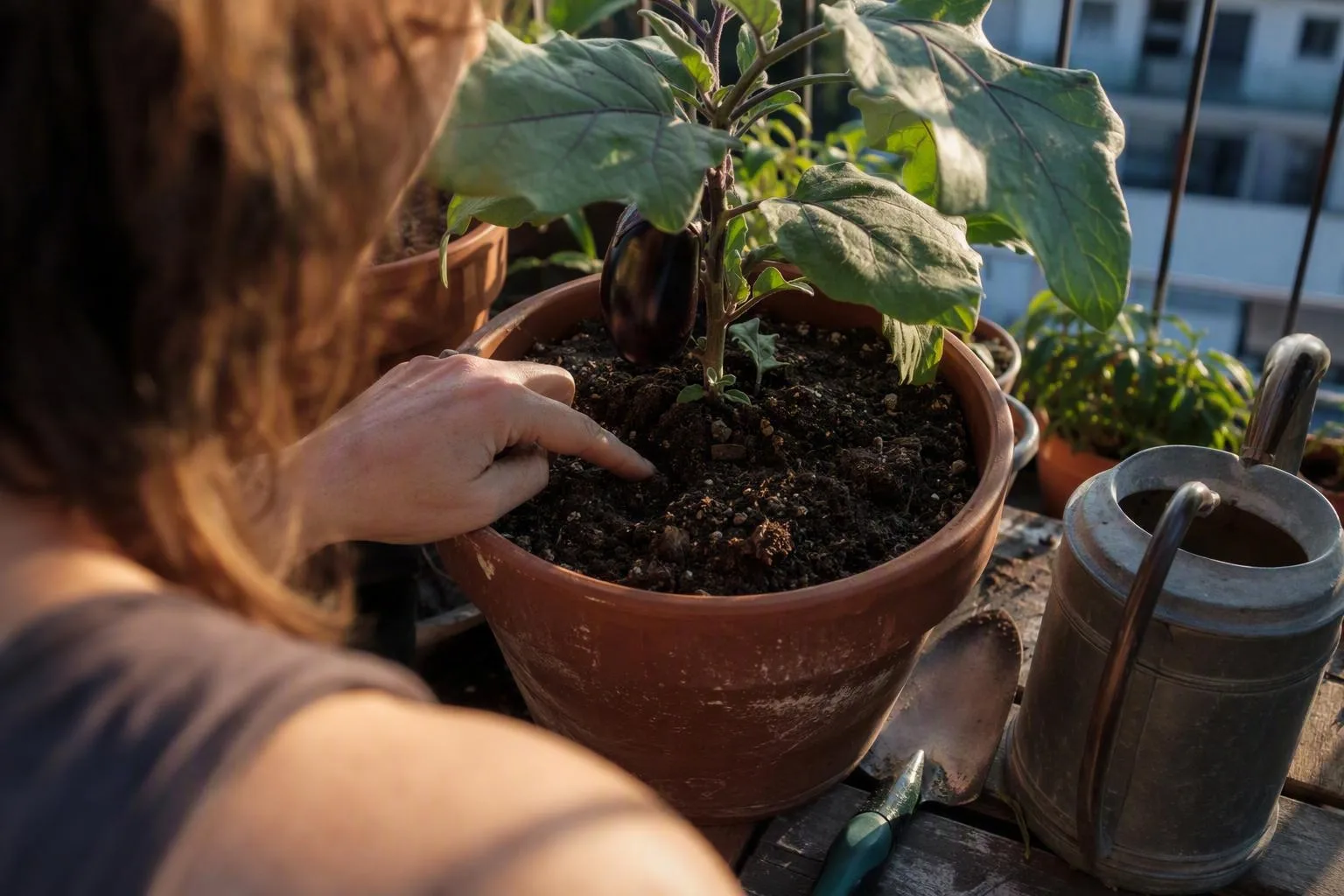
When watering, pour slowly over the surface rather than dumping a whole can in one spot. Let the first water soak in, then make a second pass until a small amount runs from the drainage holes. This wets more of the root zone and gives you evidence that water has travelled through the container. Empty standing water from a saucer after the pot has finished draining; keeping the bottom submerged turns a drainage hole into very little practical drainage.
A plastic pot in full sun may need a daily check during hot, windy weather. A glazed pot in part shade may go 2 or 3 days between checks in milder conditions. Those are checking intervals, not promises. Pot colour, wind, humidity, plant size and the mix itself can flip the answer. A large plant in a 20-litre pot can use water much faster than a small transplant in the same container.
Use this quick decision tree when the leaves look wrong:
- Dry surface, light pot, limp leaves: water slowly and check again later in the day. If the leaves recover and the mix is no longer dusty, thirst was a reasonable first diagnosis.
- Wet surface, heavy pot, limp leaves: don’t add water. Check the drainage holes, saucer and lower stem. Heat, root stress or poor oxygen around the roots can all produce wilt while the mix is wet.
- Dry top but water runs straight down the sides: the mix may have shrunk away from the container or become difficult to re-wet. Water in several small passes, or stand the pot in a shallow tray briefly so the bottom can draw up moisture, then let it drain fully.
- Leaves recover after watering but flowers keep dropping: look beyond the last watering. Check night temperature, wind exposure, direct sun and whether the plant is swinging between very dry and very wet conditions.
During a heatwave, check in the morning and again in the late afternoon. If the mix is dry, water it. If the mix is already wet and the plant is wilting, move it out of a hot wind or give it temporary afternoon protection rather than adding more water. I’d rather lose a little peak afternoon light for two days than keep a waterlogged root zone while trying to treat heat stress.
Feed around 2 to 3 weeks after transplanting, once the plant has settled and is producing fresh growth. Then follow the label for your chosen fertiliser; liquid feeds are often used at 7- to 14-day intervals, but concentration and product instructions differ. Apply feed to damp mix rather than bone-dry roots. Repeated watering carries soluble nutrients out through the drainage holes, so an established container plant eventually needs nutrients replaced. The answer to slow growth isn’t automatically more fertiliser: cold roots, low light, wind and a cramped root zone can all slow the plant.
If the plant is dark green and leafy but makes few useful flowers, pause any nitrogen-heavy feeding and review the light and moisture pattern first. Extra leaf growth can make the pot harder to manage without fixing the condition that is preventing fruit set. That is one of my less fashionable container-growing opinions: I’d accept a slightly smaller plant with steady flowers over a luxuriant plant that fills the balcony and produces very little.
Install a stake or small cage at planting, before the root ball fills the pot. For a compact plant, roughly 60 to 90 cm (24 to 36 in) of usable support above the soil is a sensible starting point. Tie the main stem loosely as it grows, leaving room for thickening. Large-fruited varieties may need more support because the fruit pulls branches outward, especially when a balcony wind catches the foliage.
When flowers appear, give the plant a gentle shake or tap the support around midday if the air is still. Eggplant flowers contain the parts needed for pollination, but movement helps distribute pollen within the flower. Don’t shake hard enough to snap stems; a light vibration is enough. If flowers drop during a cold spell or when the pot has repeatedly dried out, tapping alone won’t correct the underlying stress.
If peppers are your other warm-season crop, growing peppers in containers follows a similar sun-and-moisture logic, though the final pot choice and harvest signals differ.
Flowers, fruit and the three failures that decide the harvest
By the time eggplant flowers, most container failures are visible in the pattern of growth. I look at the whole plant and the pot before reaching for a bottle of feed. The same wilt can mean thirst, overheated leaves or roots sitting in wet mix, so the fix depends on the trigger.
1. Too little sun or too little root volume
A plant that stretches toward the brightest side, has long gaps between leaves and makes few flowers is asking for a light check first. A plant that flowers but dries out almost immediately may be telling you that the container is too small for its canopy, especially if it is also exposed to wind. Move the pot to the brightest safe position, remove competing plants from the container, and upgrade to 30 or 40 litres if the root ball has filled the available mix.
A larger pot can buy water-buffering time; it cannot manufacture sunlight. If the balcony receives only 1 or 2 hours of direct sun, I’d use that space for herbs or leafy crops and treat eggplant as an experiment rather than a planned harvest crop.
2. Dry-wet swings
Repeatedly letting the mix become very dry and then flooding it stresses the plant in two opposite ways. First, the roots have too little available water. Then, after a heavy watering, the lower mix may have too little air. Flowers are often the first part of the plant to be abandoned when moisture, heat or wind keeps changing faster than the roots can respond.
The repair is boring but effective: check the top 2 to 3 cm every day during a hot spell, water thoroughly when that layer is dry, and improve the pot’s shelter from drying wind. A thin surface mulch can slow evaporation, but it shouldn’t touch the main stem or be used to hide a blocked drainage hole.
3. Excess feed or poor drainage
Very lush leaves with few flowers can follow excessive nitrogen, low light or simply a young plant that has not reached its flowering stage. That is why I don’t diagnose it from leaf colour alone. If the mix stays wet for days, smells sour or the leaves wilt while the pot is heavy, inspect drainage before feeding again. Clear the holes, remove any standing water and let the container drain. If roots are brown and soft, recovery may be limited.
Flower drop can also follow cold nights, extreme heat, strong wind or a sharp change from dry to wet. The practical order is to check temperature and shelter, then check moisture, then review feeding. More fertiliser belongs near the end of that list, not the beginning.
Know when the fruit is ready
Use the seed packet for your chosen cultivar’s mature fruit size rather than forcing every eggplant to reach a particular length. That is especially important with compact varieties that are bred to produce slender or small fruit. As a general harvest test, pick while the skin is glossy and the fruit feels firm with a little give when pressed gently. Dull skin, a hard feel and very mature seeds usually mean the fruit has stayed on the plant too long.
Cut the stem with a short piece attached instead of twisting the fruit away. Some eggplant varieties have prickles on the calyx or stem, so gloves are sensible if you haven’t handled that cultivar before. Harvesting promptly also leaves the plant with less mature fruit to carry while it sets the next flowers.
One 20-litre pot is a modest harvest crop. In a suitable warm, bright season, several fruits are possible from one compact plant, but I wouldn’t attach a fixed yield to the container. Variety, transplant size, weather, pollination and the length of your autumn all matter. In my view, the right reason to grow one in 20 litres is that it can provide a few genuinely satisfying harvests without demanding a whole patio, not that it will replace the produce aisle.
Before you buy the plant, stand beside the empty pot and do three checks: confirm that water can leave through the holes, watch whether the proposed position gets close to 6 hours of direct sun, and make sure you can reach the top 2 to 3 cm of mix for daily checks. Buy the stake at the same time. A week after planting, you want to see new leaves holding their colour, a root zone that is damp but not saturated, and a stem that stays upright without being whipped by the wind.