Growing Lettuce in Containers: Pot Size, Sunlight and Yield
A 15 cm (6 in) deep pot can grow lettuce, but a full-size head still needs about 3–5 litres (0.8–1.3 US gal) of potting mix and 15–20 cm (6–8 in) of elbow room. That is the useful answer to how deep does a pot need to be for lettuce: 15 cm is a workable minimum for leaf types, not a promise that every shallow container will produce a full, crisp head.
With one balcony, patio or windowsill to work with, I’d spend money on enough root volume and a pot that can be watered properly before buying an elaborate planter. Lettuce is forgiving about container shape, but it is not forgiving about a thin layer of dry mix in a hot wind.
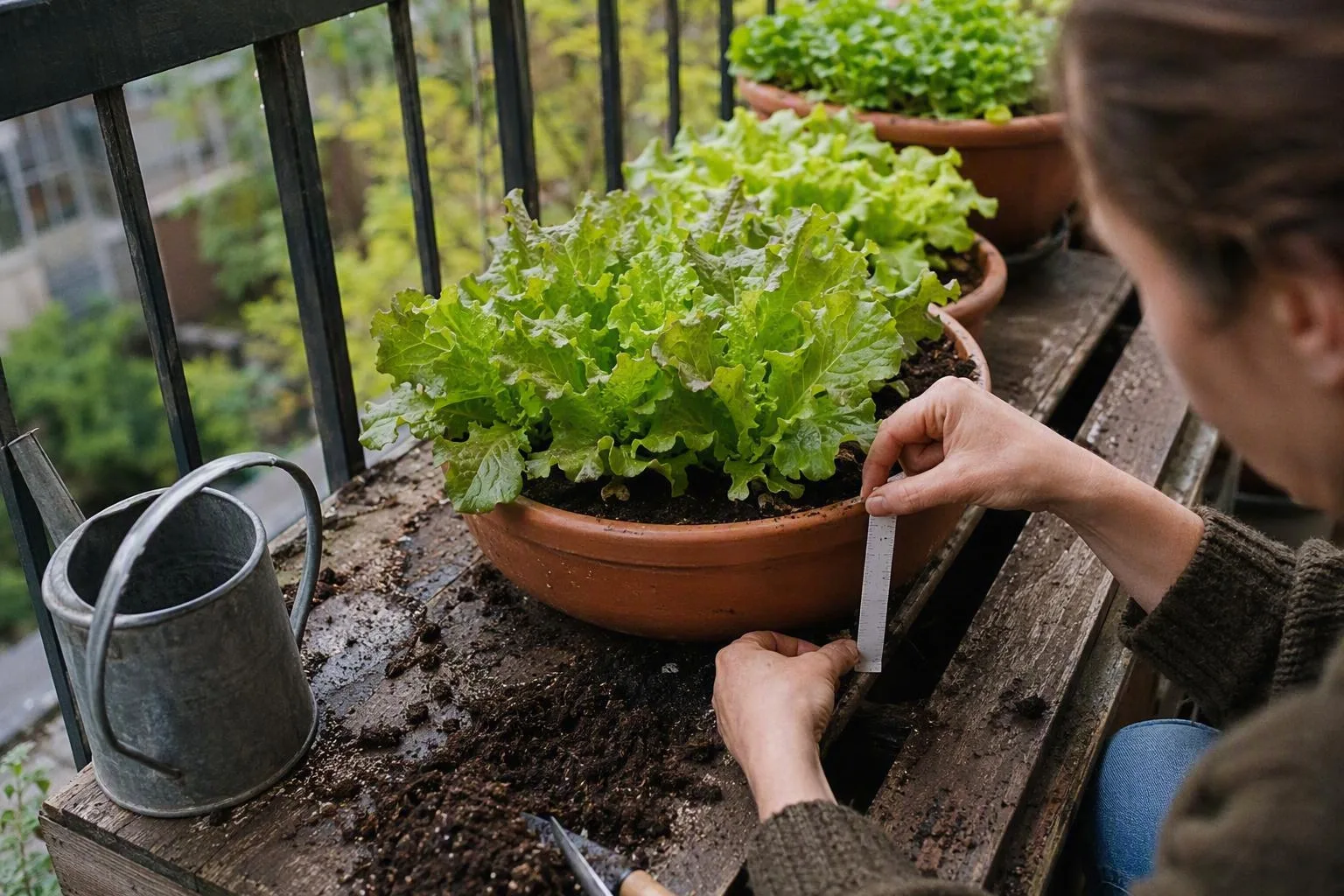
Start with the container: 15 cm depth and 3–5 litres of mix per full-size lettuce
Lettuce does not need a deep taproot like a carrot. The common loose-leaf, butterhead and small romaine types can make a useful crop in about 15 cm (6 in) of mix. What matters is that the root zone stays evenly supplied with water and air, and that the plant has enough surface area to expand without being crowded.
For planning, I allocate roughly 3–5 litres (0.8–1.3 US gal) of mix to each full-size head. That range is not a universal law for every cultivar; it is a practical container allowance built from the plant’s root volume, its 15–20 cm spacing and the need for a small water reserve between checks.
| Container | Approximate mix capacity | Good lettuce use | What to watch |
|---|---|---|---|
| 15 cm (6 in) deep pot, 15–18 cm (6–7 in) wide | About 2–3 L (0.5–0.8 gal) | Baby leaf or one small loose-leaf plant | Limited water reserve; check it closely in sun and wind |
| 20 cm (8 in) round pot, 15–18 cm deep | About 4–6 L (1.1–1.6 gal) | One full-size lettuce | A sensible single-plant unit for a compact head |
| 10 L (2.6 gal) pot | 10 L before headspace | Two or three compact heads, or repeated baby leaves | Plant count still depends on the pot’s width |
| 60 × 20 × 15 cm (24 × 8 × 6 in) window box | About 18 L (4.8 gal) before taper and headspace | A row of baby leaf or three to four compact heads | Use the inner dimensions; many boxes are narrower at the base |
The table uses nominal dimensions. A tapered window box will hold less than a perfect rectangle, and a pot filled two fingers below the rim has less mix than its advertised volume. That is why I treat the label capacity as a planning figure rather than an exact promise.
Spacing changes with the way you intend to harvest. Baby-leaf lettuce can sit about 5–8 cm (2–3 in) apart because you are cutting young leaves before the plants reach full size. Compact loose-leaf plants need around 10–15 cm (4–6 in). A heading lettuce that you want to mature as one recognisable head deserves about 15–20 cm (6–8 in).
In my own balcony setup, I once treated a 40 cm (16 in) window box as a wide, shallow tray and sowed lettuce across the entire surface. The box looked full and productive for the first few days, but a windy afternoon pulled moisture from the thin root zone faster than I expected. By late afternoon the leaves were limp, and the next watering ran down the sides instead of soaking evenly. The plants recovered, but growth stalled. I now treat depth and water reserve as one problem: a wide container is useful only if it also holds enough mix beneath the roots.
Choose the material with your watering habits in mind. Plastic usually loses water more slowly than unglazed terracotta, while terracotta can be useful if you tend to overwater and the pot is protected from hot wind. Glazed ceramic sits somewhere between those behaviours, although colour, wall thickness and position change the result. A dark metal container can heat the root zone quickly in direct afternoon sun, so I would reserve it for a cooler season or a shaded position.
Every container needs an unobstructed drainage route. Put mesh over the holes if you need to stop mix escaping, but do not seal the base with a solid layer. The gravel-in-the-bottom trick does not create more usable root space. Water moves through the fine potting mix and tends to remain perched above the coarser layer before it drains, leaving part of the shallow pot wetter than you intended. That saturated zone is the plain meaning of a perched water table: water held above a boundary inside the container.
Keep a saucer under the pot if you need to protect the balcony, then empty standing water after the container has finished draining. Wet potting mix also adds several kilograms to a large planter, before you count the pot itself. I keep heavy troughs on the floor or close to a supporting wall rather than hanging a freshly watered box from a railing. If you are unsure about the load your balcony can take, check the building or landlord guidance before grouping several large containers together.
The same volume calculation is useful for a mixed crop plan, so I use the best container size for vegetables as a reference point before choosing pots for lettuce, herbs or peppers. For a second opinion on the mechanics, compare university extension guidance on container vegetable soil volume, drainage and watering, then return to the simple test: does water soak through the full root zone without leaving the mix swampy?
Treat sunlight as a seasonal dial: 4–6 hours in cool weather, afternoon shade in heat
Do not decide on a lettuce position from the brightest patch you can see through a window. Direct light means the sun’s rays actually land on the leaves; a bright sky or reflected light can keep a plant alive while still producing thin, loose growth. Before sowing, put the empty pot in its intended place and check it at breakfast, midday and mid-afternoon for several days. Note when the sun reaches the pot, when a wall or neighbouring building blocks it, and whether the position becomes windy once the balcony is exposed.
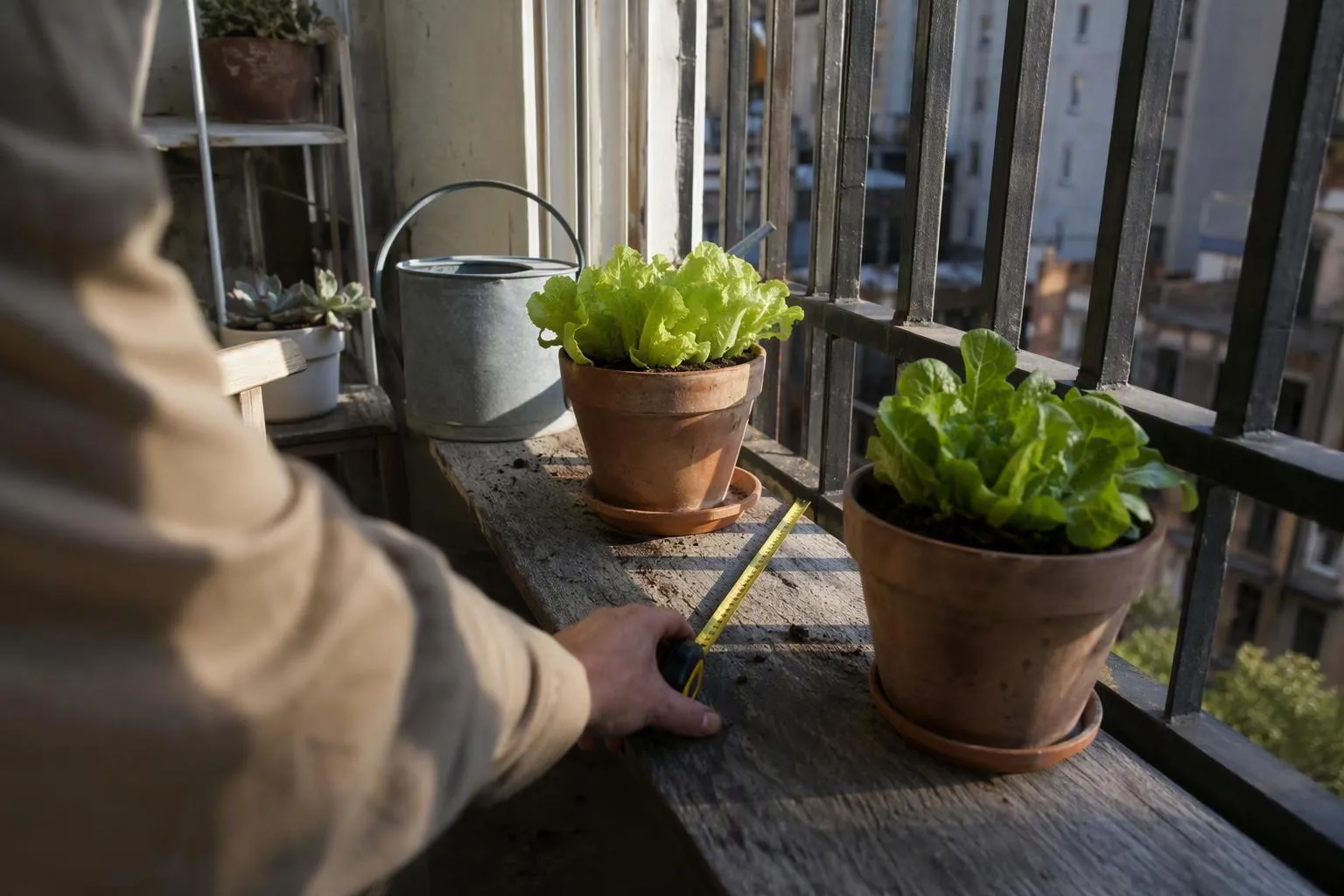
I use 4–6 hours of direct sunlight as a practical target for sturdy container lettuce, especially in spring and autumn when the air is cooler. A site receiving only 2–3 hours can still be worth trying for baby leaves, but I would expect slower growth and less compact plants than in the brighter position. That is a projection rather than a guarantee: if the leaves remain short, green and broad through the first few weeks, the spot is doing enough for the variety you chose; if the stems stretch and the leaves thin out, it is not.
The recommendation flips during hot weather. More direct sun helps lettuce in cool conditions, but strong afternoon exposure can heat the pot, increase water loss and encourage bolting. Bolting is the plant’s shift from making leaves to sending up a flower stalk. Once that stalk rises, the leaves often become more bitter and the useful harvest window narrows.
When a heatwave arrives, I would keep the pot in morning sun and give it bright afternoon shade rather than moving it into a dark corner. A position behind a light-coloured wall, beneath an open balcony above or beside taller plants can soften the hottest hours while preserving useful brightness. Shade should reduce the harsh afternoon beam, not turn the lettuce into a permanently dim houseplant.
This is one reason lettuce earns space in growing vegetables in pots on balcony setups: it can make leaves in a position that would be disappointing for tomatoes or peppers. It still needs enough light to stay compact, though. If the only available spot receives two hours of direct sun between buildings, choose loose-leaf lettuce, sow a small batch and judge the actual shape of the new growth before filling every container.
If you want to cross-check seasonal advice, look for university extension guidance on lettuce temperature, bolting and light requirements. I use that kind of reference for the broad seasonal pattern, but the balcony itself supplies the final answer because reflected heat, wind and shade from nearby buildings are specific to the site.
Sow for a moving harvest: 10–14-day repeats, baby leaves at 20–30 days, heads at 45–70
For a small growing space, I favour loose-leaf lettuce over a large heading variety. Loose-leaf lets you remove the outside leaves while the centre continues to grow, so one pot can stay useful for longer. Heading types are satisfying if you want a single, tidy harvest, but they occupy the same root volume for weeks and then arrive all at once.
Here is the container sequence I use:
- Fill and settle the mix. Use a fine, open potting mix made for containers, fill to about two fingers below the rim and wet it thoroughly before sowing. Pre-wetting stops the first watering from washing tiny seeds into one corner.
- Sow shallowly. Place the seeds about 0.5 cm (¼ in) deep and cover them lightly. Lettuce seed is small, so a deep covering can delay emergence and leave weak seedlings using their stored energy before they reach light.
- Keep the surface evenly damp. Use a gentle shower or water from below while the seeds are germinating. The top layer of a 15 cm pot can dry quickly because there is little reserve beneath it, especially beside a sunny wall or on an exposed balcony.
- Thin at the first true leaves. The first smooth seed leaves are not the plant’s mature foliage. Once the next set of recognisable lettuce leaves appears, snip out extras rather than pulling through the roots you want to keep. Leave 5–8 cm for baby leaf, 10–15 cm for compact loose-leaf and 15–20 cm for a full head.
- Feed only after establishment. Once seedlings have several true leaves and are actively growing, begin a light liquid feed if the mix is no longer supplying nutrients. If the bagged mix already includes starter feed, follow its label interval instead of adding fertiliser immediately. Apply any feed to already-moist mix so concentrated salts do not meet dry roots.
Succession sowing is the part that turns lettuce from one short harvest into a steady supply. Instead of filling every pot on one Saturday, start a small batch, then sow another 10–14 days later while the season remains suitable. On a balcony, that might mean one-third of a window box on day 0, a second third on day 12 and the final third on day 24. You can also use three small pots, which makes it easier to move the newest seedlings into better light or shade.
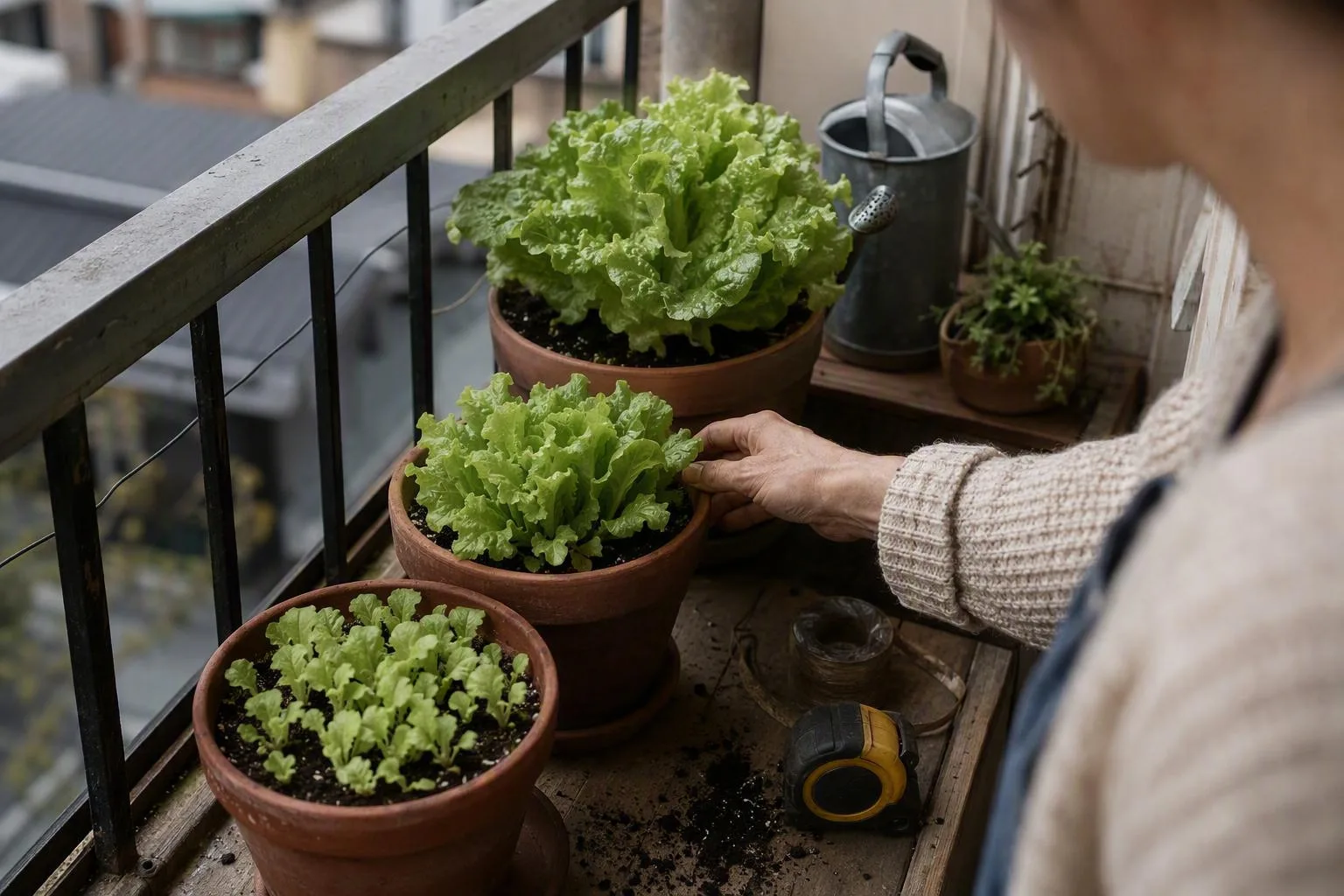
Count the harvest window from sowing as a working estimate, not a countdown timer. Baby leaves may be ready in roughly 20–30 days, while a compact full head often takes about 45–70 days. Variety, temperature, light and watering all move those dates. A cool spell can slow leaf expansion while preserving good texture; a hot spell can make the plant race towards a flower stalk before the head has filled.
Watering rhythm matters more than a fixed calendar. Check the mix with a finger 2–3 cm (1 in) below the surface, then water slowly until a little drains from the holes if the root zone is dry. In a small plastic pot in full sun and wind, that check may be needed daily. In a glazed pot in cooler part shade, the same lettuce may go several days between deep waterings. I would rather teach the reader to inspect the root zone than prescribe every-other-day watering that ignores the weather.
Do not let a seedling tray swing between bone-dry and saturated. Drying makes young leaves wilt and can interrupt growth; staying wet for long periods reduces the air spaces around roots. The practical target is damp mix with drainage, not a permanently shiny surface. Once the leaves are large enough to shade the soil, a thin layer of clean organic mulch can slow evaporation, but keep it away from the crown where the leaves meet the soil.
Harvest timing is also part of care. Pick loose outer leaves as soon as they are useful rather than waiting for every plant to reach maximum size during a hot spell. If you see a firm central stem rising above the leaves, the plant is bolting; harvest what is still pleasant, move the container into bright afternoon shade and start the next sowing rather than trying to force that plant back into head production.
The same cool-season rhythm is useful when you’re growing spinach in containers alongside lettuce. Both crops reward small, repeated sowings more than one crowded planting that matures during a week you are away.
Plan the yield by spacing, not optimism: what a 10-litre pot or 60 cm window box can return
A container yield is limited by three things working together: how much mix the roots can use, how much floor space each plant needs and whether you harvest once or repeatedly. More seedlings do not automatically mean more lettuce. They can simply divide the same water and nutrients into smaller, softer plants.
For a 10-litre (2.6 gal) pot, I would plan on two compact full heads if I want room for them to develop. Three small heads can fit when the variety stays compact and the plants are spaced around 15 cm (6 in), but that is the crowded end of the range. If the pot is tall and narrow, the volume may be adequate for roots while the rim is too small to give three plants enough light and leaf space. Shape matters as well as litres.
A 60 × 20 × 15 cm (24 × 8 × 6 in) window box has a nominal volume of 18 litres (4.8 gal), calculated from its length, width and depth before allowing for taper. That gives room for about three or four compact heads at 15–20 cm spacing if the box really holds close to 15 cm of mix. For baby leaf, sow in a short row and thin progressively, taking the thinnings as young leaves instead of leaving the whole box crowded.
Here is the planning example I would use for a small household. On day 0, sow two or three compact lettuce plants in a 10-litre pot. On day 12, sow a second small pot or another section of a window box. On day 24, make a third sowing if the weather is still cool enough. The first batch may provide baby leaves around days 20–30, while the later batches keep replacing it instead of leaving you with three mature heads on the same weekend. If you prefer whole heads, let the first group reach maturity and harvest it before the next group fills the same space.
Cut-and-come-again harvesting extends the picking window, but it does not create unlimited production from one plant. Remove the larger outside leaves with clean scissors and leave the centre growing point intact. The plant can replace some of what you take while conditions remain favourable. Once heat, drought or a flower stalk changes the plant’s direction, the replacement leaves become smaller or tougher, and it is time to clear the pot for the next batch.
My judgement is that one 10-litre pot is best treated as a salad supplement, not an endless supply. It can give you repeated handfuls of baby leaves or a couple of useful heads, but a household wanting lettuce every week needs several pots staggered through the season. That is a better use of limited balcony space than cramming six plants into one container and calling the resulting handful of leaves a harvest.
Read the failure before changing everything
| What you see | Look first at | Physical next step |
|---|---|---|
| Long, thin stems and widely spaced leaves | Too little direct light or seedlings left crowded | Move the pot to the brighter position and thin it promptly |
| Limp leaves with dry mix below the surface | Insufficient water reaching the root zone | Water slowly until the full mix is wet and drainage begins |
| Limp leaves while the mix stays wet | Poor drainage, heat around the pot or roots short of air | Stop adding water, check every hole and move the pot from reflected heat |
| Bitter leaves or a firm central flower stalk | Heat, missed watering or harvest delayed into bolting | Pick usable leaves now, add afternoon shade and sow the replacement batch |
Before the weekend, measure the inside depth of the container you already own, not the decorative outside wall. Put it in place for a three-day sunlight audit, mark a first sowing date and write the next one 10–14 days later on your calendar. In a week, the seedlings should be short and upright rather than stretched; by the third or fourth week, check the surface and the mix below it before you water again.
If this is your first season, the broader growing vegetables in pots for beginners checklist follows the same measure-first approach. Start with one pot, one small sowing and one honest observation of the light. That is enough to make the next container decision much easier.