Growing Spinach in Containers: Pot Size, Soil and Yield
A 30 cm (12 in) pot holding 10–15 L (2.6–4 US gal) of mix is my practical starting point for growing spinach in containers. In cool, evenly watered conditions, I’d plan on roughly 100–250 g (3.5–9 oz) of baby leaves from that pot over several cuts.
That harvest figure is a planning range, not a promise. Heat, drought, seed spacing and the variety you choose can move the result sharply, but the pot size gives you a sensible place to begin rather than a disappointing handful of leaves from an undersized container.
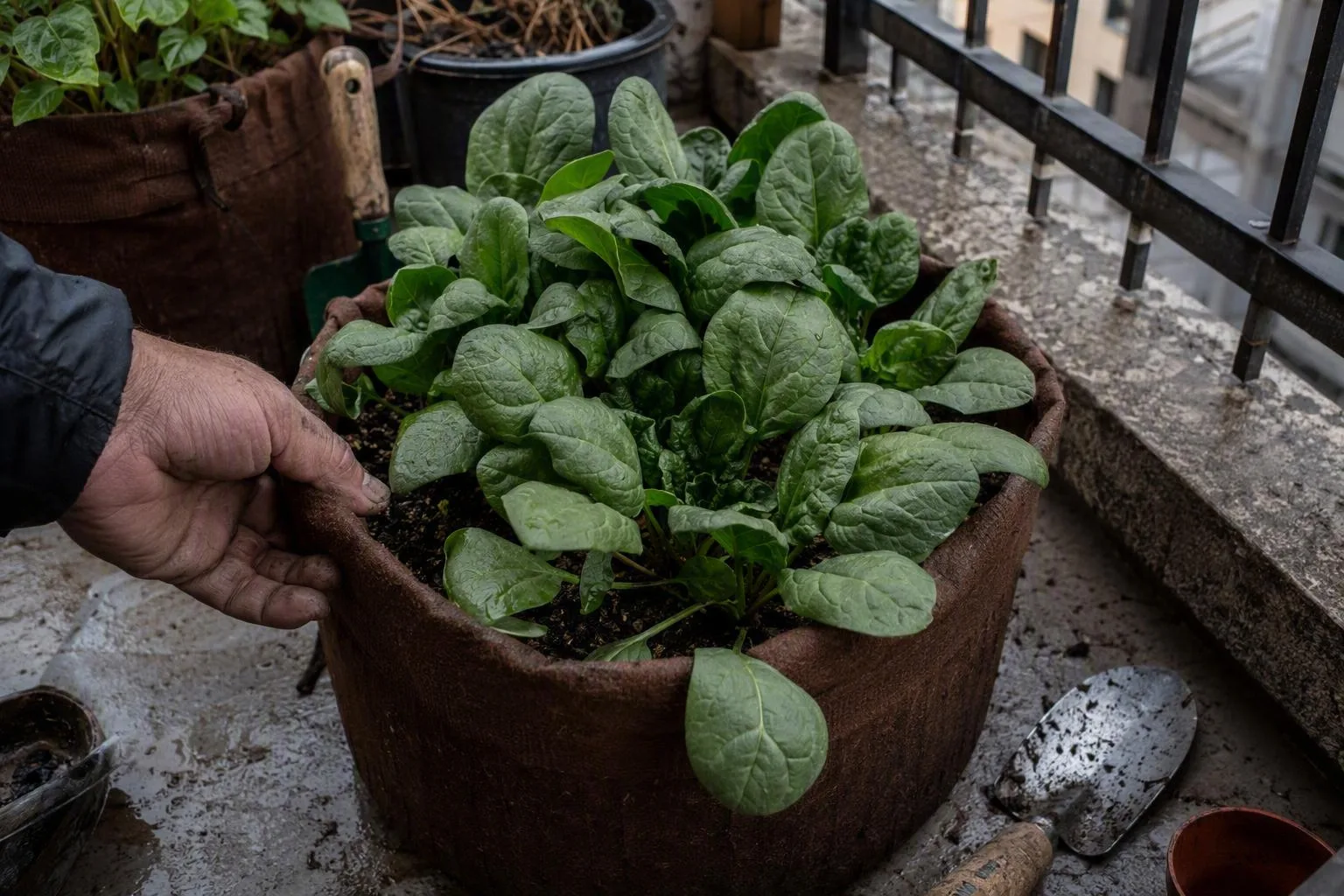
The practical starting point: 10–15 L in a 30 cm pot
For baby-leaf spinach, a pot about 15 cm (6 in) deep can work, but the shallow mix dries quickly and gives you less room for error. I’d choose a container about 30 cm (12 in) wide and 15–20 cm (6–8 in) deep if you have the space.
The useful distinction is width versus depth. Spinach produces a harvest from the leaves above the soil, so a broad surface lets you fit more plants at a usable spacing. Adding another 10 cm (4 in) of depth after the pot already reaches about 20 cm (8 in) usually contributes less harvest than adding another broad container beside it.
For a balcony, don’t buy the largest planter automatically. Wet growing mix is heavy, and wind can turn a tall, light planter into a tipping hazard. A stable, wide pot in a position where you can reach the leaves is a better starting choice than a deep container you’ll struggle to water evenly.
Choose the harvest before you choose the seed
Check the label before buying. True spinach is the cool-season leafy crop you want here. Perpetual spinach is a chard relative that is sold for spinach-like leaves; it can be useful, but it isn’t the same plant and may behave differently in heat.
Smooth-leaf spinach is easy to rinse and quick to pick. Savoy types have crinkled leaves and a fuller texture. Slow-bolting types are the better balcony choice if your spring warms quickly, because they give you a little more time before the plant switches from leaf production to a flowering stem.
I’d choose baby-leaf seed for a small pot. You can sow it more closely, harvest sooner and use the entire surface efficiently. If you want large leaves, buy a compact or slow-bolting type and give each plant 8–10 cm (3–4 in) rather than filling the pot with a dense carpet.
The phrase growing vegetables in pots covers many crops, but spinach rewards this kind of harvest-first planning more than a plant chosen only for its mature size.
The cool-weather window: 4–6 hours of sun, with shade in heat
Spinach is not a simple full-sun-or-no-sun crop. Aim for about 4–6 hours of direct sun, especially in spring and autumn. Two to four hours can still produce baby leaves, but growth will be slower. With only one or two usable hours, I’d expect a small, slow crop unless the window is exceptionally bright.
A useful growth band is roughly 10–21°C (50–70°F). Once temperatures rise above about 24°C (75°F), especially alongside long days and repeated drying, spinach is more likely to bolt. Bolting means the plant sends up a central flowering stem instead of continuing to make broad, tender leaves.
I decide sowing dates from the local forecast rather than a fixed calendar date. Spring and autumn are usually the easiest windows. Spinach can cope with light frost, but a pot has less insulating soil around its roots than a garden bed. Before a hard freeze, move the container against a sheltered wall, under a balcony roof or into an unheated protected space.
One spring on my balcony, I put a shallow spinach pot against a glass railing because it was the brightest spot. The leaves looked fine at breakfast and limp by late afternoon; the dark pot had heated up and the top layer was dry. Moving it into morning sun with afternoon shade stopped that daily collapse. I now treat spinach light as a seasonal placement problem, not a permanent address.
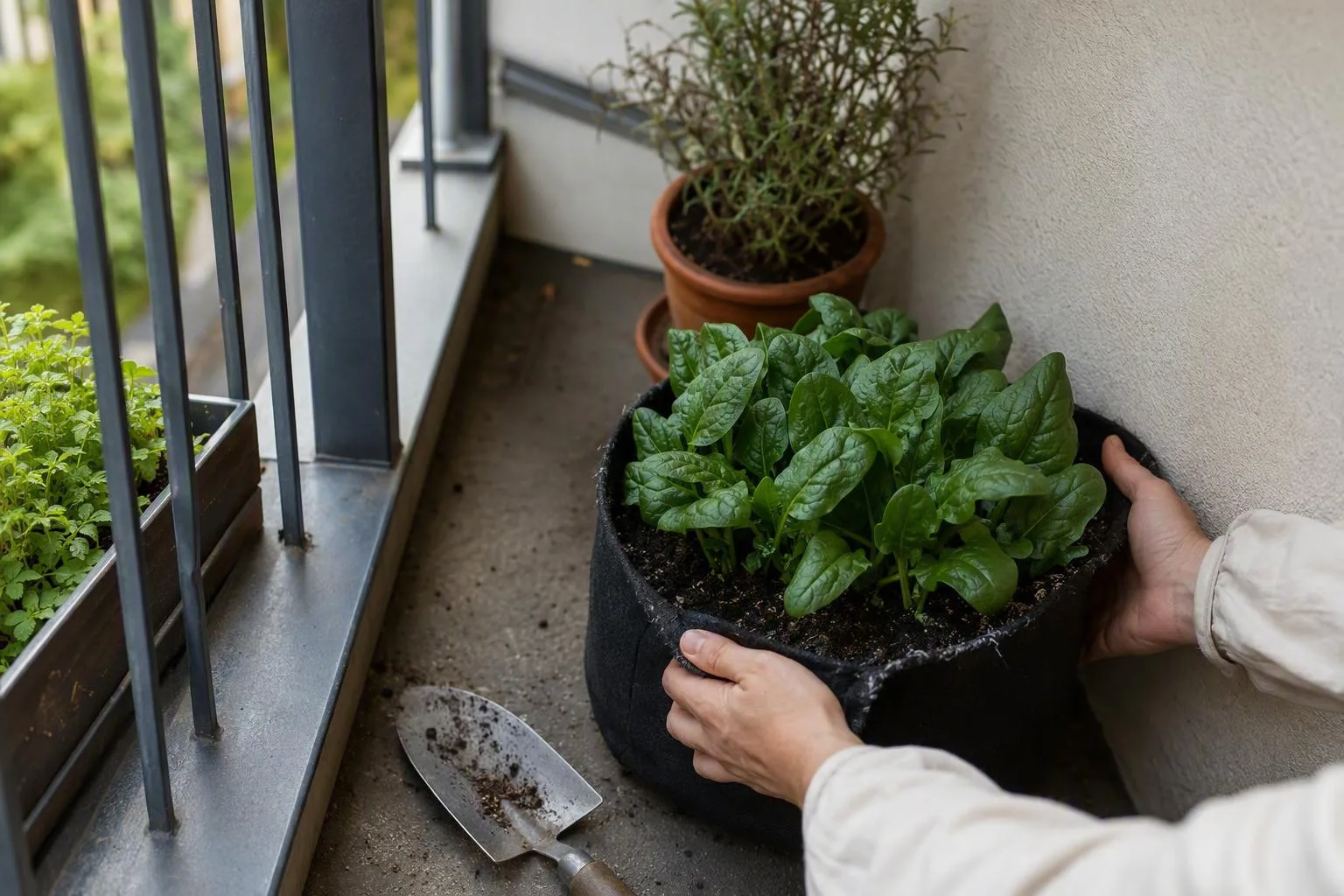
Pot maths on the shop floor: three sizes that work
Container labels can be misleading because they usually give outside dimensions, not the amount of mix left after taper, drainage space and the gap below the rim. These are practical usable-volume estimates:
| Container | Approximate usable mix | Best use |
|---|---|---|
| 20 cm (8 in) wide x 15 cm (6 in) deep | 3–4 L (0.8–1.1 US gal) | Small baby-leaf crop |
| 30 cm (12 in) wide x 15–20 cm (6–8 in) deep | 10–15 L (2.6–4 US gal) | Practical baseline pot |
| 60 x 20 x 20 cm (24 x 8 x 8 in) trough | 20–22 L (5.3–5.8 US gal) | Larger planting area |
For a round pot, estimate volume with π x radius x radius x depth. Keep all three measurements in centimetres, then divide the answer by 1,000 to convert cubic centimetres to litres. A 30 cm diameter pot that is 15 cm deep has a theoretical volume of about 10.6 L; at 20 cm deep, it is about 14.1 L. For a rectangular trough, multiply length x width x depth, then divide by 1,000. A 60 x 20 x 20 cm box calculates to 24 L before you allow for taper and headroom.
A tapered pot holds less than those simple calculations suggest. The narrower base is the reason I treat the table as usable volume rather than a promise from the manufacturer. The same calculation helps with the best container size for vegetables: look at root volume, planting surface and the weight you can safely support, not just the diameter printed on the label.
Ten to fifteen litres of wet mix can approach 10–15 kg (22–33 lb) before the pot, plant and saucer are counted. On a rooftop or balcony, keep heavy containers close to a supporting wall, spread them rather than clustering them at the outer edge, and check the building’s rules or load guidance if you’re unsure.
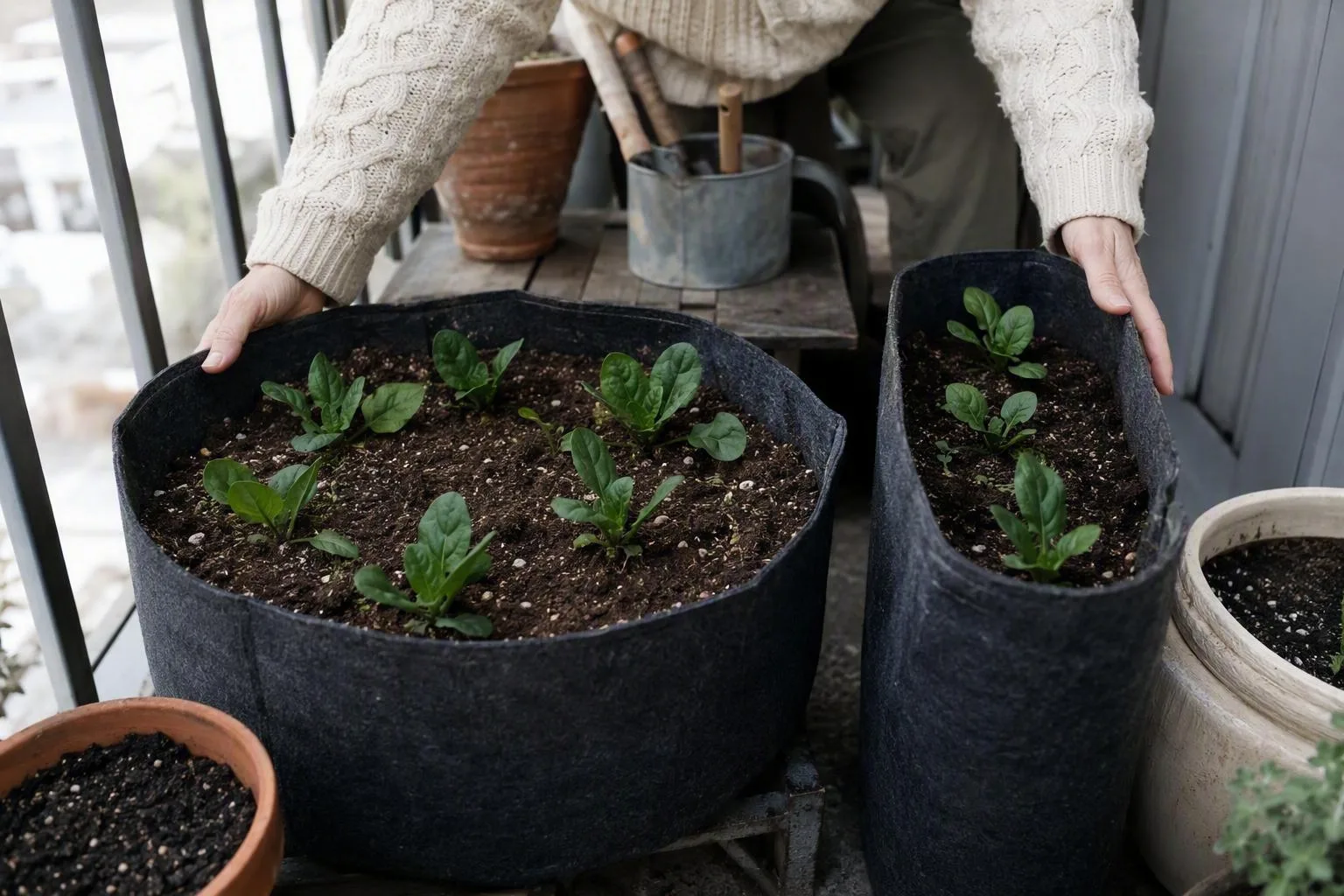
A mix that stays damp without turning airless
My starting mix is about three parts quality commercial potting mix to one part mature, screened compost. That keeps compost near 20–25% of the total volume instead of turning the container into a dense compost box. Potting mix supplies the loose structure; compost adds organic matter and some nutrients.
A practical pH range for spinach is around 6.5–7.5. I wouldn’t test a fresh bag of reputable mix just for the sake of testing. I would test, or at least replace part of the mix, when a reused container has repeatedly produced pale growth, a hard crust or poor drainage. Old mix can lose structure and accumulate fertilizer salts.
Every edible-crop container needs unobstructed drainage holes. Garden soil is a poor substitute for potting mix because it settles into a heavy, airless mass in a confined container. Choose a pot sold as food-safe, or one clearly intended for edible plants; treated timber, unknown reclaimed buckets and decorative glazes are not choices I’d make without checking their intended use.
A perched water table is the saturated band that remains at the bottom of a pot after watering, even when water has drained from the holes. It forms because fine potting particles hold water against gravity. Gravel in the base doesn’t remove that wet band. It creates a second layer beneath the fine mix and can leave the root-zone mix sitting above a saturated interface while also stealing space from the roots.
For the technical background, I’d look for container-media guidance on drainage and perched water tables rather than relying on the old gravel-in-the-bottom trick.
Sow at 1.25 cm, then thin by leaf size
Direct sowing is the least fussy method. Spinach seedlings can be slow to recover from root disturbance, and there is little benefit in starting them in a small cell only to move them into a pot a few days later.
- Fill the pot to about two fingers below the rim. This leaves room for watering without washing seed or mix over the edge.
- Pre-moisten the mix thoroughly, then let excess water drain.
- Sow the seed about 1.25 cm (1/2 in) deep. Cover it lightly and press the surface so the seed has contact with damp mix.
- Water with a gentle stream. Keep the surface damp while the seed is germinating, but don’t leave the pot standing in a full saucer.
Thin after the seedlings develop their first true leaves, meaning the first leaves that look like spinach rather than the initial smooth seed leaves. Leave about 5 cm (2 in) between plants for baby leaves. For larger leaves, thin to 8–10 cm (3–4 in). The closer spacing gives an earlier, smaller harvest; the wider spacing gives each plant more room to develop.
Under cool conditions, I’d project emergence in about 7–14 days. If the surface dries, seed may germinate unevenly, so a loose cover of mix or a little shade during the hottest part of the day can help. Sow another pot every 2–3 weeks while temperatures remain suitable. That succession is more useful than trying to make one container produce indefinitely.
This order also works well for growing vegetables in pots for beginners: wet the mix first, sow at the correct depth, then decide spacing after you can see which seedlings actually emerged.
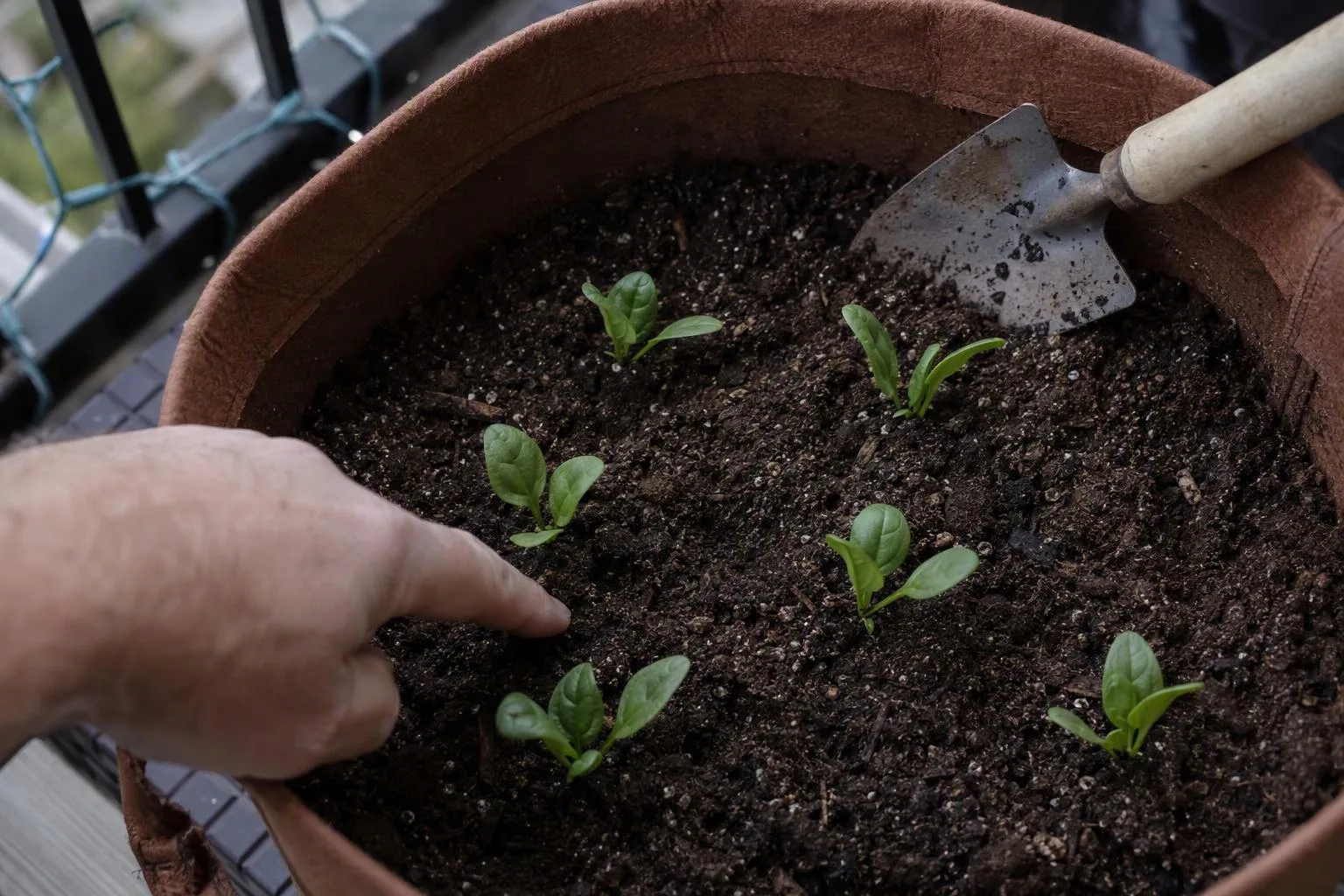
Water to the root zone, not to a calendar
Check the top 2.5 cm (1 in) of mix with a finger before watering. If it feels dry at that depth and the pot is noticeably lighter, water slowly over the whole surface until a little drains from the holes. Empty the saucer afterward. Spinach dislikes the swing from bone-dry to waterlogged more than it dislikes a watering routine that varies with the weather.
If dry mix repels water and the first pour runs down the sides, use two slower passes 5–10 minutes apart. The first pass wets the surface and opens a path for the second one to move into the root zone.
In a 10–15 L (2.6–4 US gal) plastic pot in hot sun and wind, I might check moisture daily. The same pot in cool part shade may go 2–3 days between checks. Those are checking intervals, not a watering timetable. Pot material, wind, humidity, plant size and rain can change the answer.
Wilt is not a diagnosis by itself. Limp leaves with dry mix point me toward underwatering. Limp leaves with wet, sour-smelling mix and blocked holes point toward oxygen-starved roots. I check the moisture and smell before adding either more water or more fertilizer.
Feed after the bagged mix runs out
Fresh commercial potting mix may already contain starter nutrients. I follow the feeding duration printed on the bag. If no duration is given, I usually wait about 3–4 weeks before adding fertilizer, assuming the spinach is growing normally.
Once growth slows in an unamended or depleted mix, use a balanced liquid vegetable feed at the label rate. Where the product permits frequent feeding, a cautious half-strength application every 2–3 weeks is easier to manage in a small pot than a heavy dose all at once. Water the mix first if it is dry, and don’t feed heat-wilted plants until they have recovered.
Container watering can carry soluble nutrients out through the drainage holes, but excess fertilizer can also raise salt levels. Pale, slow growth in moist mix can indicate depletion. White crust on the surface or brown leaf margins makes me stop feeding, flush the pot with plain water and check whether the mix has become too concentrated.
Yield you can plan for from one container
Use the baseline pot as one 30 cm (12 in) container holding 10–15 L (2.6–4 US gal), planted for baby leaves and kept cool, evenly moist and reasonably fed. My conservative planning band is roughly 100–250 g (3.5–9 oz) of cleaned leaves across several cuts. I would not treat that as a measured trial or a guarantee.
The range is wide because the harvest changes with spacing, leaf size, direct-sun hours, temperature and missed watering. A small 3–4 L (0.8–1.1 US gal) pot is more likely to provide one or two modest servings than a large bowl of greens. That can still be worthwhile if you sow a second pot before the first one finishes.
A 60 cm (24 in) trough with about 20–22 L (5.3–5.8 US gal) of usable mix can hold more plants mainly because it provides more planting surface. Making a container deeper does not multiply the harvest in the same way. My preference is two broad, manageable pots rather than one deep planter: they are easier to move into shade, easier to inspect and less painful to lose during a sudden heat spell.
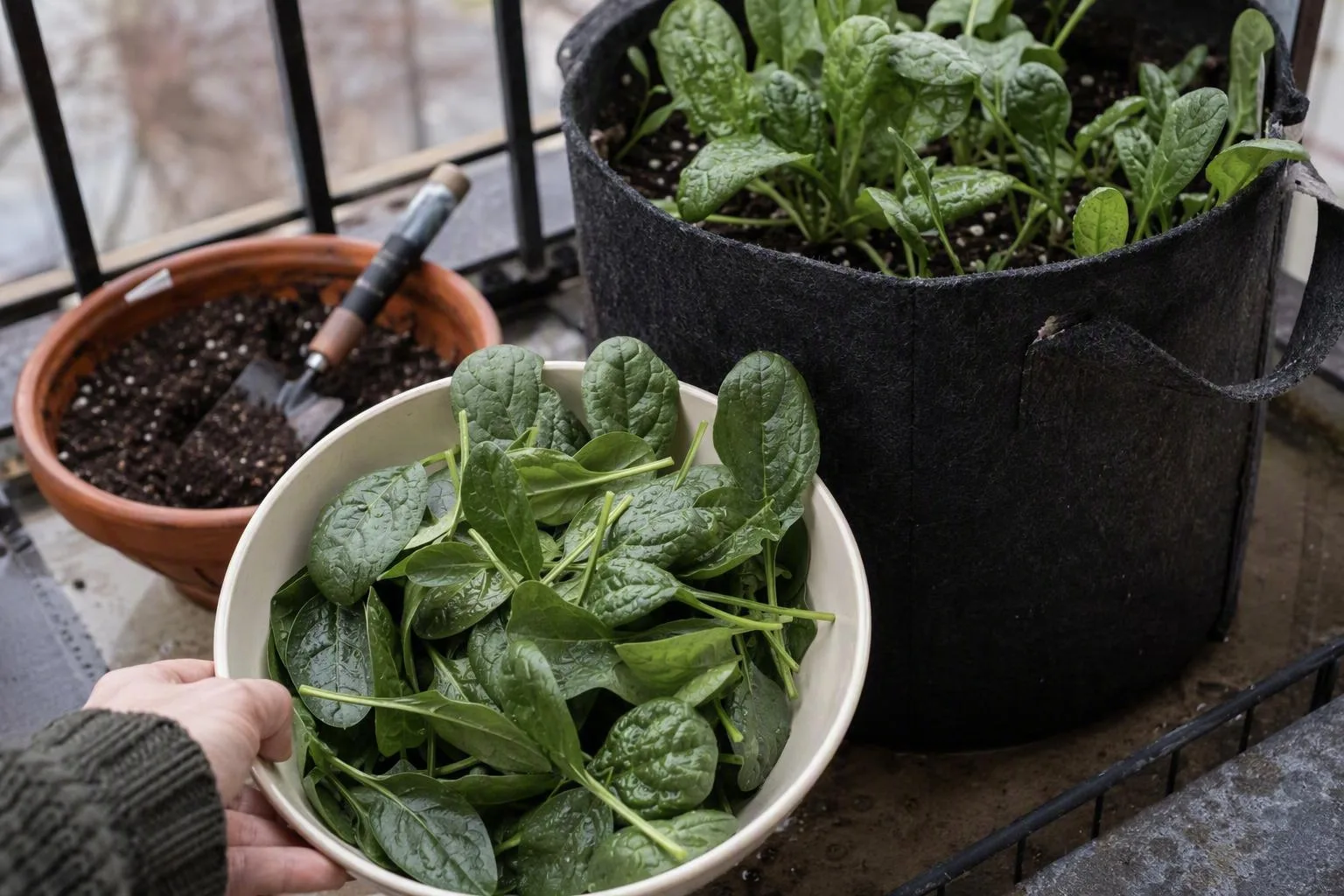
Harvest outer leaves first; pull the plant at the first bolt
For planning purposes, I’d expect baby leaves to be usable in about 25–35 days from sowing. Larger leaves usually need roughly 40–60 days. Those windows move with temperature, variety, light and whether the plant was checked by drought.
I cut outer leaves when they are around 5–8 cm (2–3 in) long, leaving the central growing point intact. Use clean scissors or pinch the leaf stalk just above the crown. Taking the outer leaves first lets the middle continue producing while the weather stays cool.
Harvest the whole plant when a central stem begins to elongate, the new leaves become narrow and upright, or the plant is clearly bolting. Leaves from a bolting plant can become tougher or more bitter. Move the pot into cooler afternoon shade and harvest promptly, but don’t expect shade to reverse a stem that has already extended.
Regrowth is possible after a light outer-leaf harvest in cool conditions. It is not guaranteed after a hard cut, severe heat or serious root stress. I harvest in the morning while the leaves are cool, remove damaged foliage, and refrigerate the crop promptly rather than leaving it in the sun beside the pot.
A symptom-to-fix grid for yellow, limp and holey leaves
A single yellow or limp leaf is ambiguous. I use the plant, the mix and the drainage holes together before changing anything.
| What you see | Check first | Practical response |
|---|---|---|
| Limp leaves and dry mix at 2.5 cm (1 in) | Underwatering or a pot that dries too fast | Water slowly, then move the pot from harsh afternoon heat if it wilts again. |
| Limp leaves, wet sour mix and no drainage | Blocked holes or a perched wet zone | Clear the holes, remove standing water and let the mix drain before watering again. |
| Yellow lower leaves with persistently wet mix | Root stress before fertilizer shortage | Fix drainage and watering first; feeding a saturated root zone adds another problem. |
| Pale, slow growth in moist mix after several weeks | Depleted nutrients or too little light | Check the light, then use a balanced feed at the label rate if the mix is depleted. |
| Long central stem and smaller upright leaves | Bolting from heat, long days or repeated drought | Harvest now, move to afternoon shade or resow for a cool-season crop. |
| Irregular holes with slime trails | Slugs or snails hiding around the pot | Inspect after dusk, remove hiding places and protect the container’s rim. |
| Clusters on tender growth | Aphids, often around new leaves and stems | Check both sides of leaves and rinse small colonies off with a gentle spray. |
| Pale or gray patches, especially in crowded growth | Possible downy mildew and poor airflow | Remove badly affected leaves, thin crowded plants and keep foliage as dry as practical. |
For a second pest reference, the phrase aphids on container plants is a useful place to continue your inspection. Don’t apply a treatment just because a leaf is yellow; first decide whether the mix is dry, saturated or simply exhausted.
Today, check the top layer, drainage holes and underside of the leaves. Over the next 7–14 days, look for either seedling emergence or a fresh central cluster of leaves. That observation will tell you more than changing three variables at once.
Three container questions worth answering
Can spinach grow indoors on a windowsill?
Yes, but a dim window receiving only 1–2 hours of direct light usually supports slow baby-leaf growth rather than a generous crop. Aim for about 4–6 hours of direct light, or use a suitable grow light, and keep the pot near 10–21°C (50–70°F). Rotate it every few days if growth leans toward the glass.
Is a self-watering container suitable for spinach?
It can help on a windy balcony or during a short absence, provided the mix wicks water evenly and the reservoir does not keep the root zone permanently saturated. Check the top 2.5 cm (1 in) before adding water. A full reservoir is not proof that the roots have the right amount of air.
Can I grow spinach in a 5-gallon bucket?
A 19 L (5 US gal) bucket has enough volume for spinach, but use one sold as food-safe, add several unobstructed drainage holes and make sure it cannot tip. A wide opening gives more planting area than a tall, narrow container. For the safety question, I’d check the specific material and intended use rather than assuming every reused bucket is suitable; the guide Are 5 gallon buckets safe for growing vegetables? covers that decision in more detail.
Before the weekend, place your empty 30 cm (12 in) pot where you intend to grow it and check that it stays stable in wind. Buy the mix, sow directly at 1.25 cm (1/2 in), and put a reminder in your phone to check the top 2.5 cm (1 in) each day until the seedlings appear.
Frequently Asked Questions
Can spinach grow indoors on a windowsill?
Yes, but a dim 1–2-hour window usually supports only slow baby-leaf growth; aim for about 4–6 hours of direct light or a suitable grow light, keep the plant near 10–21°C/50–70°F and rotate the pot.
Is a self-watering container suitable for spinach?
It can be useful on a windy balcony or during short absences, but the mix must wick well and the reservoir must not leave the root zone constantly saturated; check the top 2.5 cm/1 in before adding water.
Can I grow spinach in a 5-gallon bucket?
A 19 L/5 US gal bucket has enough volume, but use a food-safe container, add several unobstructed drainage holes and remember that a wide opening gives more planting area than a tall, narrow pot.