Growing Strawberries in Containers: How Many Plants Per Pot?
For growing strawberries in containers, start with usable width: count one plant per 20–25 cm (8–10 in) of internal pot width. That gives you one plant in a 20–25 cm pot, two in a 30 cm pot, and roughly one plant for each 20–25 cm of trough length; budget about 5–10 litres (1.3–2.6 US gallons) of potting mix per plant.
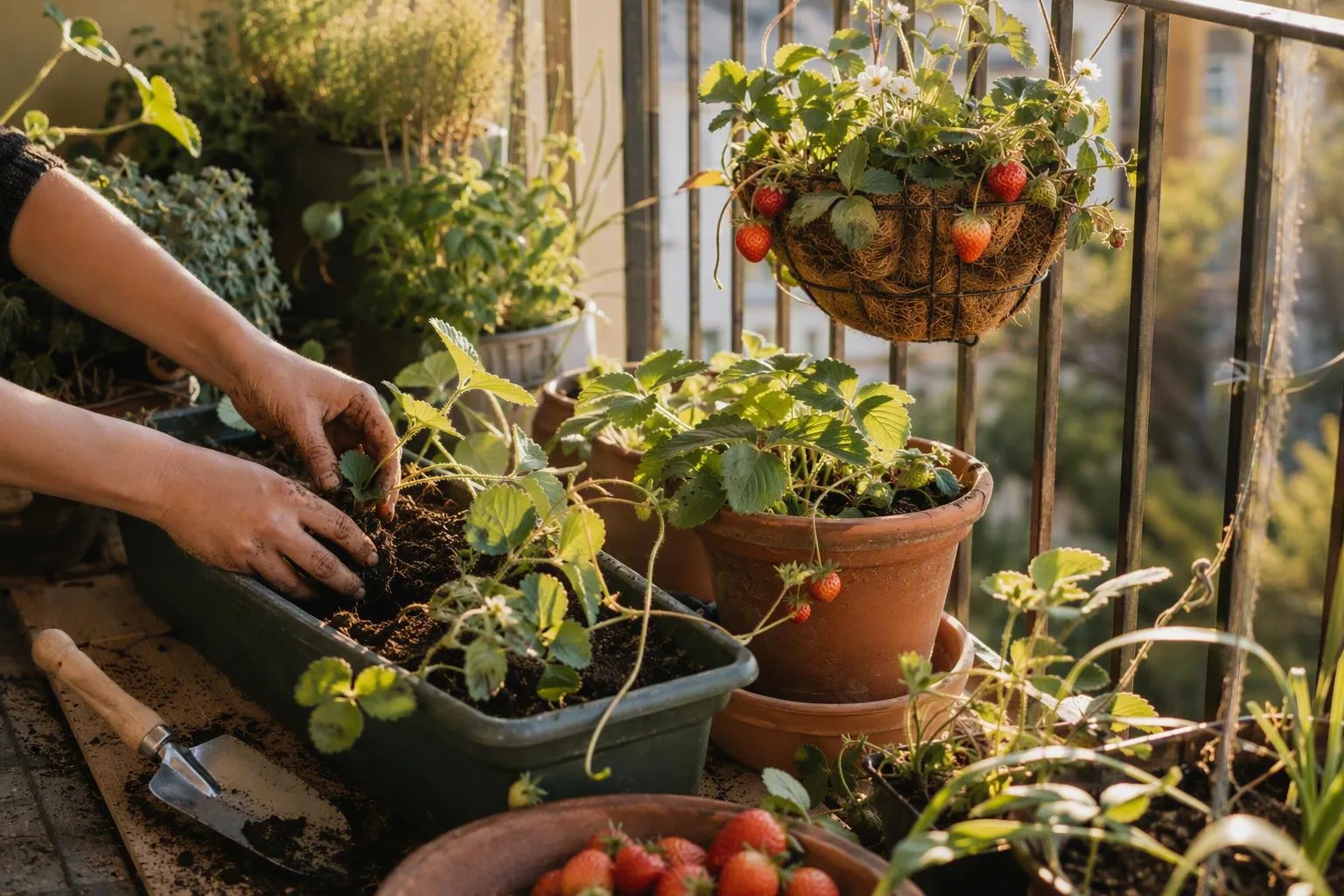
A 30 cm (12 in) pot can physically accept four small strawberry plants, but I wouldn’t call that a productive arrangement. The crowns compete for the same light, the root zone dries in patches, and leaves end up pressing against wet mix or one another. For a balcony pot, two well-spaced plants usually give you a better starting point than four crowded ones.
Start with the pot’s usable width: the plant-count answer
Strawberries need room in two directions. Their roots need enough mix to stay evenly moist, but the leaves, flowers and developing fruit also need an open surface. That is why the inside width of the container matters more than a large capacity figure printed on the label.
Usable width means the distance across the pot where the potting mix meets the sides. Measure there, not across the widest outside rim. A tapered planter may be advertised as 30 cm wide while its planting surface is closer to 25 cm. I count plants from the smaller measurement.
| Container | Practical count | Approximate mix | My buying rule |
|---|---|---|---|
| 20–25 cm (8–10 in) round pot | 1 plant | 5–10 L (1.3–2.6 US gal) | Best for one compact or day-neutral plant |
| 30 cm (12 in) round pot | 2 plants | 10–20 L (2.6–5.3 US gal) | Place them on opposite sides of the pot |
| 40–45 cm (16–18 in) round pot | 2 plants, or 3 compact plants at the wider end | 10–25 L (2.6–6.6 US gal) | Use the lower count for vigorous June-bearing types |
| 60 cm (24 in) trough | 2–3 plants | 10–30 L (2.6–7.9 US gal) | Allow at least 20 cm (8 in) of internal width |
| 90 cm (36 in) trough | 3–4 plants | 15–40 L (4–10.6 US gal) | Space along the length rather than in a tight row |
| 25–30 cm (10–12 in) hanging basket | 1 plant; 2 only in a broad, well-watered basket | 5–15 L (1.3–4 US gal) | Choose one if the basket catches wind |
Those mix figures are working ranges, not a promise that every pot of the same diameter holds the same amount. A pot needs a little headspace for watering, and a tapered or heavily curved container may hold less than its headline dimensions suggest. If the litre calculation is still fuzzy, how much soil do i need for a container gives you the simple volume maths to repeat with your own measurements.
My shop-floor check is deliberately boring: I measure the inside opening, look for the drainage holes, and estimate the actual depth before deciding how many plants to buy. I won’t pretend I ran a controlled balcony trial and measured a harvest from four crowns. I can tell you why this sequence works: the crown sits at the surface, so that surface area is where spacing has to be solved. Extra depth can buffer watering, but it doesn’t create more room for four crowns across a narrow top.
A shallow, wide pot can therefore be a better strawberry home than a deep, narrow planter with the same amount of mix. The wider shape gives each plant a clearer patch of light and reduces the chance that leaves and fruit stay pressed against the potting surface. I’d choose the squat container for a stable balcony shelf, provided it still holds at least 15–20 cm (6–8 in) of mix.
A single crown, a basket, or a trough: choose the strawberry setup
The plant type should influence the container count. A strawberry crown is the short central stem between the roots and the leaves. It is the part that must sit at the correct height, and it is the point from which new leaves, flowers and runners emerge.
Pick the habit that suits the space
Day-neutral strawberries are my first choice for a small balcony where a long, modest crop is more useful than one large flush. In plain terms, they can form flowers and fruit in repeated periods when light and temperature are suitable. They make better use of a container that has to earn its footprint over several weeks.
Alpine strawberries are compact and usually produce smaller fruit. They suit a narrow pot, windowsill or hanging basket where the pleasure is having fruit close at hand rather than filling a mixing bowl. Their smaller habit does not remove the need for water or sun, so don’t use the label alpine as permission to cram them together.
June-bearing types can make a heavier crop in one main season, but some grow more vigorously and send out more runners. In a trough or large patio container, that can be worthwhile. In a 20 cm pot, I’d leave more space around one plant rather than trying to force a larger-cropping type into a small footprint.
For a broader shortlist of compact edible plants, Easy fruits and vegetables to grow in pots is a useful companion to this crop-specific decision.
Give the roots a usable, safe container
I treat 15–20 cm (6–8 in) of internal depth as a practical floor for a strawberry container that you want to keep productive. More depth is useful in a hot, exposed position because it gives you more mix to hold water, but it does not change the width-based plant count. A pot that is 40 cm deep but only 20 cm wide is still a one-plant surface.
Use a container with unobstructed drainage holes. The holes let gravity remove free water, but they don’t make the bottom layer instantly dry. A small saturated zone can remain above the hole; this is often called a perched water table, meaning water temporarily sits in the lower part of the pot instead of draining away as it would through open ground. That is why a saucer full of standing water is a problem even when the pot has holes.
Skip the gravel layer at the bottom. In this situation it reduces the amount of root-zone mix while leaving the saturated lower zone in place. Put the pot on feet or a slatted surface instead, so the holes remain open.
Wind changes the calculation. Leaves catch moving air, hanging baskets swing and exposed containers lose moisture from the mix faster. A wet 20-litre pot is also a substantial load on a shelf or balcony, especially after rain. Set containers low and against a solid wall where possible, and check your building’s rules before creating a long, heavy row of planters.
Be honest about light
I use six to eight hours of direct sun as the practical target for dependable strawberry fruiting. A position with only one or two hours may keep foliage alive, particularly if the light is strong, but it usually isn’t a good reason to buy several crowns for a fruit harvest. Reflected brightness through a window is not the same as direct sun on the leaves.
If your balcony only gets a short sun window, put one plant in the brightest movable pot and watch what happens before filling a trough. The mobility advantage of a container matters here: move the pot to follow the sun, but do it gradually and keep watering changes in step with the new exposure.
Planting day through harvest: keep crowded roots productive
On planting day
- Check the pot first. Make sure the holes are open and the container is stable. Place a mesh screen over a very large hole if mix falls through, but don’t seal it with a solid layer.
- Use a free-draining container mix. A good peat-free or general-purpose mix is a more reliable starting point than garden soil, which can compact in a pot and leave less air around the roots. Break up compressed pieces with your fingers, but don’t press the mix down hard.
- Fill with headspace. Fill the pot to about two fingers below the rim. That gap catches water and stops every watering from running over the edge. Settle the mix with water rather than stamping it flat.
- Set the crown at the surface. Spread the roots into the mix and keep the short central crown level with the finished surface. The roots should be covered; the crown and the bases of the leaves should remain above it.
- Water thoroughly once. Pour slowly around the plant until a little excess drains from the holes. Empty the saucer after the pot has finished dripping.
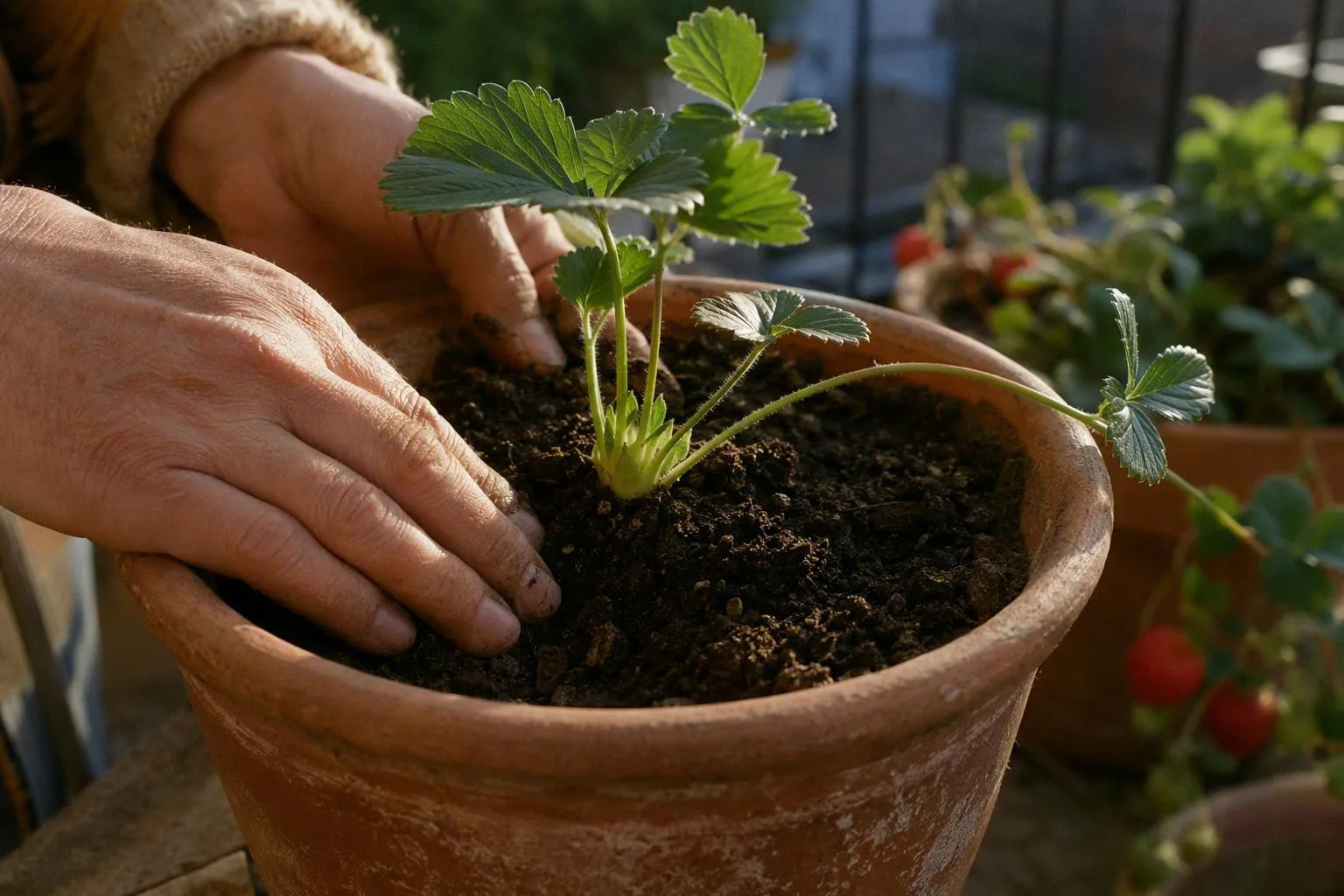
The planting depth is the detail that decides whether a newly planted strawberry settles cleanly. Burying the crown holds damp mix against the growing point and can encourage decay. Leaving the roots partly exposed lets them dry rapidly and may leave the plant loose. If the crown is sitting too low after watering, lift the plant gently and add mix underneath rather than piling more mix over its centre.
During the first two weeks
Don’t water by the calendar. Push a finger 2–3 cm (about 1 in) into the mix near, but not directly against, the crown. If that layer is dry and the pot feels light, water slowly until excess appears below. If the surface is dry but the pot is still heavy and the lower mix feels cool and wet, wait; a dry top does not prove that the root zone needs more water.
In a plastic pot in full sun and wind, I’d check moisture daily during warm weather. In a glazed pot in part shade, an inspection every second or third day may be enough in the same conditions. That is a checking rhythm, not a fixed watering schedule. Heat, plant size, pot shape and rain can flip the answer.
Water the mix rather than soaking the fruit and centre of the plant. Repeatedly wet fruit stays vulnerable to mould, while a wet crown has less air around it. If the pot drains slowly, solve that problem before increasing the amount of water.
While the plant is growing and fruiting
Feed after the plant has settled and starts active new growth. Use a balanced container fertiliser at the rate on its label; if you need a simple planning range, a liquid feed every two to four weeks during active growth is a reasonable starting point, with the label taking priority. Container plants receive a limited store of nutrients, and watering can carry some of those soluble nutrients out through the drainage holes.
Avoid turning the plant into a leaf factory with heavy nitrogen feeding. A strawberry with huge soft leaves but few flowers has a nutrition and light problem to investigate, not an invitation to add another handful of fertiliser. Stop and reassess before feeding again.
Runners are the long stems that grow out from the parent plant and try to form new plants. Remove them while fruit is the priority, especially in a small pot. If you want replacements, pin one runner into a second small pot of mix and cut the connection only after it has rooted. Letting every runner remain attached gives the original plant another set of leaves and roots to support from the same limited reservoir.
Pick berries when they have coloured fully, including the shoulder nearest the stem. Check the plant often once fruit begins to turn; ripe berries left against damp mix are more likely to spoil than berries held clear of the surface. A small piece of clean straw or a purpose-made fruit support can keep developing berries off the potting mix, but it should not block drainage or trap water around the crown.
Here is the practical test for a 60 cm trough. If its internal length is 60 cm and its width is at least 20 cm, plant two or three crowns at roughly equal intervals. Four plants may look efficient on planting day, but each plant then has less surface, less water buffer and less airflow. The extra plant is not extra harvest if it removes the light and moisture margin that made the first plant productive.
When the count is wrong, the plant tells you first
Spacing mistakes rarely announce themselves with a neat label saying overcrowded. I read the symptoms alongside the moisture, light and container shape.
Wilting while the mix is wet
Do not respond by adding more water. Check whether the drainage holes are blocked, the saucer is holding water, or the mix has collapsed into a dense layer. Roots need air as well as moisture, so a plant can wilt in saturated mix because damaged roots are not moving water effectively into the leaves. Correct the drainage and let the container reach a merely moist state before watering again.
Wilting while the pot is light and dry
This points me first toward a drying root zone, wind exposure or a watering that only wet the surface. Water slowly enough to moisten the whole root ball and let excess drain. Then check again later the same day in hot weather rather than repeating a small splash. A hanging basket may need a more sheltered position or a larger volume of mix, not just more frequent emergency watering.
Many leaves, small fruit or few flowers
Look at the sun before blaming the plant. One or two hours of direct light can limit flowering and fruit size, and crowded leaves shade the centre of the pot. Excess nitrogen, an immature plant and a vigorous variety in too little space are other plausible causes. Move the pot to the brightest safe position, stop adding nitrogen until the feeding plan is clear, and remove runners. Adding a third plant to a 30 cm pot will not repair a light shortage.
Grey mould on fruit
Remove affected berries and any dead material touching healthy fruit. Grey mould is encouraged when fruit stays wet and airflow is poor, so thin overlapping leaves where practical, keep berries off the mix, water at the base and leave space between containers. If the pot is packed with crowns, reducing the count is a more durable fix than repeatedly treating the symptom.
Brown leaf edges
Brown margins are a clue, not a diagnosis of overwatering. Check for a dry cycle, strong wind, fertiliser salt buildup or leaf scorch. If drainage is working and the mix is not saturated, one thorough watering with clean water that drains freely can help move excess soluble salts below the root zone; don’t turn that into a routine flush if the pot is already staying wet.
No fruit in the first season
A first season in a small pot is best planned as intermittent handfuls rather than a continuous bowl of berries. Plant age, variety, transplant timing and weather all change the result. In my judgement, one healthy plant in good light is a better experiment than three plants in shade, because the extra crowns cannot manufacture sunlight.
Prepare for cold weather
In freezing weather, roots in a container have less surrounding ground to buffer temperature changes. Once the plant has finished its main crop, remove damaged leaves and keep the crown intact. Group pots together against a sheltered wall, raise them off a cold wet surface and insulate the outside of the container if hard freezes are expected. In a climate with prolonged severe cold, move the pot into an unheated sheltered place if that is practical; a warm living room can push the plant into growth at the wrong time.
Before the weekend, choose the setup rather than the plant count: one 20–25 cm pot for one crown, or a 30 cm pot with 10–20 litres of mix for two. During the next week, check four things with your fingers and eyes: the top 2–3 cm of mix, the crown height, the drainage holes and whether leaves or fruit are lying on the surface. If those four checks look right, leave the plant room to grow before buying another one.