How Often to Water Container Plants — Forget the Schedule
A 15 cm (6 in) pot of basil on a west-facing balcony in late July can go from properly moist to bone dry between breakfast and dinner. The 40 cm (16 in) glazed pot beside it, same mix, same basil, same sun, might still be damp on day four. That's the whole problem with "water every three days": it's a correct instruction for one pot on one week of weather, and it quietly kills the pot next to it.
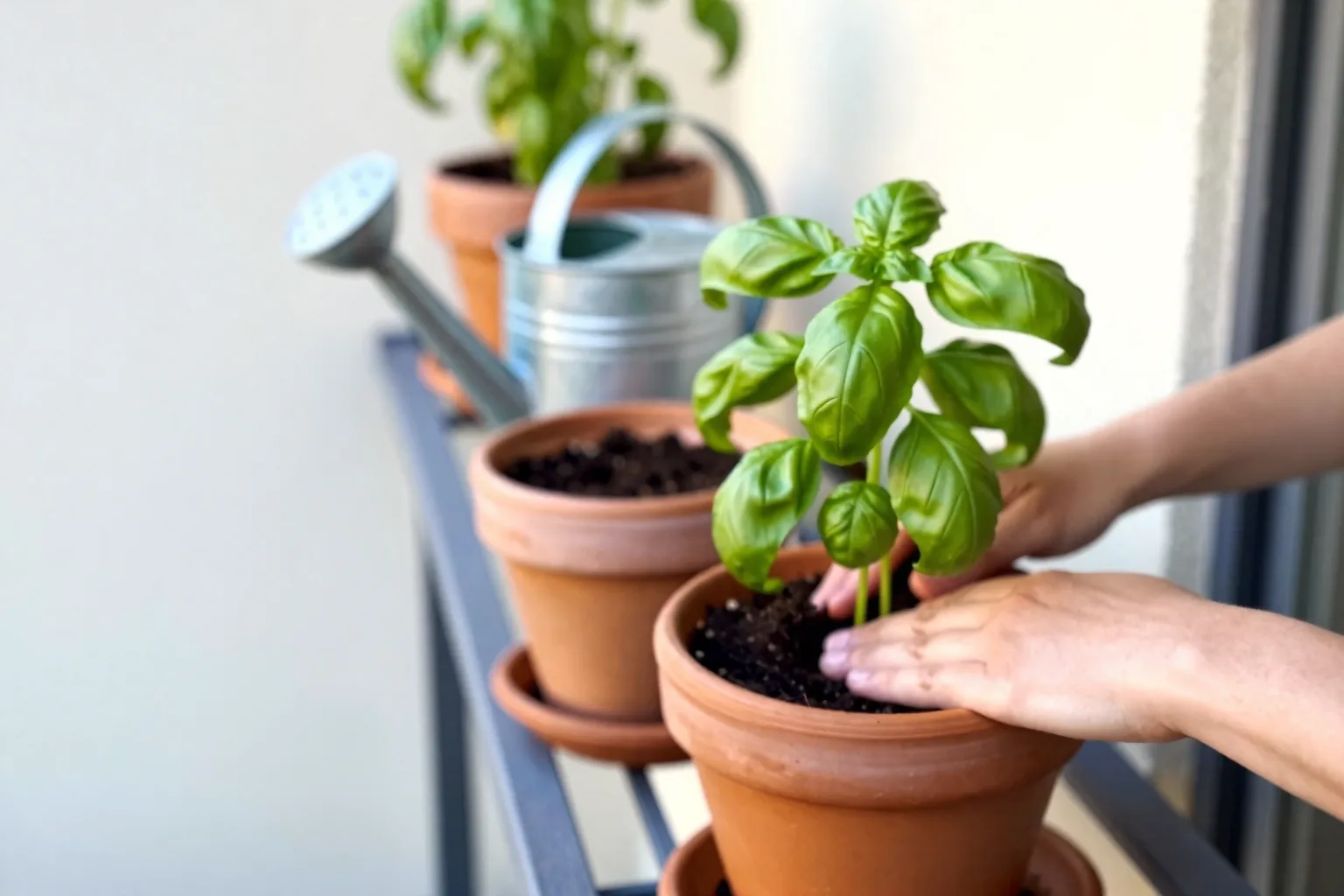
The Schedule Trap: Why "Water Every Three Days" Fails
A watering schedule is really a guess about evaporation, dressed up as a routine. It bakes in one set of conditions — one pot size, one material, one exposure, one week of weather — and then never updates itself. The weather updates constantly. So does the plant: a tomato with four leaves in May drinks nothing like the same tomato carrying two kilos of fruit in August.
It helps to know where the water actually goes. In the containers this article is about — ordinary pots and troughs on a balcony, patio or windowsill — water leaves by three routes. It evaporates off the exposed surface of the mix. It evaporates through the pot wall if that wall is porous, which unglazed terracotta very much is. And the plant pulls it up through its roots and breathes it out through the leaves. Only that third route has anything to do with the plant. The first two are pure hardware and weather, which is why two identical plants can be on completely different clocks.
The second thing a schedule ignores is that a pot has no reserve. A plant in the ground sends roots sideways and down into a body of soil that behaves like a slow battery; a plant in a 20-litre pot has exactly 20 litres of storage and nothing beyond the plastic. When the pot runs out, it runs out that afternoon, not next week.
So the honest answer to "how often should I water my container plants" is: as often as your specific pot dries out, which you find out by checking it, and the checking takes about ten seconds per pot. What follows is how to check, what changes the answer, and how to read the plant when it starts complaining.
Two Tests That Actually Work: Finger and Weight
Skip the moisture meter for now. In pots under about 30 cm (12 in) across, the cheap probe meters mostly tell you about the conductivity of one small spot of wet mix, and they'll read "moist" while sitting in a pocket of damp compost with dry mix all around it. Your finger is better calibrated and it's already attached.
The finger test. Push your index finger straight down into the mix, right to the second knuckle — that's roughly 5 cm or 2 inches on most adult hands. Don't poke around the rim, where the mix dries first and misleads you; go in about a third of the way between the stem and the pot wall. Dry mix feels loose and slightly warm, and it falls off your skin cleanly. Moist mix feels cool, and fine particles stick to your finger when you pull it out. That difference is unmistakable after you've done it twice.
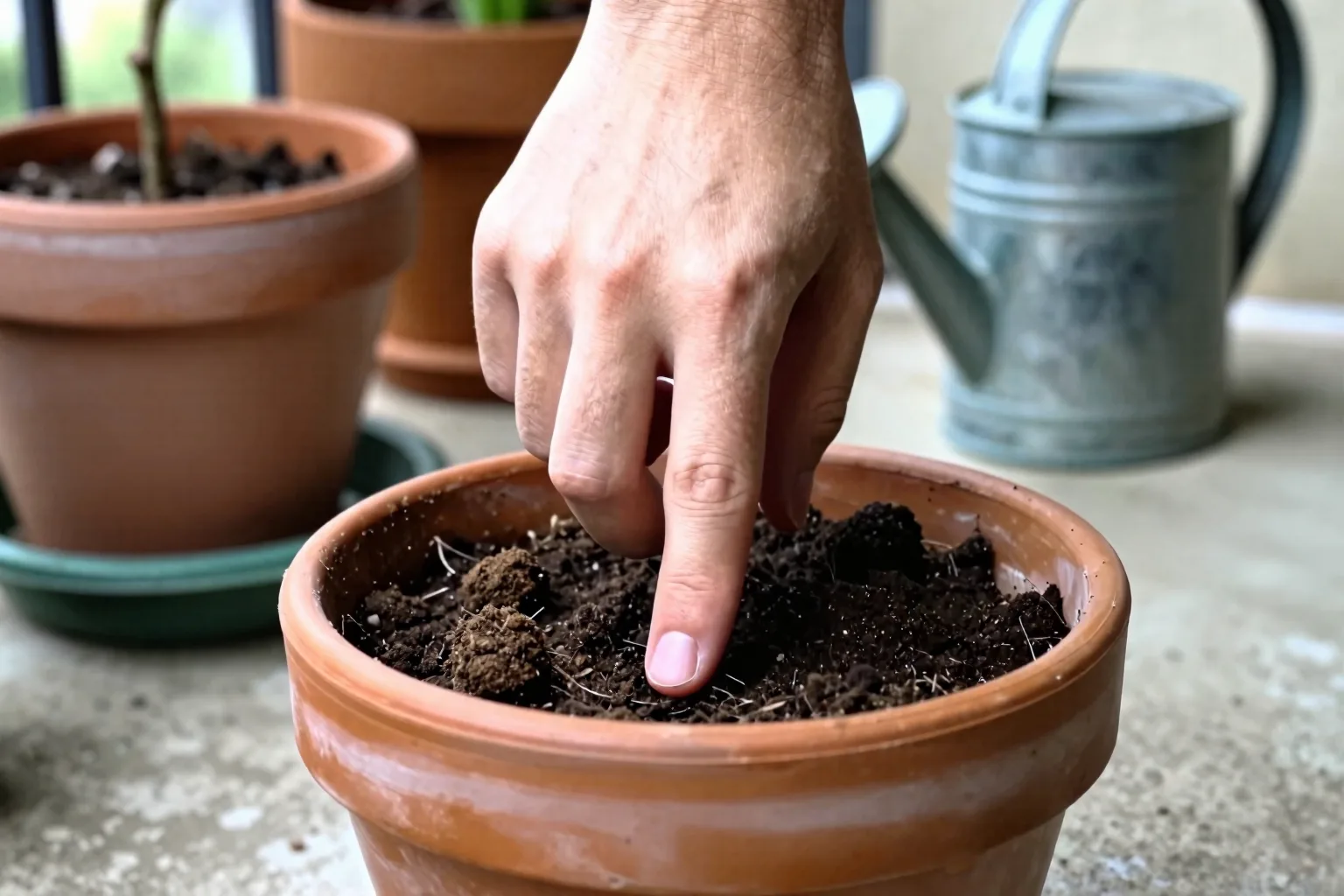
For most established edible crops in pots 20 cm (8 in) and up, water when that top 2-5 cm (1-2 in) has gone dry. Two exceptions worth remembering: seedlings and shallow-rooted leaf crops like lettuce and coriander live almost entirely in the top few centimetres, so for them the trigger is the top 1-2 cm; and anything you've just potted on hasn't rooted into the new mix yet, so judge by the rootball, not by the fresh compost around it.
The weight test. This one is faster and, for pots you can actually lift, more reliable. Water a pot thoroughly, let it finish draining for half an hour, then pick it up. That's "full" — memorise the heft. Now lift it again whenever you walk past. A pot that's ready for water feels startlingly light, because water is the heaviest thing in it. For a big planter you can't lift, tilt it a few centimetres by the rim; you're feeling for the same thing.
Here's the copy-pasteable version, the thirty-second round anyone can do before work:
- Tilt or lift each pot. Anything suspiciously light goes on the check list.
- Finger test the light ones to the second knuckle.
- If it's dry at that depth, water slowly until it runs freely from the drainage holes.
- Wait two minutes, then water again — the second pass is the one that counts on dry mix.
- Tip out any saucer that's still holding water after 30 minutes.
Step 4 is the part most people skip, and it's the reason plenty of "watered" pots are dry. Peat- and coir-based potting mixes turn water-repellent when they dry out hard: the surface beads, the mix shrinks away from the pot wall, and your watering can sends a satisfying gush straight down the gap and out of the hole in four seconds. The pot feels watered. Nothing in the middle of the rootball got wet. If a pot has gone properly dry and shrunk, the real fix is to stand it in a bucket or basin of water for 15-20 minutes and let it drink from below until the surface goes dark, then drain it. This lines up with standard extension guidance on container watering, which generally advises watering thoroughly to the point of runoff rather than giving small daily sips.
Small sips do a second kind of damage, and this is the bit I'd argue hardest for: they train roots to live in the top 3 cm of the pot, which is precisely the layer that dries fastest and burns first in a heatwave. Watering thoroughly and then letting the top few centimetres dry before you water again pushes roots down into the cooler, more stable middle of the pot. Slightly under-watered and deeply rooted beats permanently damp and shallow.
One aside on what's in the can. For everyday edible container crops, tap water straight from the tap is fine, and the old habit of letting it stand overnight to "off-gas" doesn't do much once chloramine rather than chlorine is in use. If you're on very hard water and growing something acid-loving like blueberries, that's a different conversation and rainwater genuinely helps. If you want to know what's actually in your supply, search your water utility's name together with the phrase "consumer confidence report" or "water quality report" — most utilities publish one, and it'll tell you about hardness and treatment far better than any rule of thumb.
Five Variables That Move the Clock
These are the things that decide whether your pot is on a one-day cycle or a four-day one. None of them is a small effect; several of them roughly halve or double the interval on their own, and they stack.
| Variable | Dries fastest | Dries slowest | Why |
|---|---|---|---|
| Pot material | Unglazed terracotta | Glazed ceramic, thick plastic, metal | Terracotta is porous, so water evaporates through the entire wall, not just the top surface |
| Pot size | Small pots under 20 cm (8 in) | Large planters over 40 cm (16 in) | Small pots have far more surface area per litre of mix and no thermal mass |
| Exposure | Full sun plus wind | Sheltered part shade | Wind strips the humid layer off leaves and mix, so transpiration and evaporation both run flat out |
| The plant | Fruiting crops in full leaf — tomato, cucumber | Woody herbs, young plants, succulents | Big leaf area plus fruit fill equals huge daily water throughput |
| Season and stage | Midsummer, peak growth | Autumn, dormancy, indoors in winter | Cooler air holds the water in, and a slowing plant simply drinks less |
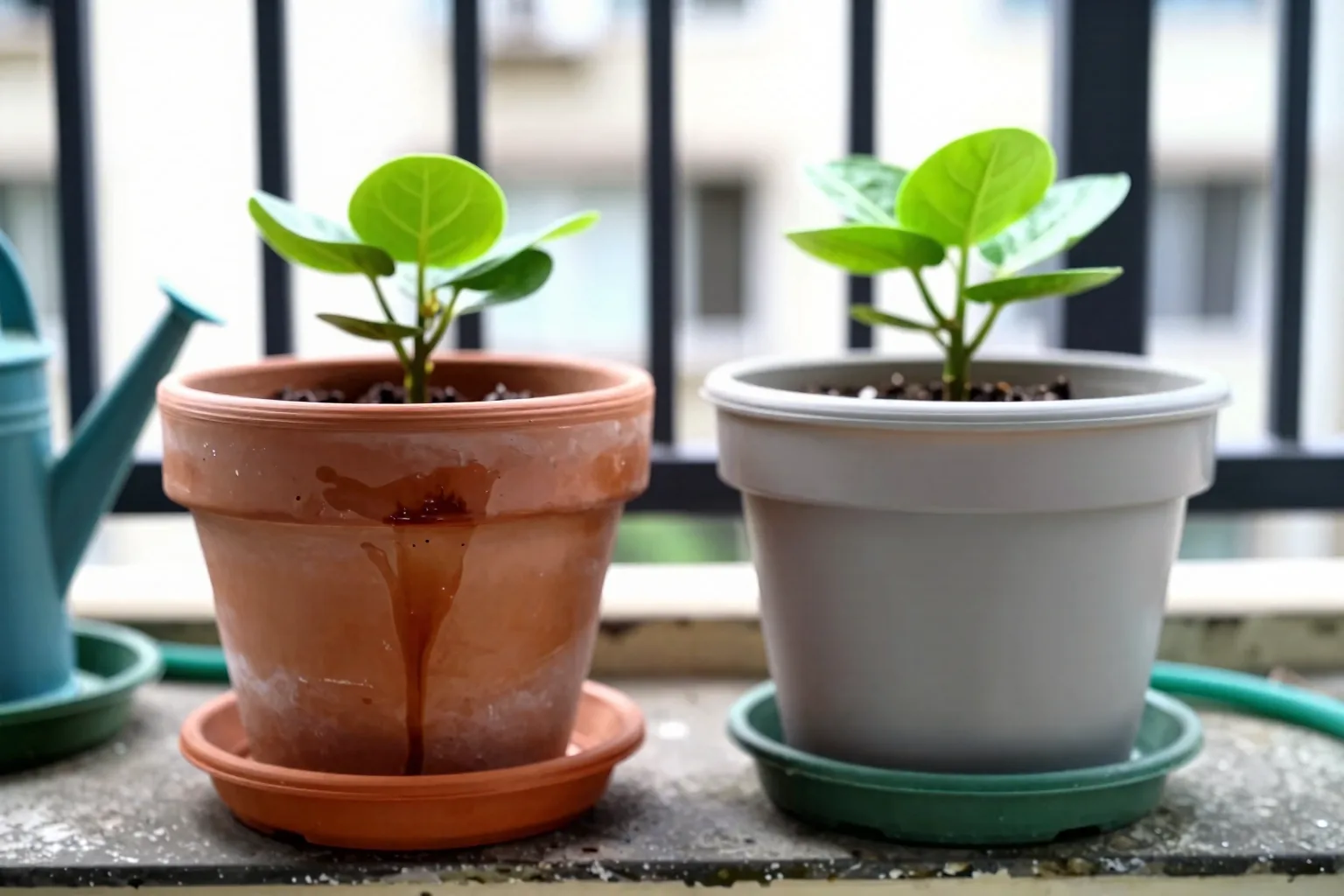
Directionally, in the mid-summer conditions most balcony growers deal with: a 15 cm unglazed terracotta pot of herbs in all-day sun and moving air can want water daily, sometimes twice on the worst days. The same herbs in a 40 cm glazed pot in half a day of sun might comfortably go three or four days. That's a fourfold spread, produced entirely by hardware and position, before the plant gets a vote. If you're deciding which pot to buy for a hungry crop, that spread is worth more than any watering gadget — and it's why choosing a pot size that holds enough soil volume does more for your summer than a better watering can. If you're weighing up materials, how terracotta, plastic and glazed pots compare in the same heat is the other half of that decision.
Wind deserves its own note because balcony growers systematically underestimate it. A balcony sandwiched between buildings, or one sitting several floors above open ground, often gets stronger and more turbulent air than a bed at ground level behind a fence — and wind, not temperature, is frequently what empties a pot by mid-afternoon on a day that didn't feel especially hot. If your pots dry faster than the thermometer says they should, look at what the air is doing before you blame the sun.
Does pot colour actually matter?
Yes, but less than people fear and mostly on thin materials. A black plastic pot in direct sun absorbs more heat than a pale one, warms the mix at the wall, and speeds evaporation; on a thick glazed or concrete planter the mass of the pot swamps the effect. The practical version: if you've got dark plastic pots in full afternoon sun, shading the pot itself — another pot in front of it, a plant spilling over the side — helps more than watering more often, because you're fixing the cause rather than topping up the symptom.
Overwatering and Underwatering Wear the Same Mask
A drooping plant with yellowing lower leaves is the single most confusing sight in container growing, because it's what both problems look like. People see wilt, assume thirst, water it, and finish off a plant that was already drowning.
The mechanism is worth having straight, because it makes the symptom overlap obvious. Roots need oxygen; they respire like any other living tissue. Mix that stays saturated has water in the pore spaces where air should be, the roots suffocate, the fine root hairs die back, and rot organisms move into the dead tissue. A plant with dead roots cannot take up water. So it wilts — not from lack of water, but from lack of working roots to collect it. Meanwhile a genuinely dry plant wilts because the water simply isn't there. Two opposite causes, one identical face.
The differentiator is not on the leaves. It's in the mix. Check in this order:
- Finger, to the knuckle. Wet and heavy while the plant wilts points to root damage; dry and light points to thirst. This one check settles most cases.
- Lift the pot. A wilting pot that still feels close to its watered weight is not thirsty.
- Look at the drainage hole. Blocked hole, pot standing in a full saucer, or a compacted crust on top — those are the physical causes of a permanently wet pot.
- Smell it, and only then tip it out. Sour, swampy smell and dark, mushy roots that slide their skin off between your fingers mean rot. Healthy roots are firm, pale and smell of nothing much.
There's also a timing tell that catches out a lot of tomato and cucumber growers: leaves that flop at 2 pm in blazing sun and recover on their own by evening are usually not a watering fault at all. Big-leaved plants close down and wilt protectively when they're losing water faster than the roots can supply it, even in moist mix. If the pot is damp at knuckle depth and the plant is upright again at dusk, do nothing. Watering that plant every afternoon it droops is how a healthy tomato ends up sitting in permanently saturated mix by August.
One structural cause deserves naming, since it turns careful watering into rot anyway: every pot holds a layer of permanently soggy mix at the very bottom that gravity won't pull out, because water clings within the mix until there's enough weight of it to overcome that grip. It's the same idea soil science describes as a water table, only compressed into the bottom few centimetres of a 25 cm pot. Understanding the perched water table and drainage holes explains why adding gravel at the bottom makes that soggy layer worse rather than better, and why a tall narrow pot drains more freely than a squat wide one of the same volume.
When the Rules Bend: Heatwaves, Holidays, and the First Frost
Three situations break the ordinary check-and-water rhythm, and in all three, "water more often" is the weakest available answer.
A multi-day heat spike. Water early, ideally before 9 am, so the pot goes into the hot part of the day full rather than playing catch-up at 3 pm. Morning is the better default generally — surface moisture dries off before nightfall, which keeps damp foliage from sitting wet overnight — though an evening top-up in serious heat is far better than a plant going dry, and I'd take a slightly damp leaf over a cooked rootball. Beyond timing, do the structural things: pull pots together into a block so they shade each other and raise the humidity between them, move the small ones into afternoon shade for the week, and put 2-3 cm of mulch on the surface. Wood chip, straw, even a layer of gravel on ornamentals: it cuts surface evaporation, which on a small pot is a genuinely large share of the loss. Stand a pot in a shallow tray of water only as an emergency measure for a day or two, and take it out afterwards.
A week away with nobody to check. Frequency can't solve this; a reservoir can. Move everything into the shadiest tolerable spot before you go — a plant in half light drinks a fraction of what it drinks in full sun — group the pots, mulch them, and water deeply the morning you leave. For the pots that matter, self-watering pots and wicking systems on a balcony carry a plant far longer than any bottle-in-the-soil trick, because they refill the mix from below at the rate the plant actually uses it. A word of caution on them: reservoirs run dry too, faster than the label implies in heat, and wicking works badly with coarse, bark-heavy mixes that break the capillary chain. A self-watering pot changes what you check, not whether you check — reservoir level and the surface mix, roughly weekly.
The slide into autumn. As nights cool and days shorten, growth slows, transpiration drops, and evaporation from the mix drops with it. Keep watering on the summer rhythm and you'll spend October slowly drowning plants that stopped drinking in September. This is where a lot of perennial container plants are lost — not to frost, but to cold, wet, airless mix in the weeks around it. Push the finger test deeper, water only when the pot is genuinely light, and get pots off cold paving onto feet or a slab so the drainage holes aren't sealed to a wet surface. Anything overwintering under cover — a dwarf citrus indoors, a dormant fig in a shed — wants markedly less water than it did in August, not merely a bit less.
The one number I'd hold onto out of all of this: a small pot in full sun can want water twice on a bad day, and the same plant in a large shaded pot can go the best part of a week. Nothing you write in a calendar spans that range. Your finger does.
So do this before the weekend: water every pot thoroughly, wait half an hour, then lift each one and hold the weight in your memory. That's the only calibration this system needs. Come back in three days, lift them again, and you'll already know which pots are on a daily clock and which ones you can leave alone.
Frequently Asked Questions
Does pot color affect how often I need to water?
Dark pots absorb more heat and warm the root zone and mix faster in direct sun, which speeds drying compared to light-colored pots — most noticeable on plastic, less so on thick ceramic.
Is it better to water in the morning or evening?
Morning is generally preferred because it lets excess surface moisture evaporate before nightfall, reducing fungal risk; evening watering isn't wrong but can leave foliage damp overnight in humid climates.
Do self-watering pots mean I can stop checking the soil?
No — reservoirs still run dry, especially in heat, and wick systems don't suit every mix; check the reservoir level and the surface mix periodically rather than assuming it's automatic.
Does tap water need to sit out before I use it on container plants?
For most edible container crops it's unnecessary; chlorine/chloramine levels in typical municipal water aren't high enough to matter for short-term container watering, though very sensitive plants or heavily treated water are the exception.