Sooty Mold on Plants: Remove It and Fix the Pest Problem
A black film that lifts with a damp cloth points toward sooty mold, not necessarily a leaf infection. The coating is usually a clue to honeydew-producing pests, so washing the leaves is only half the job: you also need to find what is making them sticky.
A black coating that wipes off points to honeydew, not a leaf infection
Sooty mold is the name commonly given to dark, surface-growing fungi that use sugary honeydew left on leaves and stems by sap-feeding insects. The coating can look alarming, but the useful first check is simple: choose a small patch and gently wipe it with a damp, soft cloth. If the black material lifts and the leaf beneath looks green and intact, that supports a surface coating rather than damage inside the leaf.
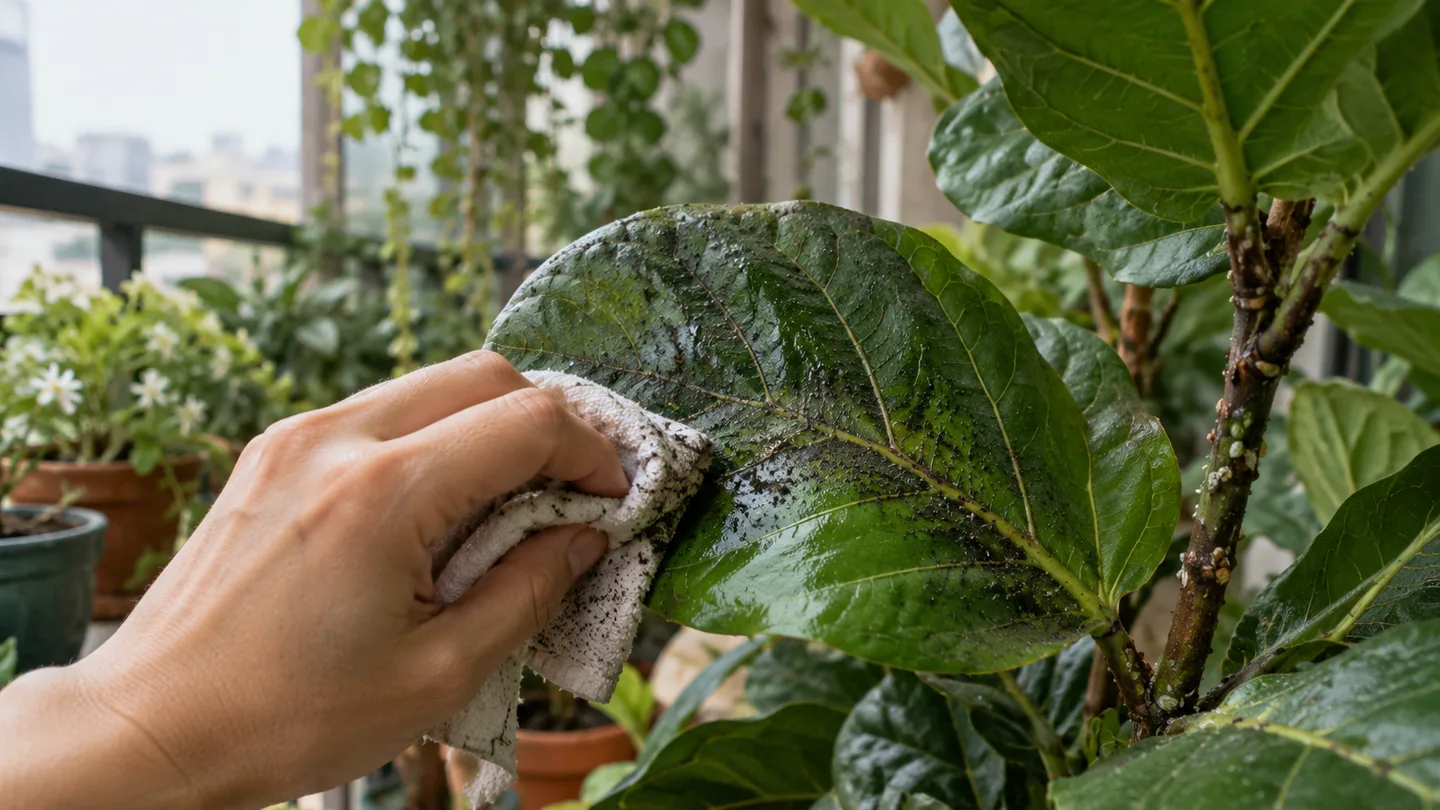
Keep the test gentle. A fingernail scrape or hard rubbing can tear the leaf and leave you with a new mark that tells you nothing. On a delicate leaf, use a wet cotton pad or rinse with a soft stream of water, supporting the leaf from underneath. The aim is to see whether the dark film moves, not to polish the leaf clean.
A wipe test is a clue, not a complete diagnosis. Some leaf spots have a dark centre or dusty surface, and several problems can happen on the same plant. If a mark stays put after a gentle wipe and appears to sit within the tissue—especially if it has a clearly bounded yellow or dead margin—consider leaf-spot disease or other tissue damage instead of assuming every dark mark is sooty mold. A photo alone may not settle it.
The coating can also hide what is happening underneath. If it builds up across a large part of the leaf, it can shade the leaf surface and make it harder for the plant to use light. A few spots on an older leaf are a different practical problem from a thick film across much of a young plant. Either way, the dark film itself doesn’t tell you which insect is present.
Follow the sticky trail to aphids, whiteflies, mealybugs or scale
Start your inspection where honeydew is easiest to miss: the undersides of leaves, the tips of new growth, stem joints and the sheltered side of the pot facing a wall. On a balcony, leaves often overlap or press against a railing, so check the tucked-away surfaces as well as the ones you can see from the doorway. Look for live insects and fresh sticky droplets, not just old black coating.
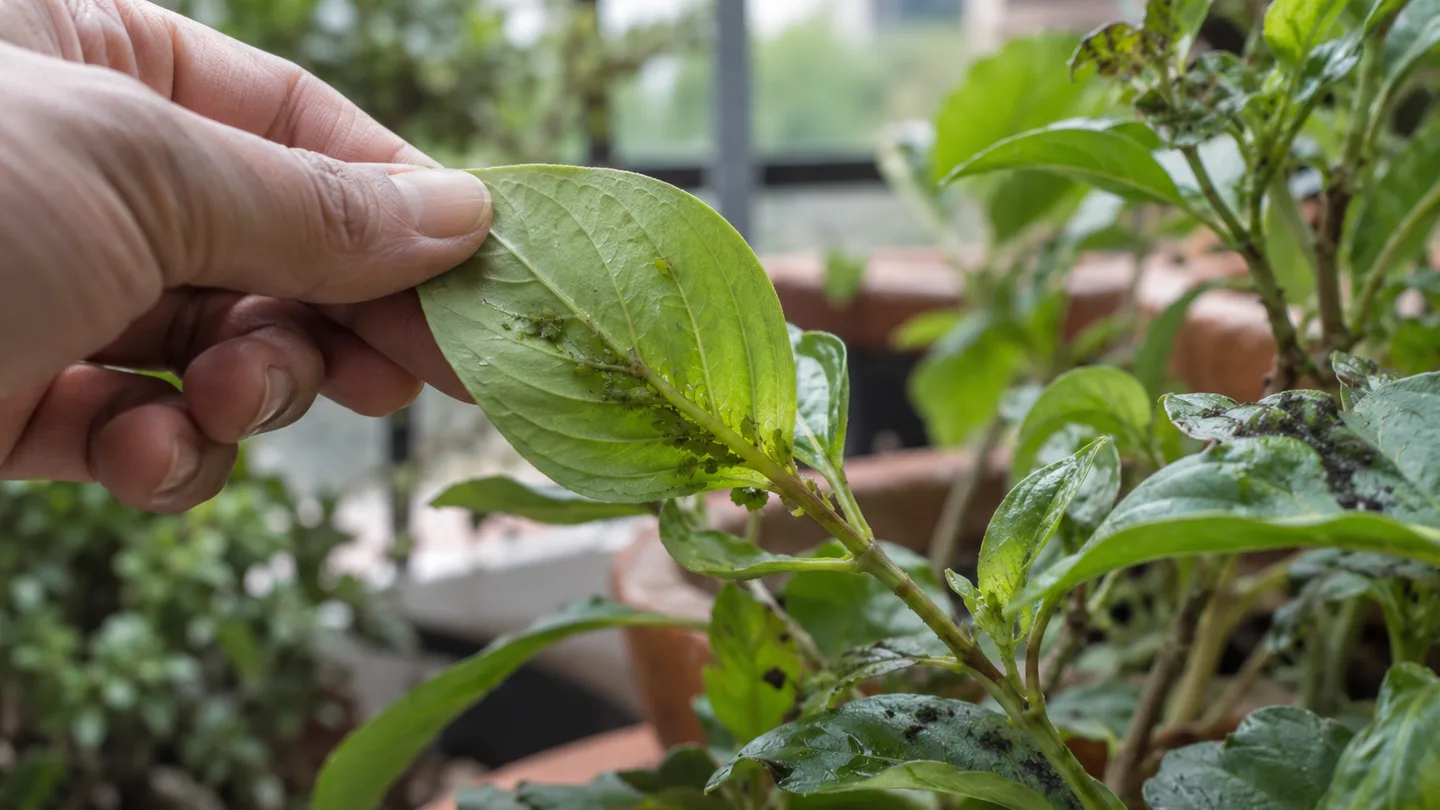
Aphids often appear in groups on soft new growth. Whiteflies are small, pale insects that may flutter up when you disturb the plant. Mealybugs look cottony and tend to hide around joints or where leaves meet stems. Some scale insects look like fixed bumps on stems or leaf veins; the softer scale types can produce honeydew. A bump that doesn’t move when lightly touched may be scale, but don’t peel it off a tender stem just to test.
Ants walking a regular route up the pot or stem can be a useful clue: they may be collecting honeydew. They aren’t the source of the sticky coating, though. Follow the trail back to the leaves and stems, and look for the insects producing it. Ants can also be present for other reasons, so their presence by itself doesn’t confirm a pest diagnosis.
Here’s a worked balcony example, not a reported trial: imagine a potted pepper with sticky droplets on the leaves and a small aphid cluster at a tender tip. I’d first check nearby leaves and the stem joints, then rinse the visible aphids off if the plant can take a gentle wash. If a product is needed, I’d choose one whose label covers that plant and pest. At the next check, I’d judge progress by whether live aphids and new stickiness are still appearing—not by whether every old black patch has vanished.
That distinction matters because old sooty mold can stay visible after the insects are gone. A darkened leaf doesn’t prove the pest is still active; fresh tackiness, new honeydew droplets or live insects are more useful signs. Conversely, a clean leaf can become coated again if the honeydew source remains.
Wash the leaves after pest control—not instead of it
If the affected pot is badly infested and you can move it without damaging the plant, set it apart from neighboring pots while you inspect and treat it. Don’t drag it through a crowded collection with leaves brushing other plants. In a tight balcony setup, simply giving it a little space and avoiding leaf-to-leaf contact can make the next inspection easier.
- Check for live pests first. Look beneath leaves and around soft tips. If you wash away the visible black film but leave a live pest colony untouched, fresh honeydew may soil the leaves again.
- Rinse or wipe gently. Use plain water and support delicate leaves with your free hand. A soft stream can remove loose residue; a damp cloth is useful where water would soak the pot or splash onto neighboring plants. Stop if the leaf starts to crease or tear.
- Choose pest treatment by label. If you use insecticidal soap or another pesticide, use it only if the label names the plant and target pest. Follow its dilution, application, repeat-treatment and harvest directions exactly. There isn’t one safe spray rate or retreatment interval for every product and plant.
- Keep household dish soap out of the spray bottle. It is not a substitute for a product formulated and labeled for plants; an improvised mixture can injure foliage, particularly in strong sun or on sensitive leaves. Don’t combine products unless their labels explicitly allow it.
For edible plants, follow any label restrictions on harvesting after treatment. Wash picked produce under clean running water before eating; don’t use household soap or detergent on the harvest. If fruit or vegetables are damaged or spoiled, discard them rather than trying to scrub them back into good condition. For a general reference, see FDA guidance for washing fresh produce; for pesticide use, check EPA guidance on pesticide labels. Those references don’t replace the instructions on the product you actually use.
Rinsing can wet the potting mix as well as the leaves. Don’t automatically give the pot another full watering just because you washed the foliage. Check the mix as you normally would; if you’re unsure about that routine, our guide to how often to water container plants covers the container-specific moisture check.
Keep it from returning: check weekly while the honeydew source is active
For the next two to three weeks, inspect the affected plant and its nearest neighbors once a week. That’s a practical follow-up window, not a promise that every pest cycle will be over by then. Check for live insects, fresh stickiness and new dark growth. If you find any of those, go back to the pest-identification step and follow the treatment label rather than increasing the dose or spraying more often on your own.
Make the inspection repeatable: turn the pot a quarter turn, check the leaf undersides and growing tips, then look at the stem joints. On a plant tucked into a corner, pull it forward enough to see the sheltered side. If neighboring pots have touching leaves, separate them enough that you can inspect each plant without moving foliage aside in a way that spreads pests around the collection.
Old mold may linger on a leaf after the honeydew source has been controlled, so don’t use the last black stain as your only pass-or-fail test. New sticky droplets are a more immediate reason to look again for pests. If the plant is otherwise healthy and the remaining film is on an older leaf, gentle cleaning or removing that leaf may be a matter of appearance; it doesn’t replace checking the new growth.
Ants are still just a supporting clue. If you manage them but don’t find and address the honeydew-producing insect, the plant may remain sticky. Likewise, moving a pot away from a wall can make it easier to inspect, but it won’t remove pests already on the plant. Don’t treat every pot in the collection automatically; inspect nearby plants and act where you find a reason.
Sooty mold is generally a surface growth associated with plant honeydew, but don’t eat it or deliberately breathe in loose residue. Avoid shaking heavily coated foliage indoors. For any pesticide, keep children and pets away as the product label directs, and don’t assume a product is harmless simply because it is used on plants.
Can I eat fruit or vegetables that have sooty mold on them?
Wash intact produce under clean running water and follow any pesticide label’s harvest restrictions if the plant was treated. Discard produce that is spoiled or damaged. Don’t use soap or detergent on food.
Can sooty mold spread from one plant to another?
Spores can move, but the coating is most likely to become established where honeydew is available. Inspect neighboring plants for the insects and fresh stickiness rather than assuming that a black mark alone means the same problem has spread.
Is sooty mold dangerous to people or pets?
It is typically surface growth on plant honeydew, but that isn’t a reason to eat it or inhale loose material. Follow pesticide labels, including their directions for keeping pets away from treated plants.
This week, check the undersides and stem joints of the affected plant and the pot beside it. If you find fresh stickiness, identify the insect before choosing a treatment; if you don’t, clean what remains gently and keep the weekly check on your calendar.
Frequently Asked Questions
Can I eat fruit or vegetables that have sooty mold on them?
Explain that visible residue should be washed off intact produce under running water; discard produce that is damaged or spoiled, and follow any pesticide label’s harvest restrictions if the plant was treated.
Can sooty mold spread from one plant to another?
Clarify that spores may move, but the coating is most likely to establish where honeydew is present; inspect neighboring plants for the honeydew-producing pests rather than assuming the black film alone is the cause.
Is sooty mold dangerous to people or pets?
Avoid declaring all growth or treatments harmless. Explain that sooty mold is typically surface growth on plant honeydew, advise against eating or inhaling it, and direct readers to follow product labels and keep pets away from treated plants as instructed.