Determinate vs Indeterminate Tomatoes: Which Fits Your Pot?
For one 20–25 L (5–6.5 gal) pot, I’d start with a determinate or genuinely compact tomato. A full-size indeterminate belongs in roughly 30–40 L (8–10.5 gal), with stronger support and more frequent water checks; a drainage hole cannot make an undersized pot behave like a large one.
That’s the practical answer to determinate vs indeterminate tomatoes for a balcony or patio. The exception is a true dwarf indeterminate, which may keep producing like a vine while staying short enough for a smaller container. Treat every figure below as a planning band, not a promise from every cultivar.
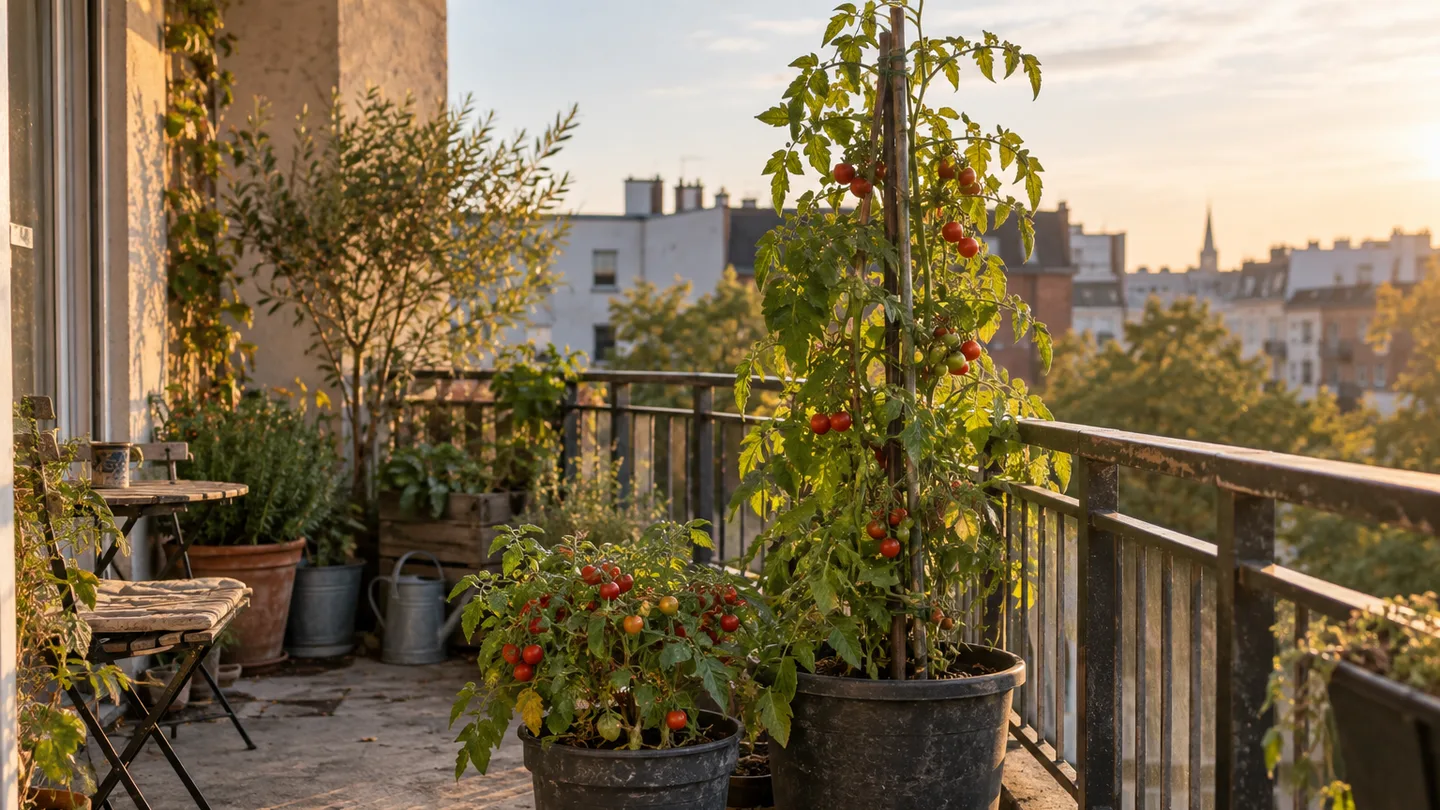
The one-pot verdict: start with determinate unless your balcony can host a long vine
If you have one pot, limited railing space and no appetite for daily rescue watering, a determinate tomato is usually the calmer choice. Many stay within a manageable framework, set much of their crop in a concentrated period and can work with support around 1.2–1.8 m (4–6 ft). I’d put one in about 20–25 L (5–6.5 gal) of mix.
Choose a full-size indeterminate when you can give the plant a larger root zone—about 30–40 L (8–10.5 gal)—plus a stake, trellis or string system around 1.8–2.4 m (6–8 ft). You also need a place where a heavy, leafy canopy won’t block a walkway or catch against a railing.
My strongest balcony rule is to buy the support before the plant. A seedling looks harmless in April. By midsummer, the support, pot, root zone and wind exposure are one project, not four separate purchases.
A dwarf indeterminate can change the decision. If the label gives a genuinely short mature height and a container recommendation that matches your available pot, it may offer a longer picking season without becoming an eight-foot vine. Don’t choose it on the word “dwarf” alone; confirm the mature spread and support instructions.
Same species, different season plan: what the growth habits actually mean
The labels describe what happens at the growing tip. A determinate tomato eventually ends much of its upward extension in a flower cluster, so its main framework reaches a relatively fixed height. It can still branch, and cultivar differences matter, but the plant is working toward a limited structure.
That limited structure is why determinates tend to ripen a large share of their fruit over a shorter window. They suit a grower who wants tomatoes for a few busy weeks, a shorter growing season or a planned period of preserving. They don’t all ripen on the same day, but the crop usually feels more like a wave than a steady trickle.
An indeterminate tomato keeps its main growing tip extending in suitable weather. It adds leaves, stem sections and flower trusses—a truss is the branching stalk that carries several flowers or fruits—rather than finishing after one final cluster. That creates a longer season plan, but it also creates more stem to tie, more leaf area to water and more canopy for wind to push around.
As a first planning range, many determinate cultivars fall around 60–120 cm (2–4 ft) at maturity. Full-size indeterminates commonly reach about 150–250 cm (5–8 ft) or more when they have adequate warmth, light and support. Those are not substitutes for the cultivar label: a small determinate can be taller than a compact indeterminate, and an indeterminate in a pot may be stopped early by cold, root restriction or pruning.
When a label is vague, check the stated mature height rather than translating “bush” into a guaranteed size. The growth habit matters because it sets the season’s workload before the first flower opens.
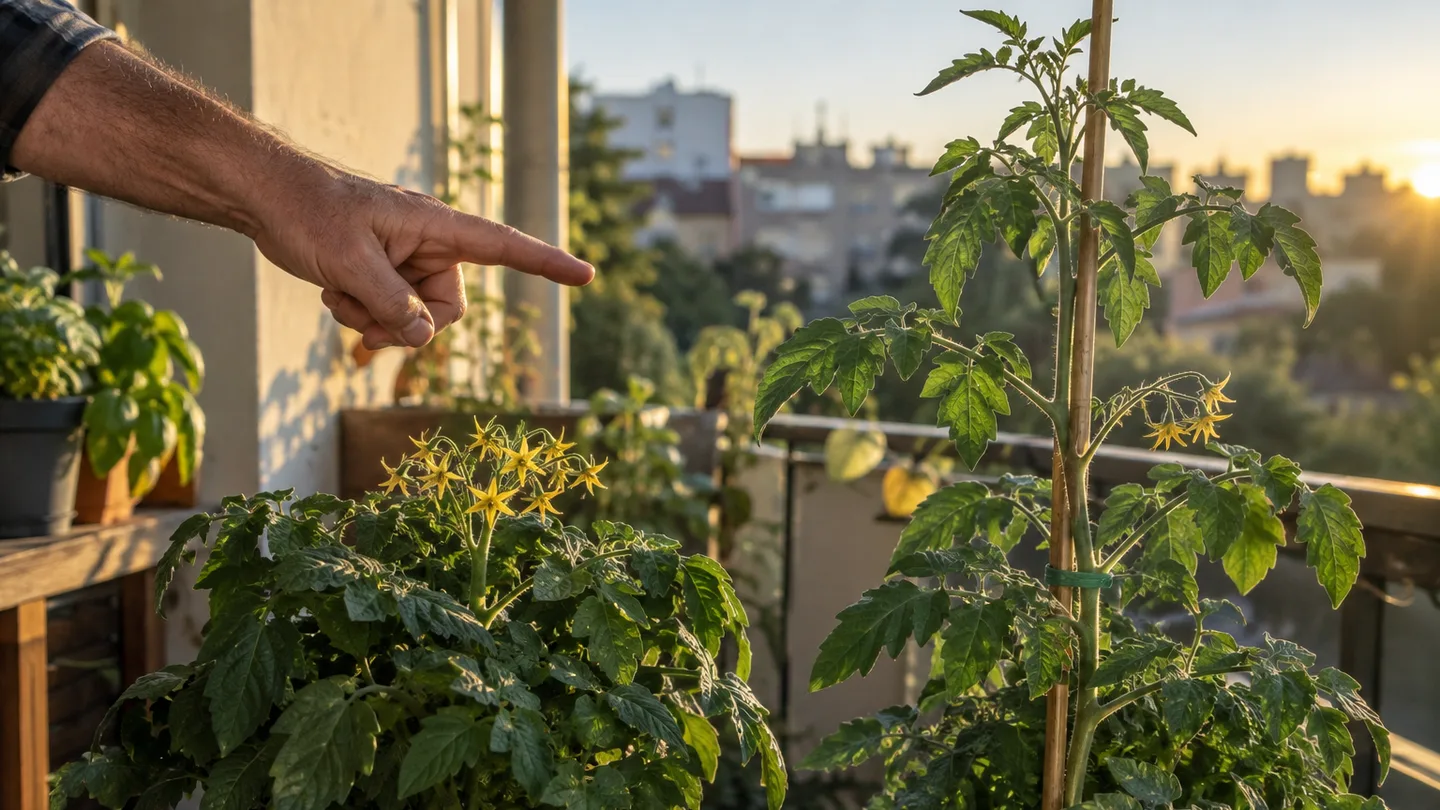
Pot volume is the hard limit: plan 20–25 L for determinate and 30–40 L for full-size indeterminate
The numbers below are where I’d begin when shopping. Measure the container’s internal space, not the outside rim, and remember that a wide, shallow decorative pot may hold less mix than it appears to hold.
| Tomato type | Practical mix band | Approximate container size | Support planning | Root-zone and drying risk |
|---|---|---|---|---|
| Determinate | 20–25 L (5–6.5 gal) | About 35–40 cm wide and 30–35 cm deep (14–16 × 12–14 in) | Roughly 1.2–1.8 m (4–6 ft) | Moderate once established; still quick to dry in wind or full sun |
| Dwarf or patio indeterminate | About 15–25 L (4–6.5 gal), only if the label supports it | About 30–40 cm wide and at least 30 cm deep (12–16 × 12 in) | Often about 0.9–1.5 m (3–5 ft), depending on cultivar | Lower canopy demand than a full-size vine, but not drought-proof |
| Full-size indeterminate | 30–40 L (8–10.5 gal) | About 40–45 cm wide and 35–40 cm deep (16–18 × 14–16 in) | Roughly 1.8–2.4 m (6–8 ft) or a planned string system | More buffered, but the larger canopy can still empty the pot quickly |
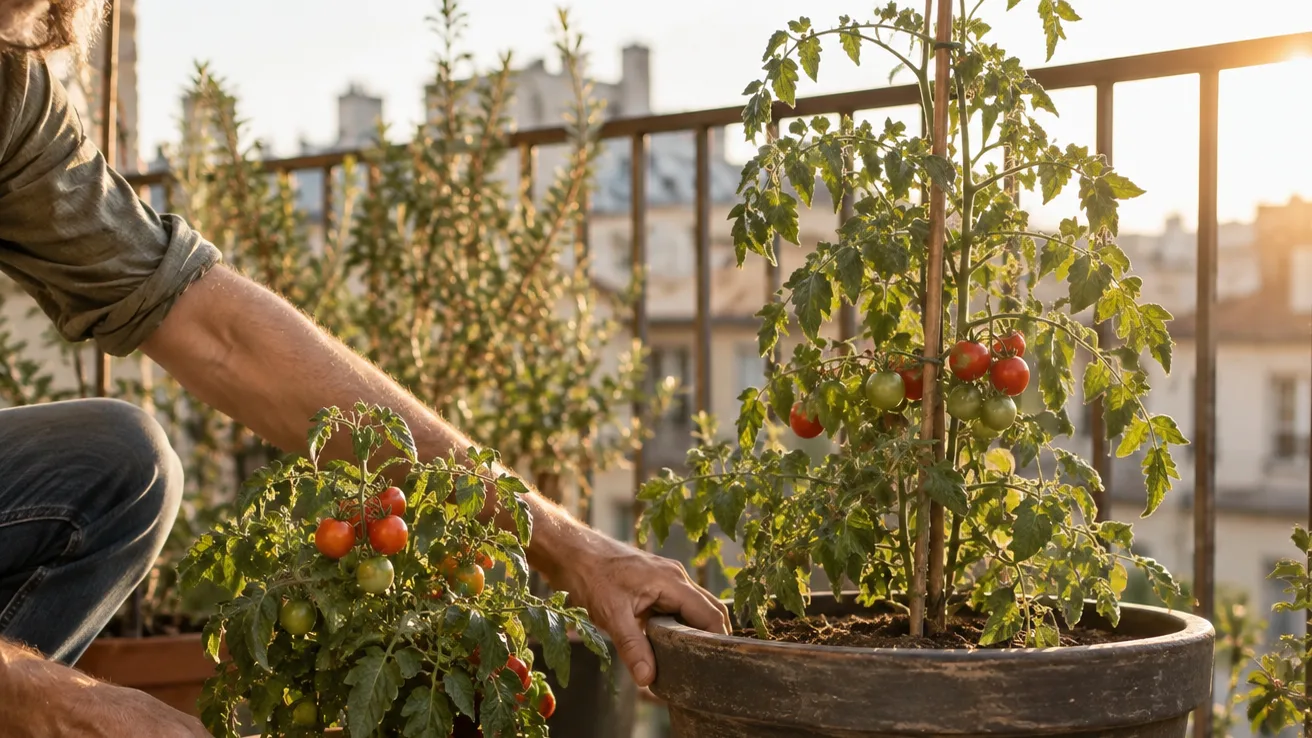
An 8–12 L (2–3 gal) pot may keep a young tomato alive. That is a different standard from supporting a fruiting plant through hot, windy weather. The smaller root zone contains less available water and fewer nutrients, so the plant reaches the point of stress sooner after each sunny day. The problem often appears as repeated midday wilt, small or uneven fruit, blossom-end problems or a plant that seems to recover only after you water it again.
A hole in the base lets excess water leave; it does not create more water-holding mix above it. This is the practical meaning of a perched water table: after watering, some moisture remains held in the lower part of the pot because the mix drains into air rather than into open ground. A drainage hole helps prevent the pot staying saturated, but the hole cannot compensate for too little total root volume.
I also wouldn’t fill the bottom with gravel to “improve drainage.” In a container, that uses up space that could have held root mix and can move the saturated zone upward instead of solving the underlying volume problem. Use a free-draining potting mix, a real hole or holes, and enough total mix for the plant you chose.
For a concrete planning example, a 22 L (5.8 gal) pot is a reasonable match for a moderate determinate. If the only available pot is 10 L (2.6 gal), I’d change the plant choice before trying to compensate with extra feeding. More fertilizer can’t supply the missing water reserve, and it may make the salt concentration in the remaining mix harder to manage.
A 1.2 m cage and a 2.1 m vine are different balcony projects
Support height is not a cosmetic detail. Many determinates can work with a cage or frame around 1.2–1.8 m (4–6 ft), although the plant may spread beyond the frame. A full-size indeterminate is a different job: plan for a support around 1.8–2.4 m (6–8 ft), or use a string, trellis or overhead system that lets you lower and redirect the vine later.
A cage’s stated height is not always its usable height. The plant may start branching outward before it reaches the top, and a fruit-heavy canopy can lean over the rim. Put the support in place before transplanting so you don’t drive it through established roots later.
On an elevated space, wind changes the calculation. A wet canopy is heavier than a dry one, and every gust applies leverage to the stem, cage and pot together. Keep the pot away from a hard railing edge, check that the support cannot rotate in the mix, and leave clearance so the foliage isn’t rubbing against a wall.
The failure signs are physical and easy to miss at first: the pot begins leaning, the cage pulls sideways, the main stem kinks where it exits the frame, or a heavy fruit truss bends the stem sharply. If you wait until the canopy is fully loaded, tying it upright can break more tissue than it saves. My preference is a slightly overbuilt support in a smaller space rather than a perfect-looking cage that becomes a sail.
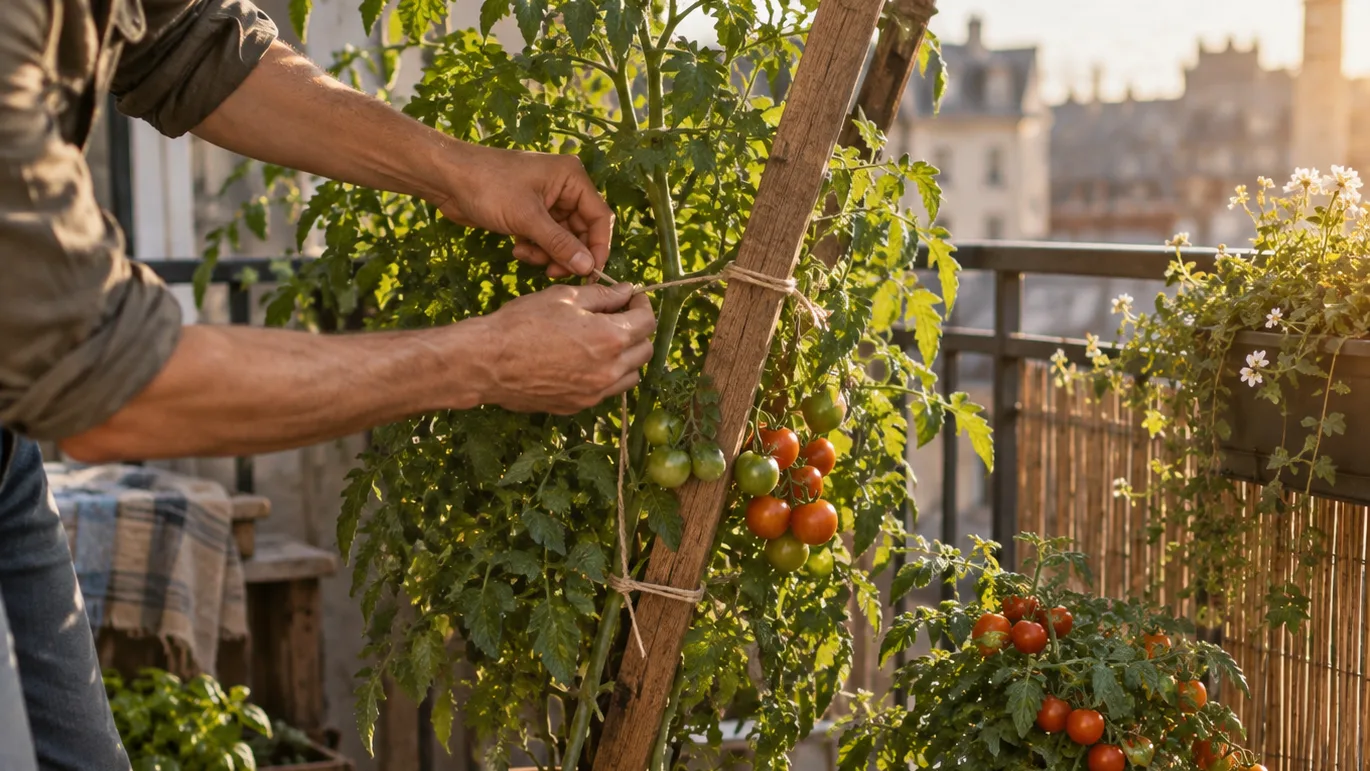
Pruning changes the risk: leave determinate side shoots, train indeterminate ones
A sucker is a shoot that emerges from the angle between a leaf stem and the main stem. The pruning advice changes because the two growth habits use their side shoots differently.
With a determinate tomato, I leave most healthy side shoots alone unless they are damaged, lying on the mix or creating an obvious tangle at the base. Those shoots can become part of the plant’s limited fruiting framework. Aggressive sucker removal may give you a tidier plant while quietly removing flower sites you needed.
With an indeterminate, training one or two main stems can make sense when the plant has a narrow trellis, strong support and a crowded balcony. I remove selected suckers while they are small, then guide the chosen stems upward. Leaving more stems is possible, but it creates a wider, heavier canopy and makes airflow and tying more demanding. I’d rather choose one training system early than chop randomly once the plant is already tangled.
Start tying when the stem reaches the support, not after the first heavy truss bends it. Use soft ties and add another tie roughly every 20–30 cm (8–12 in) of new growth during the fastest part of the season. Check new growth every few days in warm weather; a tie that was loose last week can become a constricting loop surprisingly quickly.
Over-pruning has a recognisable look: a thin, sparse plant with fruit exposed to direct sun and long bare sections between leaves. Leaves are not decorative. They provide the canopy that shades developing fruit and keeps the plant from losing water as abruptly.
Water and feed by canopy, not by label
Determinate and indeterminate are growth-habit labels, not watering schedules. A 20 L (5.3 gal) pot in black plastic, full sun and steady wind may need checking every morning and sometimes again late in the day. The same volume in a pale or glazed pot, sheltered from wind and receiving part shade, may stay workable for longer. As the canopy grows, the plant’s water demand changes even though the pot has not.
Use a repeatable check instead of a calendar:
- Push a finger or a slim wooden stick about 5 cm (2 in) into the mix, preferably in the morning.
- If that zone feels dry and the pot feels noticeably lighter, water slowly across the whole surface.
- Continue until a little excess exits the drainage holes, then let the pot drain freely.
- If the mix is still wet at that depth but the leaves are limp, inspect the drainage, roots and heat exposure before adding more water.
Midday drooping is not enough evidence by itself. A plant can fold its leaves during heat and recover by evening while the root zone is still moist. Check again early the next morning. Underwatering usually leaves a light, dry pot and a plant that improves after watering; overwatering is more consistent with persistently wet mix, yellowing lower leaves, soft growth or a sour smell. Symptoms overlap, so check the root zone before choosing the treatment.
For feeding, a modest liquid tomato fertiliser rhythm of about every 1–2 weeks is a useful starting point during active growth, but the product label and the plant’s response should control the final rate. Apply feed to already-moist mix rather than pouring concentrated fertiliser onto a dry root ball. Repeated feeding in a small pot can leave soluble salts behind as water evaporates; a pale crust on the surface or brown leaf edges is a reason to pause, water thoroughly with plain water and reassess.
Too much nitrogen can also produce lush, soft foliage without the fruiting balance you wanted. If the plant is making huge leaves and weak stems while flowers are scarce, don’t respond by adding more feed. Check light, watering swings, support and the fertiliser analysis first.
Harvest in a wave or keep picking: set expectations without fake yield promises
The useful comparison is harvest rhythm, not a promised number of tomatoes. A determinate commonly delivers a more concentrated crop over several weeks. That suits someone who wants to preserve, has a short season, or expects to be away during the middle of summer and would rather return to a plant near the end of its main flush than miss months of scattered picking.
An indeterminate usually spreads production over a longer period because the growing tip keeps making new flower trusses. That longer window depends on continued warmth, useful light, regular moisture and enough leaf health to support new growth. Cool nights, prolonged heat, shade, drought, disease or a root zone that repeatedly swings from dry to saturated can shorten either type’s harvest.
Pot size affects fruit consistency more reliably than the word determinate or indeterminate on the label. The label tells you how the stem tends to grow; the pot controls how much water and nutrient reserve sits around the roots. A smaller container can still fruit, but it gives weather and missed watering more influence over the result.
If flowers fall before they swell into fruit, don’t assume the growth habit is the culprit. Light, heat, irregular moisture and poor pollination conditions can all be involved. The more useful follow-up is blossom drop tomatoes, then compare the symptoms with what you can see on the plant.
For a second edible pot, growing peppers in containers can be a better match for a smaller support footprint, while a tomato is the better choice if you specifically want a tall, productive vine and can maintain it.
At the garden centre, decode “bush”, “compact” and “dwarf”
Garden-centre language is helpful until it isn’t. “Bush” often points toward determinate growth, but it is not a substitute for a stated mature height. “Compact” may describe a genuinely small determinate or a smaller indeterminate that still wants to keep extending. “Dwarf” usually refers to a deliberately short growth habit, not a guarantee that the plant needs almost no root volume.
A short plant can still carry a substantial canopy for its height. That’s the counter-intuitive point I’d keep in mind: short does not mean thirsty roots have disappeared. If the plant is bred to set fruit heavily on a compact framework, the pot still needs enough mix to buffer the demand.
If the label doesn’t use the words determinate or indeterminate, I’d check these five details before buying:
- Mature height and spread, in centimetres or feet.
- Whether the plant needs a cage, stake, trellis or string support.
- Recommended container size, if the breeder supplies one.
- Days to maturity and whether that timing assumes transplanting rather than sowing.
- Whether the variety is described as bush, patio, compact, dwarf or vining—and whether those words are backed by a number.
When terminology is muddled, I’d compare the packet with university extension guidance on determinate and indeterminate tomato growth, pruning and harvest habits, then give priority to the breeder’s mature-height and support instructions. Seed-packet and breeder terminology for dwarf, compact, bush and patio tomato varieties is more useful when it gives you measurements rather than just a marketing adjective.
If tomatoes are competing with too little light, Easy fruits and vegetables to grow in pots is a more sensible starting point than forcing a long vine into a shaded corner.
Make the final choice from four constraints: sun, pot count, support and absences
I’d make the decision in this order: measure the pot, identify the support, observe the useful sun window, then consider how often you can check the plant. The plant label comes last because it has to fit the space you already have.
- Choose a determinate for one 20–25 L (5–6.5 gal) pot, support around 1.2–1.8 m (4–6 ft), a shorter season, or a summer when you may be away during peak growth.
- Choose a full-size indeterminate for 30–40 L (8–10.5 gal), roughly 6–8 hours of useful sun, support near 2 m (6.5 ft) or taller, and frequent access for water and tying.
- Choose a dwarf indeterminate when you want a longer harvest pattern but the mature-height and container guidance genuinely fit your pot.
- Choose neither yet if the site gets closer to 1–2 hours of direct sun. I’d spend that container on a crop that tolerates the light better rather than blaming the tomato variety for a location problem.
Here’s a simple balcony comparison. A renter has a 22 L (5.8 gal) glazed pot, a 1.5 m (5 ft) cage, about five useful hours of sun and a ten-day absence planned for August. I’d choose a determinate or compact plant, mulch the surface, arrange a reliable watering plan and accept a more concentrated harvest.
Another grower has a 35 L (9.2 gal) pot, a 2.1 m (7 ft) wall trellis, seven hours of sun and can check moisture every morning. That is a reasonable indeterminate project. It still isn’t guaranteed to produce well—the season can turn, flowers can fail and disease can intervene—but the basic physical constraints are aligned.
Before you buy this weekend, measure the pot’s internal diameter and depth, write the volume beside it, and stand on the balcony at the times you expect to grow. Note the hours when direct sun actually reaches the pot, then choose the tomato whose mature height, support and root-volume needs fit those notes. If the label cannot tell you how tall the plant becomes, put it back and choose one that can.