Growing Blueberries in Containers: Pot Size, pH and Pruning
A compact blueberry wants about 30–45 litres of mix, while a standard highbush is better in 50–75 litres. The 20-litre decorative planter many people pick is usually a temporary home, not the container that carries a mature plant through summer.
Blueberries are manageable on a balcony, but they punish vague advice. The pot has to hold enough acidic, airy mix; the roots must stay moist without sitting in stagnant water; and the shrub needs real sun before pruning can make much difference.
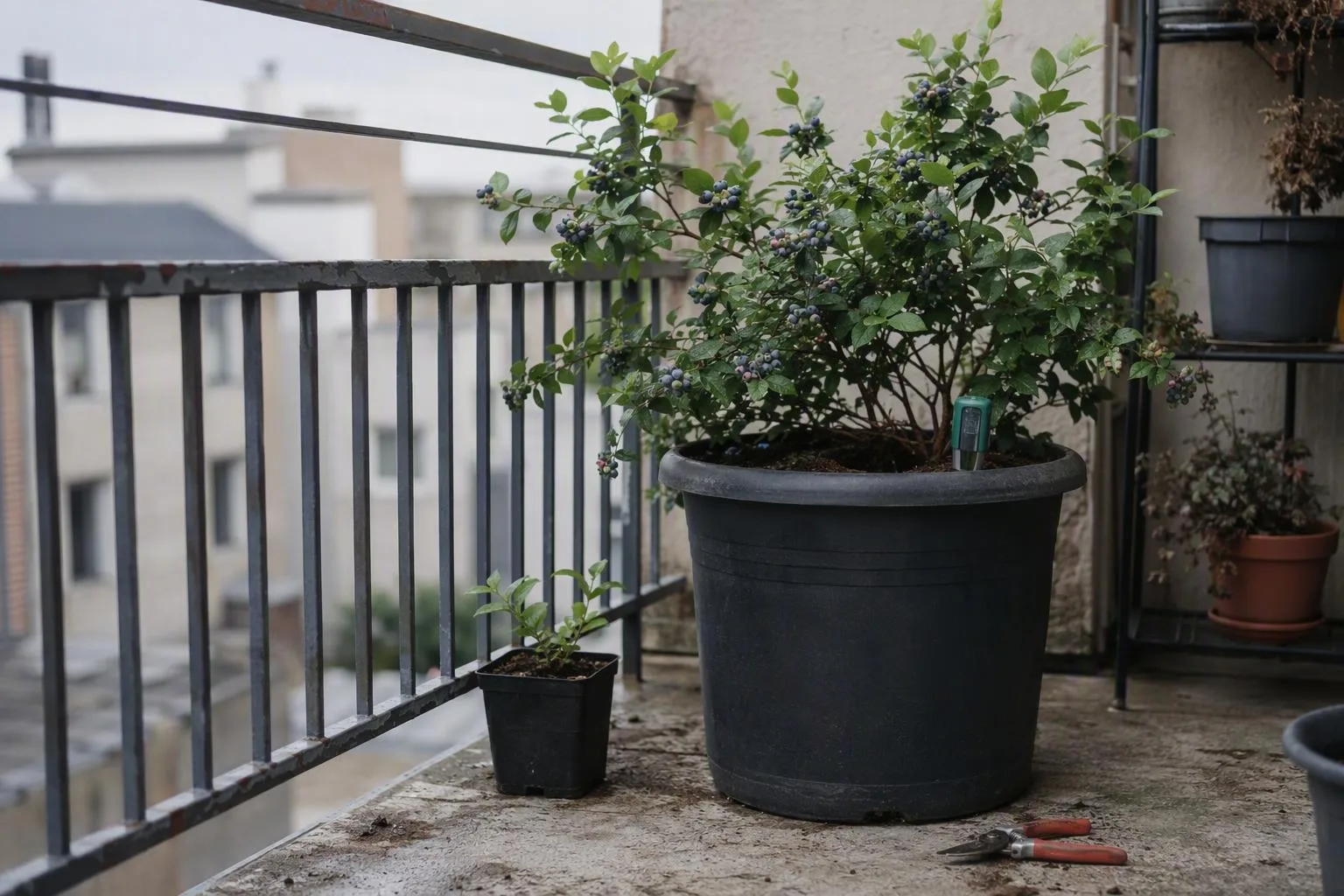
The pot I’d choose: 30–45 L for compact plants, 50–75 L for standard highbush
When I’m standing in a garden-centre aisle, I don’t trust a pot labelled large. I look at the internal width, depth and shape, because a tapered container can hold considerably less growing mix than its broad rim suggests. For a final pot, I’d choose 30–45 L (8–12 US gal; 6.5–10 imperial gal) for a compact blueberry and 50–75 L (13–20 US gal; 11–16.5 imperial gal) for a standard highbush.
| Working volume | Approximate internal size | Best fit | Watering burden |
|---|---|---|---|
| 20–30 L >(5.3–7.9 US gal; 4.4–6.6 imperial gal) | 30–38 cm wide and deep >(12–15 in) | Young plant or temporary pot | High once roots fill it |
| 30–45 L >(8–12 US gal; 6.5–10 imperial gal) | 40–50 cm wide and roughly as deep >(16–20 in) | Compact or dwarf-type blueberry | Moderate, with a useful moisture buffer |
| 50–75 L >(13–20 US gal; 11–16.5 imperial gal) | 50–60 cm wide and 40–50 cm deep >(20–24 × 16–20 in) | Standard highbush or a large established plant | Lower frequency, but heavier to move |
Those are working volumes, not necessarily the number printed on the label. Leave a few centimetres below the rim for watering and mulch, and remember that the nursery root ball displaces some mix. A blueberry’s roots are relatively shallow, but that doesn’t make a narrow pot suitable. The plant still needs horizontal room for a broad, even root zone, and a wider base is less likely to tip in wind.
Here’s the calculation I use for a tapered pot. Suppose the inside diameter is 48 cm at the rim, 36 cm at the base, and the internal depth is 38 cm. The frustum formula is π × depth ÷ 12 × (rim diameter² + rim diameter × base diameter + base diameter²). In this case, π × 38 ÷ 12 × (48² + 48 × 36 + 36²) gives about 53,000 cubic centimetres, or 53 L to the brim. If I leave 4 cm for headspace, the usable fill is closer to 47 L before the root ball takes its share. That is a plausible compact-blueberry pot, even if its rounded shop description says something different.
On a balcony, volume is also a weight and wind decision. Wet mix, a heavy ceramic pot and a tall shrub create a different load from a dry plastic container. I’d place the pot against a sheltered wall, avoid a narrow top-heavy shape, and check the building’s balcony rules or load guidance before choosing the biggest container. A slightly smaller plastic pot in a protected position is a better choice than a huge planter you cannot safely move.
Variety first: compact growth and enough direct sun matter more than a decorative pot
Buy the plant before you buy the final pot. A cultivar sold as compact, dwarf or patio-sized is easier to keep within a balcony’s height and root volume than a vigorous standard bush, but those labels are not perfectly consistent. Read the cultivar description and look for its mature size, chill requirement and pollination notes.
Compact highbush types are useful where height and width matter. As a planning band, I’d allow roughly 0.6–1.2 m (2–4 ft), while still expecting variation between cultivars. Half-high types combine highbush and lowbush traits and may sit around 0.9–1.5 m (3–5 ft). Standard highbush plants can become roughly 1.5–2.4 m (5–8 ft) or more if their roots, light and climate suit them, which is why they belong in the larger volume.
A chill requirement is the amount of cool winter weather a cultivar needs before it resumes normal growth. Match that requirement to your local winter rather than relying on a generic hardiness label. A plant can survive a cold spell and still fruit poorly if its winter pattern does not suit the cultivar.
For a worthwhile crop, I’d target around six or more hours of direct sun. A position receiving only one or two hours may keep leaves growing, but my read is that it usually falls short for dependable fruiting because the plant has less energy for flower and berry development. That also makes a typical windowsill a poor blueberry fruiting site: bright indoor light is not the same as direct outdoor sun, and a warm room can interfere with the cool dormant period deciduous blueberries need.
One compatible second cultivar is a useful option, not an automatic requirement. Many blueberries can set some fruit alone, but a second cultivar that blooms at the same time can improve the amount and uniformity of pollination. Check the named cultivars rather than assuming any two plants will bloom together.
If you’re deciding whether this is the right first fruit crop, compare it with Easy fruits and vegetables to grow in pots. My honest view is that blueberries repay the effort when you can provide sun and acidic water; in a dim balcony corner, herbs or leafy crops make a more sensible use of space.
Make the root zone acidic before the plant arrives
Blueberries need an acidic root zone, roughly pH 4.5–5.5 for the container mix I’d aim to prepare. pH is a measure of acidity: lower numbers mean more acidic conditions. The point is not to make the surface look dark or add a handful of an acidifying product. The point is to give the roots a stable medium in which nutrients remain available.
Even if you’ve already read container gardening soil advice, blueberries deserve their own mix decision. A bag labelled ericaceous, meaning intended for acid-loving plants, is the simplest route. Check that it is a potting medium rather than garden soil, and buy enough to fill the final container without stretching the mix with soil from outside.
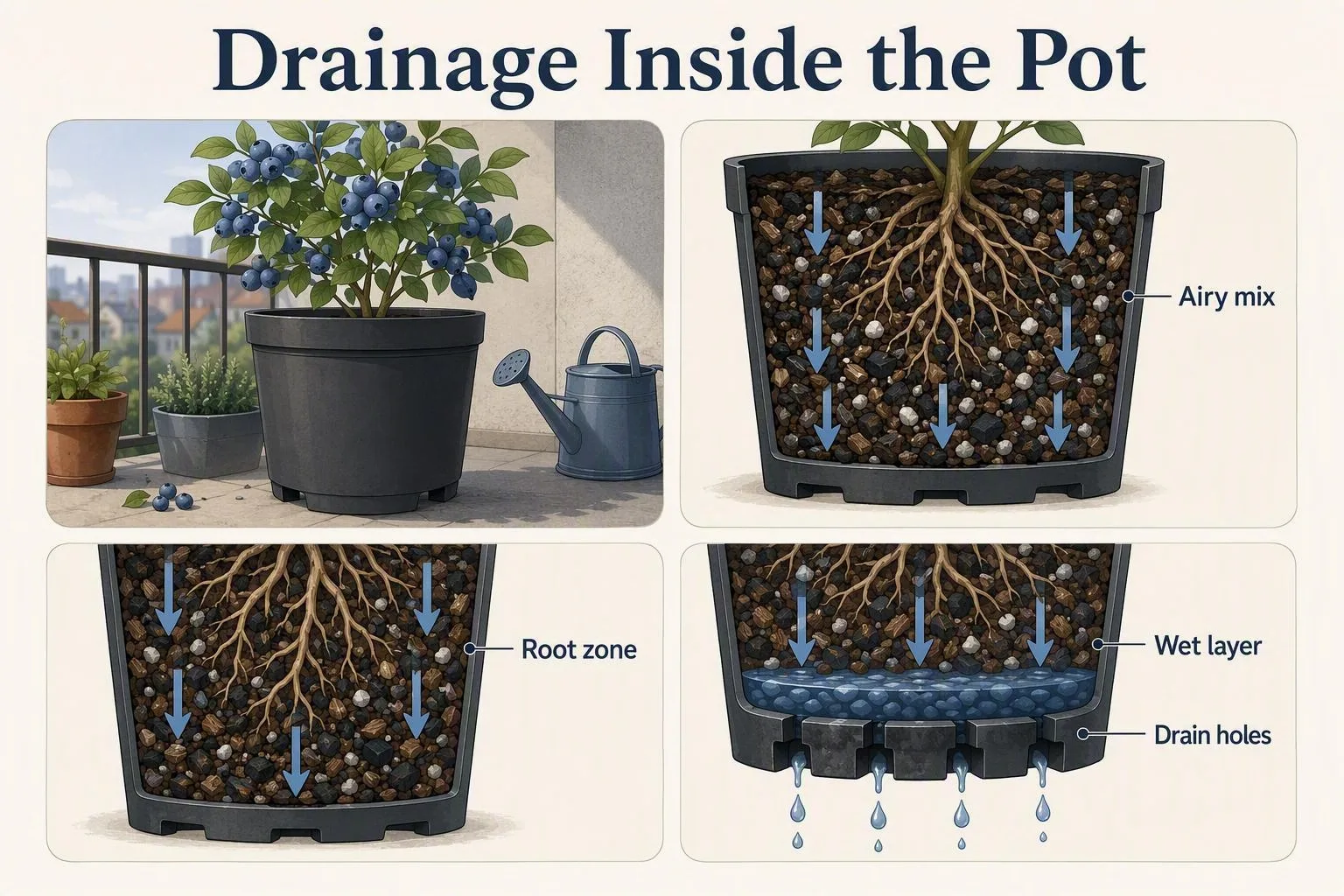
A workable DIY starting blend is two parts acidic organic material, one part fine pine bark and one part perlite by volume. The organic material holds moisture and contributes much of the initial acidity; fine bark adds structure and air spaces as it breaks down; perlite keeps the blend from packing into a dense wet mass. The exact materials matter more than the recipe’s neatness. A very coarse bark blend can dry rapidly, while fine material with too little air space can stay wet around the roots.
Don’t add garden soil, lime or unmeasured compost to this mix. Garden soil can collapse into a dense layer in a pot, and lime pushes pH in the opposite direction from the one blueberries need. Compost varies widely in pH and salt content, so I’d use it only if the product is specifically suitable and the prepared medium still tests within range.
Elemental sulfur can lower pH, but it is a slow, medium-dependent correction. Its effect depends on the starting pH, the material’s buffering capacity, moisture, temperature and microbial activity. That is why I wouldn’t sprinkle sulfur by instinct. Mix the base ingredients first, moisten them evenly, take a representative sample, and test that prepared medium. Adjust cautiously only if the reading calls for it, then allow time for a correction to act before planting.
- Combine the dry ingredients thoroughly in a clean tub.
- Add water gradually until the mix is evenly damp, not dripping.
- Test a sample using the method supplied with the kit, preferably a soil slurry or laboratory-style extraction rather than a single pushed-in probe.
- Make one measured adjustment, mix again and retest instead of adding several products at once.
- Fill the container and plant only after the mix is consistent from top to bottom.
My read on used coffee grounds is simple: they are an unreliable acidifier. Their chemistry changes with the coffee, brewing method and amount added, and a random layer can also alter drainage. Use a tested acidic medium and a pH reading; treat coffee grounds as a compost ingredient only when the whole mix has been designed to suit the plant.
For a second reference, I’d use university extension guidance on blueberry soil pH, container media, fertiliser and pruning rather than a general houseplant chart. The recommendation is not to copy a number blindly, but to compare the advice with your cultivar and water supply.
Planting day is about crown height, open drainage and a settled root ball
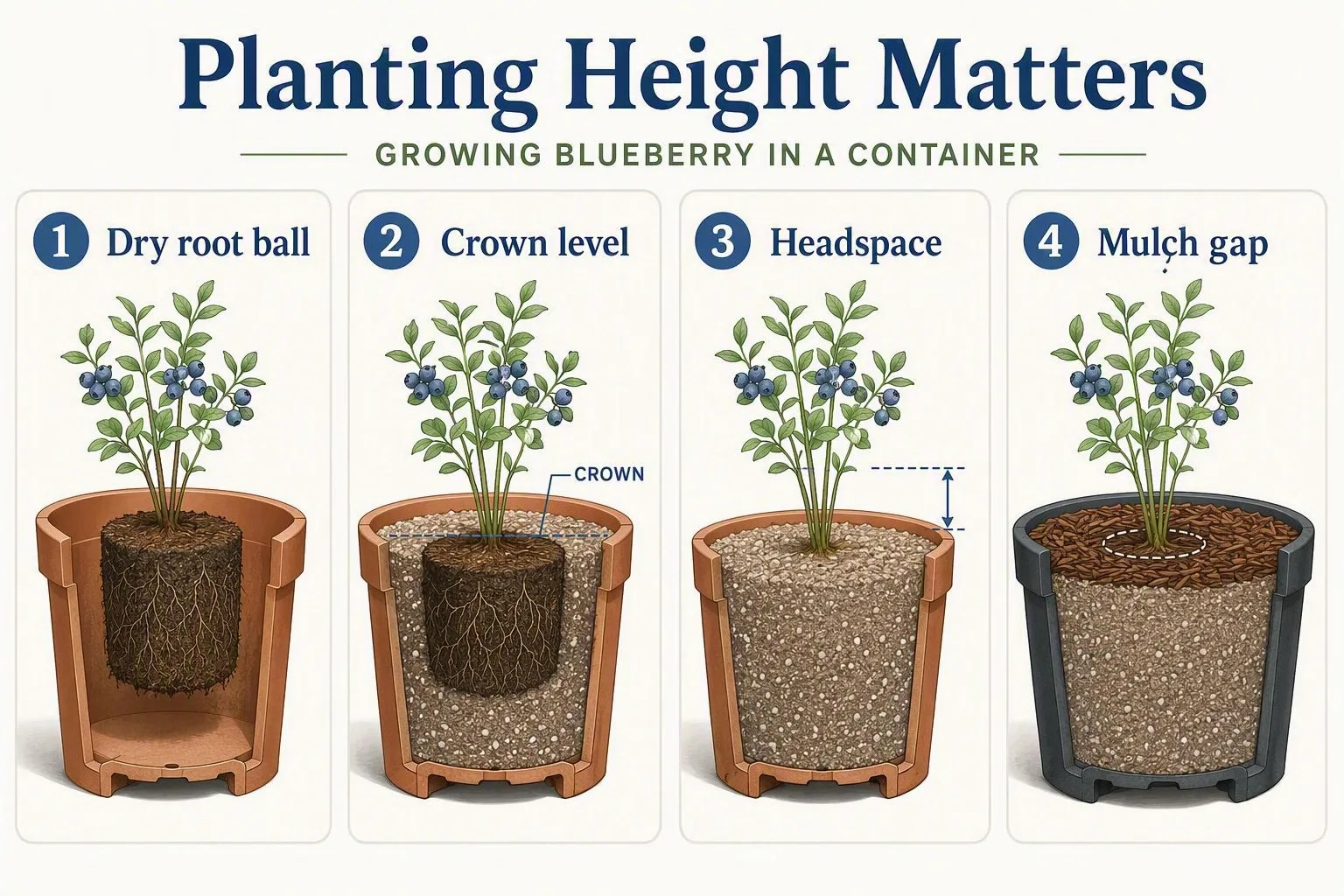
Planting depth is the detail I would slow down for. The crown is the point where the stems meet the roots. Set that point at the same height it sat in the nursery container; burying it to make the plant look more securely anchored can leave the lower stem in a persistently damp zone.
- Place mesh or a small piece of screen over each drainage hole so mix cannot wash out. Keep the hole open rather than sealing it with a solid shard or saucer.
- Add enough prepared mix to bring the crown to its original height. Test this before the root ball is in place, because topping up later is easier than correcting a buried crown.
- Slide out the plant and inspect the outer roots. Loosen only roots that are tightly circling or forming a hard outer mat; don’t tear the entire root ball apart.
- Set the plant centrally, backfill around it and firm the mix lightly with your fingers. Heavy tamping removes the air spaces you prepared.
- Water slowly over the whole surface until a little comes through the drainage holes. This settles gaps and shows whether water can leave the pot.
- Top up if the mix has dropped, then add a light 2–5 cm layer of pine-bark mulch, keeping it away from the crown.
The drainage test matters more than a gravel layer. Drainage holes let excess water leave only when the pot sits on feet, a slatted surface or a saucer that does not seal the holes. A saucer can catch runoff, but it should be emptied rather than left as a permanent reservoir.
Gravel at the bottom does not create extra drainage in the way people expect. Water tends to remain in the finer potting mix above the coarse layer before it moves out. That wet band is called a perched water table: a temporary saturated zone held above a change in texture. In a blueberry pot, moving that zone upward can put more of the root area in low-oxygen mix. Use one consistent, airy medium from top to bottom instead.
Water by root-zone moisture, then feed for growth without building up salts
Don’t water a blueberry from the calendar alone. The top few centimetres can feel dry while the lower portion is still wet, particularly in a large pot after cool weather. Push a finger or wooden skewer well below the surface, lift the pot if you can, and compare its weight with how it feels just after a thorough watering. A skewer that comes out cool and dark halfway down is telling you something the surface cannot.
When the root zone is drying, water the entire mix slowly until a small amount drains from the holes. That wets the lower roots rather than just refreshing the top crust. Empty the saucer afterward. In a plastic pot exposed to full sun and wind, I’d make a near-daily check in hot weather. In a glazed pot in part shade, the same check might be every third day. Those are checking intervals, not promises; wind, plant size, rain and pot shape can change the answer.
Water quality can gradually change the root zone. Hard, alkaline tap water brings dissolved minerals and alkalinity into the pot with each watering, so a mix that started acidic may drift upward over time. My read is that collected rainwater is generally less alkaline than tap water because it has picked up fewer dissolved minerals, but storage tanks, roofs and local air quality can change what is in it. Don’t collect from a surface contaminated with treated timber, flaking coatings or other materials not intended for edible growing.
If tap water is your only practical source, monitor the mix rather than trying to guess how much acid to add. A local water utility hardness report can tell you whether your supply deserves closer attention, although hardness and alkalinity are related rather than identical measurements.
Feed only when the plant is actively growing and the root zone is moist. Use a fertiliser labelled for acid-loving plants and follow its dilution and timing instructions. A wilted plant in dry mix needs water first; a plant sitting in saturated mix needs its drainage problem addressed first. Fertilising either condition can add stress instead of growth.
Repeated heavy doses can leave soluble salts in a container. Brown margins, a white crust on the mix or a plant that declines soon after feeding are reasons to stop, inspect drainage and consider a thorough rinse with suitable water. I prefer a modest, label-directed feeding rhythm over trying to force a flush of lush shoots that will need hard pruning later.
Prune in two passes: establish strong canes, then renew the oldest wood
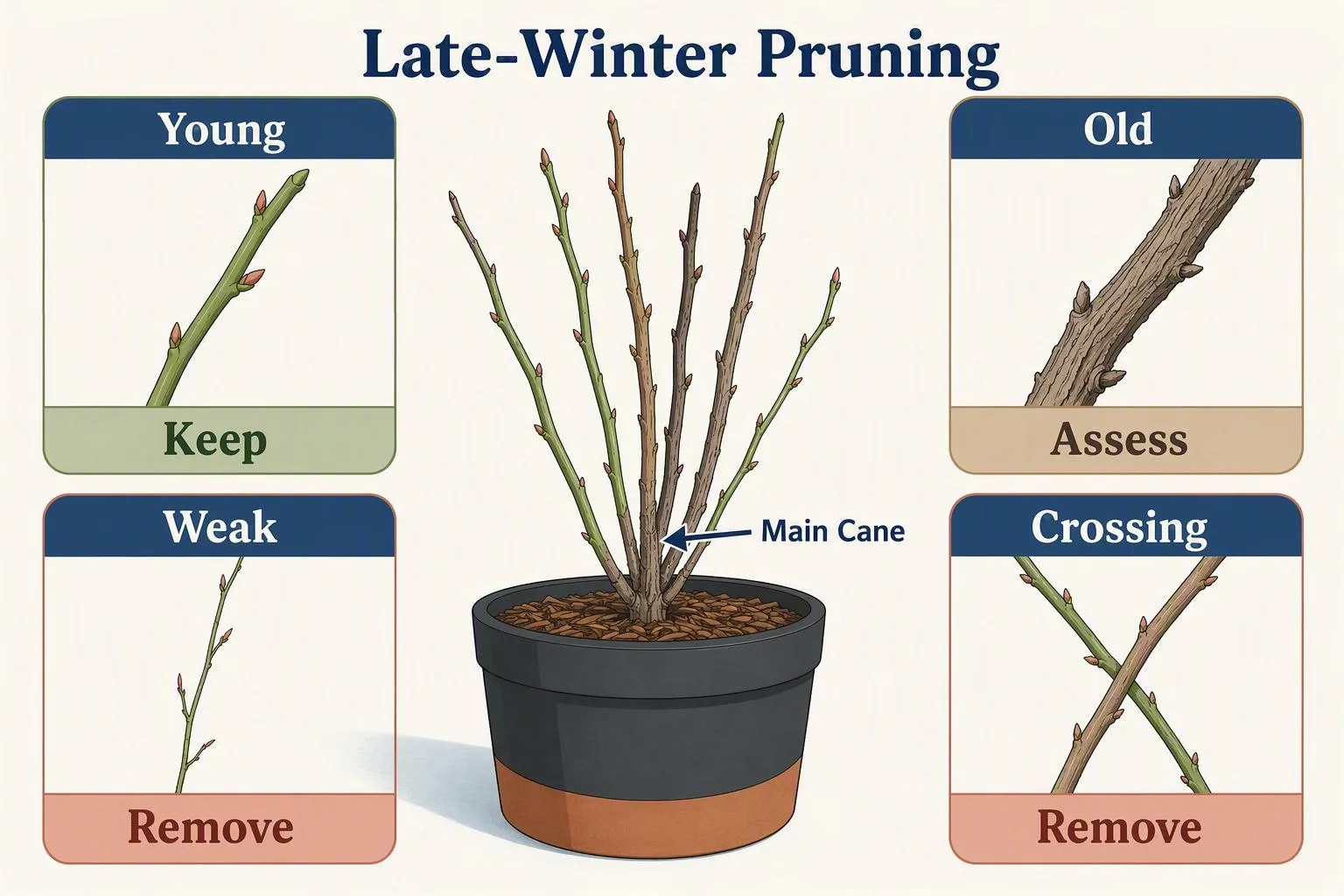
Blueberries commonly carry their flowers and fruit on one-year-old wood, meaning shoots that grew during the previous season. That makes pruning a selection job, not a haircut. If you shorten every branch to the same height, you can remove the buds that would have made this season’s berries.
For a first- or second-year plant, the roots and framework are still the priority. Many growers remove most flower clusters on a young plant so it puts more resources into roots and shoots. I’d remove the flowers or tiny fruit carefully, without making large cuts into an otherwise healthy framework. If the plant is very small, preserving a few flowers for identification is reasonable, but I would not ask a newly potted shrub to carry a full crop.
For an established plant, make the main cut in late winter while the structure is visible and before flower buds open fully. Work in this order:
- Remove dead, broken or diseased-looking wood first, cutting back to healthy wood or the base as appropriate.
- Take out stems that lie on the soil or cross through the centre, because they crowd the root-zone air and shade productive shoots.
- Remove a limited number of the oldest, weakest canes at ground level. On a vigorous plant, that may mean one to three canes; on a small container plant, it may mean none this year.
- Thin weak, twiggy interior growth so the remaining shoots have light and air.
- Keep a balanced mix of strong young, middle-aged and older productive canes rather than leaving only the newest shoots.
Flower buds are usually plumper and rounder than the narrower leaf buds, and they tend to sit toward the ends of last year’s healthy shoots. I use that distinction as a guide, not a reason to handle every bud. If buds are already swelling, finish the essential cleanup and stop before turning the shrub into a bare outline.
Container blueberries usually need lighter pruning than a neglected in-ground shrub because the root volume limits how much top growth the plant can support. My original take is that under-pruning is often easier to recover from than an enthusiastic annual reset: you can remove one more crowded cane next winter, but you cannot put this season’s flower buds back on a cut branch.
Yellow leaves, brown edges and no berries: separate pH trouble from wet roots
Start with the newest leaves, not the oldest
Symptoms overlap, so I check in a fixed order: moisture below the surface, drainage holes, recent feeding, then root-zone pH and light. Yellow leaves do not automatically mean the plant needs more fertiliser. The same pale colour can appear when roots are too wet to function or when a high pH makes iron difficult for the plant to use.
| What you see | What I’d check first | Likely direction | First response |
|---|---|---|---|
| New leaves yellow between green veins | Root-zone pH and moisture at depth | High pH can restrict iron availability | Measure pH, correct the medium cautiously and avoid relying on a one-off leaf spray |
| Whole plant is pale and growth is weak | Recent feeding, root condition and light | Nutrient shortage, poor roots or insufficient sun | Fix drainage and light before applying more fertiliser |
| Brown, crispy leaf margins | Dryness, wind and recent fertiliser | Water stress or salt injury | Check below the surface, water thoroughly when needed and pause feeding |
| Leaves are limp while the mix stays wet | Drainage holes and the lower root zone | Low oxygen or damaged roots | Do not add water; open the drainage path and reassess the medium |
| Red or purple colouring | Temperature, season, new growth and pH | Cold or general stress can contribute | Check the whole pattern instead of dosing from colour alone |
Interveinal chlorosis is the useful phrase for yellow tissue between green veins. If it appears mainly on new leaves and the medium tests above the target range, pH is a sensible first suspect. Foliar iron can make a leaf look better temporarily, but it doesn’t repair a root zone that keeps preventing iron uptake.
Brown edges need a different investigation. A pot that dries rapidly in wind can scorch leaves even when the soil surface was watered that morning. Fertiliser salts can do something similar, especially after repeated doses in a pot with limited runoff. Conversely, limp leaves in wet mix are not a request for more water; the roots may lack oxygen or already be damaged.
No berries has its own checklist: insufficient direct sun, a plant too young to crop, flowers lost to late cold, a cultivar mismatch, poor pollination or pruning that removed flower buds. Check those in that order before buying another supplement. For a blueberry on a one- or two-hour windowsill, I’d treat sparse fruit as a light problem first.
Winter, repotting and the limit of a balcony container
Leaf drop is normal for deciduous blueberries. The shrub is not necessarily dying because it becomes bare in autumn. The vulnerable part in a container is the root ball: above-ground roots experience temperature swings that roots in the ground are buffered from.
Before a hard freeze, move the pot beside a sheltered wall, out of the strongest wind. Insulate the container itself with a breathable wrap or surrounding material, while keeping drainage holes clear. Protecting the roots matters more than wrapping the bare canopy. Keep the mix slightly moist through winter, but do not leave the pot standing in a full saucer or waterlogged after rain.
A warm indoor room is not automatically safer. It can encourage premature growth and interrupt the cool dormant period. A cold, sheltered outdoor position is often the more natural winter arrangement, but the right level of protection depends on the cultivar and your local winter conditions.
Repot when you find roots circling densely, the mix has collapsed, drainage has slowed, or the container dries dramatically faster than it used to. Those are better triggers than an annual date. Repot in early spring, move up one practical size rather than jumping into an enormous planter, and keep the crown at its original height. Refreshing all the mix can disturb the roots, so preserve a sound root ball and replace only what has broken down or become unsuitable.
What one pot can realistically give you—and the check I’d make this week
A newly planted blueberry may produce little or no crop while it establishes. A mature plant in strong sun might produce anywhere from a few hundred grams to about 1.5 kg (0.5–3 lb), but cultivar, pruning, pollination, weather and container conditions vary enough that I wouldn’t plan around that figure. A low-light balcony should be treated as an ornamental growing situation with the possibility of sparse fruit, not as a dependable berry supply.
Harvest in several passes. Pick berries when they are fully coloured, slightly softened and easy to detach with a gentle lift. Colour alone is not enough; a berry can look blue before it has developed its best sweetness and can hold firmly to the stem.
Can I grow two blueberry plants in the same pot?
Separate pots are easier to water, move and keep within each plant’s root volume. Sharing a planter becomes practical only when it is substantially larger, roughly 75–100 L or more, with excellent drainage and cultivars that suit the same conditions. On a balcony, two manageable containers also let you move one plant if wind, shade or winter exposure differs across the space.
Do I need two blueberry bushes to get fruit?
Many cultivars can set some fruit alone. A second compatible cultivar flowering at the same time commonly improves pollination, fruit set and berry size, so I’d add one when space and budget allow. Check the cultivar names and bloom timing rather than assuming that two random blueberry plants are a matched pair.
Can I grow a blueberry on a windowsill?
My read is that a normal indoor windowsill is usually short of both the direct light needed for a useful crop and the cool dormant period needed for a healthy seasonal cycle. It can be a place to display a dormant plant briefly, but I wouldn’t buy a blueberry specifically for windowsill fruit.
Is rainwater better than tap water for blueberries?
Often, yes, if it has been collected cleanly and stored safely. Rainwater generally carries less alkalinity than mineral-rich tap water, but the collection surface and storage container matter. If the only water available is tap water, use it consistently and let pH testing tell you whether the mix is drifting.
Can coffee grounds lower the pH of a blueberry pot?
Not reliably enough for me to use them as the treatment. Used grounds vary, and a layer of them can interfere with water movement. Start with an acidic potting medium, test it, and make any sulfur or fertiliser adjustment from the reading rather than from a handful of grounds.
Before the weekend, measure the sunniest position for a full day and confirm that the pot’s internal dimensions can deliver the working volume you need. Buy the acidic mix and a pH test at the same time, check that the container stands clear of its saucer, then write down how the mix feels halfway down. Recheck that moisture, the drainage and the newest leaves after seven days; those three observations will tell you more than the pot label.
Frequently Asked Questions
Can I grow two blueberry plants in the same pot?
Separate pots are usually easier to water, move and keep within the correct root volume; sharing a planter is practical only when it is substantially larger, roughly 75–100 L or more, with excellent drainage and compatible plants.
Do I need two blueberry bushes to get fruit?
Many blueberry cultivars are self-fertile and can fruit alone, but a second cultivar that blooms at the same time commonly improves pollination, fruit set and berry size; check the specific cultivar rather than assuming all blueberries behave identically.
Can coffee grounds lower the pH of a blueberry pot?
Used coffee grounds vary and are not a dependable acidifier; use a tested acidic medium and make any sulfur or fertiliser adjustment from a pH reading rather than adding grounds by guesswork.