Growing Zucchini in Containers: Pot Size, Yield & Care
A standard bush zucchini needs about 20 gallons (75 L) of potting mix for a sensible container setup, and one plant may give roughly 4–10 usable fruits in a suitable season. A 15-gallon (55 L) pot can work for a compact type, but 10 gallons (38 L) leaves so little moisture and feeding room that you’ll be checking it constantly in hot or windy weather.
That is the useful answer before you buy seed. Zucchini isn’t difficult because the plant is delicate; it’s difficult because one vigorous plant has a large leaf canopy, a thirsty root system and flowers that need timely pollination. Give it enough root volume, sun and access for watering, and the crop becomes much more manageable.
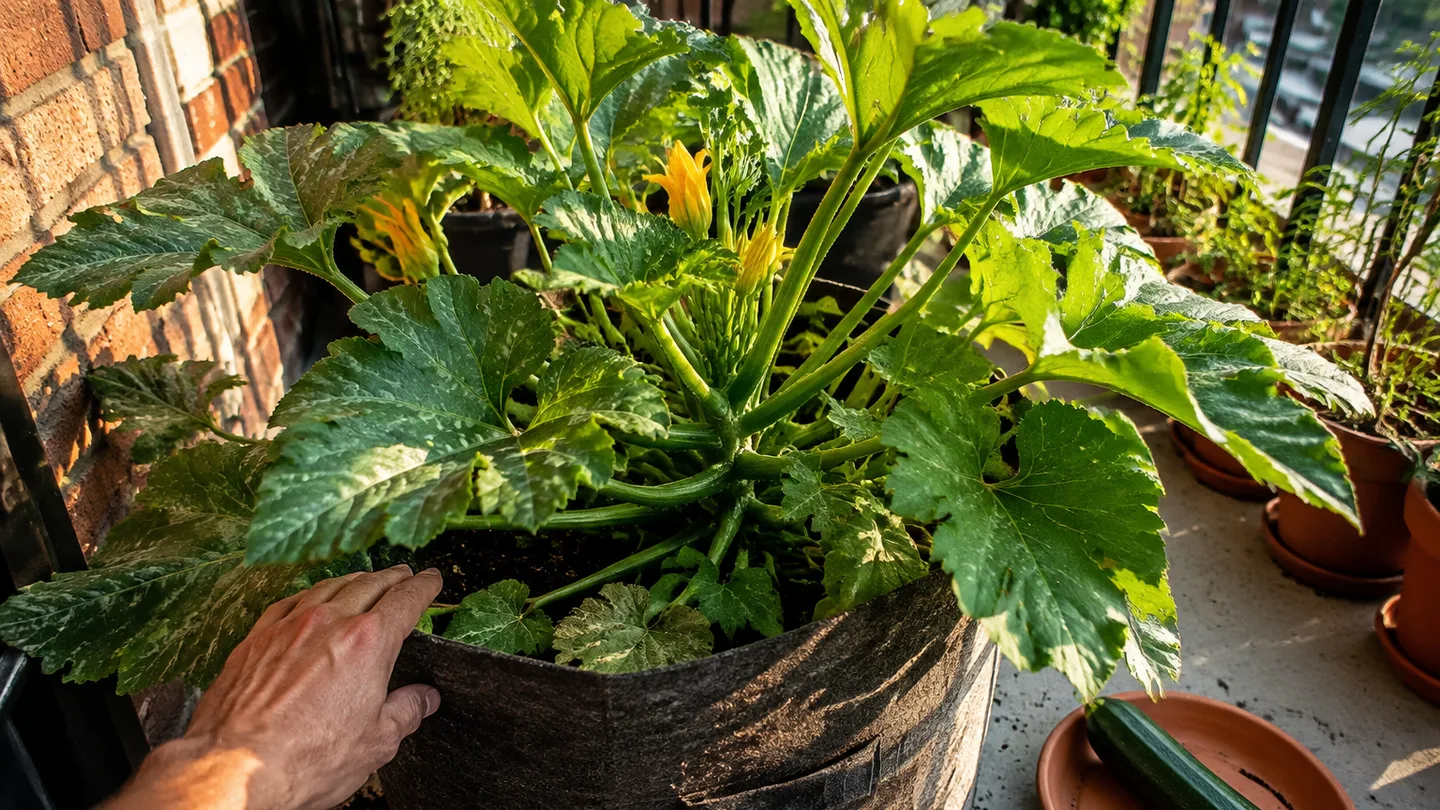
The honest starting numbers: 20 gallons (75 L), one plant, roughly 4–10 fruits
I plan for one standard bush zucchini per 20-gallon (75 L) container. That is not a promise of a particular harvest. It is a practical buffer: enough mix to slow the swing between bone-dry and saturated, enough room for roots to explore, and enough nutrient-holding capacity that repeated watering doesn’t leave the plant running on empty.
A compact variety can usually be tried in about 15 gallons (55 L), provided you accept more frequent moisture checks and a smaller margin during heat. A 10-gallon (38 L) pot may keep the plant alive, especially in mild weather, but I regard it as a high-maintenance compromise rather than a good target. The plant can look healthy in the morning and still be dry by late afternoon if the pot is exposed to sun and wind.
For yield planning, use roughly 4–10 useful fruits from one container plant as a working range, not a guarantee. Sunlight, pollination, heat, watering mistakes, disease and the length of your growing season can push the result below or above that range. I would rather plan for a modest harvest and be pleased by extras than buy two plants for a pot that can properly support one.
The surprising part is that the bigger pot is not mainly about giving the roots somewhere to go. It is about buying time. A larger root reservoir changes the speed at which the mix dries, gives the plant more room to recover from one missed watering, and spreads fertilizer through a larger volume instead of concentrating it around a few roots.
Pick a bush zucchini that fits a 60–90 cm (2–3 ft) footprint
Not every zucchini sold as a summer squash is balcony-friendly. Look for words such as bush, compact or patio on the seed packet or plant label. Many sprawling and vining squash types send stems well beyond the pot, while a bush zucchini keeps the crown more central and produces fruit around a broad cluster of leaves.
Even a compact plant needs approximately 60–90 cm (2–3 ft) of horizontal breathing room. That measurement is the mature footprint, not the diameter of the empty pot. Leaves can lean over the container edge, and developing fruit may hang toward the side with the clearest access. Leave enough space to kneel or stand beside the plant without crushing leaves every time you water.
Sun is the next filter. I’d aim for roughly 6–8 hours of direct sun for worthwhile fruiting. A balcony that receives only one or two hours may still grow large leaves, but it is a poor match for a crop that needs sustained light to flower and fill fruit. If that is your only light, herbs or leafy crops are a better use of the container. The guide to growing vegetables in pots on balcony is useful for planning which crops deserve the brightest positions.
Put the pot where the leaves won’t block a doorway, where fruit won’t overhang a walkway, and where you can reach the back of the plant. Don’t use a railing as the plant’s support unless the structure and container system are specifically designed for that load. A large pot on the floor beside a wall is usually easier to stabilise and easier to water than a heavy pot balanced at the edge.
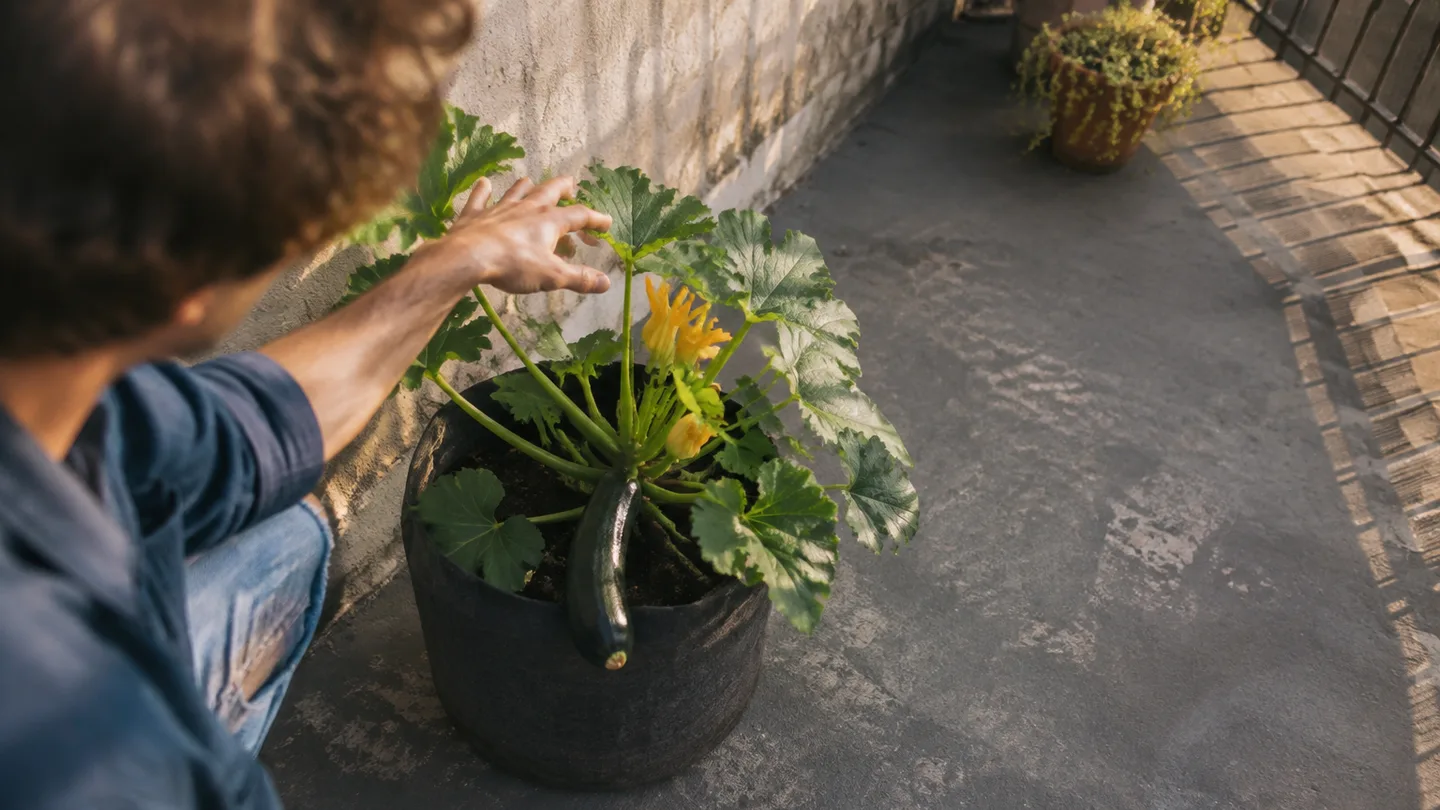
Build the root zone: pot dimensions, mix volume, drainage and balcony weight
Volume matters more than the label on the rim. A pot marketed as 20 gallons may hold less usable mix if it has a thick, flared shape, so look at the internal dimensions and fill level as well as the stated capacity. For a bush zucchini, I’d use this as a practical comparison:
| Container | Best use | My judgement |
|---|---|---|
| 10 gallons (38 L) | Emergency or very compact setup | Possible, but thirsty and unforgiving |
| 15 gallons (55 L) | Compact bush zucchini | Workable minimum with close checking |
| 20 gallons (75 L) | Standard bush zucchini | Preferred single-plant size |
A useful physical target is about 45–60 cm (18–24 in) wide and 35–45 cm (14–18 in) deep. I prefer a wide, stable container over a narrow tower because zucchini’s leaves and fruit pull the visual and physical weight outward. A broad base is less likely to tip, and its larger surface area makes it easier to water evenly around the root ball.
Use a quality potting mix made for containers, not soil dug from a garden bed. Garden soil contains fine particles that settle and compress in a pot. Once the air spaces collapse, water moves slowly and roots have less oxygen. A container mix should stay open enough for drainage while still holding moisture around the roots.
Skip the gravel layer at the bottom. Gravel feels like drainage material, but it does not create extra room for water to leave the pot. Instead, water can remain perched above the boundary between the fine potting mix and the coarse stones. That trapped zone is often called a perched water table: a layer of water held above a denser or differently textured layer after free drainage slows.
Make sure the actual drainage holes are open and that the container is not sitting flat against a surface that seals them. If you use a saucer, empty it after watering rather than leaving the pot standing in a reservoir.
Weight deserves a decision before planting. Seventy-five litres of wet mix, plus the pot and plant, can make an elevated balcony load-sensitive. Check your building, landlord or strata rules and look for local balcony load guidance before placing a large container upstairs. Put it near a structurally supported wall or column where appropriate, not automatically along a railing. In my own balcony setup, I now put the empty pot in its final position, test where the watering can will reach, and check where drainage water will go before adding mix. I used to fill containers beside the door and then discover that the sunny corner was awkward to reach. Access is part of pot size: a container you cannot comfortably water is effectively smaller than its label suggests.
For the general mechanics behind this approach, growing vegetables in pots explains why root volume, drainage and container position need to be planned together rather than treated as separate shopping decisions.
Sow after 16°C (60°F) soil: depth, spacing and the least disruptive transplant plan
Wait until the danger of frost has passed and the potting mix is at least about 16°C (60°F) before sowing outdoors. A cold container can delay emergence, and a late cold snap can damage a young plant even if the air feels warm beside a sunny wall. If you don’t have a soil thermometer, use the weather pattern as a guide: several mild nights and a stable forecast are more useful than one warm afternoon.
Sow the seed about 2.5 cm (1 in) deep. For insurance, you can place two seeds a few centimetres apart, then remove the weaker seedling by snipping it at the mix surface once both emerge. Don’t pull it out and disturb the surviving root. Thin to one plant per container, because two mature zucchini plants compete for the same finite root volume and quickly turn a manageable watering job into a daily negotiation.
Direct sowing is my first choice because zucchini dislikes repeated root disturbance. A nursery transplant is acceptable when it is young, actively growing and still has an intact root ball. Slide it out without teasing the roots apart, set it at the same depth it was growing, firm the mix around it and water thoroughly.
If you raised the plant indoors, harden it off over 5–7 days. That means gradually exposing it to outdoor sun and wind rather than moving it straight from a sheltered windowsill to a bright balcony. Start with a protected position, increase the time outdoors, and delay the strongest afternoon sun until the leaves are handling the change without drooping for hours.
In warm mix, emergence may happen within about a week, although cooler conditions can take longer. During the first fortnight, look for the first true leaves rather than judging progress by height. The young plant should be firmly rooted, with leaves expanding rather than lying flat on the mix after every sunny spell.
For a second reference on broad squash timing and cultural requirements, compare the advice with extension guidance on summer squash. I use that kind of guidance to check the seasonal sequence, not to turn a general recommendation into a promise about one balcony.
Water the root ball, not the calendar: a 2.5–5 cm (1–2 in) moisture check
A fixed watering schedule is a poor fit for containers. Instead, check the top 2.5–5 cm (1–2 in) of mix with your finger. If that layer is dry and the pot feels noticeably lighter than it did after watering, water slowly around the root zone until excess begins to leave the drainage holes.
Small sips are the trap. They wet only the upper crust, encouraging roots to stay near the surface while the lower mix remains dry or unevenly wet. Apply water in two or three passes if the mix has pulled away from the pot wall. Pause between passes so the water can move down instead of racing over the surface.
A plastic pot in full sun and wind may need checking every day and watering on most days. A glazed pot in milder part shade may go two or three days between thorough waterings. Those are starting points, not a calendar. Pot colour, container width, humidity, canopy size and the weather on your balcony all change the interval. The same moisture check is useful for many crops in growing vegetables in pots for beginners.
Midday wilt does not automatically mean drought. A large leaf canopy can droop during the hottest part of the day and recover by evening as the heat eases. Check the mix first, then look again near sunset. If the plant has recovered and the mix is still moist below the surface, adding more water may create a root problem instead of solving a leaf problem.
Persistent wilt with damp mix is a different signal. Check that the drainage holes are open, that the pot is not sitting in water and that the mix is not compacted. Roots need both moisture and air. A wet root zone can leave a plant looking thirsty because damaged roots cannot move water effectively.
I use a three-part check before watering: finger into the mix, lift or nudge the pot to judge its weight, then inspect the leaves in the evening. It takes less time than recovering from a saturated container, and it keeps me from treating every droop as the same problem.
Feed for fruit without creating a leaf jungle: the 2–3 week rhythm
Zucchini grows quickly, but that does not mean more fertilizer is automatically better. Repeated watering sends some soluble nutrients out through the drainage holes, while a pre-fertilised potting mix may already contain enough nutrition for the plant’s early growth. Read the mix label first and delay supplemental feeding until that initial charge is likely to be used or the plant is entering flowering.
Once feeding is appropriate, follow the fertiliser label rather than doubling the dose because the plant looks hungry. A liquid feed every 10–14 days can be a reasonable rhythm only when the product instructions support that interval and concentration. Granular products, slow-release products and liquid feeds do not have interchangeable instructions.
More fertilizer cannot make up for a pot that is too small. In a cramped root zone, a stronger dose can raise the salt concentration around the roots while the plant is still struggling with moisture swings. Root volume, consistent watering and adequate sun come first.
Pale older leaves may point toward depleted nutrition, but they can also appear when wet roots are not functioning well. Very soft, oversized leaves with few female flowers make me check light and nitrogen exposure before adding more feed. Flowers that appear but fail to become fruit make me inspect pollination before reaching for fertilizer. Symptoms overlap, so change one condition at a time.
Pollination is the balcony bottleneck: male and female flowers open for one morning
A zucchini plant can produce both male and female flowers. The male flower usually sits on a thin stem and has a pollen-bearing structure in its centre. The female flower has a small zucchini-shaped swelling immediately behind the petals. That swelling is the future fruit, so it is the flower to watch.
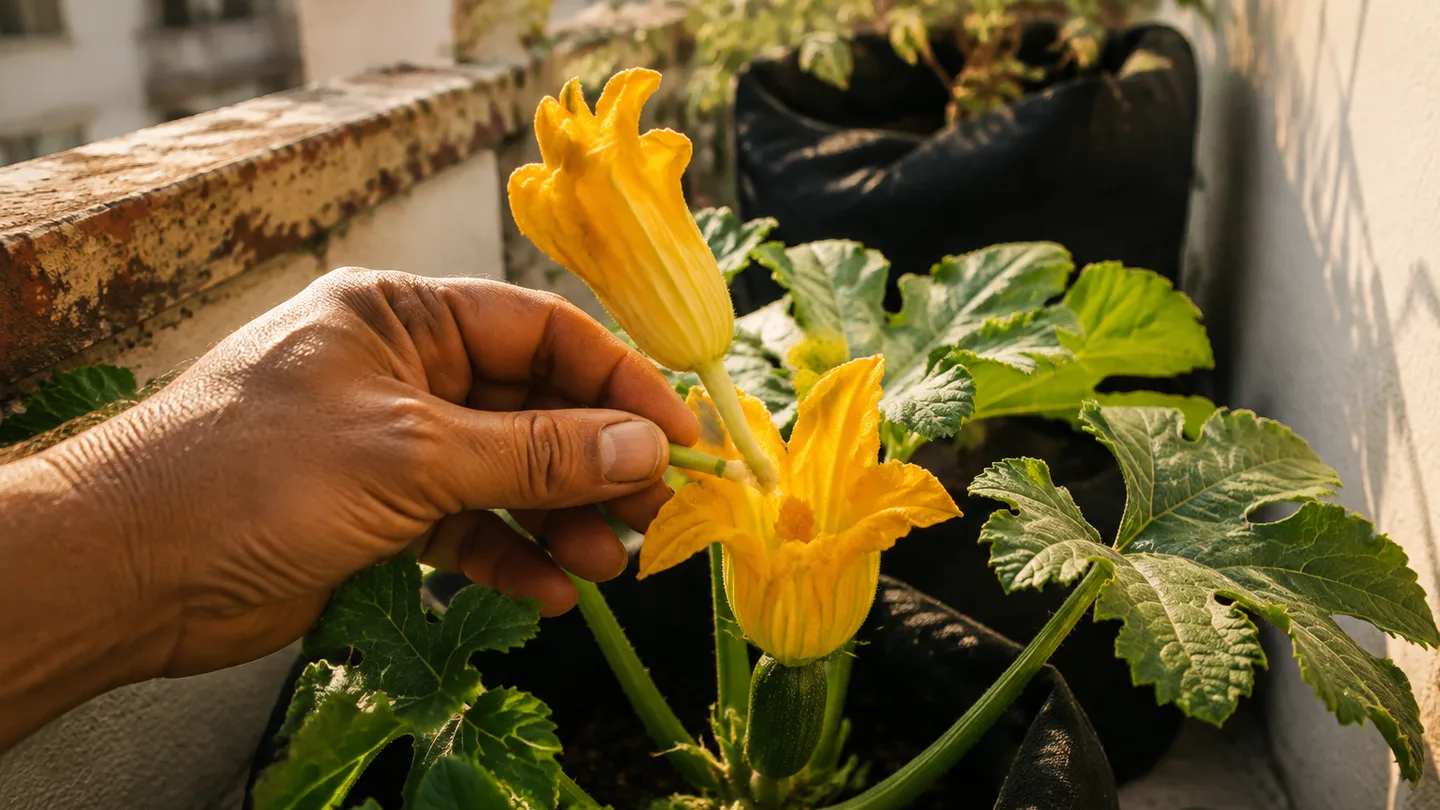
Flowers commonly open in the morning, which gives you a short, convenient inspection window while the pollen is fresh. If bees cannot reach a sheltered balcony, rain has kept them away or the plant is tucked behind a screen, hand-pollinate:
- Find a freshly open male flower and a female flower with a visible swelling behind it.
- Pick the male flower or use a small clean brush to collect pollen from its centre.
- Touch the pollen to the centre of the female flower, covering the receptive surface without scraping it.
- Leave the female flower in place and check the baby fruit over the next two or three days.
You do not need several plants for this. One plant can supply both flower types, although it may not produce them in equal numbers at the same time. If a female flower shrivels, turns yellow and drops without the swelling enlarging, pollination is one of the first things I check.
A successfully pollinated young zucchini should remain firm, stay attached and begin extending over the following days. A failed fruit often stops growing, bends or yellows from the blossom end before dropping. Heat, irregular watering and plant stress can complicate the picture, but hand-pollinating a fresh flower is a low-cost first response.
Harvest at 15–20 cm (6–8 in), then check the plant every day or two
For most standard zucchini, I’d pick at about 15–20 cm (6–8 in). At that size the skin is usually tender, the seeds are still small and the fruit is easy to cut without wrestling with a heavy stem. Some varieties are intended to be harvested smaller, so use the plant label as a refinement rather than treating the measurement as a law.
Cut through the stem with a clean knife or pruners instead of twisting until the plant tears. Wear gloves if the stems are rough, and check beneath large leaves because fruit can hide until it is much bigger than you intended.
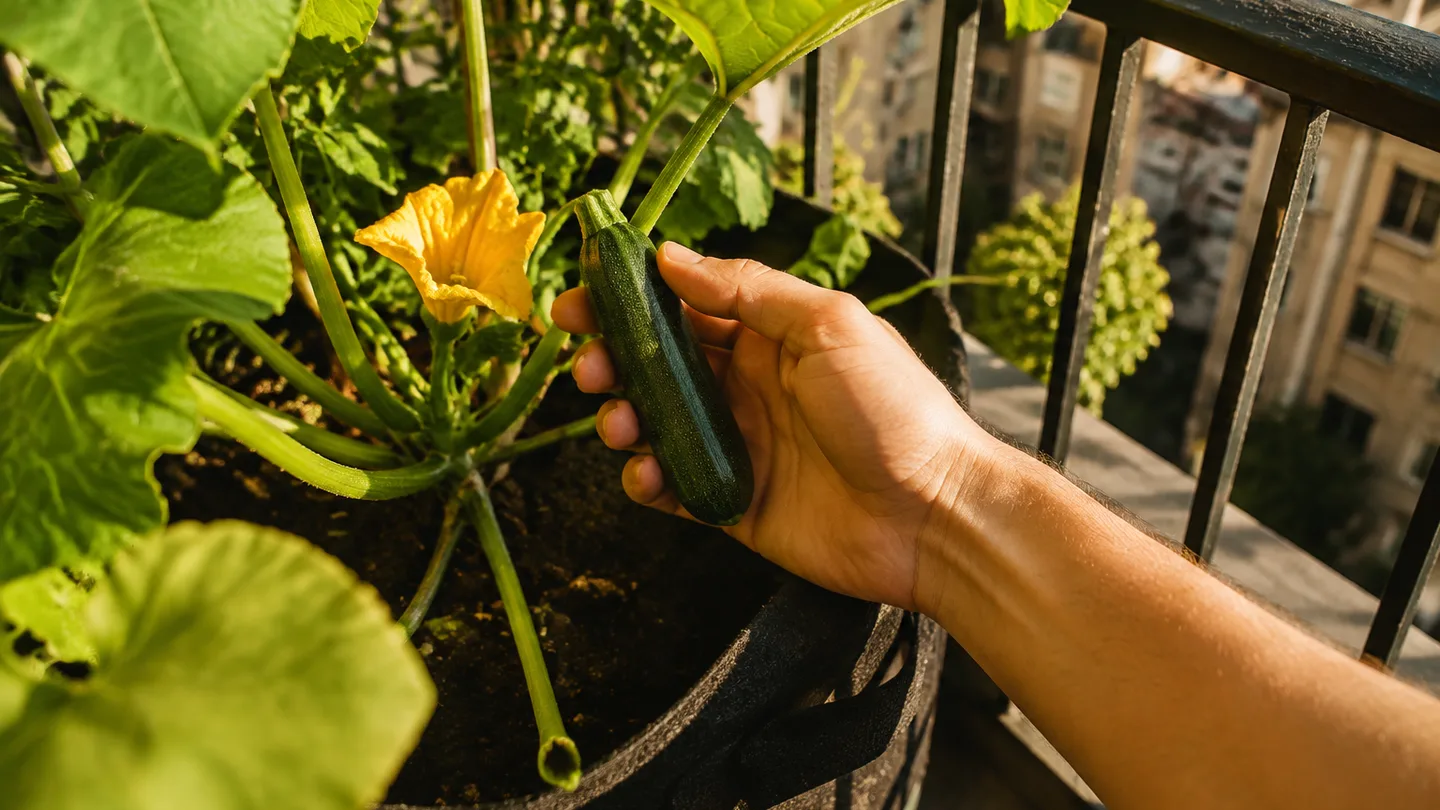
Inspect the plant every day or two once fruit begins setting. A zucchini that looks modest at breakfast can become oversized surprisingly quickly in warm weather. Leaving one giant fruit attached may shift the plant toward seed development and reduce the attention it gives to new flowers. If that happens, harvest the large fruit anyway; it may still be useful cooked, even if it no longer has the texture of a young zucchini.
Many varieties may reach a first harvest roughly 45–60 days after sowing under suitable conditions, but the actual window moves with temperature, light, variety and transplant shock. Treat the calendar as a prompt to inspect the plant, not as a guarantee that fruit will be ready on a particular date.
The 4–10-fruit planning range belongs here again. A well-positioned, well-pollinated plant may exceed it, while a plant in weak light, a small pot or a short season may produce fewer. The point of the range is to help you decide whether one large container is worth the floor space, not to grade the plant against a fixed target.
If you are comparing the crop with in-ground expectations, growing vegetables in pots vs ground is the useful distinction: a container gives you control and mobility, but its finite root volume makes heat, drought and feeding mistakes show up sooner.
When the plant fails: a symptom-to-cause check for wilt, mildew, flowers and fruit
It wilts at midday, then looks better by evening
Check the mix before watering. If the top 2.5–5 cm (1–2 in) is still moist and the leaves recover as the temperature falls, temporary heat stress is plausible. Move the pot out of reflected heat if possible, check it again near sunset and avoid drowning the roots in response to a short midday slump.
It wilts while the mix is damp
Look for blocked holes, a sealed saucer, compacted mix or water collecting below the pot. The mechanism is different from simple drought: the roots may be surrounded by water but unable to function well because the air spaces are filled. Stop adding water until the drainage problem is corrected.
Older leaves have white, powdery patches
White dust-like growth on the leaf surface is consistent with powdery mildew. Improve airflow around the plant, remove badly affected leaves with clean tools and avoid packing another pot tightly against the canopy. Keep the foliage from staying wet overnight, and check whether the plant is so shaded that leaves dry slowly.
Female flowers shrivel without producing a zucchini
Look for the tiny swelling behind the flower and hand-pollinate fresh flowers in the morning. If the fruit does not enlarge over the next few days, remove the failed flower or fruit and inspect the next one. Poor pollinator access is a particularly practical problem on enclosed balconies, where a plant can flower normally without receiving enough pollen.
Young fruit is yellow, bent or stops growing
Incomplete pollination is a common first check, followed by inconsistent moisture and heat stress. Do not assume the answer is fertilizer. A badly declining fruit can be removed so the plant can direct new growth toward healthier flowers, while the watering pattern and drainage should be corrected before the next fruit sets.
Leaves or stems show chewing, clusters or physical damage
Inspect the undersides of leaves, the crown and the stem bases. Look for insects, eggs, scraped tissue or a stem that has been bent against a railing. Remove obvious pests by hand where practical, isolate damaged foliage from neighbouring plants and use clean tools for cuts. If the stem itself is badly damaged, the next step depends on whether the plant can still move water above the injury.
Your one-week check: make sure the pot still drains freely, the mix is moist below the surface but not saturated, new leaves are expanding and at least one developing fruit is being picked before it grows past roughly 20 cm (8 in). If those four checks look good, keep the routine steady rather than changing several things at once.