How to Protect Plants From Frost Before a Cold Night
A forecast near 32°F (0°C) is a cue to check your plants, not a verdict that every pot will be damaged. To protect plants from frost, act before sunset: move the most tender containers first, shelter the rest, and cover them without trapping leaves against cold plastic.
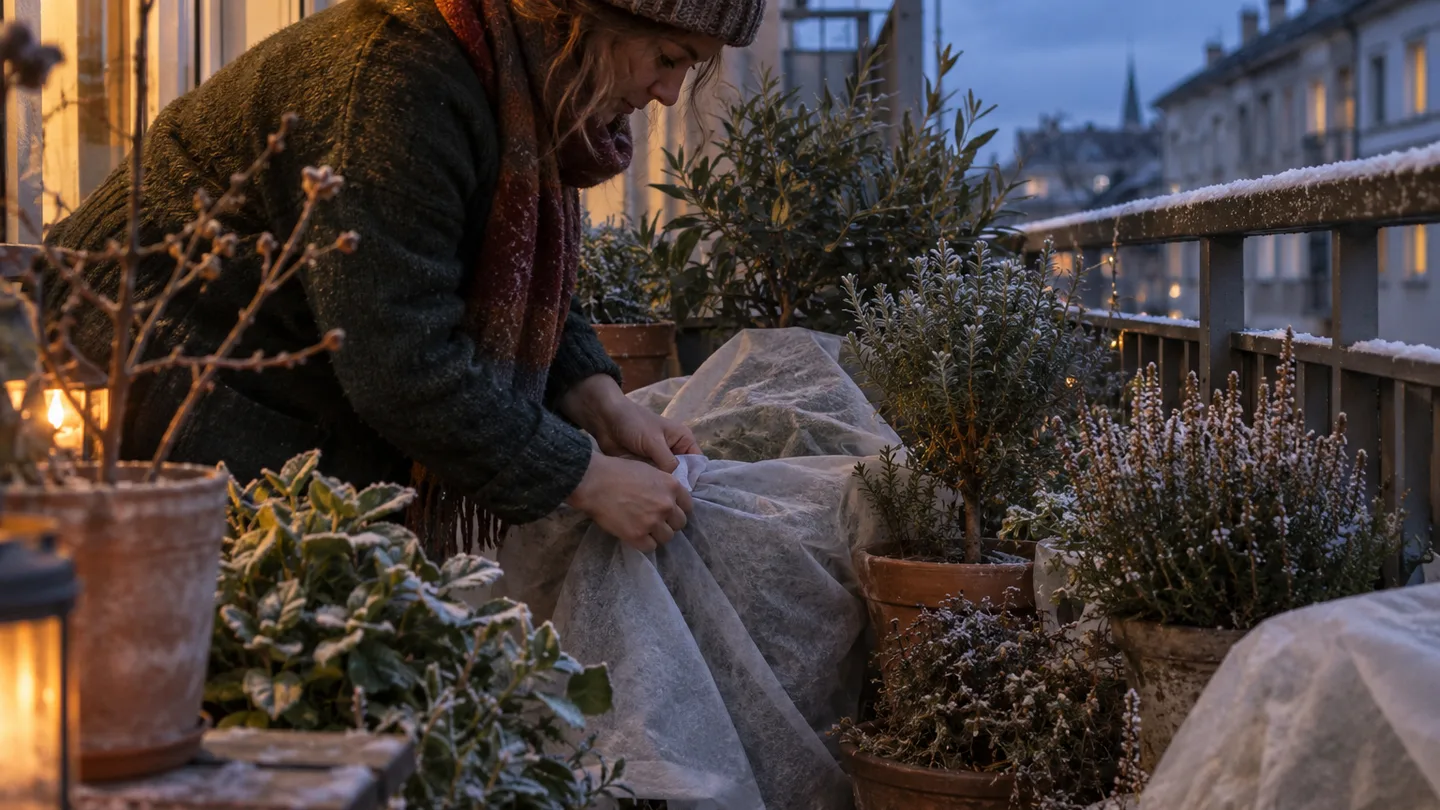
A balcony adds its own complications. A wall may block wind, but an exposed corner can still cool quickly; a pot that feels ordinary in the afternoon can be sharply cold by night. I’d rather make a short, sensible move early than scramble outside after temperatures have already dropped.
Start with the forecast low, but don’t treat 32°F as a universal damage line
32°F (0°C) is the familiar freezing point of water. It is not a universal injury threshold for plants. Leaves and growing tips vary in cold tolerance, and the outcome depends on the plant, how long the cold lasts, whether it has acclimated to cooler weather, and the conditions around your particular balcony.
Read the forecast as a combination of clues. Note the expected low, whether temperatures may stay below freezing for hours or dip briefly near dawn, and whether the night is expected to be windy. A short, calm radiational frost—when the ground and exposed surfaces lose heat under a clear sky—can create cold pockets. Wind can strip away the relatively still air around a plant and dry exposed foliage. Neither detail changes the forecast air temperature, but both affect how exposed a pot is.
Also remember that frost and freeze alerts are issued under local criteria. A warning is useful, but it can’t report the temperature beside your railing, against a wall, or at the level of your pots. If you have a balcony thermometer, use it as a local clue rather than assuming it matches the forecast exactly. For the alert wording used in your area, check your local National Weather Service frost and freeze alerts.
My practical threshold is not one magic number: if a plant is tender and the forecast approaches freezing, I prepare it. That costs little compared with discovering in the morning that the newest leaves have gone limp and translucent.
Choose what to move first: tender plants, exposed roots, and the heaviest pots
Make a quick priority list before you start lifting. First are tropical plants, tender annuals, warm-season vegetables still growing, and newly planted seedlings. Next come plants you know are sensitive or recently stressed. Cold-hardy plants can usually wait while you deal with the vulnerable ones, though “hardy” is not a promise that every variety will tolerate every duration of cold in every container.
A pot changes the roots’ surroundings. In the ground, soil surrounds roots on several sides and is connected to a larger mass of earth. In a container, the root ball is exposed around the pot’s sides and underneath; a small pot has less soil around it to buffer a rapid temperature change. That’s why I prioritize a tender plant in a small pot over a tough plant in a larger, sheltered container.
Species matters, but so do acclimation and timing. A plant that has gradually experienced cool autumn days may respond differently from the same kind of plant moved outdoors recently from a warm room. A brief dip near freezing is also different from a long cold spell. If you don’t know a plant’s tolerance, treat it as vulnerable rather than relying on a generic minimum temperature printed for the species.
Weight matters too. Don’t start by hauling the biggest wet planter across the balcony. Move light, high-risk pots first; then decide whether a heavy container can be shifted a short distance or should be protected where it stands. If a pot is awkward or unstable, don’t risk straining yourself or dropping it in the dark. A useful priority order is: tender plants, small exposed containers, newly planted crops, then hardy or sheltered pots.
Use the building and the balcony floor as your first protection
Before sunset, bring manageable tender pots indoors if you have a suitable spot. A room, enclosed porch, or garage can provide shelter for a night, but check that the space itself isn’t near or below freezing. Keep plants away from heating vents and don’t leave them in a dark place longer than necessary. Once the cold spell passes, return them to an appropriate light level rather than leaving them forgotten in storage.
If bringing everything inside isn’t practical, group pots close together near a sheltered building wall. Choose a spot out of the prevailing wind and away from an exposed balcony edge. The wall and the group can reduce direct exposure; the floor can also be less exposed than a high railing shelf. These are modest protections, not a substitute for a cover or indoor shelter when a tender plant faces a hard freeze.
Here’s a concrete planning example, not a report of a measured trial: say you have a small basil in a light nursery pot, a large ceramic planter with a hardy perennial, and a tomato still carrying fruit. I’d bring the basil inside first, move the tomato beside the wall if it can be done safely, and leave the heavy perennial planter in place unless its location is exposed. Then I’d cover the tomato and basil if they remain outside. That order protects the most vulnerable plants without making the heaviest pot the first problem.
Keep doors, stairs, drains, and access routes clear. Don’t crowd a balcony with heavy, waterlogged containers just to make a tighter cluster; check the building’s guidance about balcony loading if you’re unsure. A few pots moved into a sheltered arrangement are useful. Turning the whole balcony into an unstable stack is not.
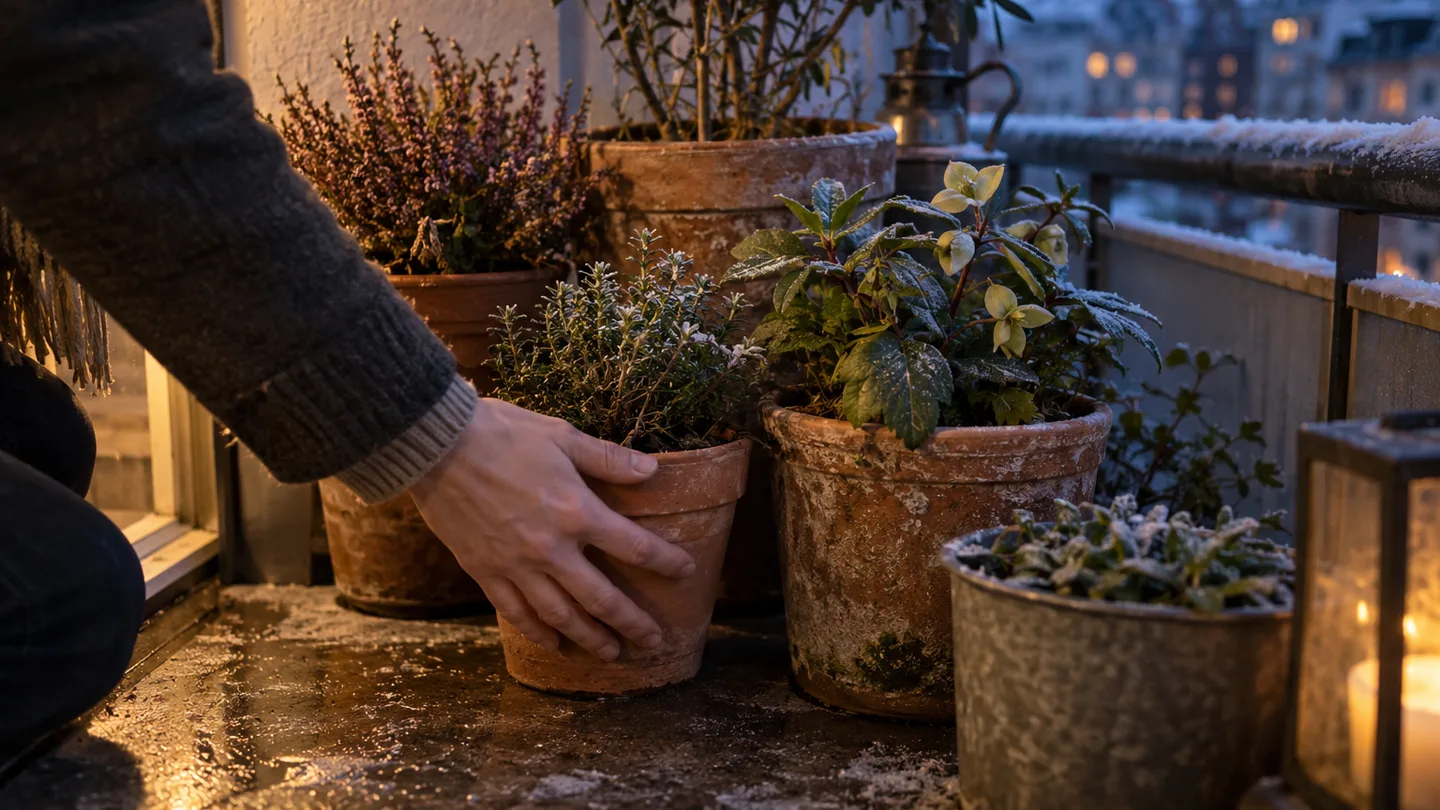
Cover the whole plant, anchor the edges, and keep plastic off the leaves
A cover works by reducing the plant’s exposure to the open sky and slowing heat loss from the sheltered space. For a small container, a breathable frost cloth is convenient. A light sheet can work as a temporary cover if it reaches the floor around the pot and is secured. The aim is to cover the whole plant and the container, not just drape a small patch over the top leaves.
Plastic is a different tool. It blocks wind and rain, but if it rests directly on foliage, cold plastic can transfer that cold to the leaves where they touch. Plastic can also trap heat after sunrise. If it’s the only cover available, use hoops, a frame, or another support to keep it off the plant, secure the edges, and remove or vent it when the immediate risk has passed. Don’t wrap a plant airtight and leave it that way through a sunny day.
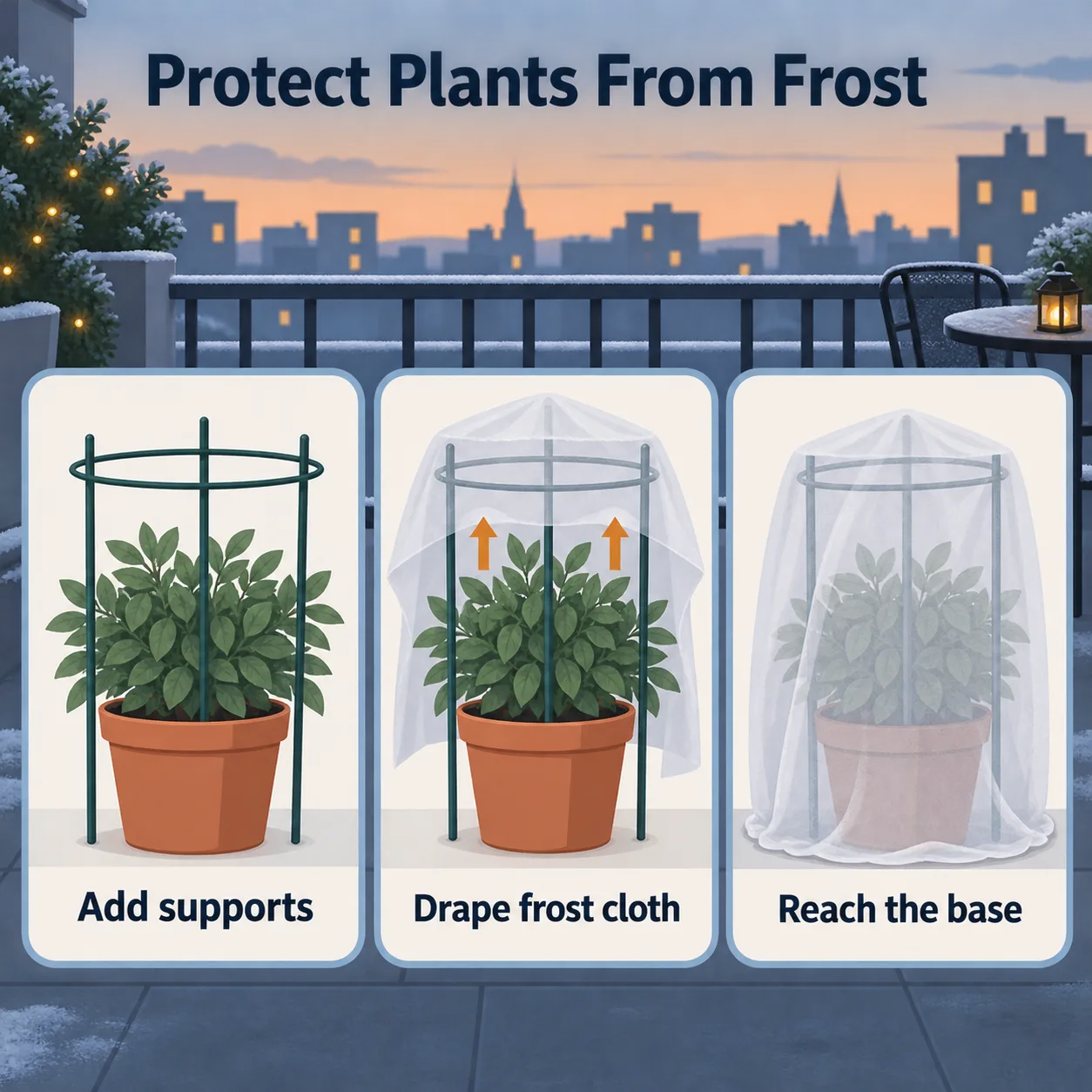
Set up the cover in this order:
- Make a support. Use a frame, stakes, or an inverted basket that won’t press on stems. Check that it can’t tip in the wind.
- Drape the material over the entire plant. Leave enough room that foliage isn’t crushed against the sides.
- Bring the lower edge down to the floor or ground. This helps shelter the air around the pot instead of leaving a large opening beneath the cover.
- Secure the edges. Use clips or weights placed safely so a gust can’t lift the covering or knock the container over.
A product’s stated temperature protection is guidance, not a guarantee for every balcony. Compare the rating with the forecast low and the plant’s needs, then account for wind, duration, fit, and how well the cover is secured. A label can’t account for every gap or exposed corner in your setup.
In my judgment, a well-fitted cover is more useful than adding another loose layer that catches the wind. A cover that lifts at the edges repeatedly exposes the plant; one secured around the pot is easier to trust and easier to inspect in the morning.
Water dry potting mix in daylight; don’t soak it at night
If the potting mix is dry, water it during daylight several hours before sunset. Moist soil can hold more heat than very dry soil, so a modest watering may help the root zone through a cold night. This is not a reason to saturate a container. Water should drain freely, and the pot shouldn’t be left standing in a saucer full of water.
Already-moist mix needs no extra water for frost preparation. Push a finger into the mix or check below the surface; the top can look dry while the root zone still feels damp. If it is damp, leave it alone. Don’t water frozen mix, and don’t pour water onto leaves as night approaches.
This is where a fixed schedule misleads. Pot size, material, wind, recent weather, and plant growth all change how quickly a container dries. If you’re unsure how to judge a container’s moisture between cold nights, see how often to water container plants and how often to water potted plants in winter. Use those as watering guidance, not a reason to add water automatically before every forecast frost.
For this one decision, the rule is plain: dry mix, water early; moist mix, skip it; frozen mix, wait. The purpose is to avoid starting the night with bone-dry potting mix, not to make a cold pot heavy and waterlogged.
Keep protection in place overnight, then uncover after the freeze has passed
Finish moving and covering plants before temperatures fall. Once the cover is on, check that it reaches the pot or floor, is supported above the foliage, and won’t blow loose. Keep it in place during the coldest hours. If you can check safely in the morning, look at the local temperature and the condition of the cover before removing it.
When temperatures are above 32°F (0°C) and the immediate frost risk has passed, uncover or vent the plant. A cover left on in sunshine can make the space underneath warmer than intended. If another cold night is forecast, you can put the cover back on before sunset; don’t assume one mild morning means the cold spell is over.
Breathable fabric may stay over plants across more than one cold night, provided it remains secure and the weather between nights doesn’t turn it into a hot, damp enclosure. Inspect for fabric weighed down by rain, a loose edge, or a frame leaning onto the plant. Follow the covering material’s own instructions where they give limits for use, and remove or vent it during a warm sunny stretch.
Wind chill is a human comfort measure, not a separate forecast temperature for plant tissue. Still, wind matters as exposure: it can move a cover, bring cold air through gaps, and dry foliage. Use the forecast air temperature to judge cold, then use wind as a reason to secure the setup more carefully.
After a cold night, wait for thaw before judging the damage
Frost injury can look like limp, water-soaked, darkened, or translucent leaves. Affected tissue may not show its full extent while it is still cold. After a thaw, some leaves recover their shape; others turn brown or black over the following days. Don’t prune or discard a plant while its tissues are frozen, and don’t assume one damaged leaf means the whole plant is lost.
Once the plant has thawed, look at the growing tips and stems as well as the leaves. Note what is clearly soft or discolored, but wait before cutting back if the boundary between living and damaged tissue isn’t obvious. Recheck over the next several days. When dead growth is clearly identifiable, remove it with clean pruning tools, taking care not to cut into firm living stems just to make the plant look tidy.
For containers that stay outdoors through a cold spell, check that drainage holes remain open and that the pot hasn’t been left in standing water. Don’t try to force a quick recovery with extra fertilizer or repeated watering; first let the plant thaw and judge the mix. If the plant is a pepper you’re trying to keep for another season, the separate guide to overwintering pepper plants can help you plan beyond this single night.
Tonight, check the forecast once more, move the tender pots before sunset, and secure any cover at the base. Tomorrow, uncover after the immediate risk has passed, then look again at the plant after it has thawed.
Three questions that come up on a frost night
Does wind chill make a plant colder than the forecast air temperature?
Wind chill describes how cold conditions feel to people. For plants, use the forecast air temperature rather than treating the wind-chill number as the plant’s temperature. Wind still matters because it increases exposure, can loosen a cover, and can dry foliage. Use it to improve shelter and anchoring, not to substitute one temperature figure for another.
Can I put a potted plant in a dark garage for one night?
For a single night, a garage can be a practical shelter if it stays above freezing and the plant can be moved without damage. Check the temperature inside rather than assuming the garage is warm enough. Keep the pot away from a heater or exhaust, and move the plant back to suitable light after the cold night.
Can frost cloth stay on for more than one cold night?
It can remain in place across successive cold nights if it is secure and the conditions between them stay cool. Check for wind damage, wet fabric pressing onto foliage, and a sunny daytime warm-up. Vent or remove the cover when the immediate risk passes, then replace it before the next cold night if needed.
Frequently Asked Questions
Does wind chill make a plant colder than the forecast air temperature?
Wind chill describes how cold conditions feel to people; for plants, use the forecast air temperature, while recognizing that wind can increase exposure and drying.
Can I put a potted plant in a dark garage for one night?
Usually, a single night in a garage that stays above freezing is a practical short-term shelter; check the garage temperature and return the plant to suitable light afterward.
Can frost cloth stay on for more than one cold night?
It can, but check the material and forecast, ventilate or remove it during warm sunny periods, and make sure the plant is not trapped under wet or wind-damaged fabric.