Overwintering Pepper Plants: When to Prune and Bring Them In
Bring a pepper indoors when nights are heading toward 10°C/50°F, not when frost is already on the forecast. I use a light cleanup before the move, then wait about 7–14 days before deciding on a harder cutback so I can separate normal indoor adjustment from genuine damage.
Overwintering pepper plants works best when you choose the plant before you choose the pot. A compact, healthy pepper with firm stems and no obvious pest problem is worth carrying through winter; a sprawling, stressed plant can demand more indoor space and attention than the next season’s head start is worth.
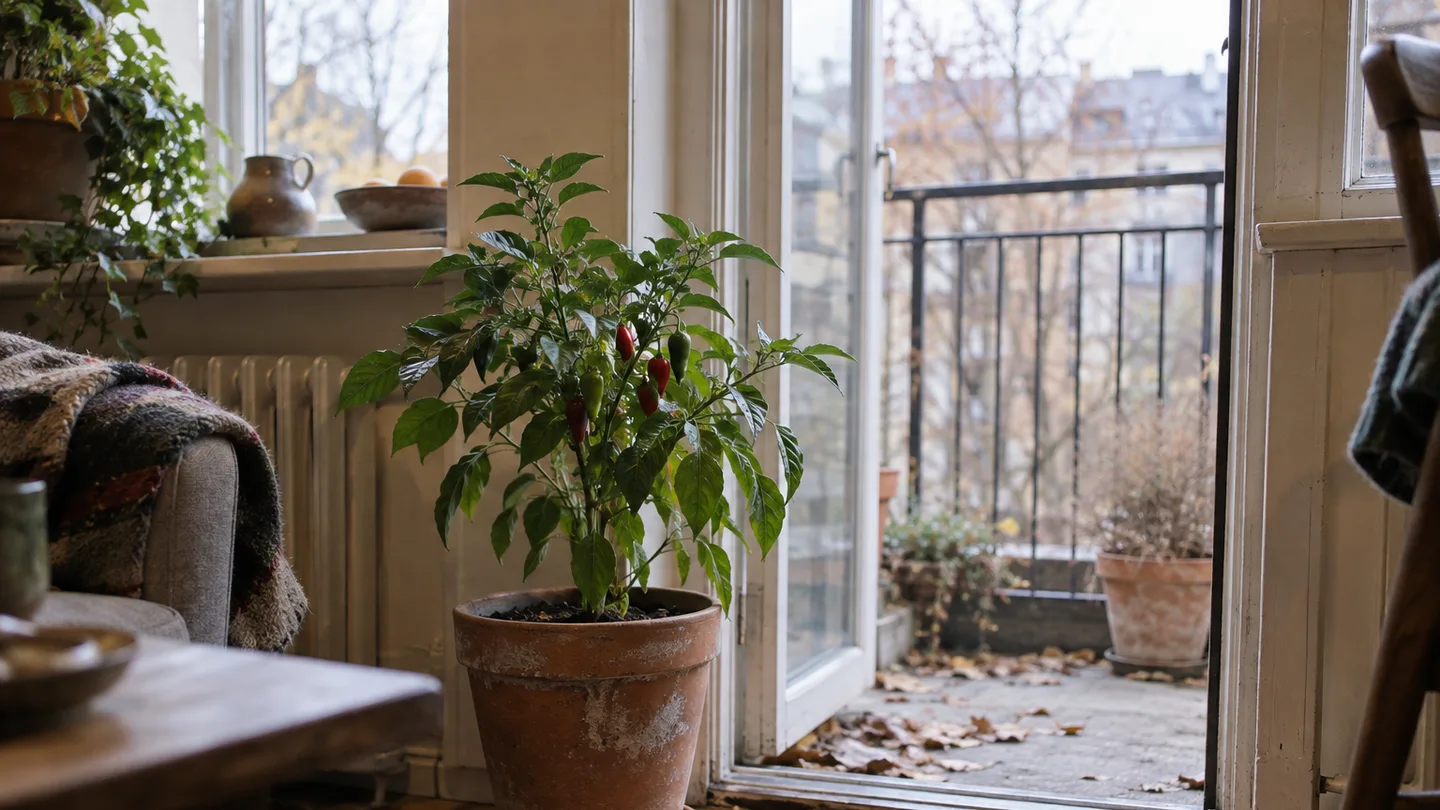
Is this pepper worth overwintering? Pick the plant before you pick the pot
I would start with the plant’s condition, not its variety name. A mature pepper with a sturdy main stem, several healthy side branches and a manageable canopy has something to preserve. A plant with blackened stems, persistent wilt, a serious infestation or disease-spotted foliage is a different calculation. It may recover, but bringing it into a warm room gives the problem a protected place to continue.
Look for three practical signs before you commit:
- Firm stems: They should not feel hollow, collapsed or soft near the soil line.
- Clean new growth: Check the newest leaves and the undersides of older leaves for clusters of insects, sticky residue, fine stippling or webbing.
- A size you can actually manage: The plant needs to fit under your available light without touching curtains, heating vents or neighbouring plants.
The indoor conditions decide which winter route is realistic. If you have only one or two hours of usable window sun, I would treat that as a way to keep a resting plant alive, not as enough light for compact, productive winter growth. A pepper kept warm in weak light tends to spend its limited energy making pale, stretched shoots. If you have a strong grow light and somewhere to keep the room around 18–24°C/65–75°F, you can choose continued growth instead.
The other route is cool dormancy: roughly 10–15°C/50–60°F, sparse watering and little routine feeding. The plant may lose some leaves, but its root system and main stems can remain viable until spring. For the broader setup, the practical principles in overwintering plants in pots apply here too: reduce demand before you reduce care.
Pot size matters more indoors than it does on an open patio. I find a 20-litre/5-gallon pot much easier to inspect, rotate and move than a 40-litre/10-gallon pot. The larger container may give a big plant more root room and stability, but it also becomes a heavier, harder-to-quarantine object. My preference is to keep a healthy pepper in the smallest container that holds its root ball without forcing a major root disturbance just before winter.
That is a judgement call, not a promise of survival. If the plant is healthy and the indoor conditions are suitable, overwintering can buy you a head start next season. If the only available spot is warm, dim and crowded, taking cuttings or starting a new plant later may be the more sensible use of your space.
Bring it in at 10°C/50°F nights—well before the first frost
Use the forecast, not the calendar. When several nights are expected to sit around 10°C/50°F or lower, I would prepare to move the pepper indoors. I would not wait for a 0°C/32°F frost warning: frost can damage tender foliage before the night reaches the temperature you were watching, and a plant that has already been chilled and soaked is harder to settle indoors.
Before choosing the exact day, check a local first-frost forecast and the overnight low for the next week. One cool night followed by warm weather is different from a run of cold nights, but the forecast gives you time to inspect, clean and drain the plant instead of carrying it in during a rushed evening.
The order matters because each step removes a different source of trouble:
- Harvest first. Pick ripe fruit and any fruit that is close to mature. Remove flowers and tiny fruit that are unlikely to finish well in the lower indoor light. This reduces the plant’s immediate demand during the transition.
- Remove obvious damage. Cut away yellow, diseased or badly torn leaves, but do not strip a stressed plant bare. Leave healthy foliage in place until you know how the plant responds indoors.
- Inspect the whole plant. Look along the main stem, inside branch joints, beneath leaves and around the soil surface. Check the pot rim and saucer as well; insects and eggs can hide outside the canopy.
- Rinse gently if needed. I use a gentle plain-water spray to knock loose dust and some insects from the foliage. I do not treat that rinse as pest control. Let the plant drain fully and give the leaves time to dry before it goes beside other houseplants.
- Move a reasonably dry pot. If the mix is already saturated from cold rain, let excess water drain before bringing the container inside. A cool, wet root ball loses water slowly indoors, so adding more on the first day is an easy way to create trouble.
- Quarantine it. Keep the pepper apart from other plants for roughly 7–14 days where space allows. A separate room is useful, but even a clear gap and a dedicated saucer make inspections easier.
Here is the kind of move I mean. Suppose the forecast says 11°C/52°F, 9°C/48°F and 8°C/46°F over three nights. On the first afternoon, harvest the fruit and remove damaged leaves. That evening, inspect and rinse the plant. The next day, once the foliage is dry and the pot has drained, move it to the quarantine spot. During the following week, check the undersides of leaves every few days rather than watering by habit.
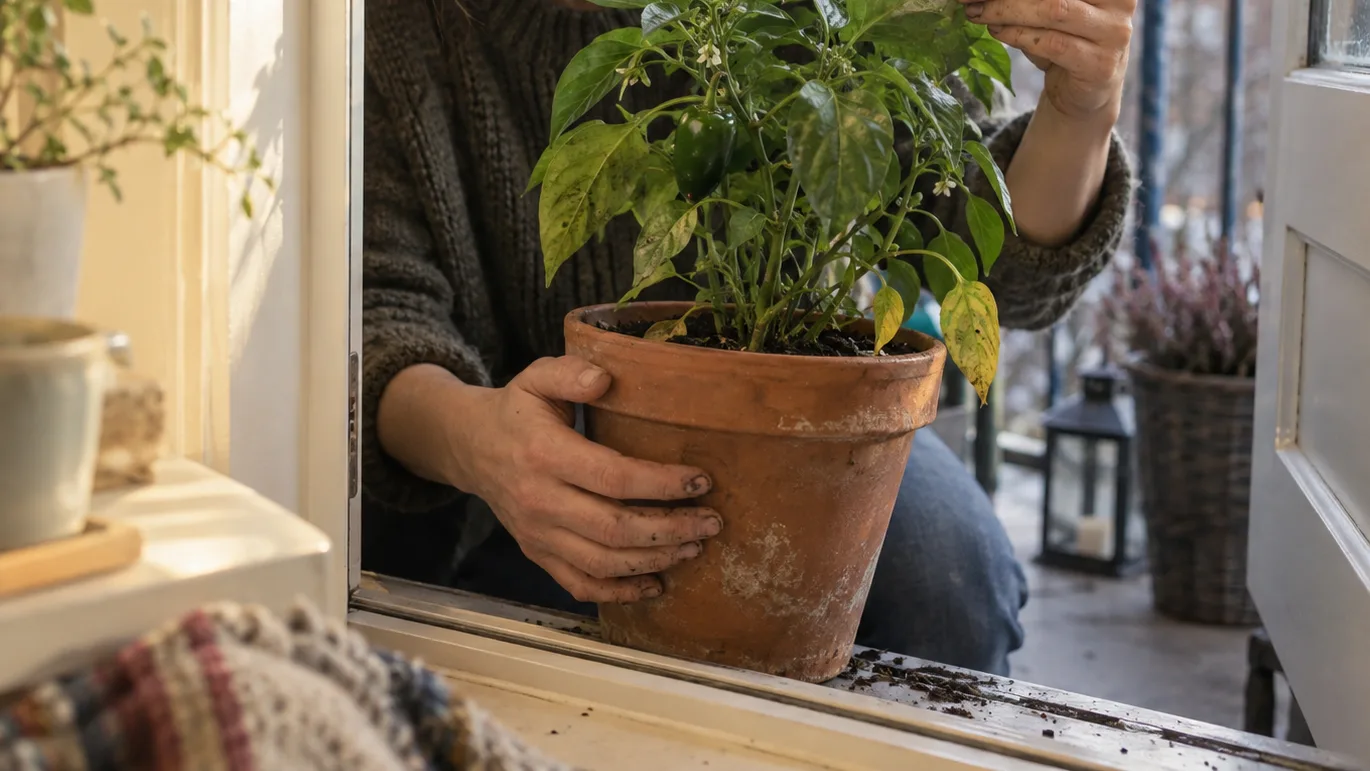
Quarantine is not a punishment or a sign that the plant is dirty. It is simply a chance to see whether a pest problem appears after the plant stops growing outdoors. For a useful inspection routine, compare the foliage with the signs described in spider mites on plants, especially if the room is warm and dry.
Prune in two passes: clean up before moving, hard-cut after 7–14 days
There are two different pruning jobs here, and combining them is where many overwintering attempts go wrong. The first is a light sanitation cleanup before the move. The second is a structural cutback after the plant has had time to adjust.
On moving day, I make only a light cut. I remove diseased or damaged leaves, spent fruit and weak pieces that are clearly broken. I avoid making the plant look tidy for its own sake. Outdoor sun, wind and indoor light are different conditions, and a pepper may drop some older leaves after the change even when its main stems are still sound. If I prune hard at the same time, I lose the chance to see which branches were genuinely failing and which were simply adjusting.
After about 7–14 days, reassess the plant. A harder cutback of roughly one-third to one-half of the leafy canopy can make sense if you have chosen cool dormancy, the plant is too large for its indoor space, or the outer growth is weak and tangled. Keep the strongest framework: firm stems with healthy branching points and no visible disease. Cut a few millimetres above a healthy node, meaning the small point where a leaf or side shoot joins the stem. New growth can emerge from that area when conditions improve.
Do not automatically make the same cut on a plant that will remain actively growing under a strong light. In that setup, the plant has enough energy to maintain leaves and produce new shoots, so light shaping is usually more appropriate than removing half the canopy. Take out crossing stems, damaged tips and growth that is pressing into the light or blocking airflow, then leave the productive framework intact.
Use clean, sharp secateurs. Make one decisive cut rather than crushing the stem with a blunt blade, and clean the tool between plants if any plant shows disease symptoms. The goal is not cosmetic symmetry. It is to reduce weak, crowded growth while leaving enough healthy tissue for the root system to support.
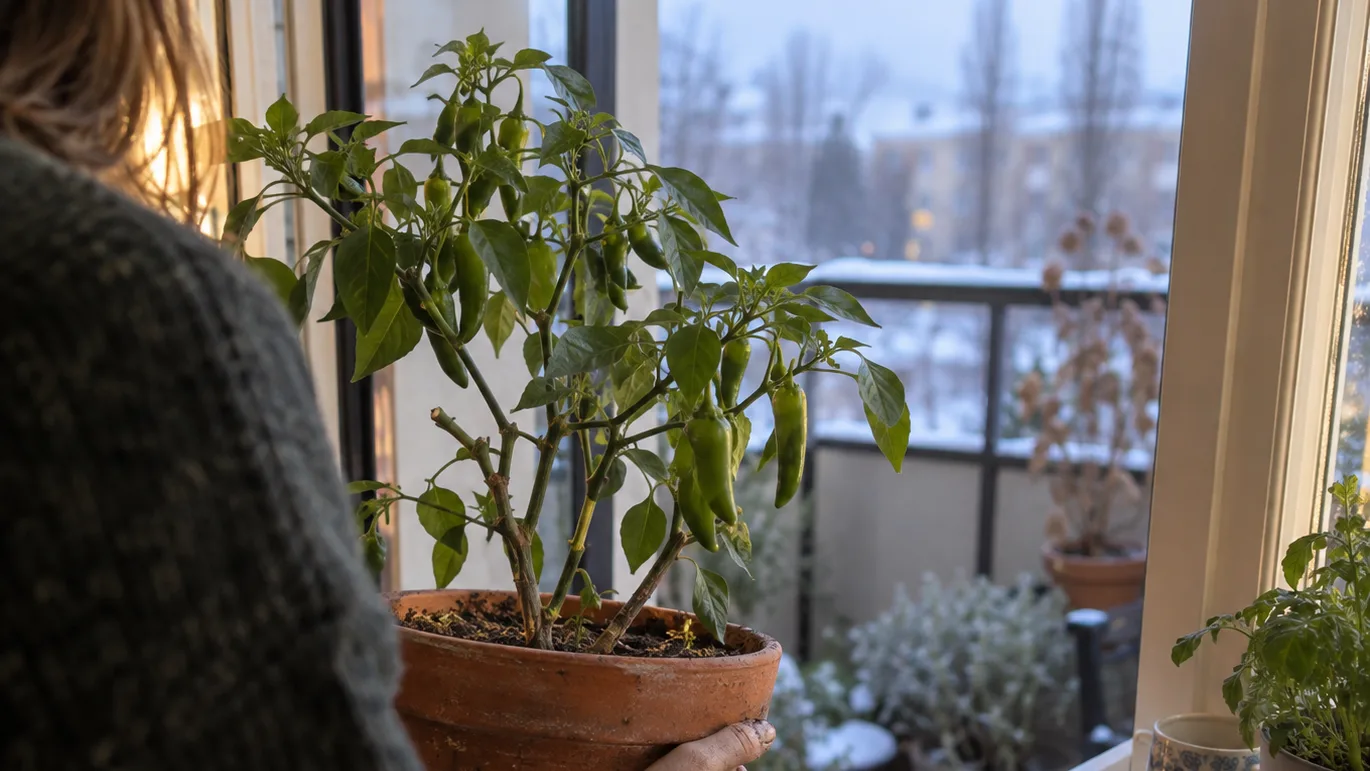
A useful before-and-after check is simple: before pruning, identify the main stem and the branches you want to keep; after pruning, you should still be able to trace that framework without guessing where the plant will regrow. If you cannot identify healthy nodes or the stems are soft at the base, pause and investigate the root zone instead of cutting more.
Run winter as dormancy or growth: the temperature–light–water trade-off
The two winter modes are not two watering schedules for the same environment. They are different balances between temperature, light and plant demand.
| Winter mode | Temperature | Light | Moisture check | Feeding |
|---|---|---|---|---|
| Cool dormancy | 10–15°C / 50–60°F | Bright ambient light if available; no strong growth target | Check every 7–14 days; in a cool room, watering may stretch to 2–4 weeks | Little or none while growth is paused |
| Active growth | 18–24°C / 65–75°F | Strong grow light for roughly 12–14 hours | Check when the top 2.5–5 cm / 1–2 in dries | Resume cautiously after firm new growth appears |
For cool dormancy, the word check matters more than the interval. Press a finger into the mix or lift the pot if it is small enough to handle. Water only when the mix is mostly dry, then water thoroughly enough to moisten the root ball and let excess drain away. Do not leave the pot sitting in runoff. In a cool room, the plant uses less water and the mix evaporates more slowly, so a fixed weekly watering day can keep the roots wet for no good reason.
A dormant pepper does not need a steady feeding programme while it is barely producing new tissue. I would wait rather than add fertiliser to a plant with no active growth. Extra nutrients cannot compensate for inadequate light, and salts left in a slowly drying pot can make the root environment harsher.
Active growth is a different commitment. A warm pepper under a strong light needs regular moisture checks because leaves continue losing water. Water when the top 2.5–5 cm/1–2 inches has dried, then adjust for pot material, room airflow and plant size. The phrase how often to water potted plants in winter is useful here only as a starting question; a warm, lit pepper behaves differently from a cool, resting one.
Weak light is the condition that flips the answer. Warmth tells the plant to grow, but weak light cannot supply enough energy for compact growth. The result is often pale foliage, long gaps between leaves and thin shoots that lean toward the brightest direction. If you cannot correct the light, lowering the temperature and allowing dormancy is usually the cleaner option.
Cold, wet mix creates the opposite problem. The plant is not demanding much water, but the root zone stays saturated. Soft stems near the soil line, a sour smell, sudden collapse or a pot that remains wet for many days are reasons to stop watering and inspect rather than add a tonic. If you are unsure whether the pattern is excess moisture, compare it with overwatered plant symptoms before deciding that the plant needs more feed.
Use the leaves and stems as a decision tree:
- Some leaf drop, but stems remain firm: Give the plant time to adjust, especially during the first two weeks indoors. Remove leaves once they are fully yellow or dry, but do not respond with daily watering.
- Aphids clustered on soft tips: Isolate the plant, rinse gently and inspect again after a day or two. New growth is the first place I look because it is easier for small sap-feeding insects to occupy.
- Fine pale speckling or webbing: Treat this as a reason to inspect closely for mites, particularly in warm, dry air. Keep the plant separated while you decide on the next treatment step.
- Soft stems or a persistently wet pot: Stop routine watering, improve drainage and check the base of the plant. More water is not a neutral response when the root zone is already wet.
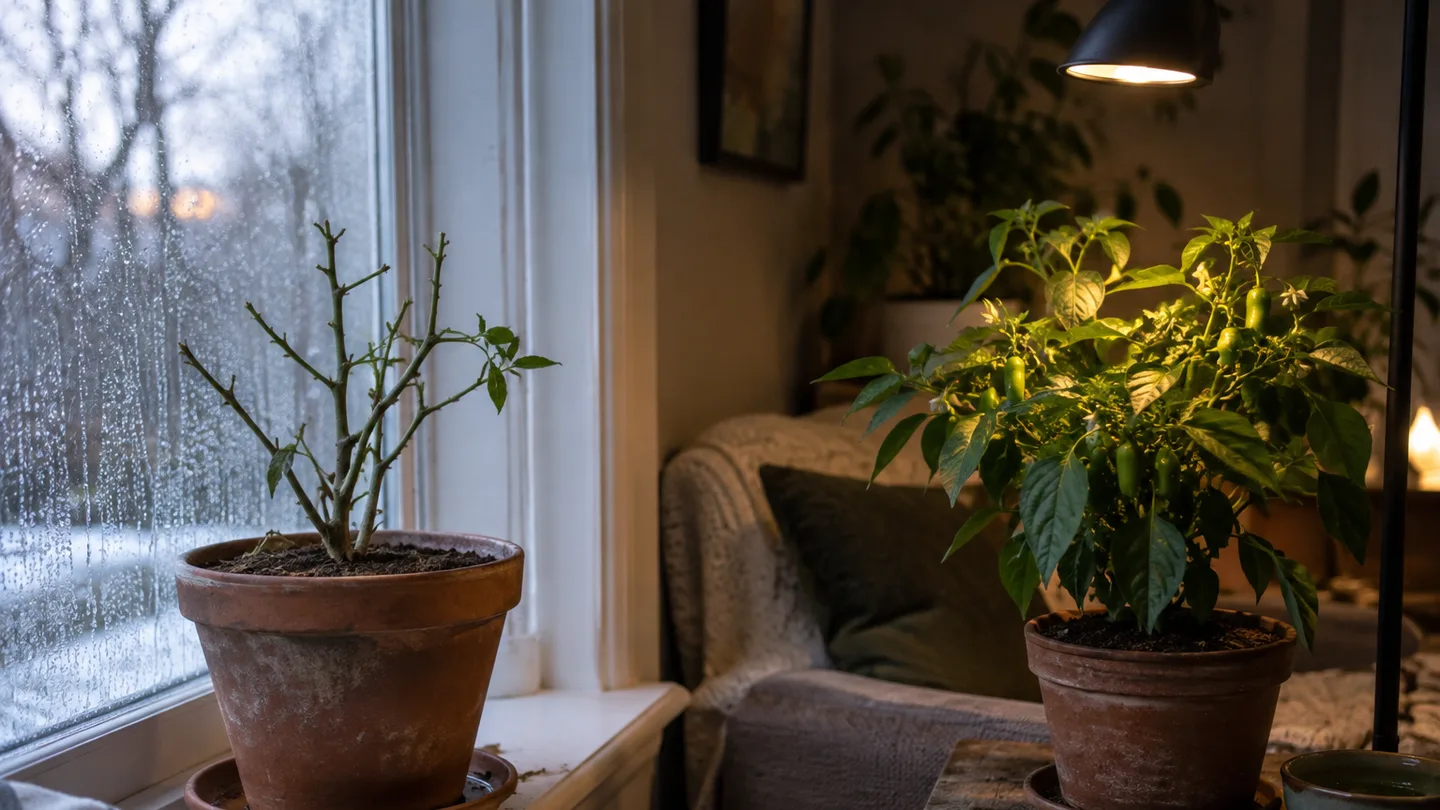
My preference is to choose one mode deliberately instead of drifting between them. A pepper kept cool but watered like an actively growing plant is set up for a wet root zone. A pepper kept warm but given only a dim window is set up for weak, stretched growth. The temperature decision should come with a matching light and watering decision.
Restart when new shoots appear, then harden off over 7–10 days
Spring restart begins with firm new growth, not with the first fallen leaf disappearing. Wait for new shoots or leaves that stay firm after opening. Then increase watering gradually and resume cautious feeding according to the product label. A few old leaves dropping does not prove that the roots are ready for a full outdoor routine.
Before moving the pepper outside, look for nights that remain above 10°C/50°F. Nights closer to 13°C/55°F give a stronger margin for a plant that has spent months protected indoors, especially if the balcony is windy. I would delay the move if the forecast still includes cold rain, sharp wind or a sudden dip near frost.
Harden the plant off over 7–10 days. The sequence below is a starting framework, not a test the plant has to pass on schedule:
- Days 1–2: Put the plant outdoors for 1–2 hours in bright shade, sheltered from wind.
- Days 3–4: Extend the time to 3–4 hours, keeping it in shade or filtered morning light.
- Days 5–6: Add a short period of direct morning sun, then return the plant indoors or to shelter.
- Days 7–10: Increase direct light and outdoor time in small steps. Leave it out overnight only when the forecast is reliably mild.
If the leaves bleach, curl sharply, flop or scorch after a jump in sunlight, step back to the previous level for a few days. If new leaves remain firm, the stems hold themselves upright and the plant is not developing bleached patches, the restart is moving in the right direction.
For a second opinion on pest handling, compare your inspection process with integrated pest management guidance from a local extension service before returning the pepper beside other plants. The useful point is not to follow a calendar blindly; it is to check the plant at each change in temperature, light and location.
Before the weekend, choose the pepper you are actually keeping, check the next week of overnight temperatures, and prepare a clean quarantine spot. By the time the plant has been indoors for a week, you should know whether it is resting calmly, growing too weakly for its light, or asking for a different winter setup.