Tomato Leaves Curling? 7 Causes and the Fix for Each
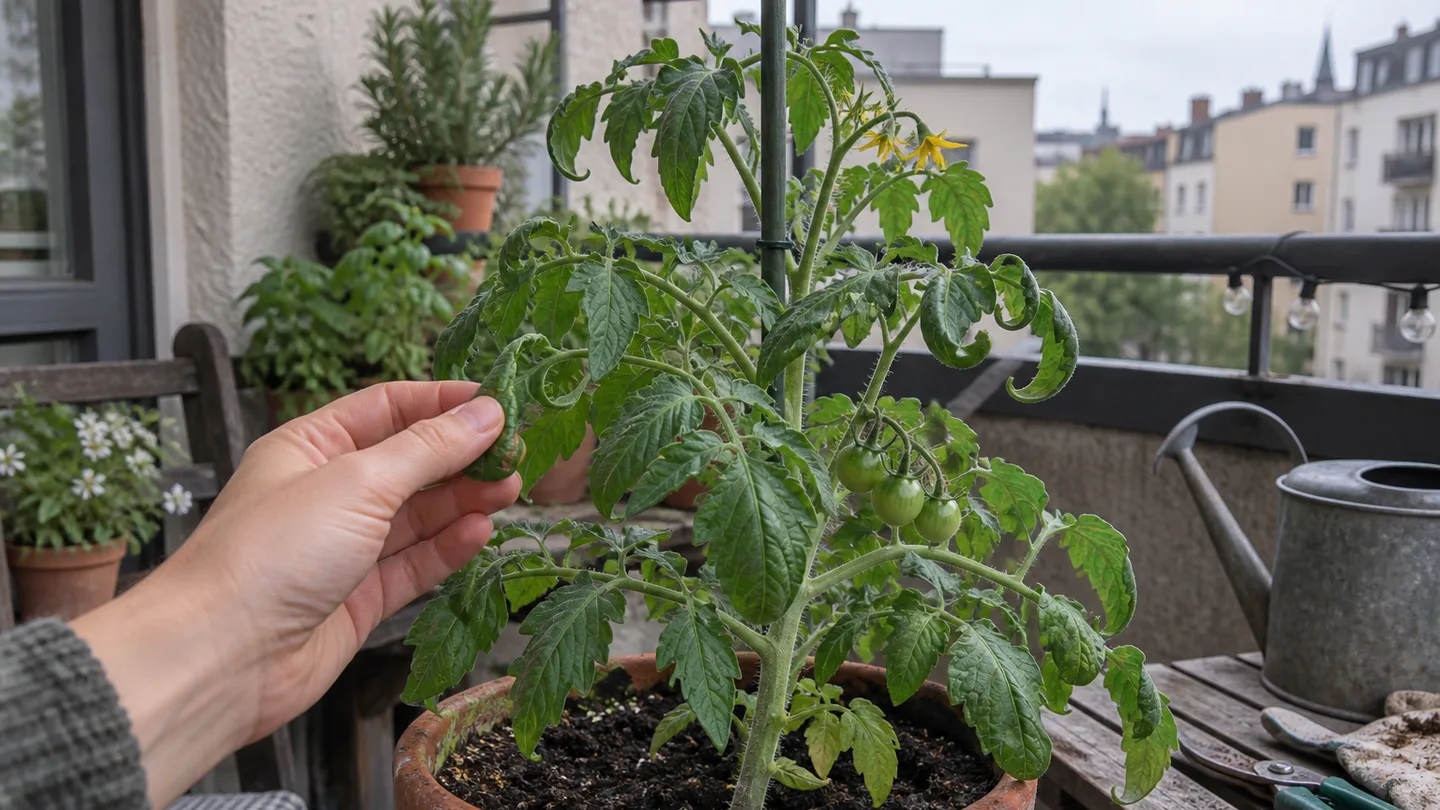
Tomato leaves curling does not automatically mean disease. The fastest split is this: check the oldest leaves, push a finger 5 cm (2 in) into the potting mix, and inspect the underside of one leaf before you add feed or spray anything.
I use that 60-second gate on every curling tomato I inspect. I look at the newest growing tip, then the lower foliage, because a 20 L (5 gal) dark plastic pot on a sunny balcony can look wilted in mid-afternoon and much better by evening. That change in timing tells me more than the direction of the curl by itself.
| What you see first | Where I look next | First move |
|---|---|---|
| Green lower leaves curl upward, new growth looks normal | Root volume and watering swings | Stabilize moisture; hold fertilizer |
| Leaves curl or droop in afternoon, pot is dry | 5 cm (2 in) below the surface | Water slowly and review heat exposure |
| Leaves yellow while the mix stays wet | Drainage holes, saucer, root smell | Fix drainage before watering again |
| Stippling, webbing, clusters, or insects underneath | Leaf undersides and growing tips | Confirm the pest before treating |
| Newest leaves are narrow, cupped, or twisted | Recent spraying nearby | Stop extra treatments and watch new growth |
| Mosaic, stunting, or persistent distortion | The whole plant and nearby plants | Isolate it and seek a plant diagnosis |
Curl direction alone cannot identify the cause. A thirsty tomato and a tomato with damaged roots can both fold their leaves, so the moisture check comes before the remedy.
Before you reach for feed: sort the curl in 60 seconds
Start with the mix, not the leaves. Push a finger or wooden stick 5 cm (2 in) down near the edge of the pot, where roots are less crowded. If that layer is dry and the pot feels light, drought stress moves up your list. If it is cool and wet after two or three days without rain or watering, drainage or root damage deserves attention instead.
Next, compare old and new growth. Lower leaves that remain green while the newest leaves unfold normally suggest a plant adjusting to root restriction, heat, or uneven moisture. New leaves that emerge twisted, narrow, yellow-mottled, or badly distorted point me toward pests, spray injury, or a virus. The plant's newest growth is its latest report; old leaves are often just a record of last week's conditions.
Turn over one leaf. Look for insects, pale speckling, sticky residue, fine webbing, or a powdery coating. Then check whether the pot can drain freely. A full saucer, a watertight decorative cachepot, or one blocked hole can keep the root zone wet even when the surface looks harmless.
Don't fertilize or spray until you've made those observations. Feed can worsen salt stress, and a pesticide aimed at the wrong problem adds another variable just when you need a clean diagnosis.
1. Physiological leaf roll — green lower leaves, normal new growth
Physiological leaf roll is the least dramatic cause and one of the easiest to mistake for a disease. The lower or older leaves curl upward along their length, often forming a tube or taco shape, but they stay green. The top of the plant continues to produce normally shaped leaves, flowers, and, sometimes, fruit.
I think of this as a water-movement problem rather than a lack-of-water problem. A recently transplanted tomato, a plant with crowded roots, or a tomato in a small pot can lose water from its leaves faster than the roots can replace it. Rolling reduces the exposed leaf area. The plant is changing its posture to slow loss, not necessarily asking for more fertilizer.
For container scale, my working minimum is about 20 L (5 gal) for a compact or determinate tomato. A vigorous indeterminate tomato is more forgiving in roughly 30–40 L (8–10 gal), particularly if it will stay in the same pot through the fruiting season. A smaller pot can still hold a plant for a while, but the moisture buffer becomes narrow and the plant may need several checks a day in hot, windy conditions.
Fix the root-zone swing before you repot:
- Water thoroughly when the upper mix has begun to dry, rather than giving repeated sips.
- Add 2–5 cm (1–2 in) of loose mulch, keeping it away from the stem.
- Move the pot away from the hottest reflected wall or railing if the root zone is heating rapidly.
- Hold extra nitrogen. More soft, fast growth does not solve restricted roots.
Repot only if the pot is genuinely limiting growth: roots circle densely at the edge, water runs straight through, or the plant wilts soon after a thorough watering. Old rolled leaves may stay rolled. I judge recovery by the next leaves, not by expecting damaged foliage to flatten like new.
2. Heat and a fast-drying pot fold leaves to save water
Heat stress has a recognizable rhythm. Leaves curl or droop during the hottest part of the day, the mix is dry 5 cm (2 in) down, and the plant partly recovers after the sun drops. A tomato in a container can reach that point sooner than one in open ground because the pot has less root volume and more exposed surface.
On balconies, I check four heat multipliers together: full afternoon sun, reflected heat from glass or masonry, wind, and dark plastic. A pot under about 20 L (5 gal) has less room for error, especially when daytime temperatures approach 30°C (86°F) or higher. That does not create a universal watering schedule; it tells me to inspect the pot more often.
If the mix is dry, water in the morning at the soil line. Pour slowly, pause when the surface begins to shed water, then continue until a little drains from the holes. That pause matters because bone-dry potting mix can repel a fast pour, sending water down the gap between mix and pot wall while the middle stays dry.
During a heatwave, move the container from the harshest afternoon exposure if you can do so safely, and add a thin mulch layer. If the pot is drying every day, treat that as evidence: the answer may be a larger container, a less windy position, temporary afternoon shade, or a different pot material. It is not a reason to water by the clock without checking the mix. For a fuller method, use the same depth test described in how much to water container plants rather than copying a calendar schedule.
3. Wet roots and poor drainage can curl leaves too
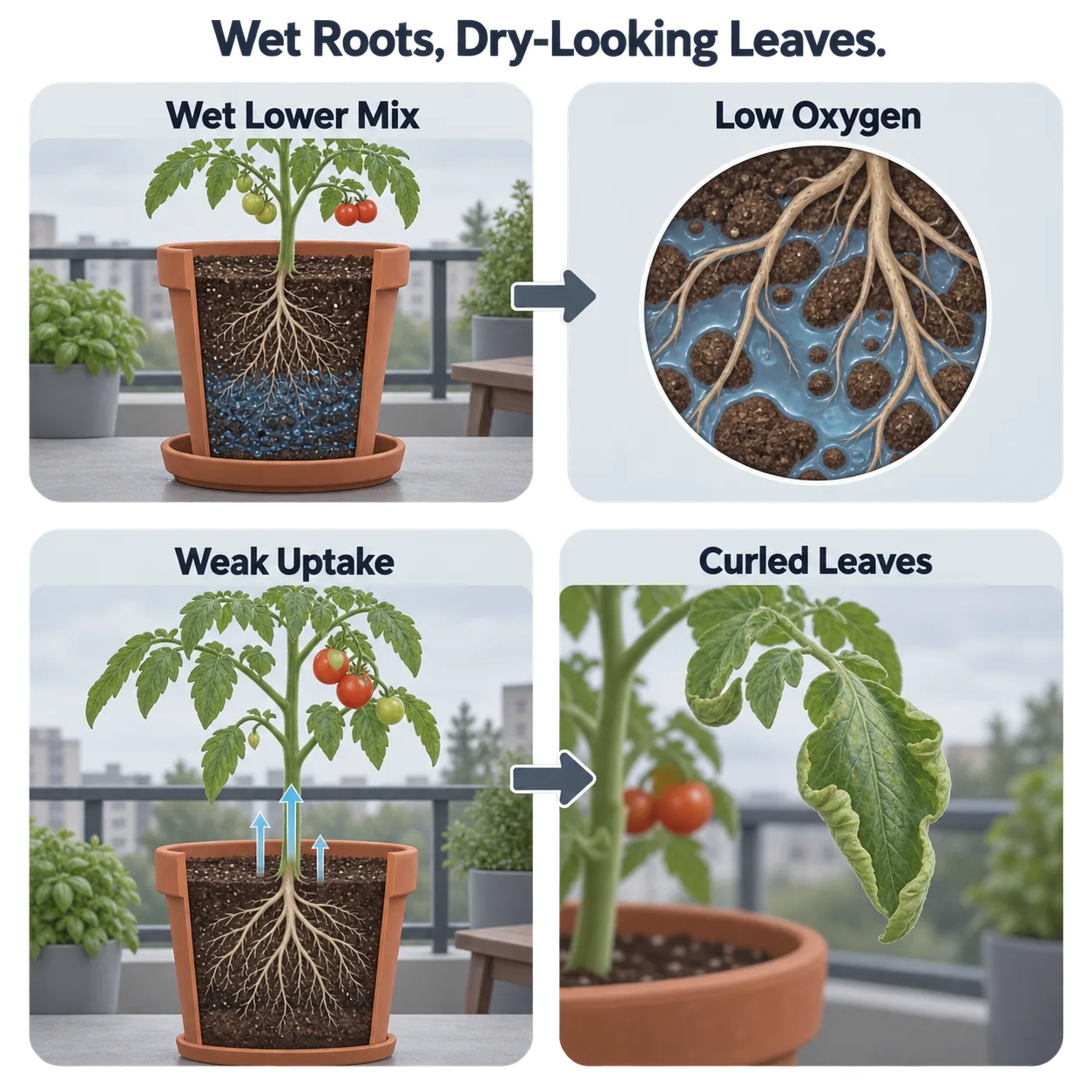
Overwatering can look like drought because damaged roots stop taking up water normally. The canopy may curl, wilt, or look strangely limp even though the pot feels heavy and wet. I move this cause high on the list when the mix is still wet 5 cm (2 in) down after 48–72 hours, lower leaves are yellowing, the saucer stays full, new growth feels soft, or the pot smells sour.
A perched water table is simply a persistently wet layer that sits above the drainage opening at the bottom of a container. Potting mix does not drain like a pipe; water is held between its particles until gravity and evaporation pull it away. Adding gravel beneath the mix does not create extra root space. In many ordinary pots, it moves the boundary between wet and less-wet mix upward, leaving less usable root volume.
Start with the physical checks:
- Lift the pot out of any watertight cachepot and empty the saucer.
- Confirm that several drainage holes are open, not just moulded dimples that never break through.
- Stop watering while the upper root zone remains saturated.
- Once the plant is stable, water again only when the mix has begun to dry at the test depth.
If the mix is compacted, collapsing, or staying wet far beyond the plant's needs, repotting may be justified. Slide the root ball out rather than pulling the stem. Brown, slimy roots and a sour-smelling mix suggest damage; firm pale roots are a better sign. Do not pour repeated doses of water into a wet pot simply because the leaves are limp. The watering problem is then part of the cause.
If you want to compare the symptoms with other container problems, overwatered plant symptoms is the useful next reference—not because every curled leaf is overwatering, but because the root-zone clues overlap.
4. Fertilizer salts or a nutrient imbalance distort the canopy
Feeding trouble usually leaves more evidence than curl alone. Look for a white crust on the mix, brown tips or margins, unusually dark green and thick foliage, or damage that appeared after repeated applications. In a finite container, fertilizer salts can accumulate because every dose enters a small root zone and evaporation removes water while leaving dissolved minerals behind.
A genuine deficiency can also produce pale foliage, but curl by itself is weak evidence. Adding a second fertilizer, a micronutrient mix, or a homemade remedy before checking the roots and moisture can turn a mild problem into salt stress. This is where I've seen the cycle happen: leaves look pale, the grower feeds, the tips burn, then the next diagnosis is made from the damage caused by the first fix.
Stop feeding first. Check the product label and your drainage. If the pot has unrestricted holes and the mix is not already saturated, my cautious container rule is to flush slowly with roughly two to three container volumes of clean water over several passes. For a 20 L (5 gal) pot, that works out to about 40–60 L (10–16 gal), but I would not attempt it in a sealed pot or leave the plant standing in the runoff.
Let the pot drain fully and hold fertilizer for about 7–14 days. That is a reset window, not a promise that a damaged leaf will recover. If new growth looks normal afterward, resume only at the label rate. If the newest leaves continue to distort, return to the pest, spray-injury, and virus checks instead of escalating the feed.
5. Aphids, whiteflies, and mites leave their evidence underneath
Do not diagnose pests from curled leaves alone. Turn the leaf over and inspect the veins, petioles, and growing tips. Aphids often gather in clusters and may leave sticky honeydew. Whiteflies scatter or rise when disturbed. Mites cause fine pale stippling, and heavier infestations may produce delicate webbing.
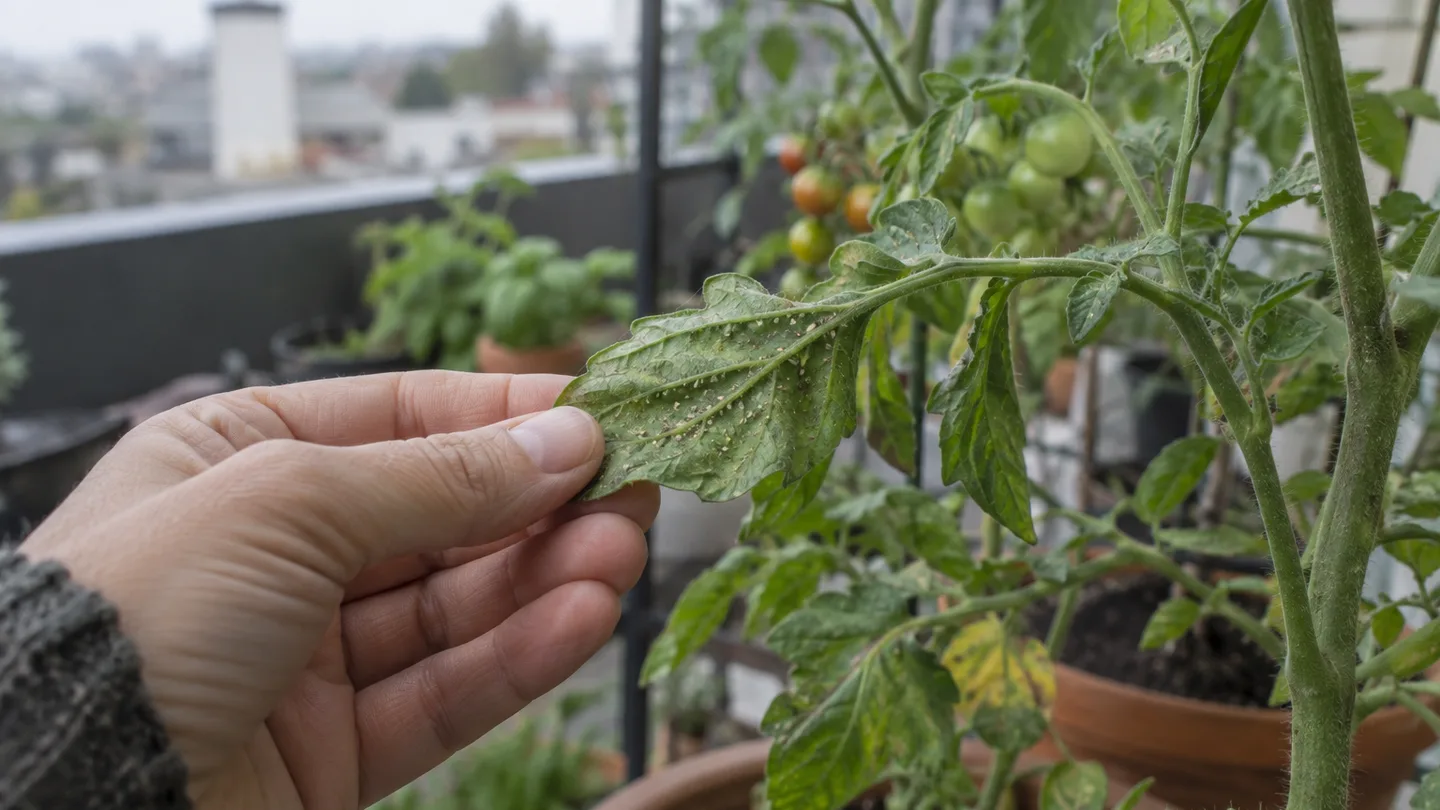
If available, I use a 10× hand lens for this inspection because tiny pests and eggs are easy to miss with the naked eye. It is especially useful when the leaf has stippling but no obvious web. Broad mites are a separate nuisance: they can distort tender new growth without producing the conspicuous webbing people expect from spider mites.
The treatment order matters:
- Isolate the pot from nearby tomatoes and other susceptible plants.
- Rinse the undersides of the leaves with a gentle stream of water.
- Use only an insecticidal soap or other treatment labelled for edible crops.
- Wet the undersides and growing tips thoroughly; contact products cannot treat surfaces they never reach.
- Repeat only at the label interval. Some products call for another pass after roughly 5–7 days, but the label takes priority.
Ordinary dish soap is a poor substitute because its detergents and concentration are not designed for living leaf tissue. They can strip the leaf's protective surface and add injury that looks like pest damage. Test any labelled product on a small area first if the plant is heat-stressed, and avoid spraying in harsh midday sun.
Remove leaves that are dead, badly damaged, or covered in pests if the plant has enough healthy foliage left. Do not strip every curled green leaf. A tomato needs working leaves to support recovery and fruit development. The related guide to spider mites on plants is useful if the evidence is stippling or webbing rather than clusters of larger insects.
6. Herbicide drift makes the newest growth cup and twist
Herbicide exposure has a different signature from ordinary heat stress. The newest leaves may become cupped, twisted, narrow, strap-like, or oddly stretched, while older leaves look comparatively normal. Veins can remain prominent. If one side of the plant faces a recently treated lawn, path, or neighbouring pot, and several nearby plants show similar new distortion, spray exposure moves higher on my list.
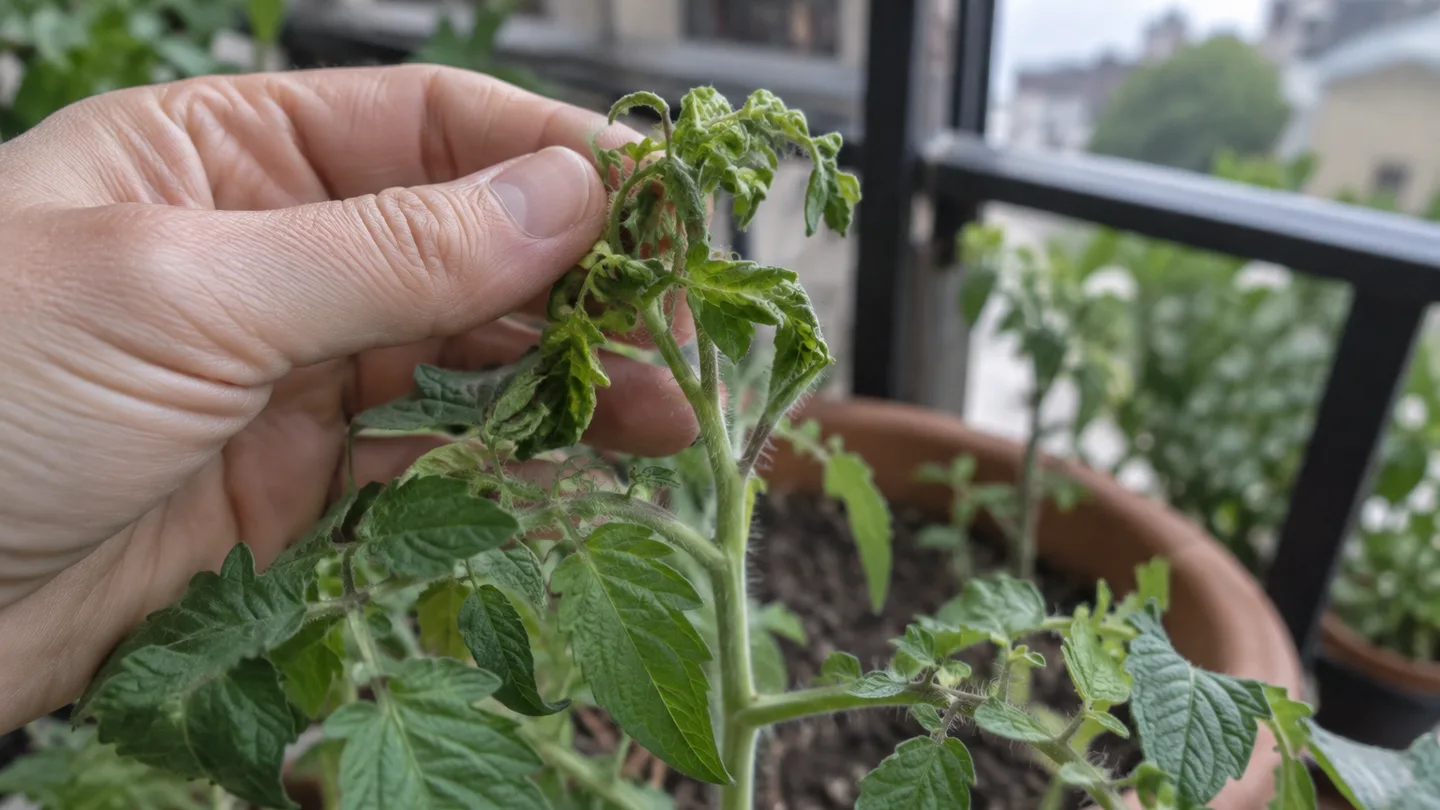
Symptoms do not always appear immediately. A plant can look fine at the time of spraying and show distorted new growth over the following several days. The new leaves are more useful than old leaves because they developed after the possible exposure.
There is no reliable household antidote. Stop extra fertilizer and foliar sprays, move the container away from the suspected source if possible, and do not compost suspect trimmings. Continue ordinary, careful watering; excessive flushing will not neutralize a product that has already affected the plant and may damage the roots.
Watch the next 7–14 days of growth. If it unfolds normally, the plant may have escaped with temporary injury. If each new leaf is more distorted, or the exposure involved an unknown product, treat the crop cautiously. For an edible tomato, read the pesticide label and follow its crop, handling, and harvest directions rather than guessing from the appearance of the leaves.
7. A virus is the persistent curl with mosaic, stunting, or yellowing
Virus is the diagnosis I reserve for curl that comes with a wider pattern: yellow-and-green mosaic, cleared-looking veins, stunted growth, distorted new leaves, unusual flower drop, or symptoms that persist after moisture, drainage, and visible pests have been corrected.
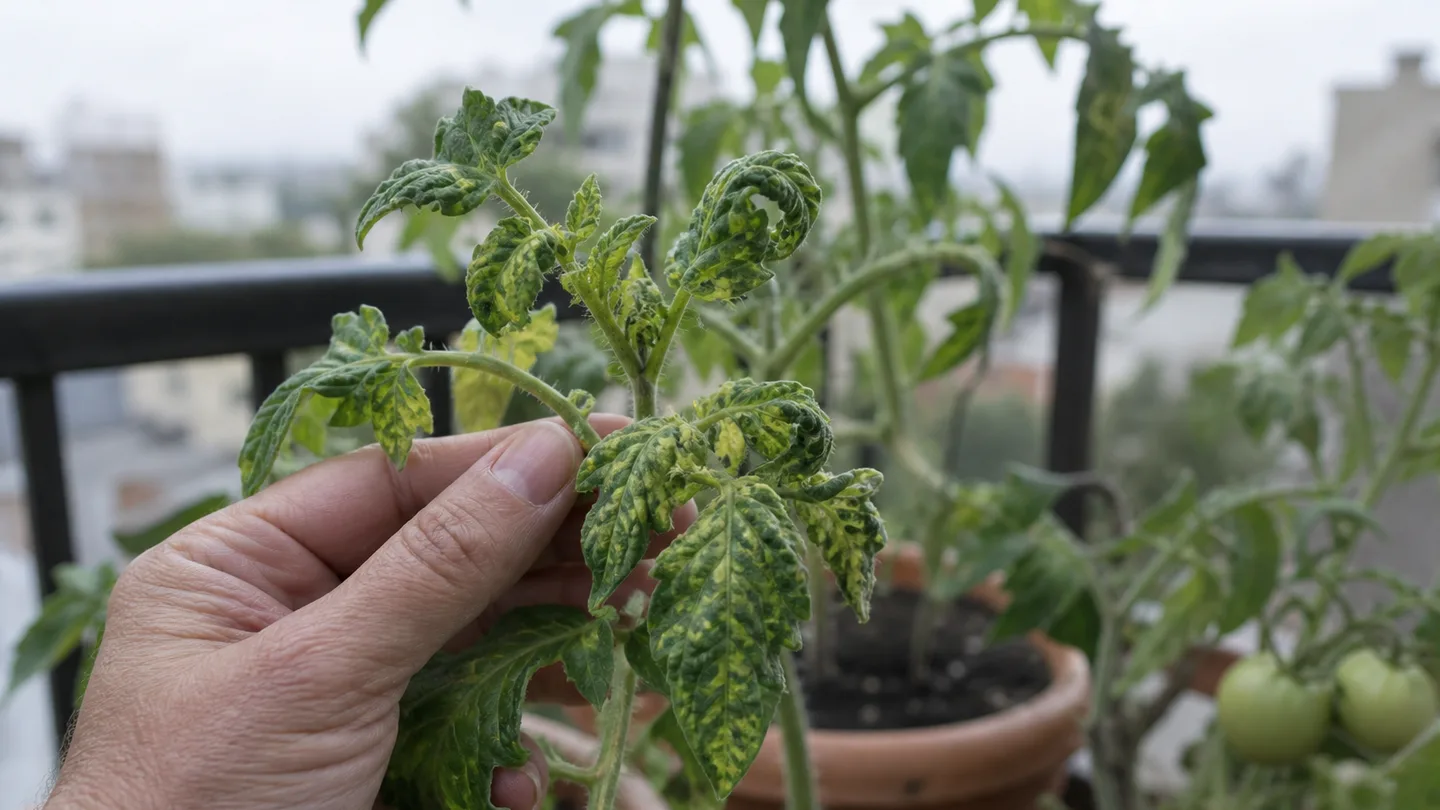
Tomato yellow leaf curl virus and other tomato viruses can be associated with insect vectors or infected transplants, but a photograph cannot tell you which virus is present. Nor can it reliably separate a virus from some forms of spray injury. That is why I look for persistence and the combination of symptoms rather than naming a virus from one curled leaf.
For now, isolate the plant from other tomatoes. Control visible whiteflies or other vectors with a method labelled for edible crops, but do not assume pest control will reverse an established infection. Clean pruners with 70% alcohol between plants, avoid saving seed from a suspicious plant, and do not compost a plant that is worsening with mosaic and stunting. Bagging it and putting it in the appropriate waste stream is more cautious than spreading infected tissue through a home compost pile.
Give the plant a monitoring window after environmental problems are corrected. If the next leaves emerge normal over 7–14 days, stress remains a reasonable explanation. If new growth continues to show mosaic, stunting, and distortion, the better next step is a local plant diagnostic service, not another product. Bring clear photos of the whole plant, the newest leaves, and the leaf undersides if you seek help.
That also answers the practical questions people usually ask next. Older curled leaves often stay curled after the cause is fixed, so judge recovery by new growth. Remove leaves because they are dead or badly damaged, not simply because they are curled; use clean tools, and bag foliage from a plant with suspected virus or herbicide exposure. A tomato with physiological leaf roll or temporary heat stress can still produce fruit if new growth and flowers remain normal, while continuing root damage, virus symptoms, or spray injury is more likely to reduce flowering.
Tomorrow, check the mix 5 cm (2 in) down, inspect one leaf underside, and look closely at the newest growing tip. In a week, compare that new growth with today's photograph. If it is green, normally shaped, and expanding, keep the care steady; if it is more twisted, mottled, or stunted, stop treating by guesswork and contact a local plant diagnostic service.
Frequently Asked Questions
Will curled tomato leaves uncurl after I fix the problem?
Older leaves often stay curled even after watering, drainage, pest, or heat problems are corrected. Judge recovery by the next 7–14 days of new growth; herbicide injury and virus symptoms may not reverse.
Should I remove curled tomato leaves?
Do not strip green leaves just because they are curled. Remove dead or badly damaged leaves with clean tools, and bag rather than compost leaves from a plant with suspected virus or herbicide exposure.
Can a tomato plant still produce tomatoes with curled leaves?
Yes, plants with physiological leaf roll or temporary heat stress can still fruit when new growth remains normal. Persistent virus, severe root damage, or continuing herbicide injury is more likely to reduce flowering and yield.