Epsom Salt for Plants: What It Helps—and What It Won’t
Epsom salt for plants is not a complete fertilizer: it supplies roughly 9.8% elemental magnesium and 13% sulfur by mass, but no nitrogen, phosphorus or potassium. I’d use it only when a leaf pattern, a watering check and ideally a potting-mix test point to a magnesium or sulfur shortage.
I’ve kept this as a longer mechanism explainer rather than a spoon-per-gallon recipe because the hard part isn’t dissolving the crystals. It’s deciding whether the plant needs those particular ions, and avoiding extra soluble salt when the real problem is wet roots, poor light, compacted mix or uneven watering.
My short rule is simple: no convincing symptom and no test, no Epsom salt. That rule is especially useful in pots, where a small amount of dissolved material occupies a small root volume and cannot disperse through a deep garden bed.
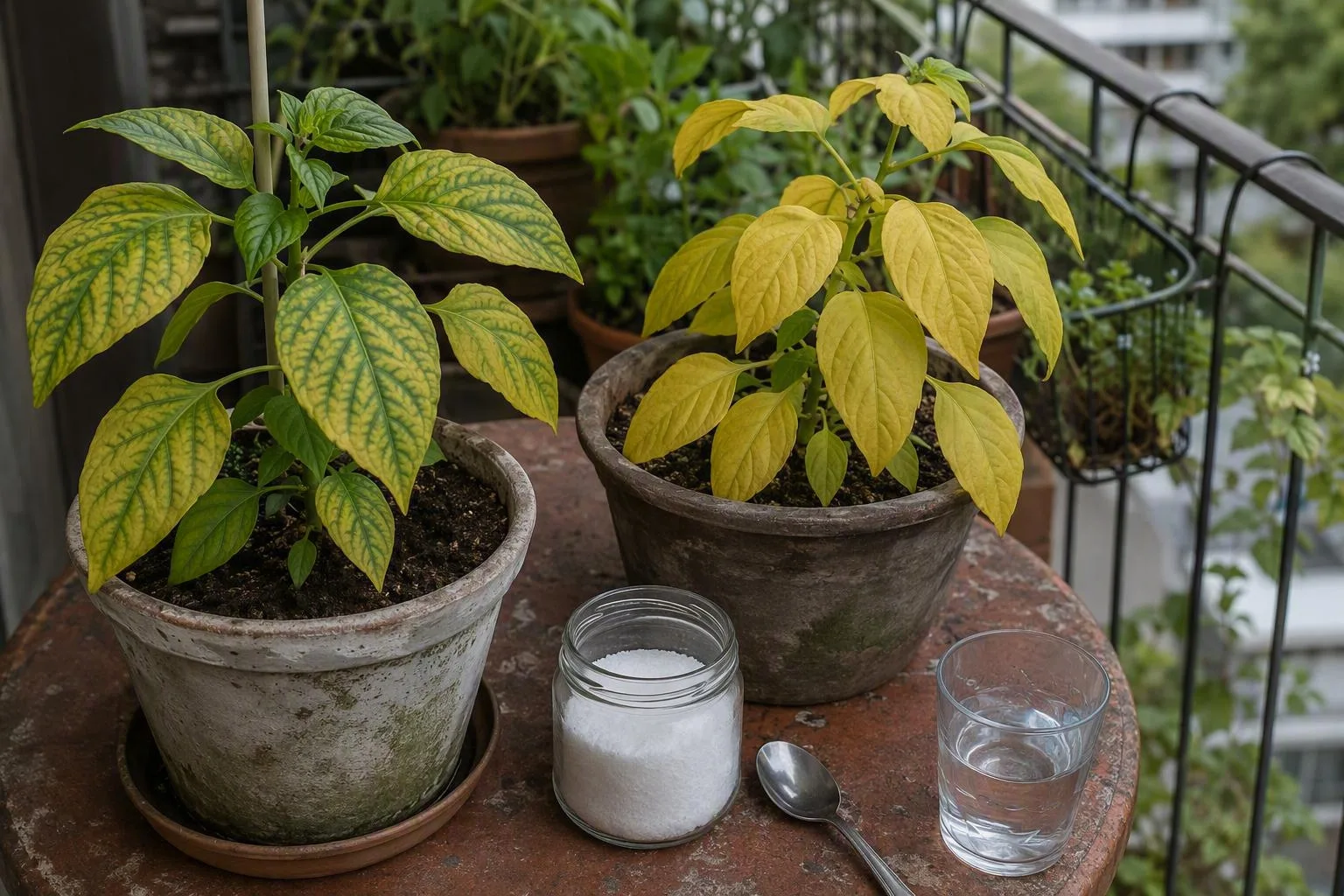
The label gives the first answer: magnesium and sulfur, but no complete fertilizer
Pure Epsom salt is magnesium sulfate heptahydrate. Heptahydrate means that the crystal contains seven water molecules for each unit of magnesium sulfate. Using the formula’s approximate atomic masses, the whole unit weighs about 246.5 parts: about 24.3 parts are magnesium and about 32.1 parts are sulfur. Those ratios work out to roughly 9.8% magnesium and 13% sulfur by mass.
That composition explains both the possible benefit and the limitation. Magnesium sits at the centre of the chlorophyll molecule, so a plant short of available magnesium can lose the green colour between leaf veins. Magnesium also supports several enzyme processes. Sulfur is used in some amino acids and proteins. Supplying one of those elements can help if it is genuinely the missing piece.
There is no nitrogen, phosphorus or potassium in magnesium sulfate itself. Those are the three numbers usually shown on a complete fertilizer label as N-P-K. Epsom salt therefore cannot replace the normal feeding plan for a fruiting tomato, a flowering annual or a leafy houseplant. It can supply magnesium and sulfur, but it cannot provide the broad nutrient mix needed to build stems, leaves, flowers and fruit.
This is where the popular advice goes off track. A plant may look greener after any change that also includes better watering, fresh mix, more light or time for new growth. That does not show that magnesium was limiting. If magnesium is already available, adding more does not turn Epsom salt into a bloom booster. The plant has no nutritional use for a limitless pile of the same two ions.
In a garden bed, extra dissolved material is spread through a large volume of soil and may be held on soil particles. A container has a finite root zone, regular watering and a drainage hole. Material that is not taken up can remain in the mix or leave with the next watering, depending on the pot and the mix. That makes a container dose harder to generalize than a garden-bed recommendation.
The narrow, defensible use is a diagnosed shortage of available magnesium or sulfur. Even then, the solution may be a complete fertilizer, a pH correction, better root health or a fresh growing medium rather than Epsom salt alone.
The leaf pattern matters more than the yellow colour
Yellow leaves are a symptom, not a diagnosis. I start with two questions: is the affected leaf old or new, and is the tissue yellowing between green veins or fading evenly? Then I check moisture, recent feeding, light and the undersides of leaves before adding anything.
In my own balcony setup, one July I had a pepper growing in a 15-litre (4-US-gallon) black plastic pot. The lower leaves developed a mottled yellow area between veins that stayed noticeably green. The newest leaves at the tip were still green, and the plant was not fading uniformly from top to bottom. I checked the mix about 4 cm (1.5 in) down with a finger, lifted the pot to judge its weight, cleared the drainage hole and looked for water sitting in the saucer. I found moist mix rather than dust-dry mix, a clear hole and no standing water. I also checked the leaf undersides and found no aphids, webbing or obvious chewing. I had no laboratory result, so I couldn’t honestly call it a magnesium deficiency.
I did not add Epsom salt. I stopped watering by the calendar, let the upper layer lose some moisture before watering again and watched the newest leaves rather than waiting for the old damaged leaves to turn green. The later growth did not repeat the same strong pattern. That observation did not identify a single cause, but it gave me a useful boundary: the leaf pattern alone was not enough to justify adding a salt. Old leaves that have already lost colour may stay marked even after the underlying problem has stopped.
| Pattern | What it can suggest | My first check |
|---|---|---|
| Older leaves yellow between green veins | Possible magnesium shortage, especially when the lower leaves are affected first | Check root moisture, recent feed, mix pH and whether new leaves show the same pattern |
| Newer leaves pale fairly evenly | Possible sulfur shortage, though root stress and general nutrient shortage can look similar | Compare the newest growth with older leaves and inspect the roots and mix |
| Older leaves pale evenly | Possible nitrogen shortage or a broader root-zone problem | Review the complete fertilizer history rather than reaching for magnesium sulfate |
| Newest leaves yellow between green veins | Possible iron-availability problem, often connected with pH or damaged roots | Check pH, drainage and root health; Epsom salt does not supply iron |
| Several leaves wilt, yellow or develop dull patches together | Root or watering stress, including a mix that stays wet or dries sharply | Feel below the surface, inspect drainage and compare the plant’s position with its light and heat |
Magnesium is mobile inside a plant, so a plant can move some magnesium from older leaves toward newer growth. That helps explain why deficiency commonly begins low on the plant. Sulfur is less mobile, which is why a genuine sulfur shortage often shows first in newer growth. Nitrogen is also mobile and commonly affects older leaves first. Iron is not readily moved to new leaves, so iron-availability problems often appear at the growing tips.
Those are useful patterns, not laboratory instruments. A damaged leaf, transplant shock, intense reflected heat, root injury or an abruptly changed watering routine can produce misleading colour. The University extension nutrient-deficiency symptom guides are useful for comparing leaf age and vein pattern, but I still pair any chart with an inspection of the pot.
A 15 mL spoonful in a 10 L pot is not a harmless default
Consider the concentration rather than the spoon. The same 15 mL tablespoon in 10 L (2.6 US gal) of root volume is 1.5 mL per litre. In 100 L (26 US gal), it is 0.15 mL per litre. The first mixture is ten times more concentrated per litre, even though the spoonful looks identical. That is why a garden-bed instruction cannot be copied casually into a small container.
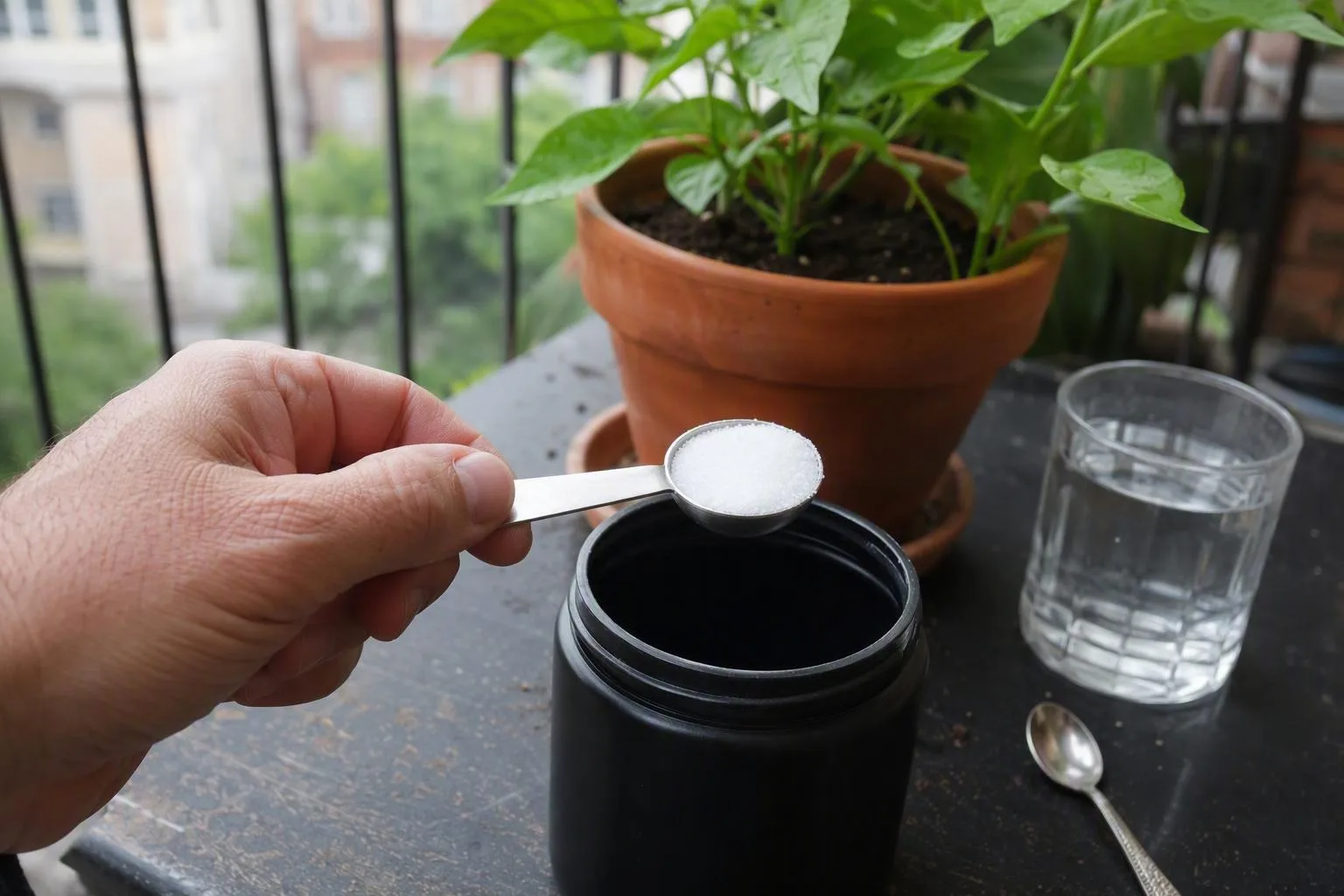
A spoonful is not a dose until the crop, root volume, product label and starting conditions are known. Before I apply anything, I use this order:
- Check moisture first. Push a finger or wooden stick below the dry surface layer. A pot that is wet near the roots can produce yellowing and weak growth because roots are short of air, while a dry pot can cause temporary nutrient uptake problems. Adding salt to either situation skips the cause.
- Check drainage next. Make sure the hole is open and that the container is not sitting in a saucer of old water. A salt application followed by poor drainage creates a concentrated pocket around the roots. A saucer is useful for protecting a balcony, but it should not become a permanent reservoir unless the crop and setup are deliberately designed for that.
- Review the crop and recent feed. Note whether the plant is a rose, tomato, pepper, herb or houseplant, then look at what you have already applied. If you’re also wondering how often to fertilize container plants, keep that question separate from the magnesium question. A complete fertilizer may already contain magnesium, and adding Epsom salt on top can make the total salt load harder to judge.
- Look at the growing medium. Record whether the pot contains a peat-based, coir-based, bark-heavy or mineral-rich mix. The wider container gardening soil question matters because mixes differ in water retention, nutrient holding and pH. A fresh, lightly fed mix is a different starting point from an old pot that has received fertilizer for months.
- Test when the decision matters. A soil or growing-medium test can show pH, soluble salts and available magnesium, but ask the laboratory how it wants a soilless potting mix submitted. A test designed for field soil may not interpret a container sample in the same way. If you send a sample, follow accredited soil-laboratory guidance for sampling rather than scooping only the pale surface crust.
Epsom salt is not a dependable pH correction. Magnesium sulfate supplies magnesium and sulfate; it is not the same material as a liming product, and it does not provide the predictable neutralizing action of a material chosen specifically to raise pH. Elemental sulfur is also a different product from sulfate. If a pH test says the mix is too acidic or too alkaline, choose the correction for that pH problem instead of assuming more Epsom salt will move it in the right direction.
The small-pot calculation also explains why I’m cautious with rates borrowed from open ground. A field recommendation is tied to an area, a soil depth, a much larger root zone and a different capacity to hold or dilute nutrients. A 10-litre pot has none of that spare volume. My practical opinion is that no symptom plus no test is a no-go, not an invitation to try a weaker-looking spoonful.
If a deficiency is real, apply once and reassess—not every week
If the leaf pattern, growing conditions and available test all point toward a magnesium or sulfur shortage, I would make one measured application that the product label allows for that crop. I would not use a universal internet recipe, because a tablespoon is a volume measure, products vary in concentration and container sizes vary dramatically.
For a root-zone application
- Choose the right product. Use a garden-labelled magnesium sulfate product whose label permits the intended crop. For edible plants, the label should specifically cover use around food crops. Do not substitute scented bath salts, coloured crystals, oils or a blended soaking product.
- Measure the label rate. Keep the unit straight: 1 US gallon is about 3.8 L, while 1 imperial gallon is about 4.5 L. A tablespoon is about 15 mL. Those are not interchangeable instructions. If the label uses a different unit, convert the water volume first and write the calculation down.
- Dissolve it separately. Stir the measured product into the required water in a clean container. Pre-dissolving prevents a dry crystal from sitting against one section of the root ball at a very high local concentration.
- Apply to already-moist mix. Spread the solution over the root zone, not against the stem and not in one small spot. Moist mix helps the solution move through the existing root zone instead of forming a concentrated wet patch beside a dry root ball.
- Let excess drain. Confirm that liquid exits the drainage holes, then empty the saucer. Don’t leave the pot standing in the runoff. If the mix does not drain, stop and repair that problem before making another nutrient application.
The goal of a root drench is to put magnesium and sulfate into the zone where roots can encounter them. It is not to soak the foliage or create a white layer on the surface. If crystals land on leaves or stems, rinse them off with clean water when practical; a drying salt residue can injure tender tissue.
When a foliar spray makes sense
A foliar spray puts a dilute solution on the leaves rather than changing the root zone. It may be considered for a confirmed deficiency when the product label specifically permits foliar use, but it does not repair compacted mix, damaged roots, incorrect pH or a blocked drainage hole. It also brings a direct leaf-scorch risk if the solution is too strong or dries quickly in bright, hot conditions.
If the label permits foliar use, I would test a small portion of one leaf first, spray during a cool part of the day and avoid treating a wilted, heat-stressed or freshly transplanted plant. I would keep the spray off edible parts unless the label gives clear crop instructions. A foliar treatment is not a reason to repeat a root drench at the same time.
Reassess after about 2–4 weeks rather than every few days. Look at new growth: old yellow tissue may remain yellow because the damaged cells do not rebuild their lost chlorophyll. A reasonable projected sign of improvement is that new leaves stop developing the same interveinal pattern. If new leaves keep showing it, repeating Epsom salt automatically is the wrong next step; return to pH, root health, light, moisture and the test result.
For the moisture part of that check, use the same physical inspection described in how much to water container plants: check below the surface and account for pot material, wind, heat and root volume instead of following a fixed calendar.
Blossom-end rot, pale new leaves and other jobs Epsom salt cannot do
The most useful myth-busting question is not whether Epsom salt can ever help. It is what the crystals cannot supply. They contain no calcium, so they are not a reliable treatment for blossom-end rot. They do not provide nitrogen for a pale, hungry plant, iron for iron chlorosis or an insecticide for aphids. They also cannot make a waterlogged root system breathe.
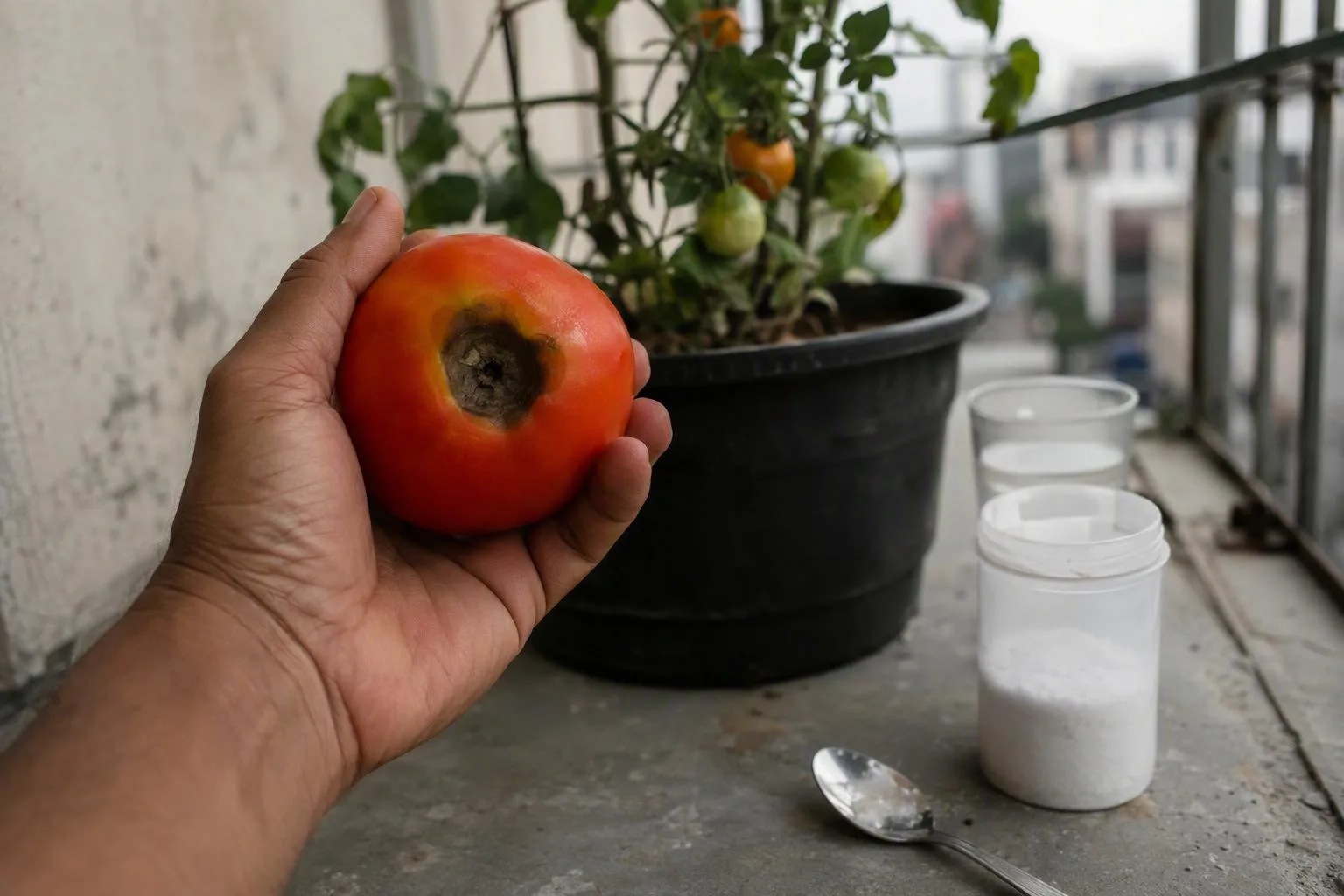
Blossom-end rot appears as a dark, sunken patch at the blossom end of a tomato or pepper. The underlying issue is usually a problem with calcium reaching developing tissue, often made worse by uneven water supply or damaged roots. Adding magnesium sulfate does not add calcium, and excessive magnesium can complicate the balance of other cations in the root zone. Stabilize watering and inspect roots before adding another mineral.
| Symptom | Actual cause to investigate | Better next step |
|---|---|---|
| Dark, sunken end on tomato or pepper fruit | Uneven water uptake, root stress or a calcium-distribution problem | Keep moisture steadier, check drainage and roots, and don’t treat it as a magnesium shortage |
| Many flowers but few fruits | Insufficient light, heat stress, poor pollination or an imbalanced feeding pattern | Audit light and temperature, help pollination where appropriate, and review complete feeding |
| Newest leaves pale with green veins | Iron availability, high or unsuitable pH, or damaged roots | Test the medium and correct the root-zone or pH problem; Epsom salt supplies no iron |
| Older leaves pale evenly | Possible nitrogen shortage or a broader restriction on root uptake | Review the complete fertilizer label and the watering pattern before adding magnesium sulfate |
| Sticky leaves, clusters of insects or distorted tips | Aphids or another pest | Inspect leaf undersides and stems, identify the pest and use a crop-appropriate control |
| Plant wilts while the pot feels light | Underwatering or a root ball that has become difficult to re-wet | Water slowly until the root ball is evenly moist, then adjust the interval to the pot and weather |
| Plant wilts while the mix stays wet | Restricted roots, poor drainage or root damage | Open the drainage route, reduce standing water and inspect roots before feeding |
| Water runs down the sides or mix stays hard | Compacted or water-repellent growing medium | Rehydrate carefully or replace the medium; a soluble salt will not restore structure |
| White crust on the mix or pot rim | Accumulated fertilizer salts or minerals from irrigation water | Stop extra salts, assess drainage and consider a careful flush or repot if the crust persists |
Routine Epsom salt advice is often aimed at roses, tomatoes, peppers and houseplants because those are familiar plants with familiar yellow leaves. Familiarity is not evidence of a magnesium shortage. For a healthy plant in a balanced mix, I see routine use as a poor trade: the possible benefit is conditional, while the extra soluble material is real whether or not the plant needs it.
Overuse can show up as a white crust on the mix or pot rim, scorched leaf edges, stunted growth or a plant that wilts even though the soil is wet. These signs are not exclusive to Epsom salt; hard irrigation water and ordinary fertilizer can leave the same residue. Treat the crust as a prompt to inspect the whole salt and watering history, not as proof of one product.
My recovery sequence is deliberately boring:
- Stop adding Epsom salt and other unnecessary amendments.
- Check the drainage holes, saucer, mix moisture and root-zone smell.
- If the pot drains freely and the plant is not already waterlogged, run plain water slowly through the mix so excess soluble material can leave. Don’t keep flooding a pot that has no working drainage.
- If crust returns, roots are damaged, or the mix has collapsed, remove the plant for a root inspection and repot into a suitable medium when the crop and season allow.
- Resume a normal complete feeding plan only after watering and drainage are stable.
This is also why I keep the Epsom question separate from container gardening tomatoes. Tomatoes need enough root volume, regular moisture and an appropriate complete feeding plan; magnesium sulfate is a specialist correction, not the foundation of the crop. The most useful Epsom salt habit is not keeping a jar beside every pot. It is knowing when not to open it.
Before the weekend, photograph the oldest affected leaf and the newest growing tip. Check the mix several centimetres down, clear the drainage hole and write down the last fertilizer you used. In a week, compare the new growth with that photograph. If the same pattern is moving into fresh leaves, get a suitable potting-mix or pH test before applying anything.