Grow Papaya From Seed: Pot Size, Heat, and Fruit Timing
A papaya grown from seed may need a 20–30 gallon (75–115 L) final pot, warm conditions around 75–85°F (24–29°C) to get started, and roughly 9–18 months to reach ripe fruit in a favourable setting. Those are planning ranges, not a promise: a balcony with only an hour or two of direct sun may keep a plant alive without giving it enough light and warmth to fruit reliably.
I’ll walk through the decisions in the order you’ll meet them: choosing seed, starting it warm, sizing the pot, then judging whether your balcony can carry the plant through flowering and fruiting.
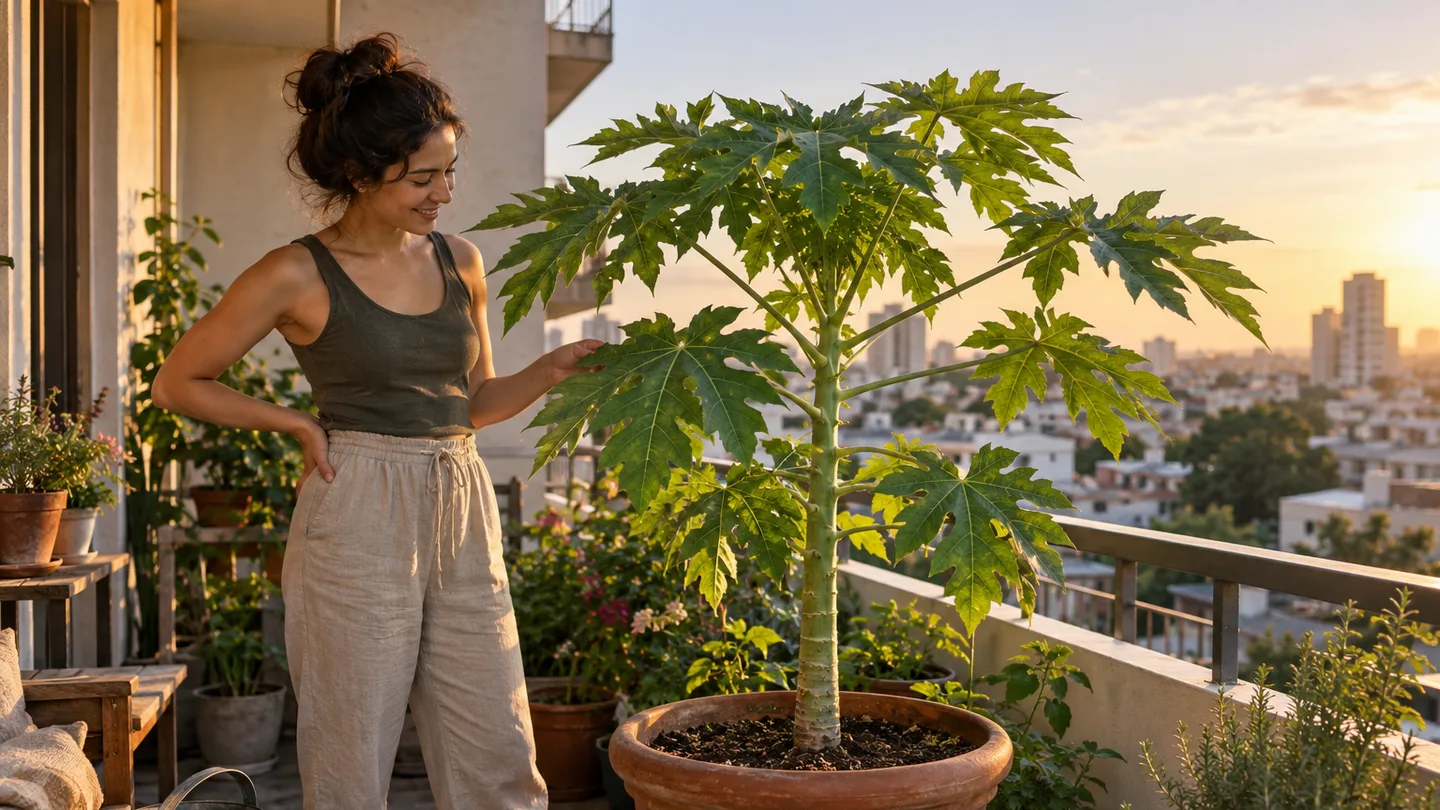
Start with the fruit, not the pot: what seed-grown papaya can and can’t predict
Choose a ripe papaya and scoop out more seeds than you think you need. Seedlings can vary, and the plant you raise may not reproduce the fruit’s flavour, size, or other traits. A seed from a sweet grocery-store papaya is a chance to grow a papaya plant, not a label guaranteeing an identical crop.
Rinse the seeds well and rub away the slippery coating around them. That coating is the fleshy material around each seed; removing it makes the seeds easier to handle and reduces the sticky residue in the sowing mix. Let them surface-dry briefly while you prepare the pots, then sow them. I wouldn’t leave them forgotten on a sunny windowsill for days: the useful next step is to sow clean seeds while you’re ready to keep the mix warm and slightly moist.
Seed also leaves an important question unanswered: what flowering type will the plant have? Depending on the variety, papaya plants may have male, female, or flowers with both functional reproductive parts. A seedling’s eventual flowers are more informative than the fruit it came from. If you’re comparing seed-grown fruit trees, the patience involved in growing mango from seed is another useful reference point, though the crops have different needs.
Honesty about experience: I don’t have a personal papaya season or harvest to report, so I won’t pass off a made-up balcony diary as firsthand experience. Here’s a clearly labelled planning composite instead: a renter sows six cleaned seeds in warm conditions, sees sprouts over the following few weeks, and keeps one seedling. It grows on, but the balcony gets only about two hours of direct sun. At 18 months the plant is leafy, yet there’s no ripe fruit to show for the wait. That scenario isn’t evidence of a measured outcome; it illustrates why seed choice and pot size can’t compensate for a poor light window.
For a broader shortlist of crops that fit containers more readily, see Easy fruits and vegetables to grow in pots.
Warmth sets the germination clock: aim for 75–85°F (24–29°C)
For a warm start, use the 75–85°F (24–29°C) range as a practical target for the seed mix. Sow about ¼ inch (0.6 cm) deep in a small pot or cell with drainage holes. Keep the mix evenly damp, like a wrung-out sponge: moist throughout, without water standing in the bottom. A clear cover can slow surface drying, but lift it for air and remove it once seedlings emerge.
Warmth matters because seeds in cool mix tend to take longer to begin growing. Cold, wet mix can also remain saturated for longer, while a tray that dries hard between checks can interrupt germination. Set the pot somewhere reliably warm, but don’t put it on a heat source that could cook the mix or dry it out unnoticed. Check the soil itself rather than trusting the room thermostat; a sunny windowsill can swing from warm to chilly overnight.
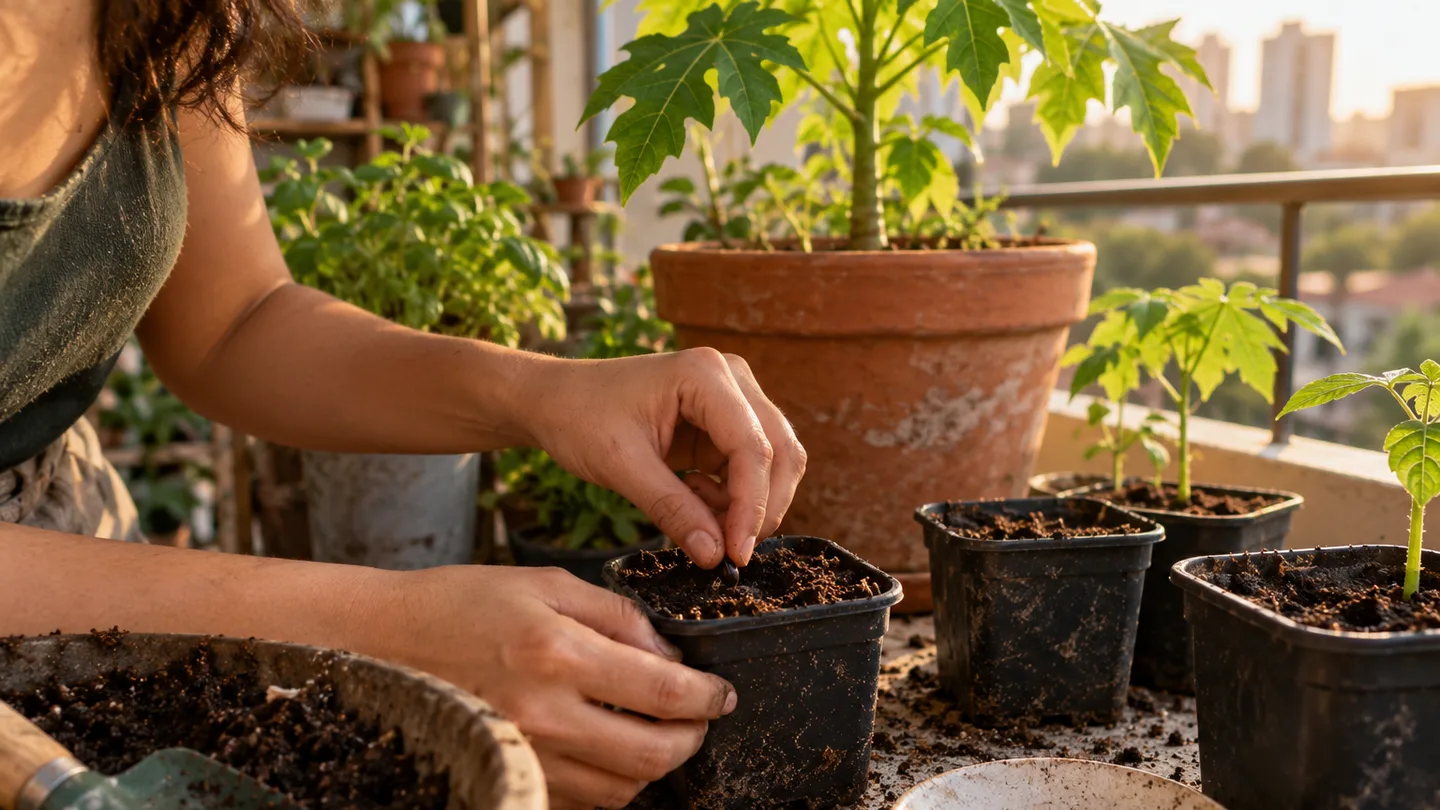
In suitable warmth, allow roughly two to four weeks for sprouts to appear. That window is a useful checkpoint, not a deadline. If nothing has emerged by the end of it, inspect the mix. If it’s cold, dry, or waterlogged, correct that first and give the seeds more time. If the mix has stayed warm and evenly moist for several weeks beyond the expected window and still looks unchanged, sow a fresh batch while keeping the original pot if it hasn’t turned sour or mouldy.
Once a seedling has opened its first true leaves—the leaves that follow the initial seed leaves—give it bright light and keep the root area warm. When roots begin filling the starter container, move it up a size. A very large pot at this stage makes moisture harder to judge: a small root system can’t use water across a large volume of mix quickly, so the lower portion may stay wet while the surface looks dry.
If you’re also planning herbs, growing basil in pots offers a useful contrast: basil can be kept in a much smaller container, while a vigorous papaya asks you to plan for a substantially larger root zone.
Pot-size ladder: move from a small starter cell to a 20–30 gallon (75–115 L) home
Think in stages. Start seeds in a cell or pot around 3–4 inches (8–10 cm) across. Move a growing seedling into a 1–3 gallon (4–11 L) container when its roots begin to hold the starter mix together. For a long-term home, 20–30 gallons (75–115 L) is a workable target for many container-grown papayas, with a pot roughly 18–24 inches (45–60 cm) across and similarly deep if the shape allows.
Here’s the quick volume check. The dimensions are approximate because tapered pots and manufacturer shapes vary; use the stated capacity when it’s available.
| Stage | Useful capacity | What it’s for |
|---|---|---|
| Seed starting | Cell to about 1 quart (1 L) | Germination and early roots |
| Young seedling | 1–3 gallons (4–11 L) | Growing on before the final move |
| Long-term container | 20–30 gallons (75–115 L) | More root room and a larger moisture buffer |
A small final pot gives you less soil to buffer a hot, windy afternoon. It also leaves less room for an increasingly large root system. The practical signs of a pot that’s too restrictive can include rapid drying, roots circling at the edges, and a plant that becomes difficult to keep evenly watered. A dwarf variety or a grower with limited space may decide that a smaller container is a fair compromise, but expect the plant’s size and fruiting prospects to be constrained too.
Choose a stable container with open drainage holes. A papaya can become tall above the rim, so a light, narrow pot may tip in wind even when the drainage is good. I prefer a broad, stable plastic container over a fabric grow bag for an exposed balcony: the solid sides are less prone to drying out in wind, and the base is easier to keep steady. That’s a practical preference, not a universal rule; a sheltered patio or a grower who can water frequently may make a different choice.
Skip the layer of gravel at the bottom. Water moves through fine potting mix differently from how it moves through a coarse gravel layer, and the boundary can leave saturated mix sitting above the stones rather than drawing water out of the root zone. Use a pot with holes and a free-draining potting mix instead. Keep the pot raised enough that the holes aren’t sealed against the floor, and empty any saucer after watering so the roots aren’t left standing in runoff. For other container dimensions and crops, the site’s guide to growing citrus in containers is another place to compare long-term pot choices.
The balcony must be warm and bright enough: 6+ hours of sun, with cold limits in view
Before buying a large pot, track direct sun on the exact spot where it will sit. Check it in the morning, around midday, and later in the afternoon on more than one clear day. A bright-looking balcony can still have a short direct-sun window if a neighbouring building blocks the midday hours. Move a small test pot if needed; light at the railing may differ from light against the wall.
For dependable fruiting, I’d look for about six or more hours of direct sun. A site with one or two useful hours might keep a papaya growing, especially in warm weather, but I wouldn’t choose it for a crop whose success depends on sustained vigorous growth and flowering. This is the uncomfortable but useful square-footage decision: if the balcony is dim, give the best-lit position to a crop better suited to it rather than assuming a bigger pot will make up the difference. The article 30 best vegetables to grow in buckets can help with that space-allocation decision.
Papaya is a warmth-loving plant. Cool nights can slow growth, and temperatures close to freezing can seriously damage or kill exposed growth. A container gives you some mobility: you can shift it against a warm wall, out of a cold wind, or under cover when a cold spell approaches. That helps with brief weather changes, but it doesn’t turn a dim, cold balcony into a tropical growing season. A tall plant can also catch wind above the railing, so account for shelter and tipping risk before settling on its permanent position.
In a warm climate, a sunny patio may suit papaya far better than an apartment windowsill. Indoors, a window that looks bright to you may still provide too little direct sun for reliable flowering and fruiting. If the plant has to spend much of the season in a cool room or in a shaded corner, plan for foliage first and treat fruit as a possibility rather than the expected return.
Keep the root ball evenly moist, not waterlogged, as the pot heats and dries
Don’t set a fixed watering calendar and assume it will hold. Check the mix: press a finger into the top 1–2 inches (2.5–5 cm), then judge the deeper root area and the pot’s weight. If the surface is dry but the pot still feels heavy and the mix below is damp, wait and check again. If the root zone is drying and the container feels noticeably lighter, water slowly until some drains from the holes. That check gives you a better starting point than watering because a certain day of the week has arrived.
How often you need to check changes with pot size, material, wind, heat, and how freely the mix drains. A smaller pot in direct sun may dry much faster than a large pot in a sheltered spot. Fabric sides can lose moisture across their surface; a saucer can hold runoff; a dense mix may stay wet longer than expected. Look at the soil and the drainage conditions together. A dry surface alone doesn’t prove the whole root ball needs water.
Drooping leaves can come from dry roots, but they can also appear when roots are stressed in saturated mix. Feel the soil before adding more water. If it’s wet and the pot is still heavy, check that the drainage holes are open and that runoff isn’t sitting in a saucer. If it’s dry and the pot is light, water thoroughly and recheck. When active growth is underway, feed according to the fertilizer label; don’t increase the dose just because the plant looks slow. Cold, shade, or a wet root zone may be the limiting factor instead of a lack of fertilizer.
On hot, windy days, I’d make a quick moisture check part of the balcony routine rather than trying to predict an exact interval. Watering advice for containers depends on the conditions at the pot, and a simple check beats an inflexible schedule when weather changes.
Flowers reveal the fruiting problem: male, female, and self-fertile papaya plants
When a papaya reaches flowering size, look closely before deciding that a lack of fruit means you’ve watered or fed it badly. Papaya flowering types vary. Some plants bear male flowers, some female flowers, and some have flowers with both functional reproductive parts. Seed-grown plants can be unpredictable, so a single seedling may not be able to set fruit by itself.
Male flowers commonly appear in clusters on longer stalks. Female flowers tend to sit closer to the main stem, with a visibly swollen base that is the developing ovary. Flowers with both functional parts can have features of each. These shapes are clues rather than a reason to diagnose a plant from one glance; inspect several flowers as they open, and keep the variety’s information if you have it.
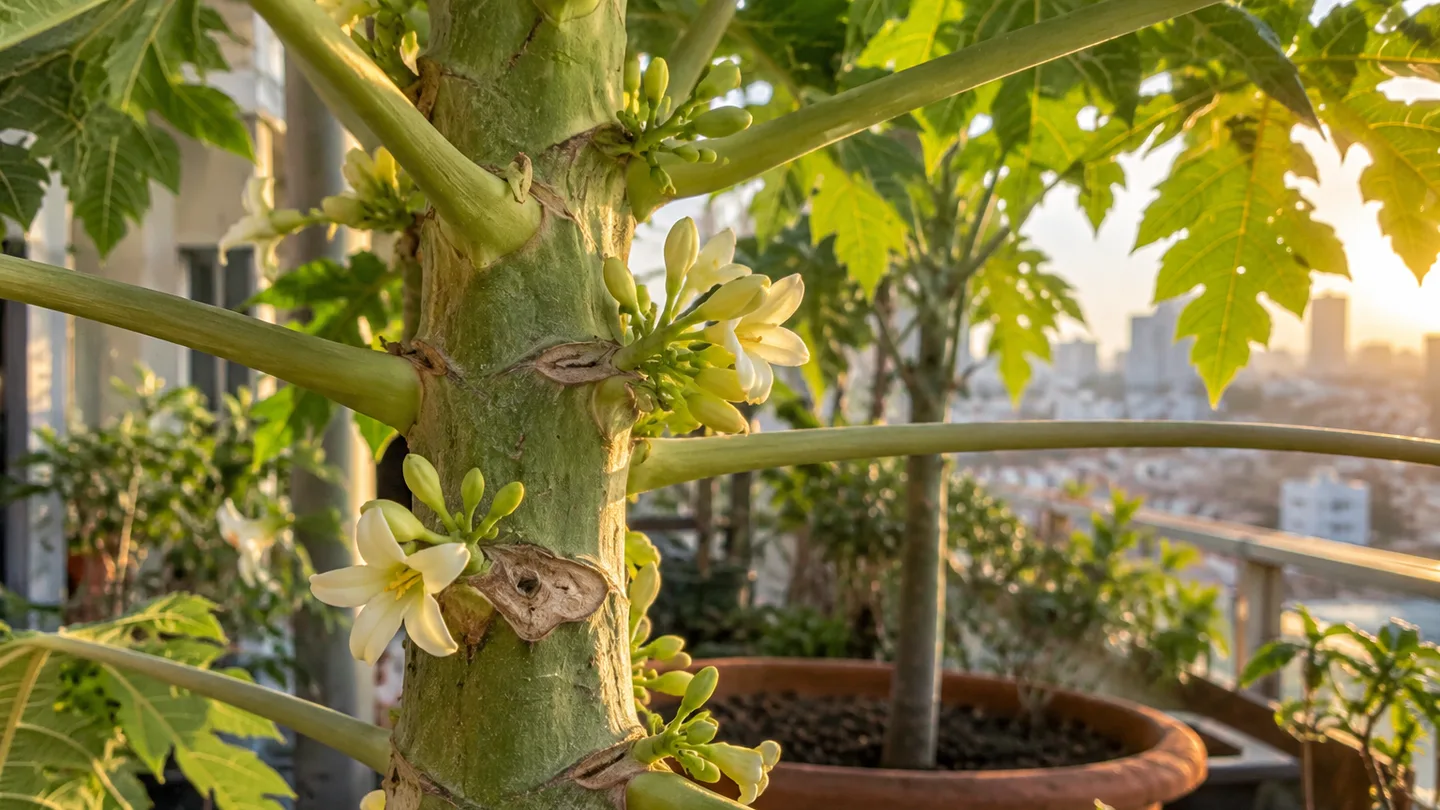
If you have flowers but no developing fruit, check what kind the plant is producing and whether it needs pollen from a different plant. A male plant can produce flowers without giving you fruit, while a female plant may need pollen from a compatible source. A self-fertile type can set fruit alone under suitable conditions, but that possibility doesn’t erase the need for adequate light, warmth, and healthy growth. If you have only one seedling and don’t know its type, waiting for flowers is how you learn what you’re working with.
That’s why I wouldn’t buy a large container on the assumption that one seed guarantees a fruiting papaya. The pot can support a bigger plant, but it can’t change its flowering type. If fruit is the main goal and balcony space is tight, a known self-fertile plant may be a more deliberate choice than a random seedling, provided you can source one and give it the required conditions. For a seed-grown plant, enjoy the growing stage while keeping the pollination question open until flowers appear.
For background reading, the University of Florida IFAS papaya guidance and cooperative-extension advice on container drainage are useful subjects to look up through their official sites. I’m not attaching a guessed page address here.
From seed to ripe fruit: plan for roughly 9–18 months, or longer in marginal conditions
Under warm, bright growing conditions, roughly 9–18 months from sowing to first ripe fruit is a reasonable planning range. Flowering and fruit development take place after the seedling has established and grown; cold spells, low light, a cramped root zone, or a plant that can’t fruit on its own can stretch that timeline or prevent a harvest altogether. It’s a way to plan the season, not a countdown you can rely on.
Once fruit forms, watch its colour and feel rather than picking by calendar. Depending on the variety, a ripe papaya changes from green toward yellow or orange and yields slightly to gentle pressure. Don’t squeeze hard enough to bruise it. If you need to bring fruit indoors before a cold spell, harvest only fruit that has begun to colour and let it finish ripening in a warm place; very immature fruit may not ripen well after picking.
A useful way to judge the project is to separate the milestones. Germination tells you the seed started. A sturdy, steadily growing plant tells you the pot and conditions are supporting vegetative growth. Flowers tell you the plant has reached the reproductive stage, while the flower type helps answer whether it can set fruit alone. A developing fruit is a later milestone again. If one stage stalls, go back to the condition that controls it instead of treating every delay as a watering problem.
My slightly contrarian view: don’t make the seedling’s first pot upgrade your biggest purchase. Keep it in a manageable intermediate container while you confirm that the balcony really gets a long sunny window and that you can shelter the plant from cold and wind. A large pot is useful once the site earns the commitment; before then, it’s heavy, awkward to move, and easy to overwater around a small root system.
This week, watch the intended spot for direct sun, check the lowest night temperatures you expect during the growing season, and test that the container drains freely. If those conditions look promising, buy a small seed-starting pot and sow several cleaned seeds. If the balcony gets only a brief shaft of sun, choose a more suitable crop first and save papaya for a warmer, brighter place.