Growing Cilantro in Pots: Why It Bolts and How to Fix It
In growing cilantro in pots, the number that decides the season is often the temperature around the plant. Once a container sits through sustained mid-20s°C (mid-70s°F) days, cilantro can switch from making leaves to making flowers; the practical fix is to cool the pot and sow another one before the first crop gives up.
Bolting isn’t simply a watering mistake, and a sharper pair of scissors won’t permanently reverse it. The best cure for bolting is usually not a harder prune but a second pot, started before the first one reaches its reproductive stage.
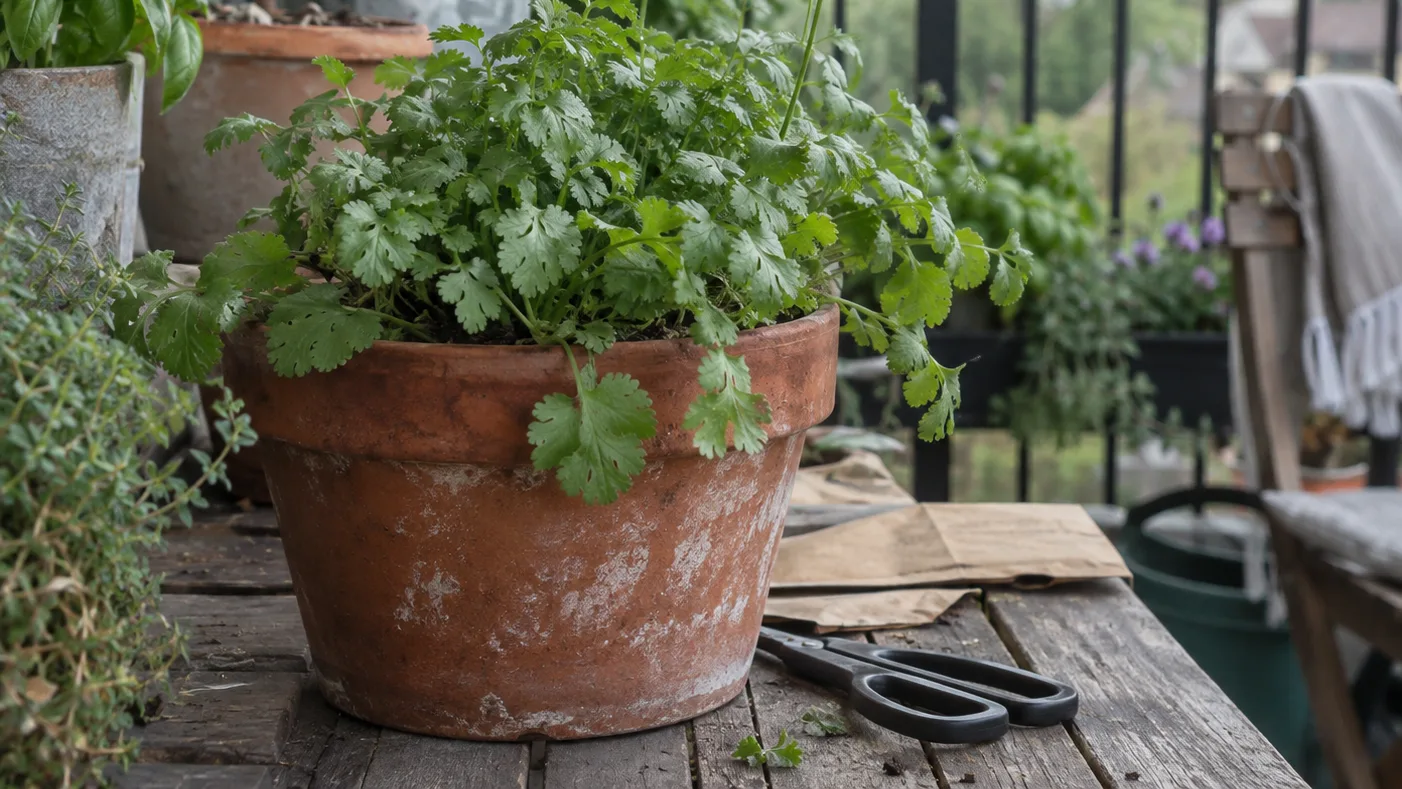
The short answer: cilantro bolts when heat turns a leafy crop into a seed crop
Cilantro is a cool-season annual. That means its useful leafy stage is favoured by cooler conditions, while the plant’s natural end point is a flower stalk followed by seed. Bolting is the visible change between those stages: the plant sends up a firm central stem, its newer leaves become smaller and more finely divided, and flower buds appear at the tips.
For a balcony pot, sustained temperatures in the mid-20s°C (mid-70s°F) are a practical warning zone rather than a universal on-off switch. Variety, day length, wind, moisture and the heat held by the container all alter the timing. Longer bright days can add to the pressure. So can a dry root ball or a black plastic pot sitting against a sun-warmed wall.
Pots make the problem easier to trigger because the roots have a small volume of mix to buffer heat and water loss. A plant in a deep outdoor bed may have cooler soil below it; a plant in a shallow container can have its entire root zone warm and dry within the same afternoon. That’s why cilantro may bolt even when you’ve watered it correctly for several days.
Early pinching can buy a little more leaf harvest if you remove the first small flower stalks. It cannot reliably return a plant with repeated stalks and feathery new growth to its former leafy shape.
Don’t confuse bolting with legginess. A leggy cilantro plant has long, thin stems and wide gaps between leaves, usually from weak light or crowding, but it has no developing flower buds. A bolting plant has an upright central stalk and a clear reproductive direction. Leaning can be corrected with better light; an advanced bolt is better treated as a harvest or seed crop.
Give the roots 20 cm of depth—and keep the pot cooler than the air
I use 20 cm (8 in) as the floor for cilantro, not the target. A smaller pot can germinate seeds, but it gives you less water and temperature margin once the leaves fill out. If this is your first season growing herbs in containers, spend money on mix volume and a sensible position before buying speciality feed.
| Container choice | Useful dimensions | Approximate mix | Best use |
|---|---|---|---|
| Minimum practical pot | 20 cm (8 in) deep, 20–25 cm (8–10 in) wide | 5–7 litres (1.3–1.8 gallons) | One compact sowing and an early leaf harvest |
| More forgiving pot | 25–30 cm (10–12 in) deep and wide | 12–18 litres (3–5 gallons) | Repeated leaf harvest, warmer balconies and less frequent checking |
Those are working volumes, not promises of exact capacity. A tall narrow pot and a squat round pot with the same width can hold different amounts, and I leave roughly two fingers of space below the rim so water doesn’t run straight over the edge. If you’re buying by pot diameter, check the container’s stated litre capacity where possible.
Use fresh potting mix rather than garden soil. Garden soil can settle into a dense mass in a pot, leaving less air around the roots and making the container harder to re-wet evenly. Choose a mix that drains freely but still holds some moisture. Put the pot on feet or a slatted surface if the drainage holes sit flush against a balcony floor.
Skip the gravel layer at the bottom. A perched water table is the saturated band that remains above a drainage boundary; adding stones beneath fine potting mix doesn’t make that band disappear. The useful drainage improvement comes from open holes, a suitable mix and a container that isn’t sitting in a permanently full saucer.
A thin surface mulch can slow evaporation. Use a light layer of fine bark, coir or composted material, keeping it away from the stems. Mulch helps the surface hold moisture; it won’t cool a root ball that is already hot through and through.
Aim for roughly 4–6 hours of direct light for leafy growth, with morning sun and afternoon shade in hot weather. The warm setup that suits growing basil in pots is not the setup I choose for cilantro. Small, dark containers absorb more heat and contain less water, so they can need attention sooner than a larger pale or glazed pot in the same position.
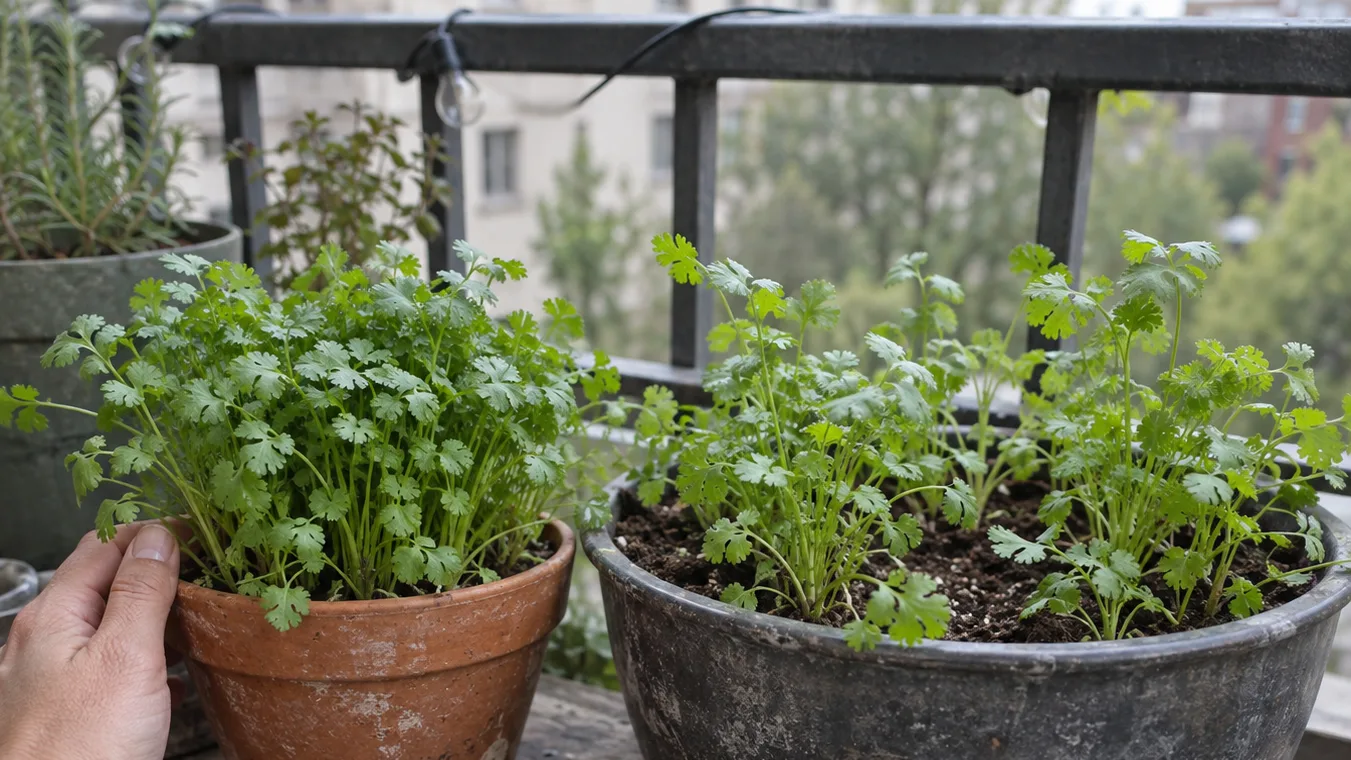
Sow shallow, sow often: the 14–21-day succession schedule
Cilantro is one of the herbs I direct-sow rather than transplant. Its young root system can be disturbed by lifting, and a successful transplant doesn’t buy much time if the weather is already pushing the plant toward flowers.
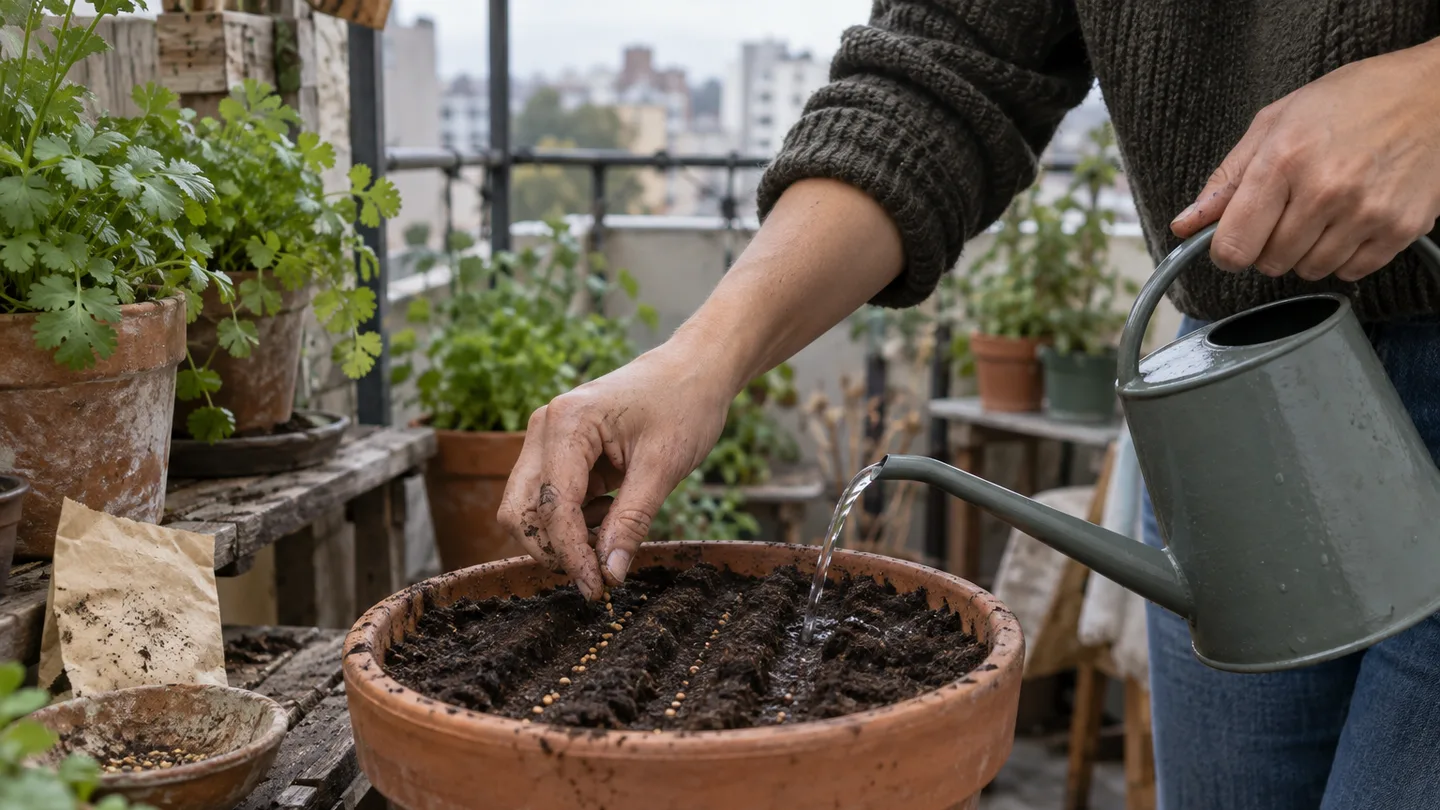
Start by wetting the potting mix thoroughly, then let excess water drain. Make shallow lines or small dimples about 0.5–1 cm (¼–½ in) deep. Place the seeds, cover them lightly, and firm the surface with your fingertips so the seeds have contact with the damp mix. Water with a gentle stream; a hard pour can expose them or wash them into one corner.
- Keep the surface evenly moist while the seeds are germinating, but don’t leave the container standing in water.
- Under suitable conditions, expect germination in roughly 7–14 days. Move the pot into good light as soon as the seedlings emerge.
- Thin crowded seedlings once they are easy to handle. For leaf harvest, leave about 2–5 cm (1–2 in) between plants. For larger plants or seed production, work toward up to 10 cm (4 in).
- Take the first small harvest at roughly 3–6 weeks, depending on variety, temperature and how densely you sowed.
A packet labelled slow-bolt can be useful because the selected plants may hold their leafy stage longer under warm conditions. Slow-bolt does not mean bolt-proof. Once the pot is hot, the days are long and the plant is mature, the label cannot cancel the crop’s life cycle.
For planting dates, I’d compare your local conditions with university extension guidance on cilantro and coriander sowing, cool-season growth and bolting. For variety wording, seed breeder or supplier guidance for slow-bolt cilantro varieties and days to harvest is useful as a cross-check, not a guarantee for a wind-exposed balcony.
My basic succession is simple: sow Pot A this weekend, Pot B 14–21 days later, then a third pot if the weather is already moving into the mid-20s°C (mid-70s°F). Put the youngest pot in the coolest suitable position. The oldest pot can be harvested for leaves or allowed to flower for coriander seed.
Read the plant before you blame the weather: a bolt-or-stress diagnosis
One droopy afternoon doesn’t tell you enough. Check the mix, look at the newest growth and inspect the plant again in the morning. Cilantro’s symptoms overlap, but the order of those checks usually separates a watering problem from a plant that has simply changed stages.
| What you see | Likely cause | Check | Response |
|---|---|---|---|
| Upright central stalk, smaller leaves and visible buds | True bolting | Look at the newest growth and the stem tip | Move it cooler, harvest early stalks and prepare a fresh sowing |
| Limp leaves with dry mix below the surface | Underwatering or wind-driven drying | Push a finger 2.5 cm (1 in) into the mix and lift the pot | Water slowly and thoroughly, then change the position if it dries rapidly |
| Afternoon wilt while the mix is still damp | Heat load around the leaves or roots | Check the pot’s side and its position near walls or paving | Move to morning sun and afternoon shade; don’t add water blindly |
| Thin, leaning stems without buds | Low light or overcrowding | Look for long gaps between leaves and crowded seedlings | Give stronger light and thin the plants |
| Yellowing leaves with a mix that stays wet | Poor drainage or excessive watering | Check drainage holes and whether the saucer stays full | Improve drainage and let the upper mix dry modestly between waterings |
On my balcony, I once blamed a wilting cilantro pot on thirst because the leaves folded during the afternoon. The mix was still damp, but the black plastic pot was sitting beside a heat-holding wall. Moving it to morning light and afternoon shade lifted the heat stress by evening; it did not undo the central flower stalk that continued to rise. That distinction is useful: the shade solved the immediate wilt, while the plant’s developmental stage still called for harvest or resowing.
Cilantro can bolt with adequate water because moisture is only one part of the signal. Temperature, bright day length and maturity can all point the plant toward seed production. Watering more often may prevent drought stress while doing nothing to stop a mature plant from flowering.
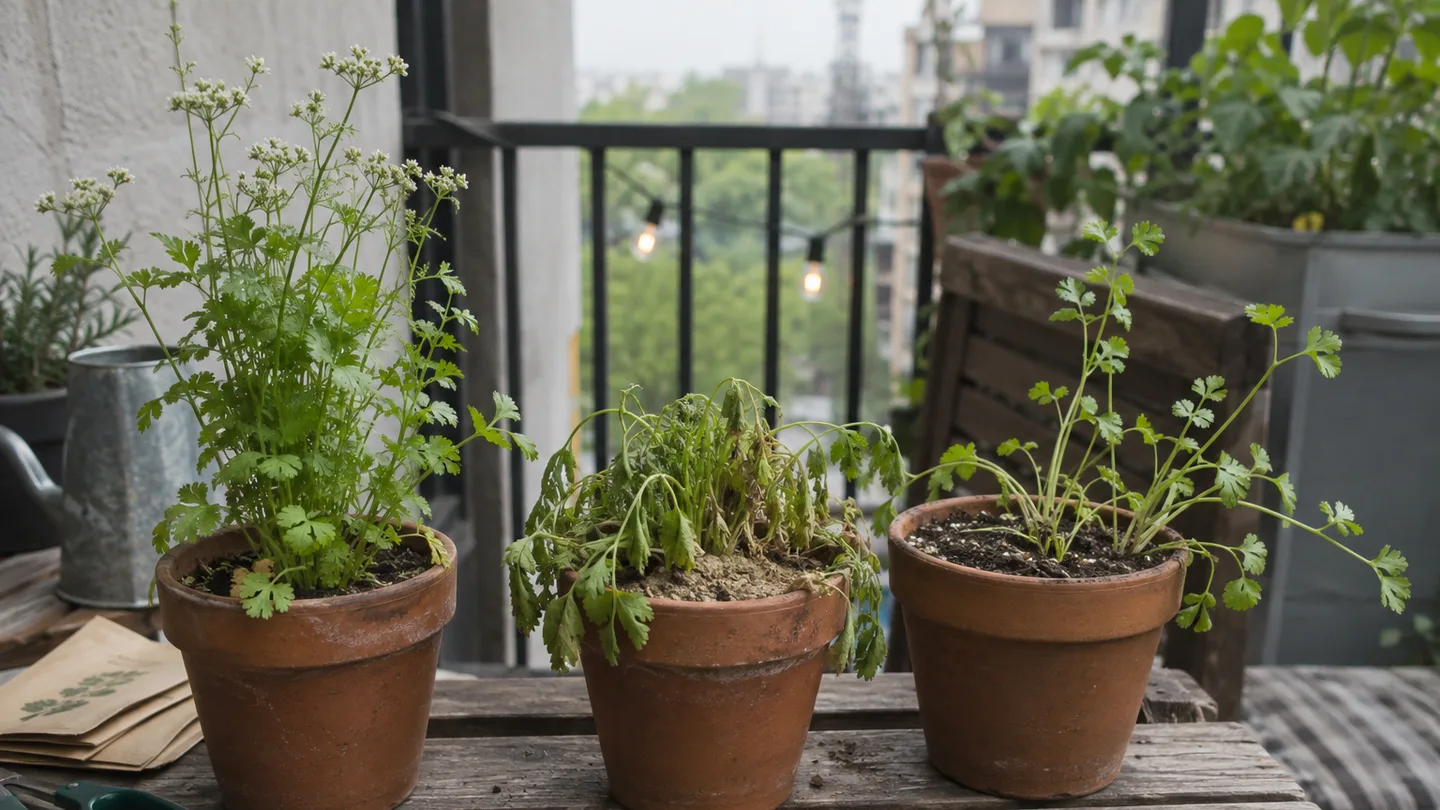
Once the stalk rises, use a three-step rescue—not a hard prune
When I see the first flower stalk, I use this order rather than cutting the plant down immediately. The sequence matters because a severe prune removes leaf area while the plant is already trying to finish its reproductive cycle.
- Move the pot first. Put it where it gets bright morning light and protection from strong afternoon heat. Avoid deep shade; cilantro still needs enough light to make useful leaves. If the pot is sitting against brick, metal or dark paving, create an air gap or move it to a cooler surface.
- Check moisture by the mix, not the calendar. When the top 2.5 cm (1 in) has dried, water slowly until a little drains from the bottom, then empty any saucer. In a small plastic pot in full sun and wind, I may check daily and sometimes water daily. A larger glazed pot in part shade may go two or three days between checks. Those are position-based examples, not a fixed schedule.
- Harvest or pinch only the earliest stalks. If the first flower stem is small and the plant still has broad leaves, remove it cleanly above a leafy junction and keep harvesting outer stems. If new stalks keep appearing or the new leaves are already feathery, stop trying to reset the plant and sow again.
Mulch helps the surface lose water more slowly, but it cannot cool an overheated root ball on its own. The opposite mistake is keeping the pot saturated in an attempt to hold the plant back. Constantly wet mix limits air around the roots and can produce yellow leaves, soft stems or a generally stalled plant that looks nothing like healthy leafy growth.
Feed only after checking the basics. If you used a new commercial potting mix with starter nutrients, I usually wait 3–4 weeks before considering a light feed. Pale leaves can justify a gentle, label-directed feed, but fertilizer won’t fix a hot pot, crowded seedlings or a plant already committed to flowering. If the leaves are green and the stalk is rising, temperature and plant age are the more useful clues.
That is my main judgment call with cilantro: I’d rather lose one mature pot to seed and have a new one coming than keep pruning an exhausted plant and expect supermarket-style bunches from it.
Harvest by the handful, or let one pot make coriander seed
A bolting plant still gives you two legitimate end points. For leaves, cut the outer stems when they are around 10–15 cm (4–6 in) tall. Leave the central growing point when possible, and avoid removing more than about one-third of the plant at a time. Smaller, repeated cuts give the remaining leaves a better chance to keep contributing before the plant finishes.
Bolting does not automatically make the leaves or flowers unusable. I’ll still use them if the plant is healthy and has not been treated with anything unsuitable for edible crops, but the flavour is often stronger and less delicate than that of young leafy cilantro. Flowers can bring a sharper, more herbal note to food, so I use them sparingly.
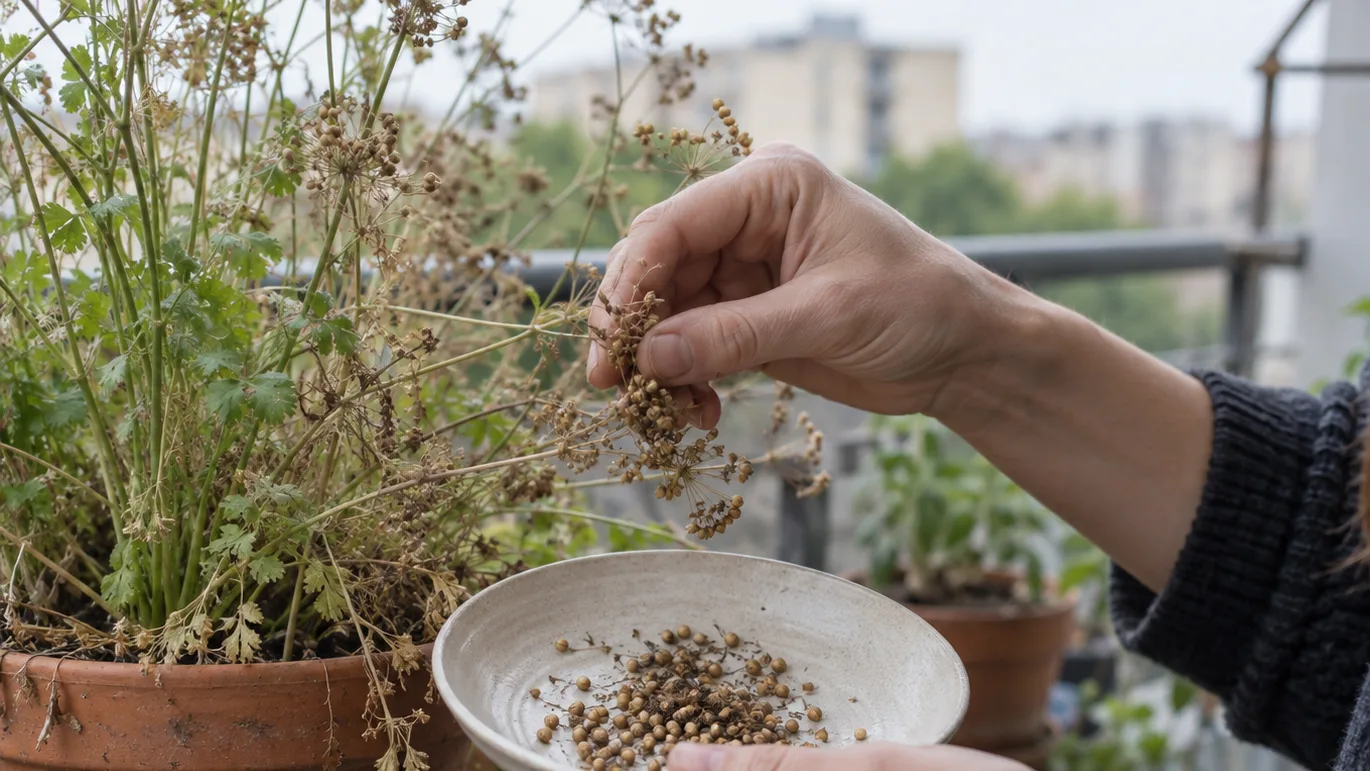
If you want coriander seed, stop fighting the stalk. The seed heads begin green and gradually dry toward tan or brown. Cut the heads into a paper bag when most of the seed feels developed but before the dry heads scatter, then hang or place the bag somewhere airy and dry. Once the heads are crisp, rub them gently between your fingers and separate the seed from the dry plant material.
One pot supplies modest handfuls over a limited season, not an endless supply of bunches. That is why succession sowing is more useful than trying to make one plant perform indefinitely. For a mixed edible balcony, the cool-weather rhythm is closer to growing lettuce in containers than to keeping a warm-season herb such as basil going all summer.
A two-pot balcony plan that keeps leaves coming
The simplest reliable plan is to stagger the plants instead of asking one pot to defeat its own biology.
- This weekend: fill Pot A, sow shallowly and label the date. Use at least 20 cm (8 in) of depth, with drainage holes and fresh potting mix.
- After 14–21 days: sow Pot B. Keep it in the coolest suitable position, especially if Pot A is already getting afternoon heat.
- If mid-20s°C (mid-70s°F) weather is arriving: add Pot C rather than waiting for Pot A to recover from stress. Let an older pot provide leaves or seed while the new one establishes.
For the first week, check three physical things rather than looking for a perfect growth chart: the mix should be evenly moist but not waterlogged, the seedlings should receive direct light, and the first pot should be thinned before its stems crowd each other. If Pot A has started an upright stalk, move it out of the hottest afternoon position today and sow Pot B anyway.
Before the weekend, buy the deeper pot, fresh mix and seed packet. On sowing day, write the date on the label. That small record will show you whether your balcony’s real problem is heat, spacing or an overly long gap between sowings—and it gives you a second crop before the first one runs out of leaves.