Growing Figs in Containers: Pot Size, Pruning and Winter Care
A fig doesn’t need a garden bed, but it does need a serious pot: I start a young tree in 20–30 litres (5–8 US gallons) and move an established fruiting tree towards 45–75 litres (12–20 US gallons). Put that root volume in roughly 6–8 hours of direct sun, prune with the crop in mind, and a balcony fig becomes manageable rather than merely ornamental.
That sizing answer is only half the job. You also need a common fig suited to your local winter, a mix that drains without drying instantly, and somewhere cool to keep the dormant pot if hard freezes are normal. I’d treat one container fig as a fresh-snacking tree rather than a preserving orchard, but it can still earn its floor space.
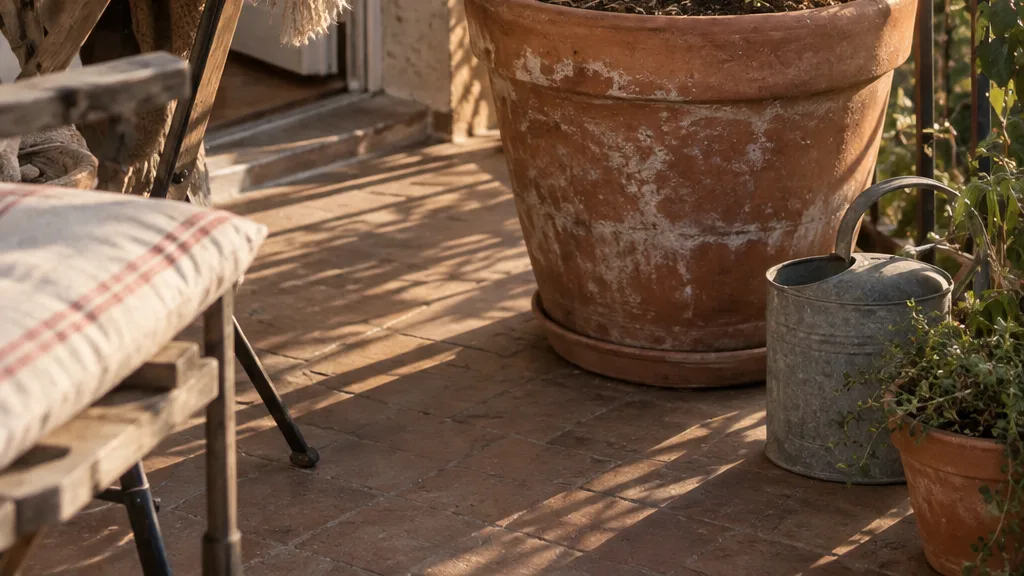
Start with a common fig, full sun and a tree that fits the balcony
For a container, I’d start with a common fig: the type generally able to set fruit without a separate pollinating tree. Check the label rather than assuming every fig has the same requirement. Some figs sold under other pollination groups need conditions that are difficult to provide on a balcony, so a locally recommended common fig is the simpler choice.
Sunlight is the other decision that cannot be repaired with better fertiliser. Aim for about 6–8 hours of direct sun, preferably on the brightest unobstructed side of the balcony. If your sunlight audit shows only one or two usable hours, I wouldn’t spend a large pot on a fig. The tree may stay alive, but ripening becomes much less dependable. Compare it with Easy fruits and vegetables to grow in pots instead and reserve the brightest position for the crop that needs it most.
Figs have two useful fruiting terms. A breba crop forms on older wood that grew the previous year. The main crop forms on new shoots produced during the current season. Breba fruit usually arrives earlier, while the main crop is the one most affected by a short or cool summer.
That distinction matters when choosing a cultivar. A tree that starts fruiting late may look perfectly healthy in spring and still leave you with hard, unripe figs when autumn arrives. On a short-season balcony, I’d favour a common fig that is known locally to ripen within the available summer, even if its mature size or fruit colour is less fashionable than another variety.
There is no prize for buying the largest tree in the garden centre. A smaller, well-rooted plant is easier to establish in the right pot, easier to shelter from wind, and less likely to arrive with a rootball that has already outgrown its container.
Pot volume in litres: 20-30 L to start, 45-75 L for an established fig
The pot-size question is best answered in litres, because a tall narrow pot and a wide shallow pot can look similar on a shop floor while holding very different amounts of mix. These are the working ranges I’d use for a container fig:
| Tree stage | Mix volume | Approximate pot size | What it suits |
|---|---|---|---|
| Starter | 20–30 L (5–8 US gal) | 30–40 cm (12–16 in) wide and 25–35 cm (10–14 in) deep | Young tree establishing its first canopy |
| Intermediate | 35–45 L (9–12 US gal) | 40–45 cm (16–18 in) wide and 30–40 cm (12–16 in) deep | Established rootball before the final pot |
| Established | 45–75 L (12–20 US gal) | 45–60 cm (18–24 in) wide and 35–45 cm (14–18 in) deep | Fruiting tree kept in a container long term |
The useful middle size is 35–45 litres (9–12 US gallons). It is the step I’d choose when a young fig has filled its starter pot but is not yet carrying the canopy you want to maintain. The litre-to-gallon conversions above are rounded US-gallon equivalents, and the centimetre-to-inch dimensions are rounded buying guides rather than exact capacity calculations. A tapered planter, thick-walled ceramic pot or pot with a raised internal base can hold less mix than its outside measurements suggest.
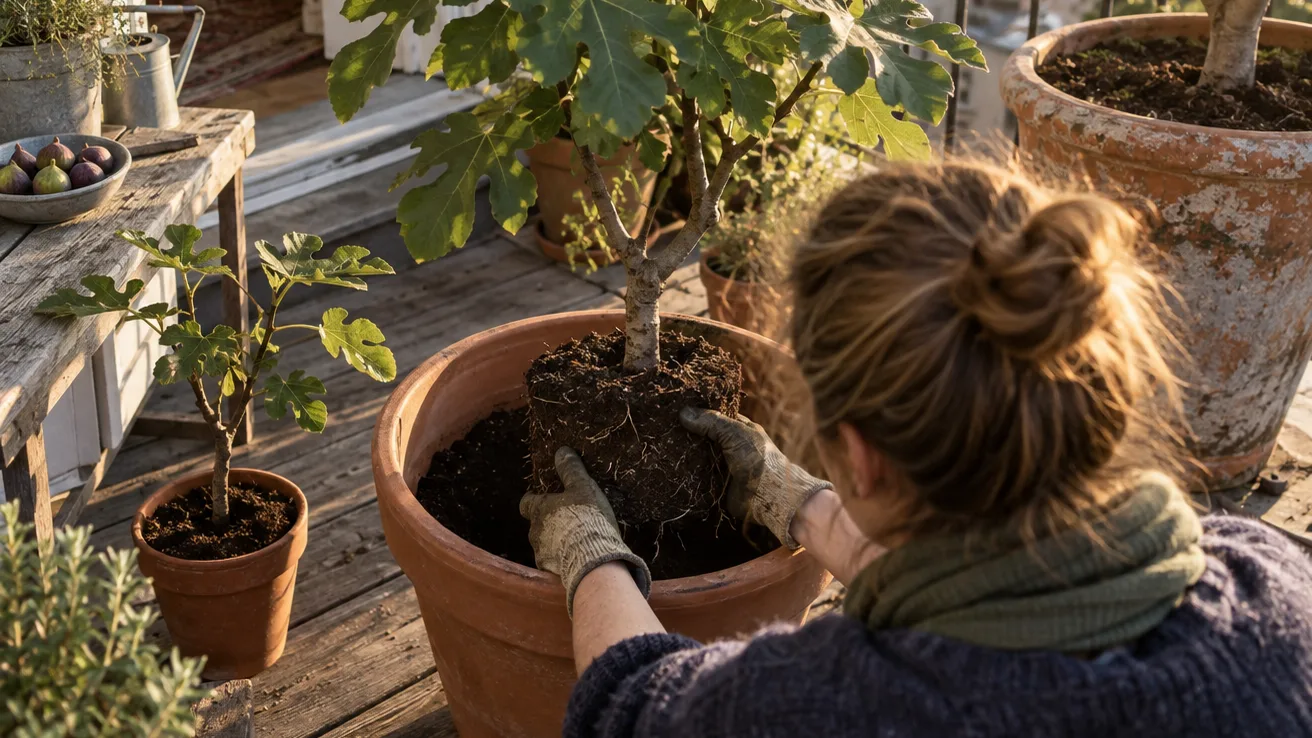
I prefer stepping up by roughly 5–10 cm (2–4 inches) in diameter rather than jumping from a small nursery pot straight into the biggest container available. The reason is not that figs dislike space. It is that a large ring of unused mix can stay wet after watering while the small rootball is still using very little of it. The roots then sit beside damp, poorly aerated mix instead of colonising the pot evenly.
Match the next pot to the rootball. If roots have reached the sides and bottom and the plant dries rapidly after watering, move up one size. If the rootball is still compact and the plant is growing steadily, more volume may add weight without adding useful growth.
Once the fig is established, 45–75 litres gives me a reasonable compromise between root stability, fruiting space and balcony practicality. Going bigger can reduce watering frequency, but it also makes the tree harder to move before winter and increases the load on an elevated space. A large fig in a light pot can also become a sail in strong wind.
Build a root zone that drains without making the pot too heavy
Use a free-draining container mix rather than garden soil. Garden soil settles in a pot, restricts air movement and can make the container much heavier when wet. A suitable mix should hold enough moisture for the fig to use between checks while allowing excess water to leave through open holes.
This is where the perched water table causes confusion. In plain language, it is a saturated layer that can remain at the bottom of a pot after watering, even though the drainage holes are unobstructed. The water is not refusing to leave because the holes are too small; the fine mix above the opening holds onto water until air and gravity can pull it away. Adding gravel to the bottom changes the boundary between materials but does not remove that wet layer. It also takes away space that could have held root-friendly mix.
Keep the drainage holes clear and fill the pot to about 3–5 cm (1–2 inches) below the rim. That empty band gives you room to water slowly without washing mix over the edge. If the pot sits on a balcony floor, raise it on pot feet, slats or another stable support so the holes are not sealed against the surface. Empty a saucer after the mix has drained rather than leaving the container standing in water.
Material changes the watering rhythm. Plastic is light and usually holds moisture longer. Unglazed terracotta loses water through its walls and can need closer checks in hot, windy weather. Glazed ceramic or concrete gives useful stability but may be too heavy for a balcony once the pot, wet mix and tree are combined. Check the building or landlord’s load guidance before committing to a very large, heavy planter.
Wind deserves a place in the planting plan. Put the pot where a wall or railing reduces the strongest gusts, but leave enough clearance for air to move around the leaves. Don’t copy the acidic mix used for growing blueberries in containers; figs need a different root-zone approach. The useful principle shared by both crops is not the pH recipe but the need to choose the mix for the plant rather than treating all container fruit as interchangeable.
Prune to a 3-5-stem framework without sacrificing every breba fig
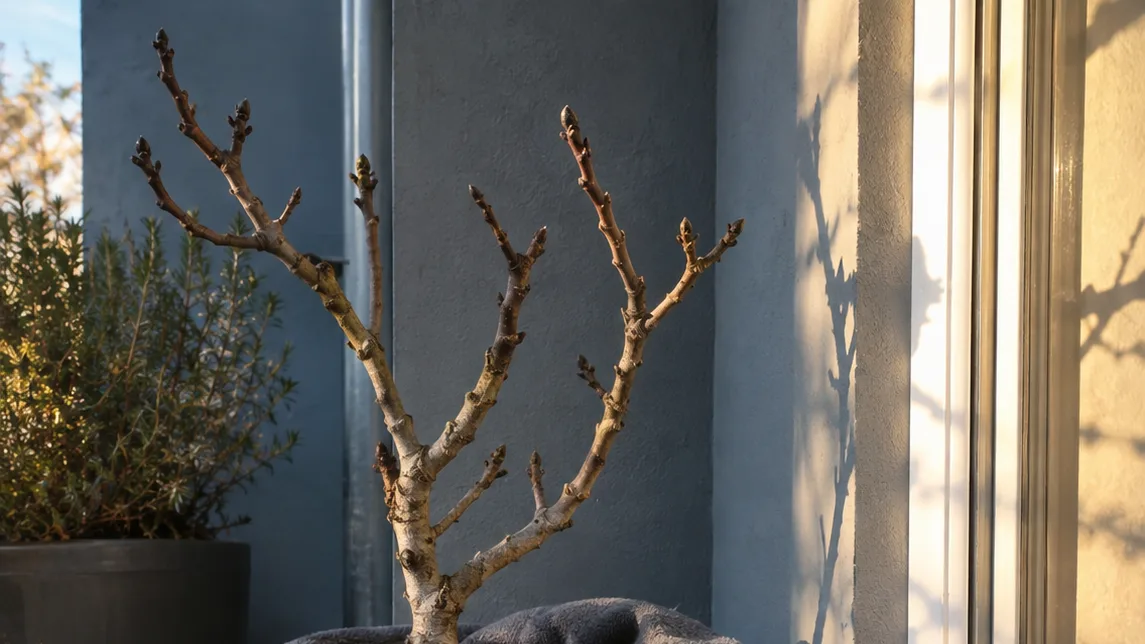
Prune a container fig while it is dormant and leafless, ideally in late winter before the buds begin pushing. Start by removing dead wood, shoots that cross through the centre, and weak growth that will never make a useful branch. Then keep 3–5 main stems spaced so light can reach the middle of the tree and the canopy stays within the balcony’s practical limits.
A bush-shaped framework is usually easier to manage than one tall trunk in a pot. It spreads the weight, gives you several replacement stems if one is damaged, and lets you lower the overall height with selective cuts. Once the framework is clear, shorten overcrowded or overlong side shoots by roughly one-quarter to one-third when they are pushing beyond the space you have. Cut back to a healthy outward-facing bud rather than leaving a long bare stub.
Pruning is not just a size-control exercise. It is a crop decision. Hard pruning produces a smaller canopy and fresh shoots, but it can remove the older wood carrying the breba crop. Lighter pruning preserves more possible early fruit but leaves a larger, more complicated tree. If the main crop is your priority, you can be firmer. If the breba crop matters, remove only what is dead, damaged, crossing or genuinely out of bounds.
In my own setup, I grew a ‘Brown Turkey’ fig in a 50-litre (13-gallon) plastic pot on a west-facing balcony. One late winter I shortened the older side shoots more aggressively than I needed to because I wanted the canopy inside the railing. The tree leafed out strongly, but the early figs that had been sitting on that older wood were gone. I had traded the breba crop for a tidier silhouette. Since then, I clear the structure first and make the shortening cuts only where the branch is actually crowding the balcony or the centre of the tree.
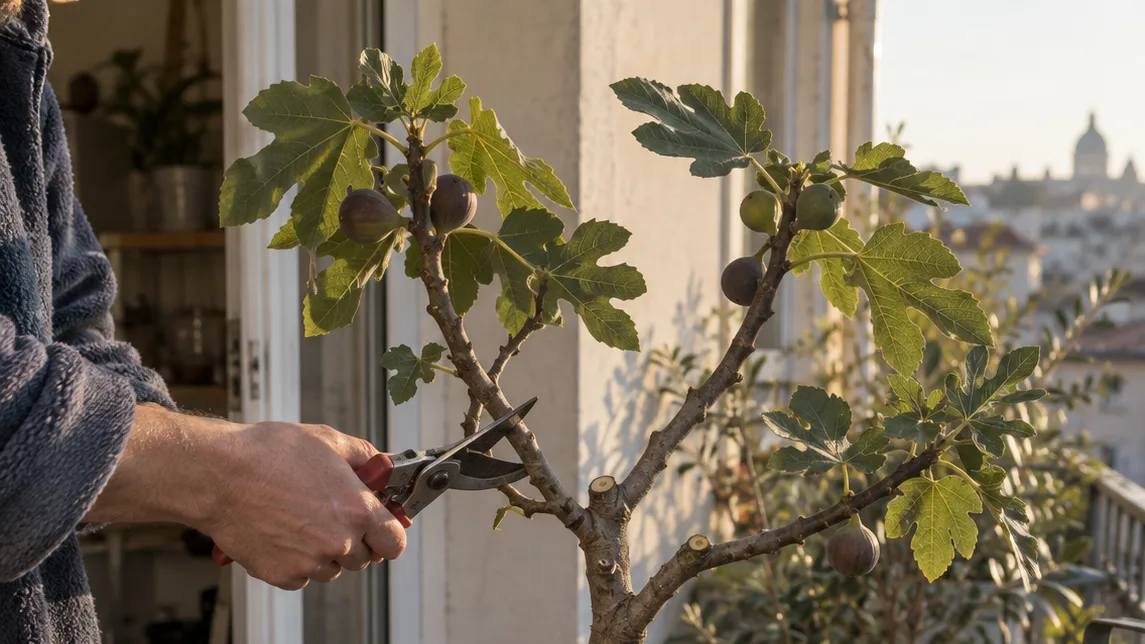
If you are unsure which wood is old enough to carry breba fruit, wait until the tree has leafed out slightly and mark the branches before cutting heavily. A tidy tree with fewer figs is not a failure if that was the deliberate trade-off; an aggressively pruned tree that was expected to carry an early crop is a planning mistake.
Summer checks: water when the top 2-3 cm dries, then feed before late summer
Don’t water a potted fig by weekday. Push a finger 2–3 cm (about 1 inch) into the mix, or use a wooden stick if the surface is crusted. If that upper layer is dry and the pot feels noticeably lighter, water. If the surface is dry but the mix below is cool and damp, wait.
When you do water, wet the whole rootball. Apply water slowly around the surface, pause, then apply enough for a little to drain from the holes. A quick splash that only wets the top encourages roots to remain shallow and can leave the centre of the rootball dry. In a small plastic pot in full sun and hot weather, the check may lead to watering close to daily. In a larger glazed pot in cooler part shade, the same check may lead to watering every few days. Wind can shorten either interval.
Pale leaves, leaf drop and soft fruit need diagnosis rather than an automatic dose of fertiliser. Pale leaves with a dry rootball can follow drought; pale leaves with persistently wet mix point me first towards poor aeration or damaged roots. Leaf drop can follow a dry spell, root stress or a sudden cold change. Soft fruit may simply be ripe, but fruit that softens early while the mix is swinging from dry to saturated deserves a check of the roots and watering pattern.
Feed while the fig is actively making leaves and fruit, following the label for an edible crop. I prefer modest feeding over trying to force a dark green canopy. High-nitrogen fertiliser late in the season can push leafy growth and soft shoots when the tree should be hardening for winter and finishing its fruit. Once the fruit is swelling and the season is turning, more leaf is not automatically more harvest.
Winter storage at 0-7°C: move the pot before a hard freeze
Winter care depends on whether your outdoor winter is merely cool or regularly freezing. In a mild climate, a dormant fig can often remain outside in a sheltered position, with the pot protected from the coldest wind and the root zone kept from sitting wet. In a colder climate, I move the container before a hard freeze rather than waiting to see whether the tree looks affected.
As nights approach 0°C (32°F), or when a hard freeze is forecast, move the pot into an unheated garage, shed, cool basement or similar space. Aim for roughly 0–7°C (32–45°F) while the tree is leafless and dormant. The space does not need to function like a warm living room. In fact, a warm room is usually the more awkward option: it can wake the fig before there is enough light for sturdy growth.
Water is the winter balancing act. Check the mix every 3–6 weeks. It should not be left as a dry, dusty block, but it also should not be kept wet on a schedule. If the mix is dry several centimetres down and the pot feels unusually light, add a small amount of water and let it drain. Avoid a full summer-style soaking unless the rootball has become genuinely dry.
Wet dormant roots have little demand for water, so saturated mix can lose air and encourage root damage. An exposed container also loses root protection faster than a fig planted in the ground because cold reaches the sides and base of the pot. Wrapping the container, grouping it against a wall, or moving it into shelter helps, but those measures do not make a frozen rootball safe in every climate.
I’d compare your plan with RHS guidance on growing figs in containers, then use local frost-date and winter minimum-temperature records to decide when the pot should move. Frost dates are a planning aid, not a guarantee; a forecasted hard freeze is the immediate reason to act.
Keep a dormant fig separate from the routine for growing citrus in containers. Citrus generally remains leafy and needs a bright place when brought indoors, while a fully dormant fig can rest in a much cooler, darker space. When the fig begins swelling buds, move it gradually towards brighter conditions and resume watering as growth becomes visible.
One year in the same pot: repotting, harvest signals and failure checks
Late winter: inspect before you prune
A fig can stay in the same container for several seasons, but I treat roughly 2–4 years as a planning window rather than a deadline. Repot when roots are densely circling the outside of the rootball, when roots are emerging from the drainage holes, or when water runs straight through and the plant dries again unusually quickly. One symptom on its own is not enough; check the rootball before moving to a larger pot.
Repot just before active growth if possible. Slide the tree out, inspect the roots, loosen the outer circling layer and refresh the mix. Move up one container step rather than placing a compact rootball into a dramatically larger pot. For a mature fig that has reached a practical final size, root pruning and replacing some of the old mix can be more sensible than continually increasing the pot’s footprint, but it is a job to do carefully while the tree is dormant.
Spring and summer: watch the new growth and fruit
After leaf-out, look for new shoots that are evenly distributed rather than all emerging from one crowded point. Keep the top layer of mix under observation as the canopy expands. Fruit set is encouraging, but it does not guarantee ripe fruit; sunlight, cultivar timing, water consistency and the length of the warm season still decide the finish.
Autumn: harvest by feel as well as colour
A ripe fig usually develops the variety’s mature colour, softens, droops from the stem and yields with a light lift rather than a hard tug. Check fruit daily once several figs begin to soften. A fig left too long can split, ferment or attract pests, especially after a wet spell. If fruit remains hard while leaves are beginning to fall, the tree may simply have run out of warm season; more fertiliser at that point will not turn it into an earlier cultivar.
Winter: make the next move before the weather makes it for you
One week before the next major change in weather, check five things:
- the top 2–3 cm of mix and whether the lower rootball is still damp;
- new growth that needs tying or a crossing shoot that should be marked for pruning;
- fruit colour, softness and any splitting;
- drainage holes that may be blocked by roots or a balcony surface; and
- the forecast for the next cold snap, not just the current afternoon temperature.
The most useful decision is usually the least dramatic one: give the fig enough pot volume to stay steady, but not so much that it becomes impossible to move. Before the weekend, measure the pot’s inside diameter and depth, count the hours of direct sun where it will sit, and choose the next container from the 20–30, 35–45 or 45–75 litre range. Then put one finger into the mix before you reach for the watering can.