Growing Herbs Indoors: How Much Light Does Each Herb Need?
Most kitchen herbs need about 6–8 hours of direct window sun for steady, leafy growth. If your window offers less, a grow light running roughly 12–16 hours is a useful starting schedule—but lamp intensity and distance matter, so those hours are not a one-for-one substitute for sunshine.
That’s the short answer to “how much light does each herb need?” The longer answer is to check the actual spot, then choose herbs to suit it. A plant may stay alive in dimmer light while making fewer leaves, growing slowly, or stretching toward the window. Surviving is not the same as producing enough for dinner.
By direct sun, I mean a visible patch of sunlight falling on the leaves. Bright indirect light is a bright room where the sunbeam doesn’t land on the plant. A compass direction can help you guess where to look, but it can’t tell you whether a building, tree, deep overhang, or the season is blocking the light.
The quick answer: most indoor herbs want 6–8 hours of direct sun
Use 6–8 hours as a practical target for sun-loving herbs such as basil, rosemary, thyme, oregano, and sage. Parsley, mint, cilantro, and chives can be more forgiving of a partly sunny position; I’d begin around 4–6 hours of direct sun for those and watch how the new growth responds. These are working ranges, not guaranteed minimums for every variety or every window.
Sunlight and grow-light hours need separate treatment. A sunbeam changes in strength through the day and with the season; an electric lamp’s output depends on its design, distance, and how much of the plant it covers. A timer setting can make your routine consistent, but it cannot tell you by itself whether the leaves are receiving enough light.
If a plant is alive but disappointing, look at its newest growth. Long spaces between leaves, thin stems leaning one way, and slow production of usable leaves are reasons to check light first. Then check watering and temperature before deciding that the plant or the room is hopeless.
Herb-by-herb light chart: basil, mint, parsley, rosemary and the rest
Here’s the quick comparison I’d use before buying. The sun column means hours of direct sun reaching the leaves, not total daylight in the room. The grow-light column is a starting schedule for a suitable lamp, not a promise that any bulb used for that long will do the job.
| Herb | Practical direct-sun target | Grow-light starting schedule |
|---|---|---|
| Basil | 6–8 hours | 12–16 hours |
| Cilantro | 4–6 hours | 12–14 hours |
| Dill | About 6 hours or more | 12–16 hours |
| Mint | 4–6 hours | 12–14 hours |
| Parsley | 4–6 hours | 12–14 hours |
| Chives | 4–6 hours | 12–14 hours |
| Rosemary | 6–8 hours | 12–16 hours |
| Sage | 6–8 hours | 12–16 hours |
| Thyme | 6–8 hours | 12–16 hours |
| Oregano | 6–8 hours | 12–16 hours |
I’d read the ranges as a sorting tool: the first group belongs in your brightest spot, while the more tolerant herbs are better candidates for a window that gets a shorter sunbeam. If you’re mainly interested in one crop, the guides to growing basil in pots, growing cilantro in pots, and growing chives in pots cover their other container needs too.
A lamp with broad, even coverage can serve a small group of herbs. But if its edge leaves one pot dim or the taller plant shades its neighbour, sharing a timer won’t fix the uneven light. Arrange the leaves, not just the pot rims, under the useful part of the lamp.
Audit your window before choosing herbs
Pick the spot where you might actually keep the pots. On a clear day, check it in roughly one-hour blocks and note when a direct sun patch reaches the leaves. Add those blocks at the end. Repeat the check on another day if you can, especially if passing cloud or a moving shadow made the first count hard to read.
For example, suppose sunlight hits your intended shelf from 9 to 11 in the morning and again from 2 to 4 in the afternoon. That’s about four hours of direct sun at that spot, even though the room stays bright for much longer. I’d put mint, parsley, cilantro, or chives on that shelf before assigning it to rosemary or basil. If the crop you want is basil, consider a grow light rather than expecting bright room light to make up the difference.
Window direction is a clue, not a measurement. Nearby buildings and trees can shade a window; an overhang can cut off part of the sky; and the sun’s path changes with the season. Even two windows facing the same direction can give a plant different conditions. The leaves are the part you’re growing, so measure light where they’ll sit.
If you want a second opinion on interpreting an indoor setup, look for university extension guidance on growing herbs indoors. For a windowsill or balcony, the useful principle is still the same: check the light that reaches the plant, not a label on the window.
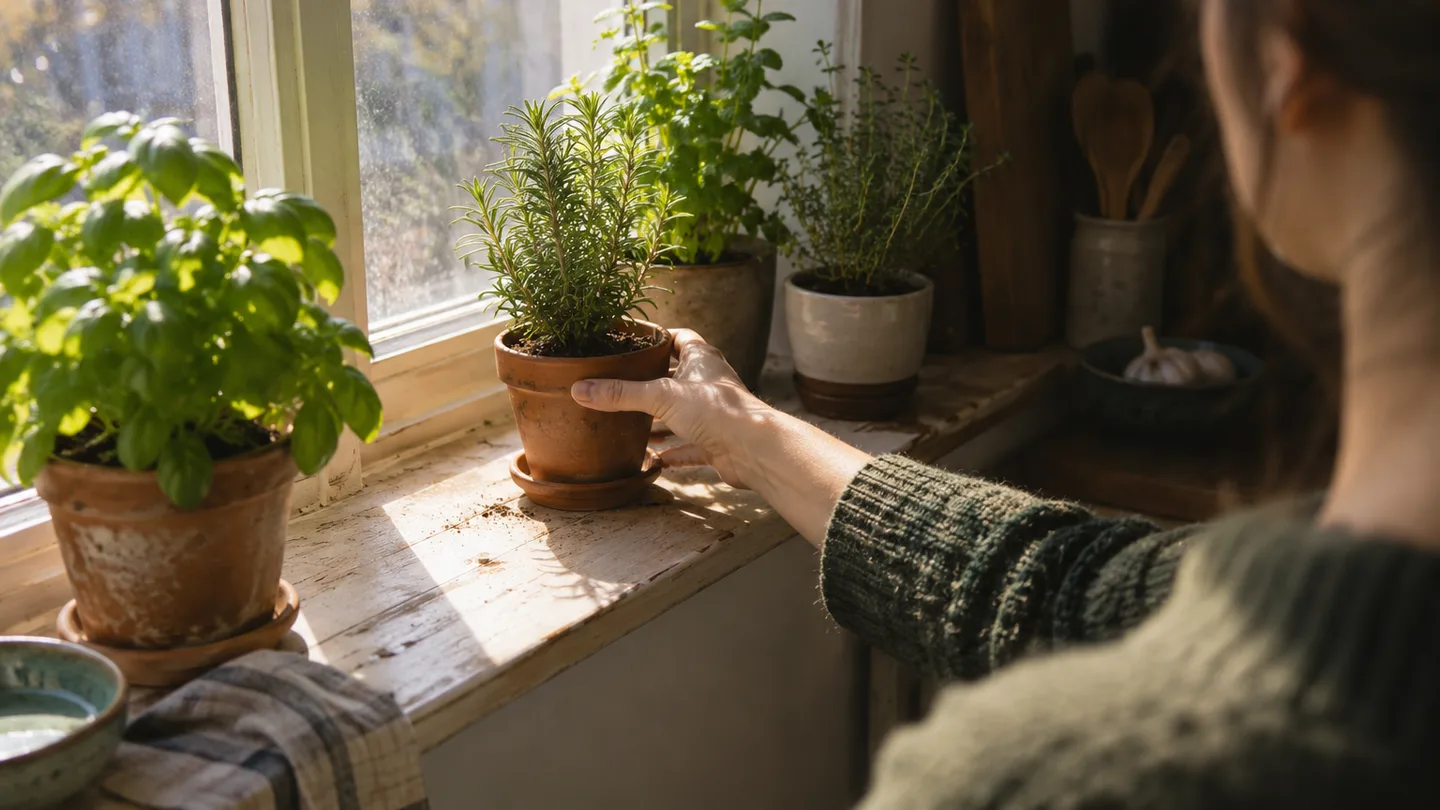
Bright-window herbs: basil, rosemary, thyme, oregano and sage
These are the herbs I’d reserve for your brightest window or a well-positioned grow light. Basil is grown for soft, plentiful leaves, so weak light can show up as thin stems, generous gaps between leaves, and a plant that leans hard toward the glass. Rosemary, thyme, oregano, and sage tend to grow more slowly and have firmer, woodier stems, but slow growth in a dim spot still means fewer sprigs to harvest.
In winter, a window that met the target in summer may not provide the same useful sun. If new growth becomes stretched or sparse, move the pot to a brighter position if one is available, or add a lamp. For basil, the separate guide to growing basil in pots can help you sort out light from pot and watering problems; a leggy stem alone doesn’t identify the cause.
One useful distinction: if the leaves look healthy but the plant barely adds new growth, light may be limiting growth without causing dramatic damage. If stems are stretching and leaning, the plant is also showing you the direction it’s reaching. I’d respond to that pattern before buying more fertilizer; feeding can’t replace the light needed to use it.
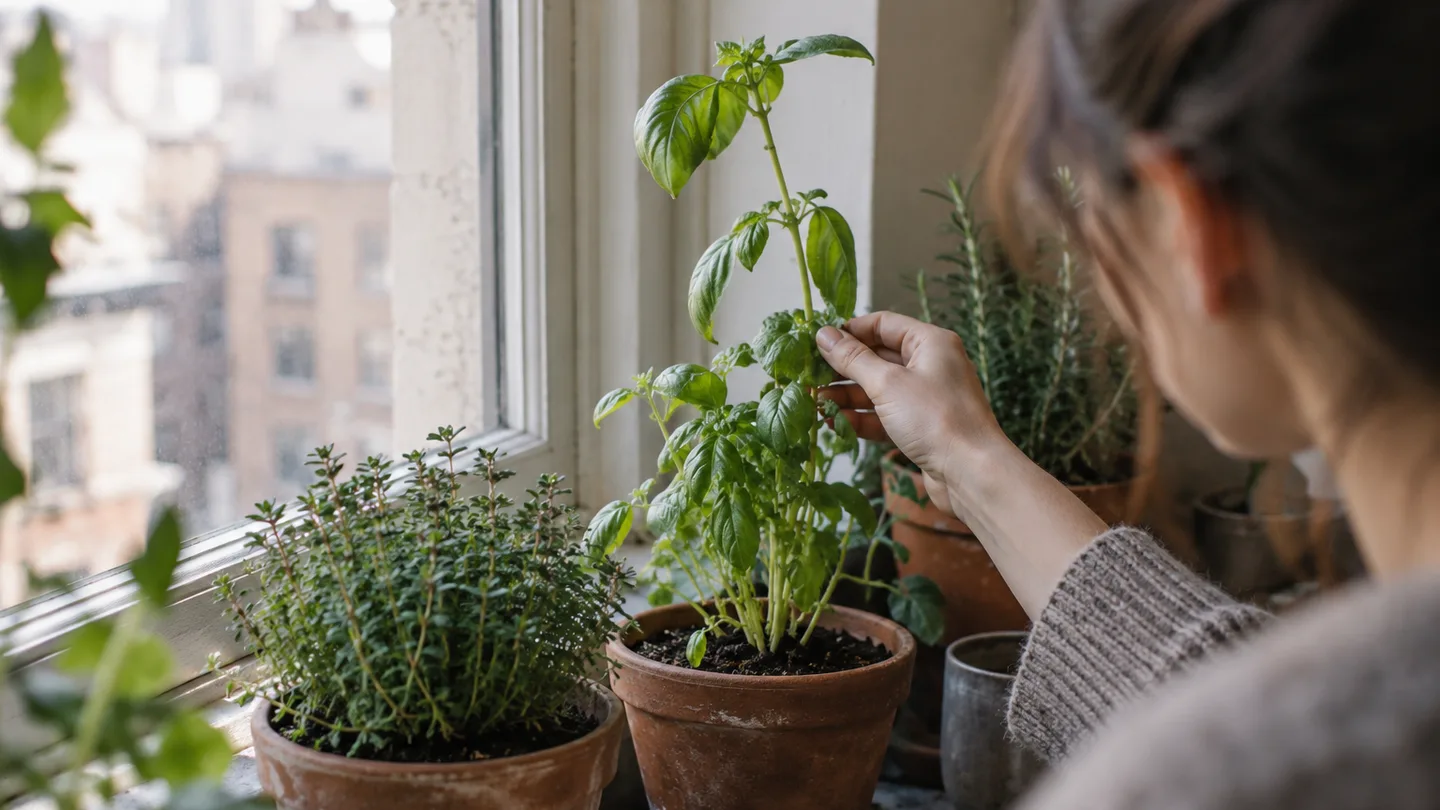
More forgiving, not shade-loving: mint, parsley, cilantro and chives
Mint, parsley, cilantro, and chives are reasonable first choices for a spot with a shorter stretch of direct sun. “More forgiving” doesn’t mean “happy in a dark corner.” Less light generally means slower replacement of leaves after harvest, so take smaller cuttings and give the plant time to grow back.
Cilantro needs a little extra context. If it starts to send up a tall flower stalk, light isn’t the only explanation: heat and the plant’s age also affect that change. Moving it to a dimmer spot may reduce the light it can use without undoing the other conditions. If cilantro is your priority, the guide to growing cilantro in pots is a useful companion for its container care.
Mint can be a forgiving choice for a partly sunny window, but keep an eye on how quickly its pot dries and how much room it has. Chives and parsley can also suit that position if their new growth stays reasonably sturdy. I’d rather grow a smaller, well-lit group than cram several pots into a window where the back row is shaded by the front.
Grow lights: set the timer first, then match the lamp to the leaves
For many indoor herb setups, 12–16 hours under a grow light is a sensible starting schedule. Set a timer and leave a daily dark period rather than running the lamp around the clock. Then judge the result by the growth and by how evenly the leaves are lit. Those hours don’t mean much if the lamp is weak, too far away, or aimed at only one side of the group.
Start with the fixture maker’s distance guidance. There isn’t one reliable number of inches for every lamp: light output and spread differ. If you hang a fixture much farther away than its instructions recommend, the leaves receive less of its output. If it sits too close, heat or excessive light may damage the foliage. Adjust in small steps, keeping the whole plant in view.
Think of light as a combination of duration, strength, and coverage. Adding more hours may help when a suitable lamp is slightly short on daily time; it won’t necessarily compensate for a poorly positioned or low-output bulb. A group of pots can share a lamp if its useful beam covers them and the leaves are at reasonably similar distances. Grouping herbs with similar needs makes that arrangement easier to manage.
White or full-spectrum fixtures are often easier to live with because you can see leaf color more naturally. A purple-looking lamp isn’t a requirement; what matters for this decision is whether the lamp provides useful light across the leaves. If you’re comparing setups, extension advice on plant light and grow-light schedules can give you another reference point, but follow your fixture’s directions for its own placement.
Can an ordinary household LED bulb grow herbs?
It may help if it provides enough light at the leaves and is positioned to cover them, but an ordinary room bulb can spread its output across the whole room instead of concentrating it on the plants. If stems keep stretching despite a long schedule, check the lamp’s suitability and placement rather than simply adding more hours.
Do I need a purple grow light, or will a white one work?
White light can work when the fixture gives the herbs suitable intensity and coverage. It also makes it easier to judge leaf color and spot changes. Choose by the lamp’s plant-growing guidance and the area it covers, not by color alone.
Can several herbs share one grow light?
Yes, if the lamp reaches all the leaves and the pots can sit at suitable distances. A short row of herbs with similar light needs is easier to light evenly than a mixed-height cluster in which one plant shades the rest.
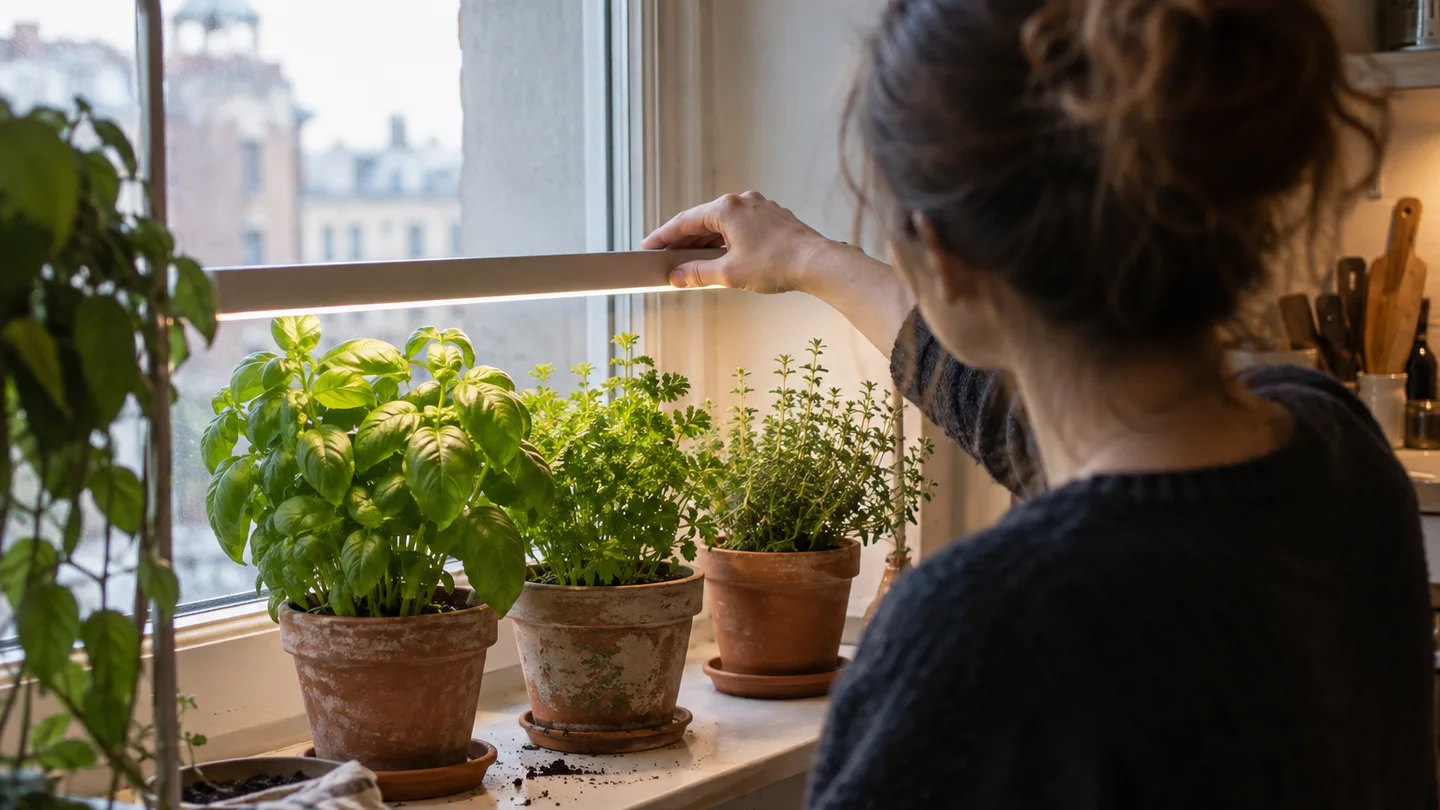
Leggy stems, pale leaves or scorched edges? Read the pattern before moving the pot
Long gaps between leaves, weak stems, or a plant leaning toward the window: check whether the spot gets enough direct sun or whether the lamp reaches the plant. If several nearby herbs stretch in the same direction, the position is worth examining. Turn the pot only after you’ve considered whether a brighter location or better lamp coverage is needed.
Pale or bleached patches on the leaves: consider whether a grow light is too close or whether the plant was moved suddenly into stronger sun. Move the lamp a little farther away or give the plant a less intense position, changing one thing at a time. A pale leaf can have other causes, so don’t diagnose light from color alone.
Dry, crisp edges: check both the light setup and the pot’s moisture. A small pot near a warm window or lamp may dry faster, while too much water can also leave a plant looking poorly. Feel the mix below the surface before changing your watering routine. For chives, the guide to growing chives in pots covers the wider container picture.
My rule is to change one factor, then watch the next new growth. If you move the pot, change the lamp, and alter watering all at once, you won’t know which adjustment helped—or whether one made things worse. Existing damaged leaves may not turn green again; look for healthier growth after the change instead.
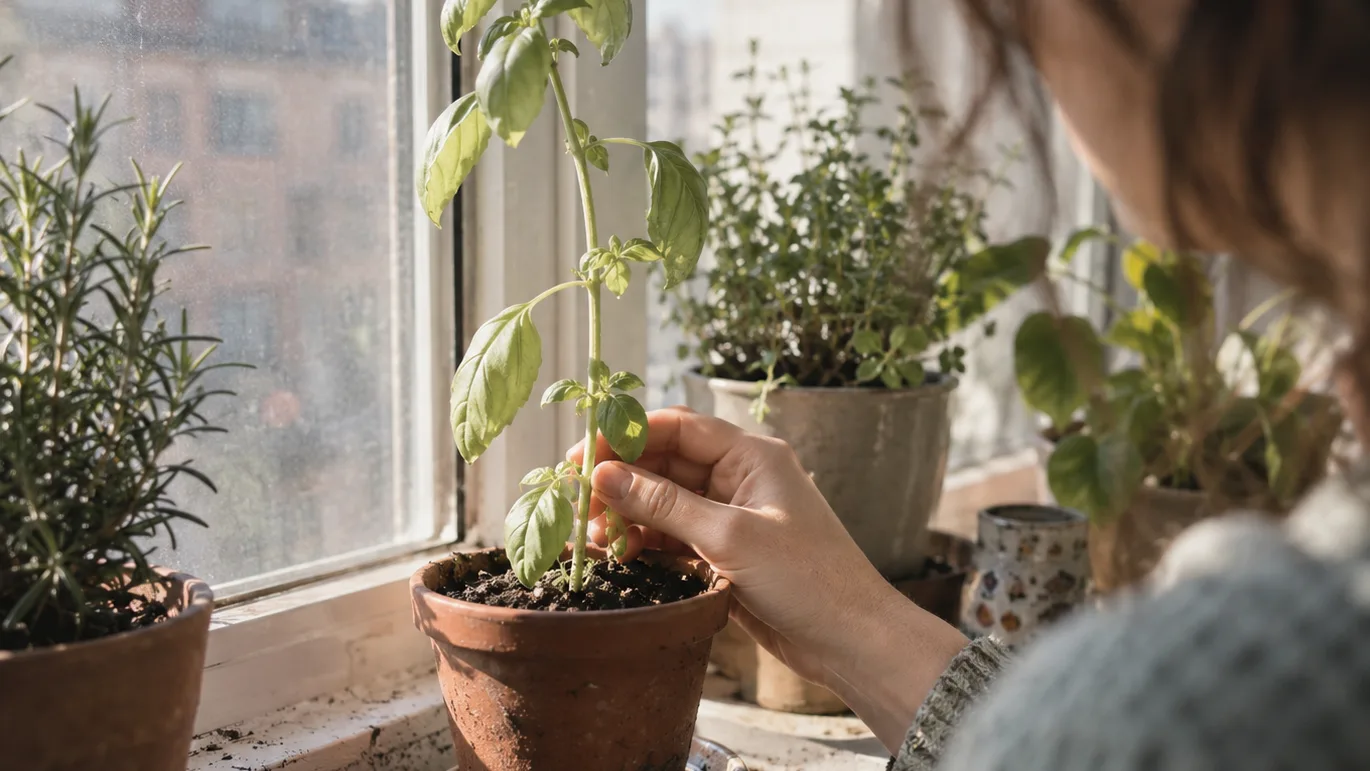
Recheck the light when seasons change or the plants move
A windowsill’s light is not a fixed feature of the room. The sun’s angle and the length of the day change, while trees may leaf out and cast a different shadow. Recheck the spot when the season shifts, or when a herb starts growing differently without an obvious change in care. A summer sun count shouldn’t be treated as a winter guarantee.
Moving pots closer to the glass may help if the window is the brightest available spot, but watch for hot glass, cold drafts, and leaves pressed against the pane. A grow light can fill in when the window falls short. Rotate pots now and then if growth is consistently reaching toward one side, but rotation won’t make a dim position bright.
If you move indoor herbs outside for warmer weather, don’t take them straight from a sheltered room into strong, direct sun for the whole day. Ease them into brighter conditions over several days, checking for bleached or scorched leaves. The move changes both light and exposure, so a gradual transition gives you a chance to notice a problem before the whole plant is stressed.
Choose a first windowsill lineup that fits the light you actually have
For a bright window with a long stretch of direct sun, start with basil and one or two of rosemary, thyme, oregano, or sage. In a partly sunny spot, try mint, parsley, cilantro, or chives, and accept that growth may be slower than it would be in a brighter position. If you want a mix of both groups in one room, put the brighter-window herbs closest to the strongest sun or give them their own lamp.
A very dim room is a poor bet for a productive herb windowsill without supplemental light. That doesn’t mean you need a complicated setup: a suitable lamp, a timer, and a position that reaches the leaves are a more useful starting point than buying many plants and hoping they adapt. Choose a small group first so you can see how your spot behaves.
Before you buy anything, put a note by the intended shelf and record when direct sun reaches it over a clear day. Add the hours, compare them with the chart, and decide which two or three herbs actually fit. That small check is your next step.
Frequently Asked Questions
Can an ordinary household LED bulb grow herbs?
It may help if it is bright enough, positioned to light the leaves, and used for a suitable daily schedule, but ordinary room lighting is often too weak or too spread out; a purpose-made grow light makes coverage and intensity easier to assess.
Do I need a purple grow light, or will a white one work?
Both can support herb growth when intensity and coverage are suitable; white or full-spectrum light is often easier to live with because leaf color and plant symptoms are easier to see.
Can several different herbs share one grow light?
Yes, if the lamp covers the whole group and the pots can be arranged at suitable distances; grouping herbs with similar light needs makes adjustments simpler.