Leaf Miners on Container Plants: Identify, Treat and Prevent
A winding pale line on a basil or chard leaf is not a stain you can wash off: it is often a leaf-miner larva eating between the two leaf surfaces. The useful treatment is not a stronger spray aimed at the outside; first confirm the tunnel, then remove active mines and match any control to the insect’s life stage. On a balcony, that order matters because every leaf you cut is part of a small, finite canopy.
Here’s how I separate genuine leaf miners from lookalike damage, what I do in the first day, and how I decide whether an edible leaf should be cut, kept or discarded.
The tunnel is the clue: what leaf-miner damage actually looks like
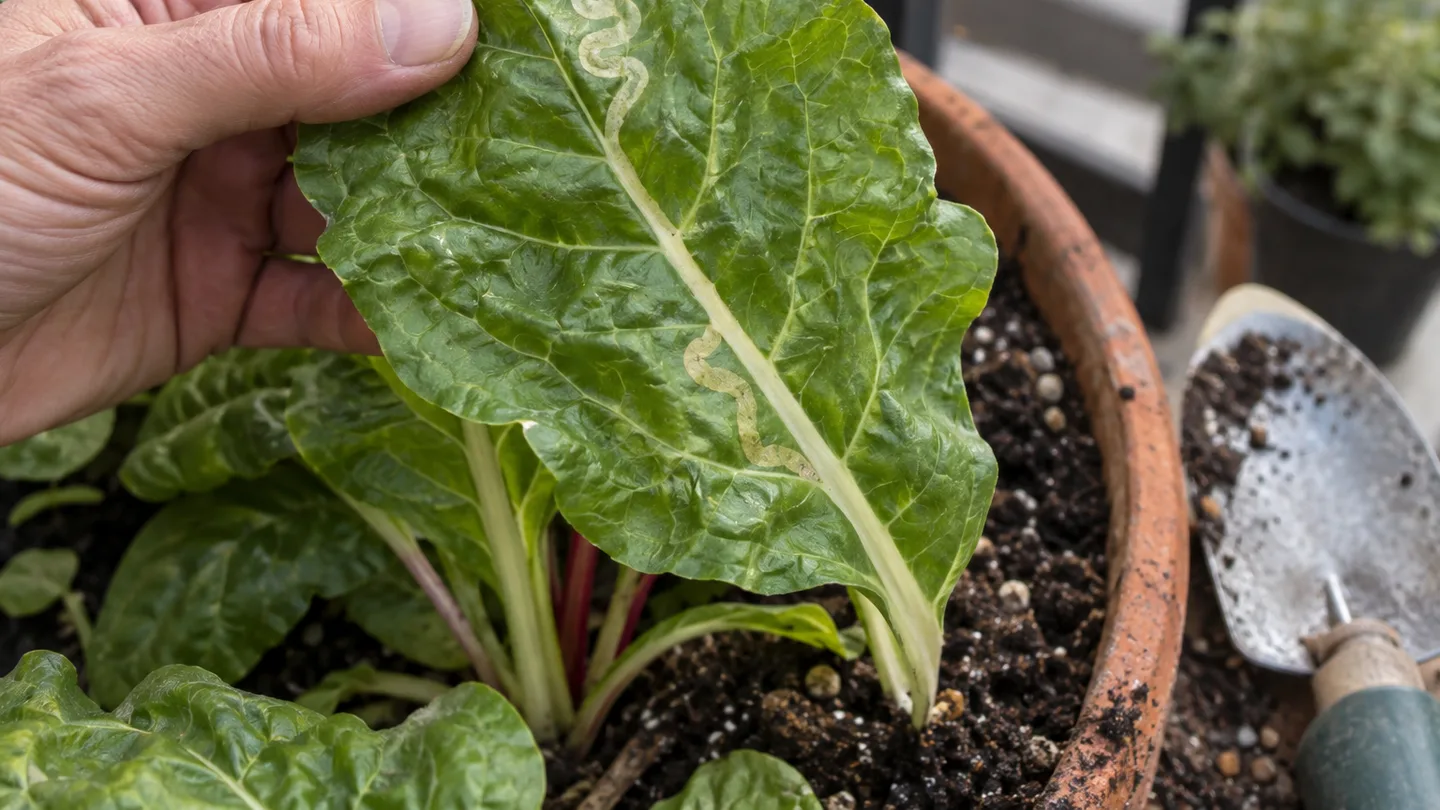
Leaf miner describes the larval stage of an insect that feeds inside a leaf rather than chewing from the outside. The larva lives between the upper and lower leaf surfaces, leaving a pale trail as it consumes the softer tissue. That enclosed feeding habit is the reason a leaf can look marked without having obvious holes.
The usual sign is a pale serpentine mine: a winding line that may cross itself, widen gradually or end in a cloudy blotch. Fresh damage can show a dark thread of frass, which is the insect’s waste, along part of the tunnel. At the freshest end, look for a tiny translucent or cream-coloured larva. It may be only a few millimetres long and easy to miss unless you hold the leaf against the light.
I use that light test before reaching for anything else. If the path is enclosed inside the leaf, the damage is probably a true mine. If the mark sits on the surface and rubs, flakes or changes when the leaf is turned, I start considering a different pest or a non-pest problem.
Old mines will not close up as the plant recovers. The damaged tissue remains visible, sometimes becoming tan or papery. That means a clean-looking leaf is not the immediate goal. I judge whether treatment is working by the absence of new trails on new or recently expanded leaves.
Three lookalikes that leave a different kind of mark
Before treating leaf miners, compare the damaged leaf with the rest of the plant. The distribution of the symptom often tells me as much as the mark itself.
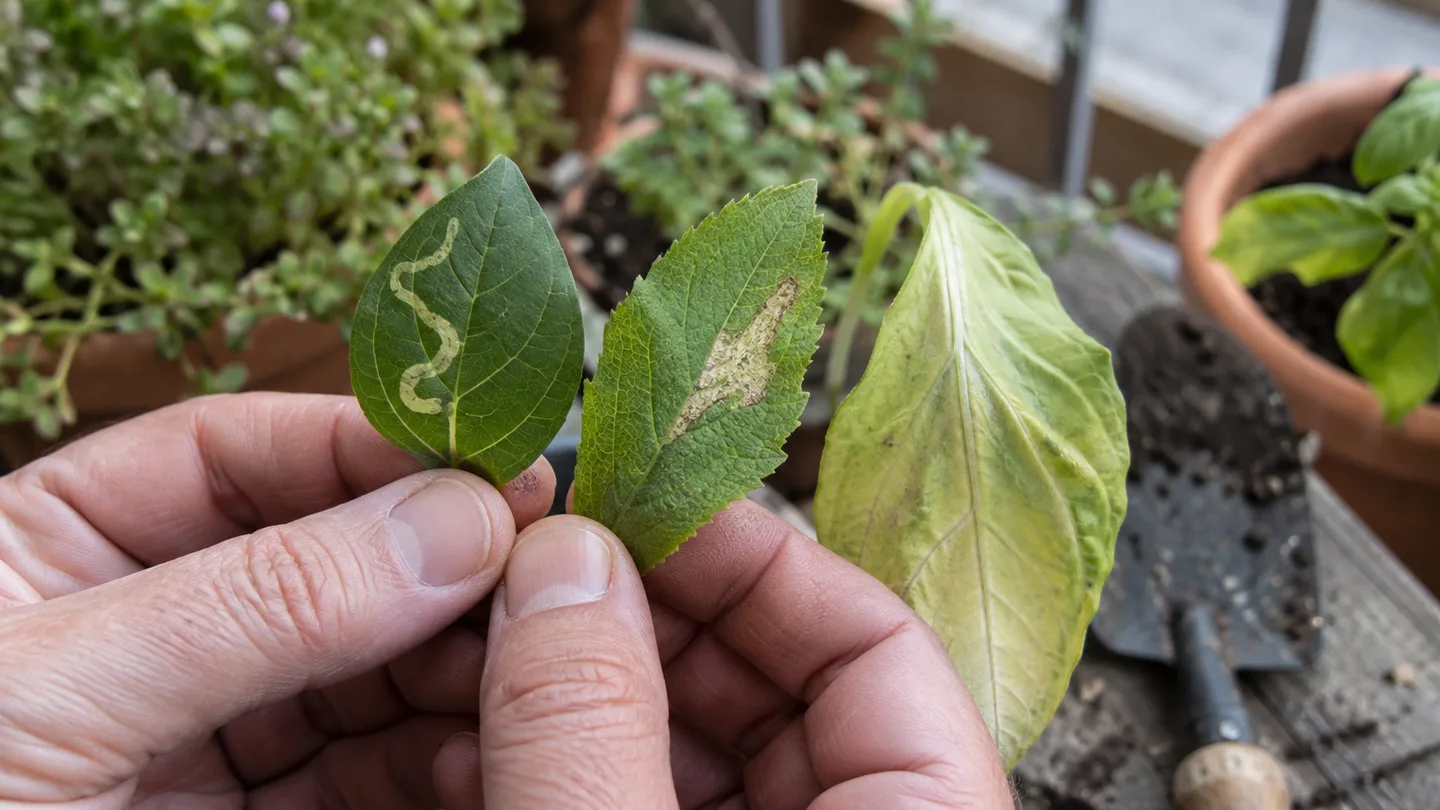
- Sunscald or heat damage: exposed areas may bleach, bronze or turn tan, especially where a leaf faces strong reflected light. The tissue is discoloured, but there is no enclosed winding channel and no larva at a fresh end.
- Thrips and other surface-feeding pests: the damage tends to look silvery, scraped or stippled on the surface. Tiny dark specks may be present. Check both sides of the leaf, but do not expect to find a continuous tunnel inside it. For a broader comparison of fine stippling and surface pests, see spider mites on plants.
- Nutrient or root stress: the symptom usually follows a broader pattern across several leaves or across much of the plant. Yellowing, pale new growth or general loss of vigour does not normally form a single winding track with a defined leading edge.
A genuine mine is enclosed in leaf tissue. Many lookalikes remain surface damage, while nutrient stress often follows the plant’s age, watering history or root condition. One mined leaf beside otherwise healthy foliage points me toward a local insect injury; a whole pot changing colour at once makes me inspect roots, watering and light before blaming leaf miners.
The first 24 hours: contain a small infestation without stripping the plant
When I find a fresh mine on a container plant, I do not start by pruning everything that looks imperfect. I work from the pot outward so I do not spread infested material around the balcony.
- Move the pot away from its neighbours. Keep it separate from herbs, leafy greens and young plants while you inspect it. This is containment, not a claim that a balcony can be made pest-proof.
- Inspect nearby pots. Look closely at new leaves, the undersides of foliage and plants with similar soft growth. Adult leaf-miner flies can move between nearby hosts, so the surrounding pots may be part of the same problem.
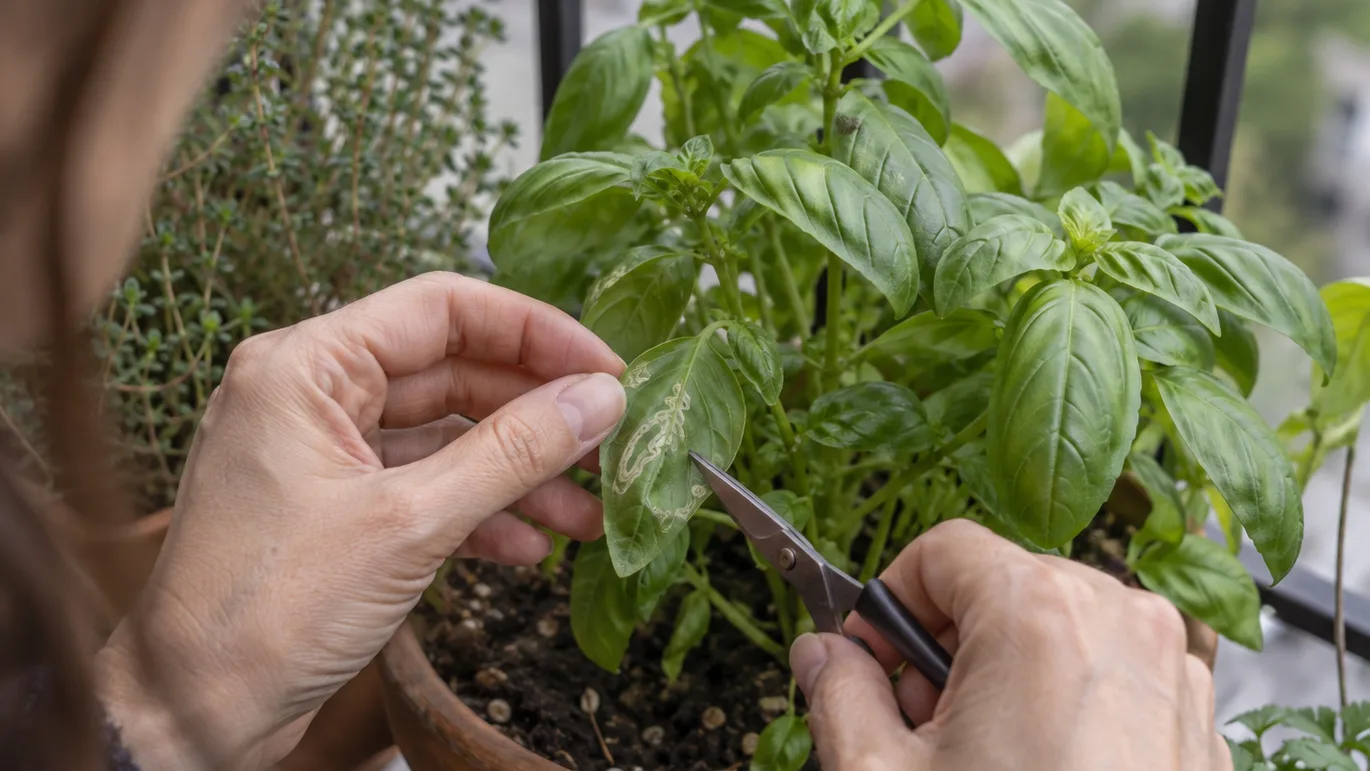
- Remove leaves with active mines. Prioritise leaves where the trail is still pale and advancing, or where you can see the larva near the newest end. Put the material straight into a bag or closed container before carrying it across the balcony.
- Clean the tools. Wipe pruning scissors after the job, especially if you move from a suspect plant to a healthy one. Wash your hands before handling edible leaves.
Selective removal is safer than stripping the whole canopy. Imagine a 20-centimetre (8-inch) basil pot with ten useful leaves and one active mine. Removing that one leaf costs a noticeable portion of the plant’s working foliage, but removing all ten leaves to be certain leaves the plant with no reserve for recovery. If almost every leaf is mined, preserve the healthiest growth and move to a control suited to the insect’s life stage rather than repeating indiscriminate pruning.
The practical rule is simple: remove active mines, not every old mark. A leaf with one old, dry trail may still be contributing more to the plant than a bare stem would.
Why a contact spray can miss the insect completely
The leaf surface is not the same place as the leaf-miner larva. Eggs may be laid on or near the surface, but once the larva enters the leaf it feeds between the layers. A spray that works by touching exposed insects may never reach the damaging stage inside the tunnel.
This explains two common disappointments. First, a spray cannot repair a mine that already exists. The missing tissue is gone. Second, new trails may appear after spraying because eggs, larvae or adult flies were still present elsewhere in the plant group. A new mine after treatment does not automatically prove that the product did nothing; it may mean the treatment did not reach that life stage or that another adult arrived afterward.
For edible herbs, vegetables and fruit, the label is part of the treatment. Check that the crop is listed, that the application method matches the instructions, that any repeat interval is followed and that the pre-harvest interval is clear. Do not use an ornamental-only product on food crops simply because the active ingredient sounds familiar. A home-made mixture does not solve the crop-label problem.
I would also avoid escalating because an old mine still looks ugly. The useful question is whether fresh damage continues. If the plant is making clean new leaves, repeated applications aimed at cosmetic perfection may cause more stress than the remaining trail.
Match the control to the life stage: leaves, traps, beneficials and labels
Instead of asking for one magic leaf miner spray, match the tool to what it can actually reach.
- Active larvae inside leaves: removing mined leaves is the most direct low-risk option on a small container plant. Some products are designed to move into leaf tissue, but whether one is legal and suitable depends on the crop, pest, formulation and local label. I would not improvise here.
- Adult flies: yellow sticky cards near the canopy can show whether adult activity is continuing. They are useful as a monitoring tool and may catch some adults, but they do not remove larvae already inside leaves. Place them where you can inspect them without brushing against the plant.
- Natural enemies: parasitoid wasps can attack leaf-miner larvae. If you see signs of beneficial activity, broad-spectrum spraying can work against your own control effort as well as the pest. Biological control is more realistic in a greenhouse or screened growing space where conditions and releases can be managed; on an open balcony, beneficial insects may arrive unpredictably.
Pupation also varies among leaf-miner species. Some larvae leave the leaf and develop in soil or plant debris, while others use different nearby sites. That is why removing fallen leaves and cleaning the pot surface can reduce carryover without being presented as universal eradication. Sanitation closes one route; it does not stop every adult fly from arriving from outside.
For product decisions, I would check government pesticide-label guidance before buying anything for an edible crop, then compare the situation with university extension IPM guidance. The label’s crop list and harvest instructions outrank a generic internet recommendation.
The edible-leaf decision: cut, keep or discard
There is no useful blanket rule that every leaf with a mine must go. The decision changes with the crop, the amount of damage and the product history.
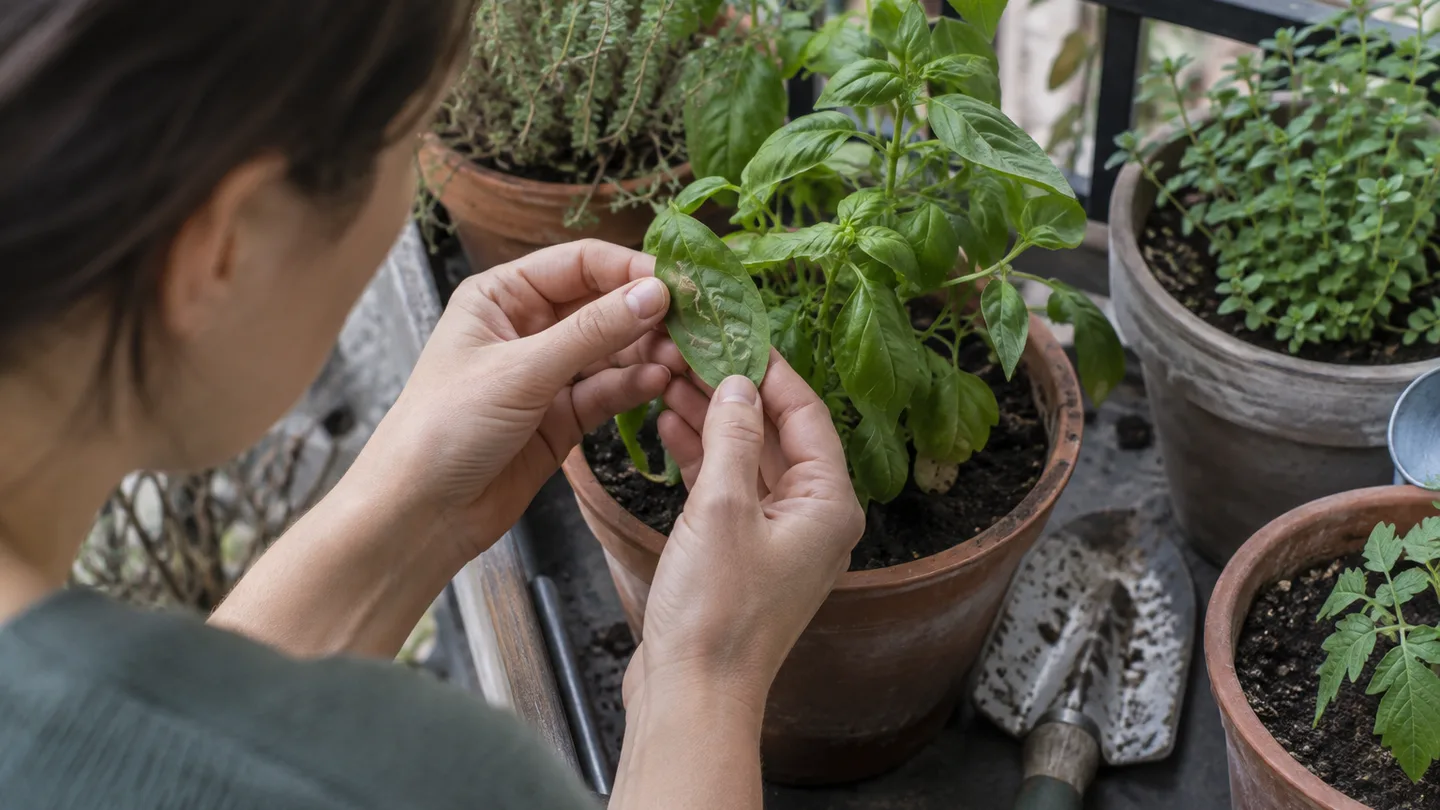
On basil, parsley, chard, lettuce and other crops where the leaf itself is the harvest, I remove badly mined tissue for quality and inspect the rest. A leaf with extensive tunnels, dead patches or an uncertain spray history is not worth saving for the kitchen. On a fruiting plant, I am more willing to keep a lightly mined green leaf if it is still contributing to the canopy and the plant is otherwise growing normally.
Safety is a separate question from appearance. Use only products labelled for that edible crop and observe the full pre-harvest interval: the label-defined time between the last application and harvest. Washing produce is sensible, but washing does not turn an off-label application into a permitted one and does not replace the required interval. If you do not know what was applied or when, discard the affected harvest rather than guessing.
For a small herb, cutting one or two damaged leaves may be the sensible compromise. For a larger tomato or citrus plant, removing every marked leaf can reduce the canopy more than the pest itself would have done. I would keep lightly damaged, fully green foliage unless it is actively mined, collapsing or interfering with inspection.
Basil, leafy greens, tomatoes and citrus do not share the same threshold
Basil and tender herbs. These are appearance-sensitive crops because the harvested part is the leaf. A single winding trail is not necessarily a plant emergency, but a heavily mined small herb can lose a meaningful share of its useful foliage quickly. Remove the worst leaves, pinch away badly damaged tips if needed, and protect the clean new growth.
Leafy greens. Treat the problem mainly as an edible-leaf and quality decision. Inspect the underside before harvesting, remove badly mined leaves, and avoid applying anything unless the product label specifically includes that crop. If new leaves emerge clean, the plant may continue producing even though older damage remains visible.
Tomatoes and other fruiting plants. Preserve total leaf area. A few mines on an older, healthy leaf may be mostly cosmetic; repeated damage on new growth or a large proportion of the canopy deserves faster action. The same canopy-first judgment matters in pruning tomato plants: remove what is necessary for health and airflow, not every imperfect leaf.
Citrus in containers. Citrus leafminer damage often concentrates on the soft new flush. The emerging leaf may become puckered, twisted or distorted as the tunnel follows its growth. I focus inspection on fresh tips and avoid removing every older leaf just because one new flush was attacked. A citrus plant can look untidy while still having enough healthy foliage to keep growing.
The surprising part is that the smallest pot often needs the gentlest pruning. A damaged leaf on a large citrus or tomato canopy may be expendable; the same leaf on a small basil plant may be a substantial part of the plant’s working area.
A balcony prevention routine built around twice-weekly checks
My prevention routine is deliberately boring. It is easier to inspect a few pots twice a week than to rescue a crowded collection after every leaf has become a hiding place.
- Check new growth first. Look at the newest leaves and their undersides, where soft tissue is easiest to damage. Scan for pale lines, blotches and a fresh leading edge.
- Repeat during warm, active growth. Twice-weekly checks give you a chance to remove a small number of active mines before the problem becomes a whole-canopy decision.
- Quarantine new plants when space allows. Keep a new purchase apart from established containers for roughly 7–14 days and inspect it several times. This lowers the starting pressure; it does not guarantee that a pest-free plant will remain pest-free.
- Clear fallen leaves and nearby weeds. Some leaf-miner species can use plant debris or soil during part of their development, and weeds may provide alternate foliage. Remove material rather than moving it from one pot to another.
- Leave inspection room. Crowded pots make undersides difficult to check and encourage you to miss the first few mines. If you use insect mesh, make sure it does not block the light and airflow the crop needs.
An open balcony still has open edges. Adult flies can arrive from outside, so quarantine and sanitation reduce the starting pressure but cannot create a sealed growing room. Prevention is a lower number of fresh mines and earlier detection, not a promise that leaf miners will never appear.
Recovery is new growth, not disappearing mines: the 7–14-day follow-up
Give the plant a clear follow-up window after removing active mines or applying a correctly labelled control. Existing tunnels should remain visible. The useful signs are clean new leaves, no fresh pale trails and steady growth over the next 7–14 days.
Check the plant at two separate inspections rather than declaring success after one clean morning. If new mines continue, return to the diagnosis: inspect surrounding pots, examine the undersides, check the sticky card for adult activity and consider whether the mark is actually a leaf miner. Escalating treatment without revisiting the diagnosis is how a harmless old scar turns into unnecessary pesticide use.
Keep watering consistent while the plant recovers. Extra water does not flush leaf miners out of a leaf, and extra fertiliser does not repair mined tissue. If the plant is also wilting or yellowing, compare the symptoms with overwatered plant symptoms and review how often to water container plants outdoors instead of treating every decline as an insect problem.
Can I compost leaves with active leaf-miner tunnels?
Bagging or disposing of actively mined leaves is the safer balcony choice unless you have a reliably hot, managed composting system and local guidance supports composting them. Some species may continue development in plant debris or nearby soil, so do not assume that an ordinary cool pile has stopped the life cycle.
Will leaf miners come back after I remove the damaged leaves?
They can. Adult flies may arrive from outside, and some species may persist locally in debris or soil. Removing active leaves, checking nearby pots and using screens where practical can reduce repeat attacks, but none of those steps makes an open balcony pest-proof.
Are leaf miners harmful to people or pets?
Leaf miners are plant-feeding insects rather than insects that infest people or pets. The food-crop caution comes from the plant and any treatment used on it: wash edible produce, follow the crop label and observe the full pre-harvest interval.
Before the weekend, inspect every new leaf on your containers, remove only the leaves with active tunnels, and take a dated phone photo of the cleanest new growth. In a week, compare that same growth: old mines may still be there, but the new leaves should tell you whether the problem is actually moving forward.
Frequently Asked Questions
Can I compost leaves with active leaf-miner tunnels?
Explain why actively mined leaves are safer to bag or dispose of unless the reader has a reliably hot, managed composting system and local guidance supports composting them; some species may continue development in plant debris.
Will leaf miners come back after I remove the damaged leaves?
Yes, because adult flies can arrive from outdoors and some species can persist locally in plant debris or soil; sanitation, inspection and screens reduce repeat attacks but cannot guarantee a sealed balcony.
Are leaf miners harmful to people or pets?
Clarify that leaf miners are plant-feeding insects rather than a human infestation, while edible produce still needs washing and any pesticide use must follow the crop label and pre-harvest interval.