Powdery Mildew Treatment: What Actually Works in Pots
A white leaf isn’t automatically a spray problem, but a talcum-like coating that keeps spreading across fresh foliage is a strong reason to act. In a pot, the treatment that actually works is usually a sequence: confirm the disease, remove the worst leaves, improve the canopy, then apply a labelled contact product with enough coverage to reach the infection.
Old white marks may remain after the mildew is inactive. I judge success by what appears next on the plant, not by whether yesterday’s damaged leaf suddenly turns green.
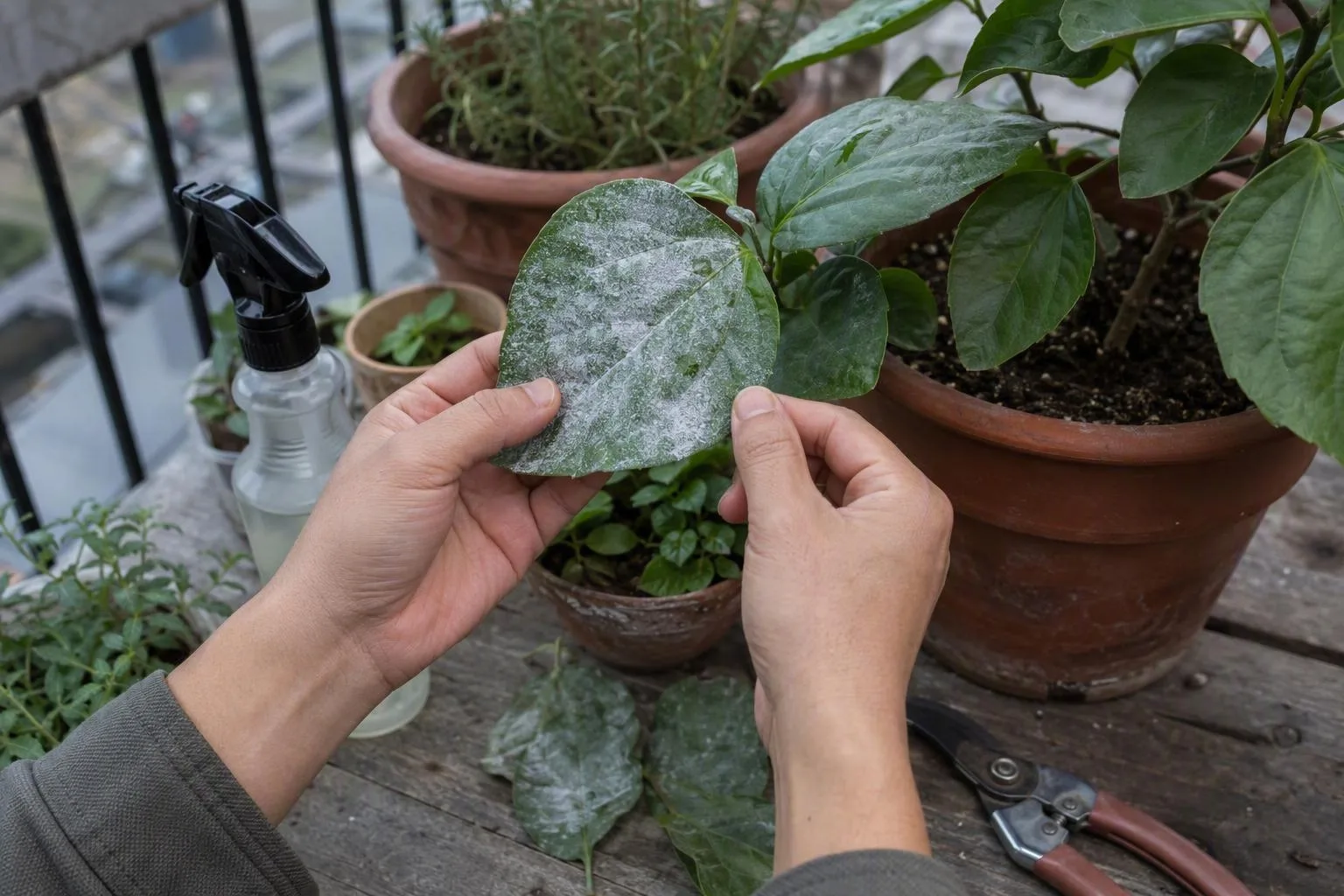
Before you spray, confirm it is powdery mildew
Powery mildew usually looks like a loose white or grey dusting on the surface of leaves, stems or young growth. The useful clue is movement: the coating enlarges, joins neighbouring patches or appears on newer leaves. A mark from dried hard water or a spray deposit tends to appear once, stay in the same shape and wipe away as a crust or film.
On my balcony, I once wiped a white crust from a basil leaf and assumed it was mildew. It did not return or spread to the next leaf; I had been looking at dried water residue from a poorly adjusted nozzle. On another plant, the white coating reappeared on the newest leaves after I wiped it away. Treating those two problems alike would have meant spraying the wrong plant for the wrong reason.
Downy mildew can confuse the picture. As a working distinction, downy mildew is more likely to produce pale or angular patches on the upper surface with grey, purple or downy growth underneath when conditions stay humid. Powdery mildew more often announces itself as a surface powder, sometimes on otherwise fairly dry foliage. The patterns overlap, so take a close photograph of both sides of an affected leaf before buying a product. If you’re uncertain, compare the symptoms with powdery mildew identification and cultural control guidance before treating.
The first 24 hours: isolate the pot and remove the worst leaves
I would not begin with a full-canopy spray. I begin by stopping the affected pot from brushing against its neighbours, because a crowded balcony makes every movement an opportunity to spread contaminated plant material.
- Move the pot carefully. Hold the container by its rim or support the root ball from underneath. Avoid dragging foliage through nearby plants. Put the pot where it still receives useful light but has space around the leaves.
- Remove the worst tissue. Cut leaves that are heavily coated, collapsing or mostly yellow. If the plant has just one or two affected leaves, remove those first. If it is a small annual with infection across nearly every leaf, keep the healthiest growth rather than stripping it bare.
- Bag the waste. I put infected leaves straight into a bag instead of leaving them in the pot saucer or on the balcony floor. Fallen foliage is easy to brush against later, and the tidy-looking option is not always the cleanest option.
- Clean the tool before the next plant. I wipe pruning blades between plants with 70% isopropyl alcohol or the disinfectant specified for the tool, then let the surface dry. Clean blades won’t solve airborne spread, but they remove one avoidable route between pots.
Pruning lowers the amount of visibly infected tissue and opens the canopy. It does not replace treatment when new leaves are still developing fresh white patches. Leave enough healthy foliage for the plant to feed itself while you deal with the source of continuing infection.
The balcony conditions that keep it returning
Powdery mildew does not require a leaf to be soaked all day. A leaf can look dry while the air around a dense canopy remains humid and still. That combination gives spores a better chance to establish, especially where leaves touch and the plant receives little direct light.
The useful fix is not simply more water. I look for a brighter workable position, more space between pots and a route for air to move through the leaves. Wall corners, balcony screens and tight clusters can create small pockets where moisture lingers even when the open balcony feels breezy.
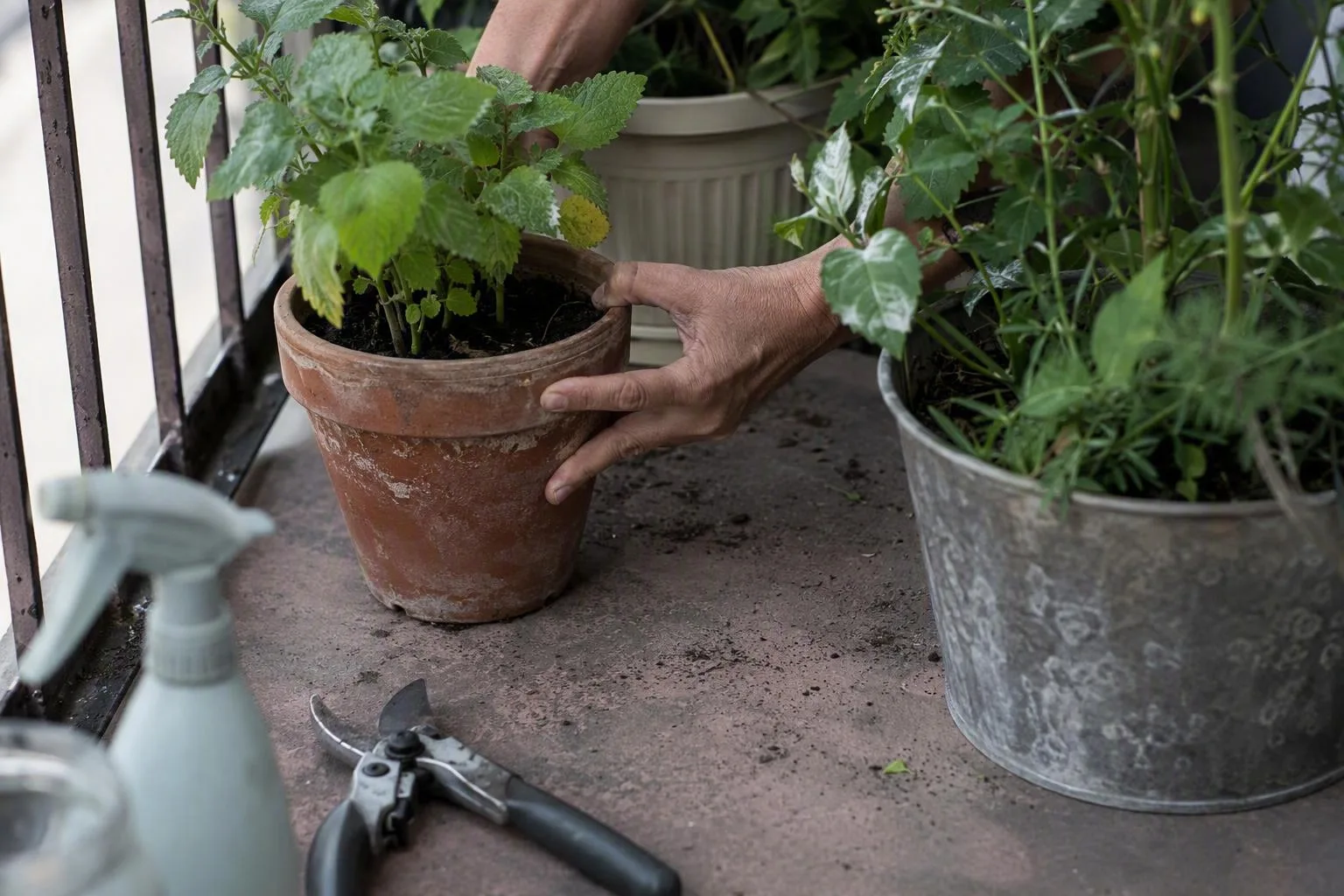
For compact herb canopies, I start with a gap of about 15–30 cm (6–12 in) between neighbouring plants. That is a starting gap, not a mature spacing rule. A tomato, cucumber or squash that is 20 cm (8 in) wide as a seedling may become much broader once fruiting, so I plan for the final canopy rather than the plant’s size on shopping day.
Keep leaves from touching if you can. Turn pots so the densest side faces open air, remove a leaf that is permanently trapped against a wall, and avoid stacking saucers or containers into a solid block. Water the potting mix when the crop needs water instead of routinely misting the foliage as a mildew treatment. I’m not claiming that every leaf-wetting practice has the same result in every climate; I’m saying that on a small balcony, repeated misting is a poor substitute for airflow.
If your balcony gets only one or two usable hours of sun, I would not pretend that spacing can create full light. Choose plants and varieties that can tolerate that position, put them in the brightest safe spot, and be stricter about crowding. In that situation, the practical goal is not an ideal microclimate. It is removing the avoidable disadvantages: a shaded wall corner, touching foliage and a pot cluster that never dries internally.
A treatment table: potassium bicarbonate, sulfur, oils, biologicals and baking soda
I think of these products as different tools, not interchangeable bottles. The choice changes with the crop, the weather, the condition of the leaves and what the label actually permits.
| Option | What it is useful for | Condition that changes the choice |
|---|---|---|
| Labelled potassium bicarbonate | A contact suppressant for early powdery mildew. It needs to land on the affected surface rather than travel through the plant. | Use only a product whose label lists your crop and disease. Coverage matters more once the canopy is dense. |
| Sulfur | An established contact option for some crops and mildew problems. | Crop directions, heat and recent oil use matter. Sulfur labels I’ve used commonly warn against application above roughly 90°F (32°C); I treat that as a stop sign for the day rather than a universal rule, and you should check your own product’s label. |
| Horticultural oil | A coverage-dependent suppressant that can be useful when the foliage is actively growing and not stressed. | Heat, drought stress, tender leaves and recent sulfur use can change the risk of spotting or burn. The exact product label controls the interval and crop use. |
| Biological controls | Most sensible as a preventive or early-infection tool, where the product is intended to occupy the leaf surface or suppress the disease. | They are a poor match for a neglected canopy already covered in heavy growth. Follow storage, timing and reapplication directions closely. |
| Ordinary baking soda | It is sodium bicarbonate, not potassium bicarbonate, and it is not automatically a substitute for a labelled garden product. | Homemade mixtures vary in concentration, water quality and added ingredients. A stronger mixture can mark or burn foliage, and an edible crop adds a food-use question. |
All of the contact options above have the same important limitation: they suppress active growth where the spray lands; they do not erase old white marks or guarantee that the disease will not return. I would choose a labelled potassium bicarbonate product for an early problem on a suitable crop, consider sulfur only when the crop and conditions fit, and treat oils as a coverage-and-weather decision rather than a universal home remedy.
Do not assume that a product labelled for ornamental plants is suitable for herbs or vegetables. Read the crop, disease, rate, timing and harvest instructions before mixing anything. If a label says not to combine oil and sulfur, or gives a waiting interval between them, that direction takes priority over a general spray schedule.
The spray sequence that decides whether a treatment works
The order matters: a good product applied to an unprepared, crowded canopy can look useless. Here is the sequence I use for a potted plant.
- Read the label first. Confirm that the product lists the crop and powdery mildew, then check the dilution, protective equipment, application interval and any temperature or harvest restriction. If the crop is edible and it is not listed, stop there.
- Remove the worst leaves. Pruning heavily coated or collapsing tissue reduces the amount of active growth you are asking the spray to cover. Don’t remove every leaf simply to make the plant look clean.
- Patch-test one or two leaves. Apply the mixed product to a small area and wait 24–48 hours for spotting, scorch or distortion before treating the whole plant. This is particularly useful with tender herbs, young leaves and oil-based products.
- Mix only at the stated rate. Stronger is not a shortcut to better coverage. It increases the chance of residue or leaf injury without fixing a missed leaf surface.
- Choose a low-stress application time. Avoid direct, intense sun and high heat if the label warns against them. Use a cooler part of the day that still gives the foliage time to dry in line with the product directions.
- Cover the canopy deliberately. Wet the upper and lower surfaces of affected leaves, the petioles and the crowded inner growth without chasing heavy runoff. Turn the pot as you work. A spray that reaches only the visible outer leaves has not contacted the whole problem.
- Keep the equipment clean and the tank simple. Don’t add soap, oil, fertilizer or another pesticide unless the label specifically allows the combination. Unapproved tank mixes make both the plant response and the harvest interval harder to judge.
- Respect the reapplication interval. Check new growth rather than expecting damaged leaves to recover. Reapplying early because an old patch is still visible can add stress without adding control.
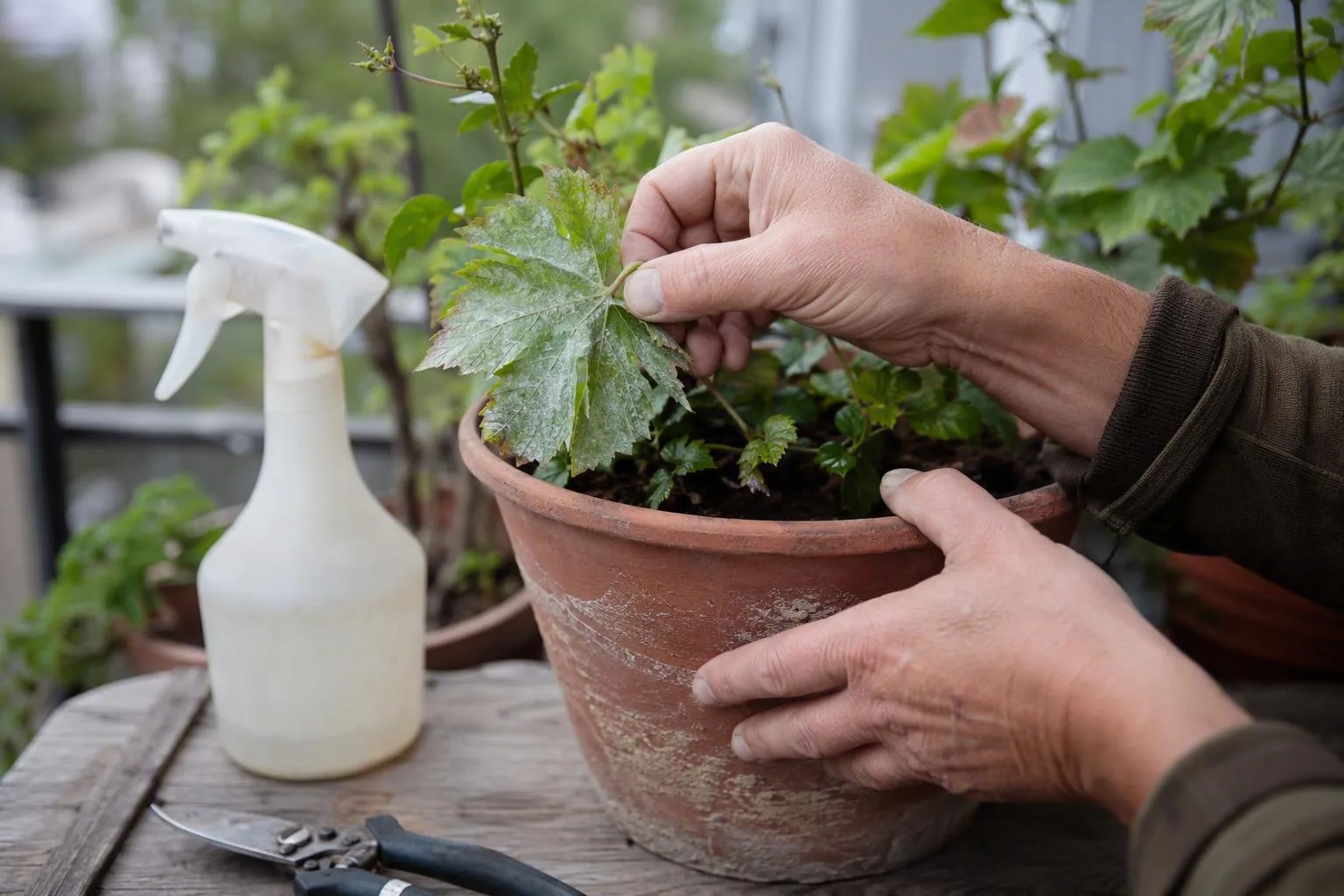
Coverage is the part people can inspect immediately. After spraying, look at the underside of a leaf and the centre of the plant. If those surfaces are completely dry while the outside is wet, the product may not have reached the tissue that needed it.
Edible pots need a separate residue and harvest check
For herbs, vegetables and strawberries, the product label is part of the treatment. The pre-harvest interval, or PHI, is the number of days the label requires between the final application and picking. The interval, dilution and permitted crops belong together; borrowing a rate from an ornamental label is not a safe substitution.
Before using anything on food, check that the label names both the edible crop and the disease. An ornamental-only fungicide, a homemade baking-soda mixture or a product meant for a different crop is not automatically suitable. For the regulatory side of that decision, use official pesticide-label guidance rather than a seller’s short product description.
Wash harvested produce under running water and handle it as you normally would, but washing cannot override an unapproved product or a missed PHI. A leaf with superficial cosmetic marking is a different judgement from produce that is slimy, collapsing, rotten or carrying an unpleasant smell. I don’t treat every mildew-marked harvest as automatically safe or automatically unusable; I check the product history, the crop, the harvest interval and the condition of the food.
Why the leaves still look white after treatment—and when to change course
Leaves are records, not a scoreboard. An old powdery patch can remain pale, stained or rough after the active growth has stopped. Contact treatments do not repaint that tissue, so a plant can be improving while yesterday’s leaves still look disappointing.
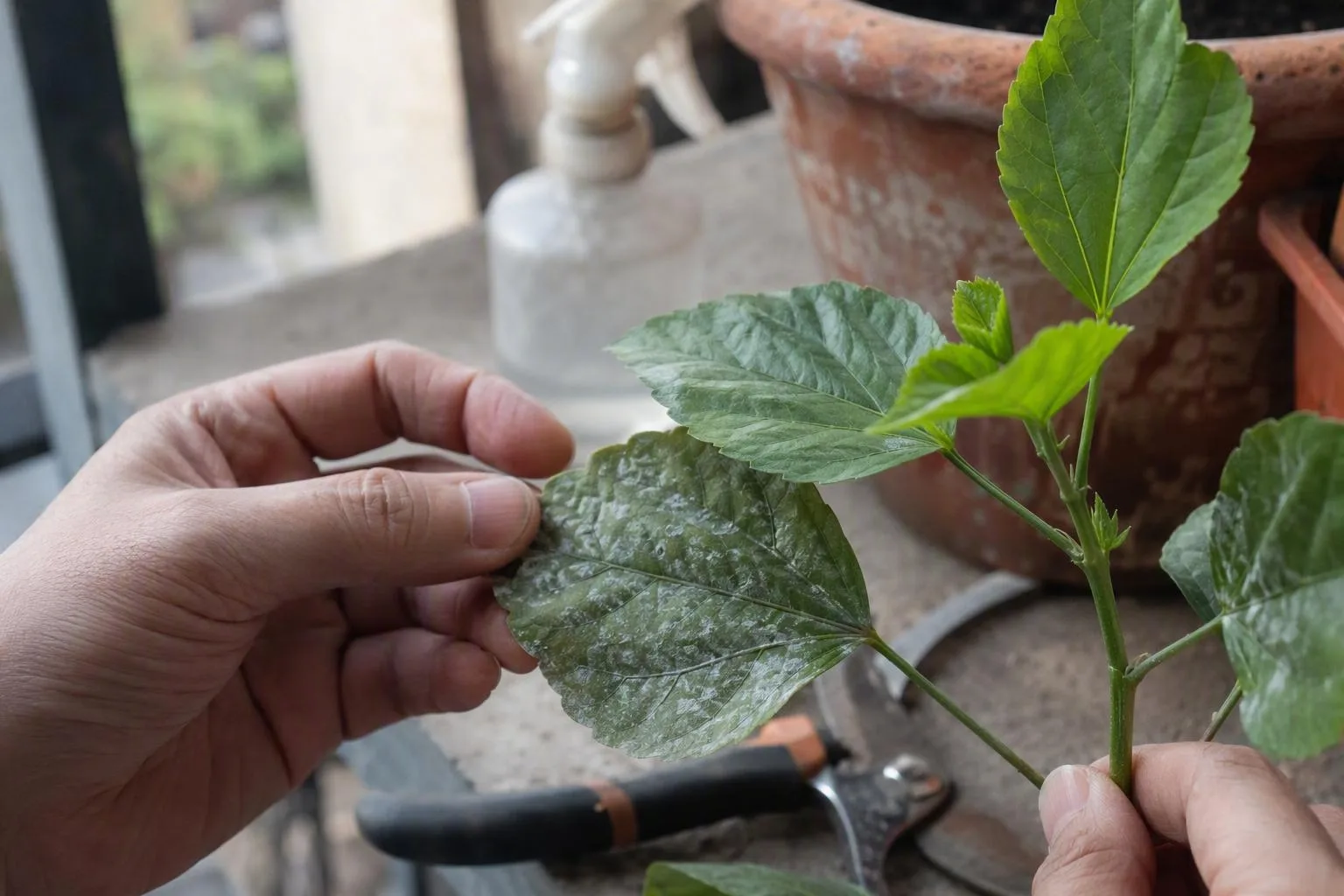
Fresh white growth on a newly formed leaf is more useful evidence of continuing infection. I give the plant one or two label intervals to show a direction; depending on the product, that may be roughly 7–14 days, but the printed reapplication instruction comes first.
If new patches continue, I check in this order:
- Was the diagnosis wrong, especially if the marks are angular, fixed or mostly underneath?
- Did the spray reach the lower surfaces and inner canopy?
- Was the plant heat-stressed, drought-stressed or sprayed in harsh conditions?
- Was the active ingredient appropriate for this crop and disease?
- Has the canopy become so crowded that the original humidity problem remains?
I don’t simply spray more often when the plant fails this check. A severely declining annual in a small pot may no longer repay repeated treatment, particularly if removing more leaves would leave no useful canopy. Removing that pot can be the kinder choice for the plant and the safer choice for nearby containers.
Reset the pot without creating a second problem
Powdery mildew often triggers an overwatering response: the grower sees stressed leaves and adds water. The disease is primarily a foliage problem, so soaking the pot more frequently does not remove the white growth. Waterlogged roots can create a separate decline, and excess nitrogen can push soft, crowded foliage that is harder to ventilate.
For many annuals, I make the first moisture check in the top 2.5–5 cm (1–2 in) of mix, then adjust the decision for the crop, container size, pot material, wind and heat. A shallow herb pot in a hot, windy position may need checking far more often than a large glazed container in part shade. If you’re comparing how often to water container plants, use the plant’s moisture and the site conditions rather than copying a calendar.
Water at the soil line when the plant needs it, and confirm that the drainage holes are open. Your container gardening soil should hold moisture while still allowing excess water to leave; compacted or permanently wet mix is a root-health problem, not a mildew cure. Return to the normal crop-feeding rate instead of adding extra fertilizer in response to a white leaf. For that decision, how often to fertilize container plants should follow the crop and the potting mix, not the presence of mildew.
Repotting is not a powdery mildew treatment by itself. I would repot only when the container has a drainage fault, the roots are unhealthy, the mix has collapsed or the plant genuinely needs a different root volume.
A seven-day check and the next-season cleanup
Use the next week to collect evidence rather than to chase every old mark.
- Every 2–3 days, inspect the newest leaves and the undersides of nearby foliage.
- Remove fresh, heavily infected leaves before they fall into trays or onto the balcony.
- Check adjacent pots, including plants that looked clean when you first moved the affected one.
- Clear fallen leaves from saucers, shelves and the floor.
- Wash or disinfect reusable supports, clips and pruning tools before storing them.
Infected debris and volunteer seedlings can contribute to carryover because they leave host tissue and spores close to the next planting. I treat sanitation as a way to reduce the starting pressure, not as a promise of a clean season. Recurrence depends on the host, local humidity and airflow, and the particular powdery mildew species involved.
For the next planting, choose a resistant variety when one is available for the crop, and give the mature plant enough room to develop without a permanently packed canopy. Those choices can lower the amount of early infected tissue and reduce the starting pressure next season, although they cannot remove every source of spores. I would not replace healthy potting mix automatically simply because leaves were infected; clean the plant debris and fix the canopy or drainage issue first.
Does powdery mildew live in potting soil?
I treat powdery mildew primarily as an aerial leaf-and-stem problem rather than a disease of the root zone. That does not mean the pot can be ignored: spores and infected debris may remain around the container, on fallen leaves or on supports. Remove the waste and clean the surfaces before assuming that a full repot is necessary.
Will powdery mildew come back next year?
It can, but the answer depends on the host plant, local conditions and the particular mildew species. Infected debris and volunteer plants can contribute to carryover. Sanitation, mature-canopy spacing and resistant varieties reduce the starting pressure; they do not make recurrence impossible.
Can I use neem oil on an edible plant with powdery mildew?
Treat neem as an oil-based product, not as a universally safe home remedy. Use it only when the exact product label lists the edible crop and disease, patch-test first, avoid heat- or drought-stressed foliage, and keep it away from sulfur unless the label permits the timing. If the label does not cover your crop, choose a permitted option or leave the plant unsprayed.
Today, isolate the pot, photograph one affected leaf from both sides, and remove the leaves that are collapsing. In seven days, compare that photograph with the newest growth: clean new tissue is the sign to keep following the label, while fresh white powder is the prompt to revisit the diagnosis, coverage and product directions.
Frequently Asked Questions
Does powdery mildew live in potting soil?
Explain that the infection is usually an aerial leaf and stem problem rather than a root-zone disease. Spores and infected debris can remain around the pot, so removing plant waste and cleaning containers matter more than automatically replacing otherwise healthy potting mix.
Will powdery mildew come back next year?
Explain that recurrence depends on the host, local conditions and the particular mildew species. Spores or infected debris and volunteer plants can contribute to carryover, while sanitation, mature-canopy spacing and resistant varieties reduce— but do not eliminate—the risk.
Can I use neem oil on an edible plant with powdery mildew?
Treat neem as an oil-based product, not as a universally safe home remedy. Use it only when the exact product label lists the edible crop and disease, test a small area first, avoid heat- or drought-stressed foliage, and do not apply it close to sulfur unless the label permits that combination.