Winter Sowing: What to Plant Now and What to Skip
Winter sowing is excellent for kale, spinach, parsley and calendula; it is the wrong start for tomatoes, peppers and basil. The dividing line is whether the seed and its young seedling can cope with a cold, wet, light-changing container until spring—not whether the packet says vegetable.
I use winter sowing to mean sowing into a covered, ventilated container that stays outdoors, rather than scattering seed directly onto frozen ground. The container catches rain, holds enough humidity for germination and lets the seedlings experience real outdoor light, but it does not turn a warm-season crop into a cold-tolerant one.
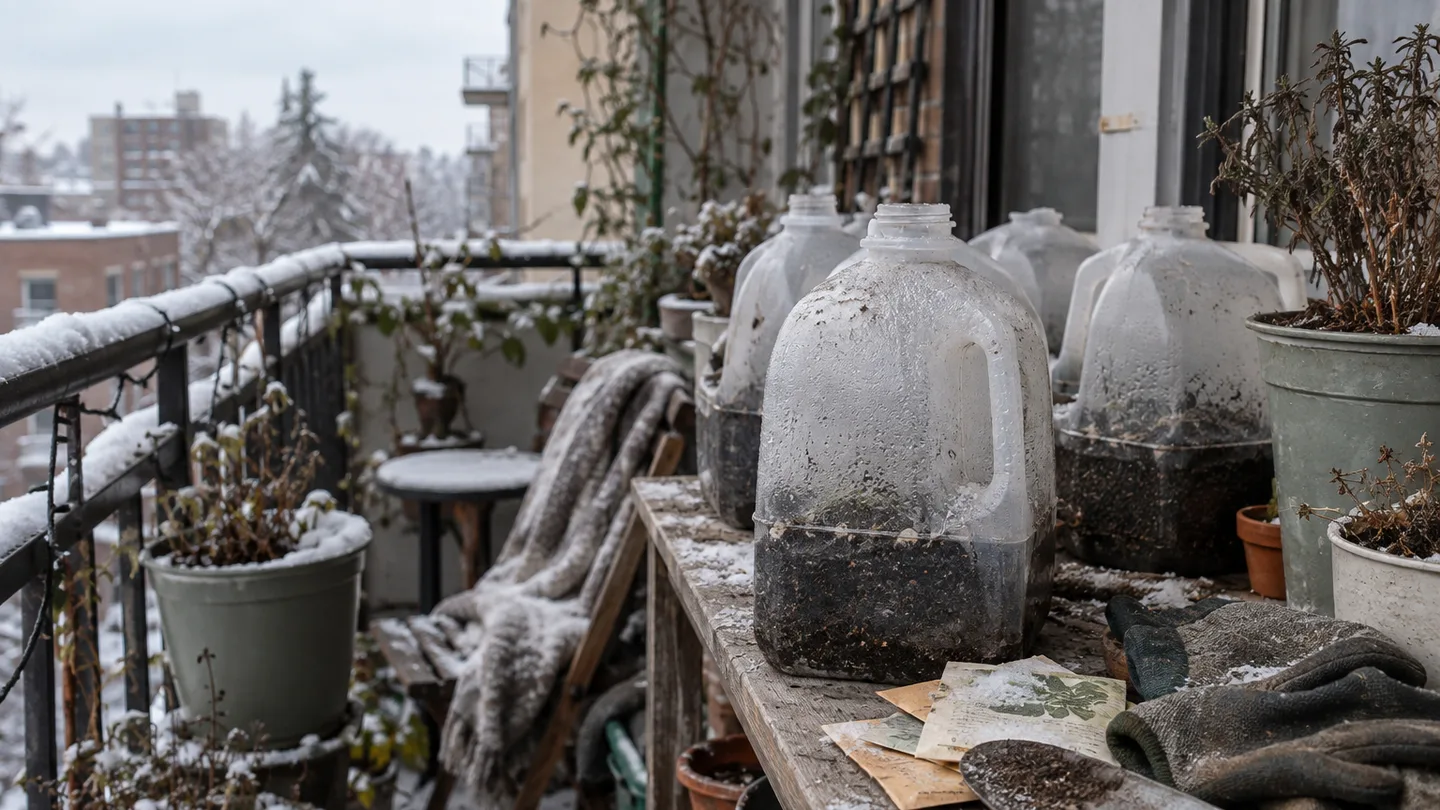
The cold test: which seeds can wait outdoors until spring?
Before I buy a packet for winter sowing, I ask three questions. They are more useful than a universal list because the same crop can behave differently on an exposed rooftop and a sheltered patio.
Ask the packet three questions
- Can the seed tolerate freezing? Seeds intended for cool-season sowing or autumn exposure have a better chance of sitting dormant through cold weather. That does not mean every seed from a hardy plant will survive a container that stays waterlogged or repeatedly freezes and thaws.
- Can it germinate in cool conditions? I use roughly 4–10°C (40–50°F) as a practical reference for cool germination, not as a universal cutoff. A seed that needs a warmer window may remain dormant outside, then rot before spring warmth arrives.
- Does it need a warmer 18–24°C (65–75°F) range? If the packet gives a warm germination range, I treat that as a strong reason to use indoor seed starting instead of an unheated outdoor jug.
Cold stratification is a related but different idea. It means giving a seed moist, cold conditions for a period of time so dormancy can ease. Some perennial seeds benefit from that winter-like treatment, while a hardy leafy green may simply germinate when the mix warms enough. In both cases, the seed needs moisture without stagnant saturation, and the container needs enough airflow to stop the first leaves being smothered by mould.
That is why winter cannot be reduced to a calendar date. A mild coastal winter may give parsley or calendula several opportunities to sprout, while an exposed balcony may keep the mix frozen for much longer. A clear container in full afternoon sun also warms faster than one tucked beside a shaded wall. If you are checking a new crop, compare the packet with extension guidance on winter sowing and with local last-frost records, then use the more cautious interpretation.
The phrase seed germination temperature charts can also be useful when a packet gives a range but does not explain whether it is a minimum, an optimum or simply a likely indoor setting. I would rather delay a sowing than put a warmth-dependent crop into a wet container for several months.
Plant now: a crop matrix for hardy greens, herbs, and cool-tolerant flowers
For a balcony grower, the food crops with the clearest payoff are hardy greens and a few cool-season herbs. Flowers and perennials can be worthwhile, but they usually repay the space with colour or an experiment rather than a bowl of produce.
| Group | Useful timing | Examples | What I would expect |
|---|---|---|---|
| Hardy greens | True winter to late winter | Spinach, kale, leaf lettuce | A small harvest of young leaves once growth resumes; thin plants if you want full-size heads. |
| Hardy herbs | Late winter, or earlier in a sheltered spot | Parsley, chives, cilantro | Parsley may be slow, while chives can wait quietly and restart as light improves. |
| Cool-tolerant annual flowers | True winter to early spring | Calendula, poppies, hardy violas | A low-cost way to test outdoor sowing; check the packet because flower hardiness varies. |
| Perennials | Late winter, with some waiting longer | Region-appropriate coneflower, yarrow and other hardy perennials | Emergence may follow a mild spell or may take several months, especially where dormancy is strong. |
| Conditional cool crops | Late winter in suitable climates | Peas, onions, carrots and beets | Possible in the right container and weather pattern, but drainage, root disturbance and sowing depth matter. |
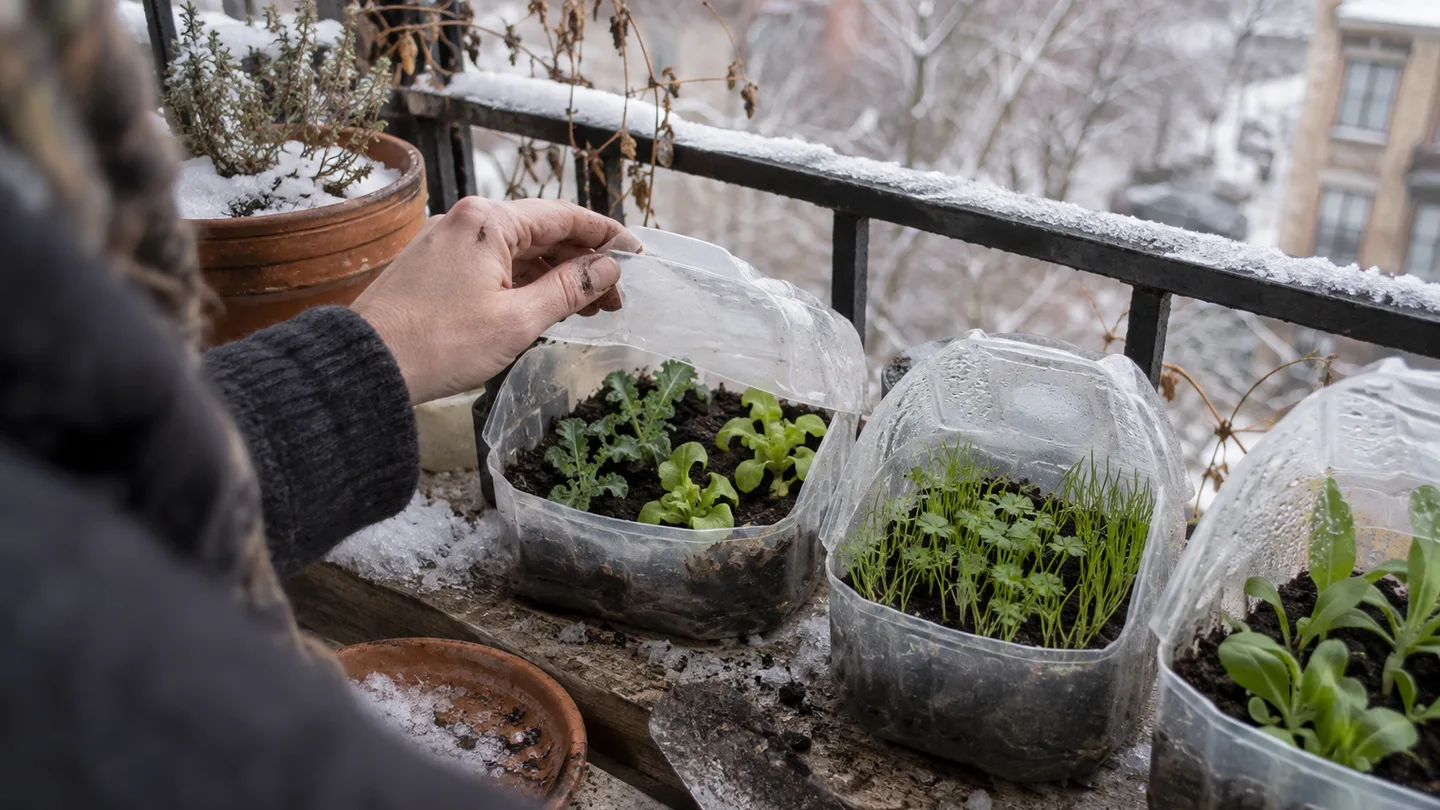
A 1–2-gallon container (3.8–7.6 litres) is enough for a modest winter sowing, not a miniature field. For spinach or lettuce grown as baby leaves, I sow a small pinch and thin after emergence so the leaves are not pressed tightly against one another. For kale, parsley or a flower that must reach maturity, I follow the seed packet’s final spacing and accept that one container may hold only a few worthwhile plants.
The seed packet’s mature-spacing guidance still matters even when the seedlings look tiny. The first leaves can make a container seem empty, but roots begin competing below the surface before the pot looks crowded above it. If I want a full-size kale plant, I give it more room or move it into a deeper pot. If I want baby kale, I harvest earlier rather than pretending a shallow container can produce the same plant as a garden row.
Do not expect every winter-sown seed to appear on the same schedule. A mild spell may trigger greens and annual flowers, followed by another cold snap. Some perennial seeds may remain quiet until the mix has gone through enough cold and then warmed gradually. I check for a change in the surface and for the first green hook rather than digging through the pot every few days.
For food, I give the square footage to spinach, kale, leaf lettuce, parsley and cilantro before I give it to a flower. That is a judgement call, not a rule. Calendula and poppies earn their place when the aim is a forgiving experiment, a brighter balcony or seed saved for another season. They are not a substitute for a productive herb pot.
Skip the unheated jug: warm-season seeds that need a different start
The practical skip list starts with tomatoes, peppers, eggplants, basil, cucumbers, squash, beans and melons. I skip outdoor winter sowing for these crops because they commonly need warmth to germinate, their seedlings can be damaged by cold, or the combination of cold and wet mix gives them a poor start even if a few seeds eventually sprout.
There are three separate reasons to skip a crop. First, the seed may sit dormant until the container warms, losing time without producing a seedling. Second, the seedling may emerge during a bright thaw and then be injured by the next hard freeze. Third, a slow-drying container can keep the seed coat wet long enough for decay or fungal problems before useful growth begins. The clear cover protects humidity; it does not supply the steady warmth that a tomato or pepper expects.
Skipping outdoor winter sowing does not mean skipping the crop. For tomatoes, peppers and other warmth-dependent plants, I start indoors roughly 4–10 weeks before the local last-frost window, then adjust the lead time to the crop and the packet. A slow-growing pepper may need more advance time than a fast cucumber, while an apartment with a dim windowsill may need a grow light rather than an earlier sowing.
Peas are the most useful edge case. They tolerate cool conditions, but I would use a late-winter sowing only where the container drains freely and the weather is not staying cold and saturated. Onions can go either way: some gardeners winter-sow them for a long, slow start, while others start them indoors because the seedlings need a long season. Carrots and beets deserve a separate warning because their roots dislike disturbance; if I grow them in a container, I prefer sowing them close to their final position rather than raising them in a small transplant cell.
Cucumbers, squash and beans are not improved by being placed outside early. Their seedlings grow quickly once warm, and a cold interruption can leave a weak plant that never catches up. I would spend the covered container on a hardy green and reserve indoor space for the warmth-dependent crop.
Build the winter-sowing container around freeze, drainage, and airflow
The order matters because a winter-sowing container has to handle several changes before spring: freezing, thawing, rain, brighter sun and faster evaporation. Set it up in this order rather than adding holes or labels as an afterthought.
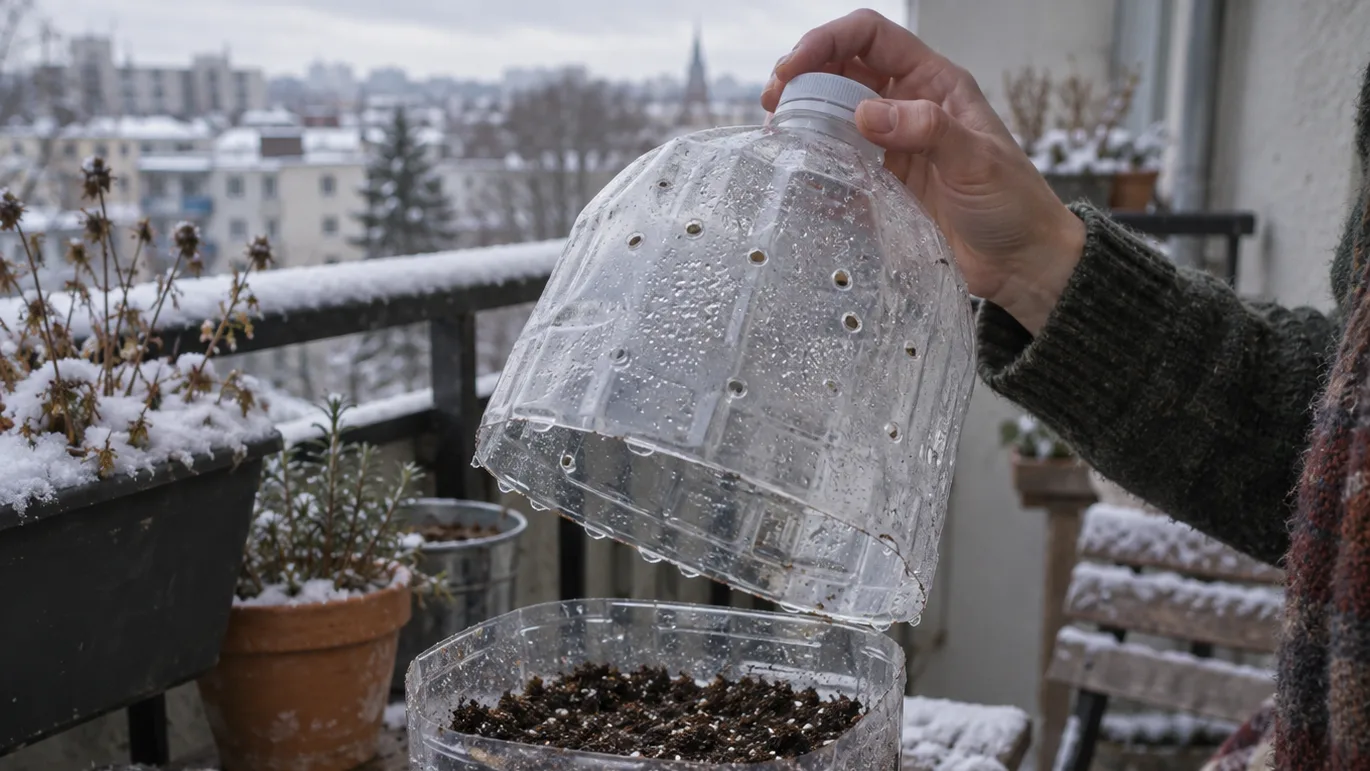
- Start with a clean, translucent container. A 1–2-gallon container (3.8–7.6 litres) gives a small sowing enough mix to buffer temperature changes without becoming an awkward weight on a balcony. A cut milk jug, clear food container or translucent storage tub can work if it is clean and has never held chemicals. If the material or its previous contents are unknown, I do not use it for edible crops.
- Add drainage before adding mix. Make effective holes at the lowest part of the container so rain and thaw water have a route out. One opening that clogs against the balcony surface is not a drainage plan. Set the container on feet, a rack or a surface where water can escape rather than sealing the holes against a saucer.
- Fill with about 5–8 cm (2–3 inches) of moist mix. I use a fine seed-starting mix or a loose potting mix labelled for containers. Moisten it before sowing so the seed is not washed into a corner by the first heavy watering. If your mix is a mystery, the practical notes in container gardening soil are worth checking before you fill every jug.
- Sow at the packet’s depth. Tiny seed should not be buried under a deep winter blanket, while larger seed needs enough contact with damp mix to avoid drying. Press the surface gently, then label the crop and sowing date with a marker that can survive rain.
- Create a ventilated cover. The cover should hold humidity while leaving a route for excess heat and condensation to escape. A hinged jug with a small air gap, or a clear lid that is not clamped airtight, is more useful than a sealed container. Keep the cover attached so wind cannot carry it across the balcony.
Garden soil is usually the wrong material for this job because it can compact in a small container, drain slowly and form hard clods around shallow roots. A loose mix gives the seed both moisture and air. Those two needs can pull against each other: saturated pores leave less room for oxygen, while an overly dry mix stops the seed coat from swelling.
A gravel layer at the bottom does not solve that problem. Water does not automatically move from fine mix into coarse gravel just because the gravel is lower; the fine layer can hold a saturated band above the change in texture. Gardeners often call this the perched water table. The useful fix is a container with open drainage and a suitable mix, not a decorative stone layer that steals root space.
A sealed jug can overheat during a sunny thaw because clear walls admit sunlight and the trapped air has nowhere to go. I check the container when the weather shifts, not only when the calendar says spring. On a balcony, place it where it receives natural cold and precipitation but cannot fill with runoff from a roof or become a loose object in strong wind.
For edible crops, clean containers are the simple food-safety step worth taking. Wash out old containers, avoid anything that held pesticides, solvents or unknown chemicals, and do not assume a decorative glaze is food-safe merely because the pot is sold at a garden centre.
When the lid starts steaming: the spring handoff from seedling to transplant
Winter sowing is not set-and-forget. The container does most of its work quietly, but spring thaws change the balance between light, heat, air and water quickly.
- Inspect at least weekly through winter thaws. Look under the lid for condensation, check whether the mix is still damp and confirm that wind has not shifted the container. In a long frozen spell, the check may be brief. During a sunny thaw, it becomes the important visit.
- Vent when the interior warms. Open or lift the cover when sunlight raises the inside temperature, then close it again if a hard freeze is forecast and the crop is still dormant. The aim is to avoid a humid, stagnant pocket without exposing tiny seedlings to unnecessary drying wind.
- Water by looking at the mix, not by following a calendar. If the surface is damp below the top layer, leave it alone. If the mix is shrinking from the sides or feels dry beneath the surface, add water gently at the edge or from below so seeds and roots are not blasted out of position.
The failure signals are usually visible. Mold or algae that keeps returning points to excess moisture and poor airflow. Lanky seedlings are a light and temperature problem: the container warmed enough to encourage growth, but the seedlings did not receive enough usable light. The advice for leggy seedlings applies here too—more warmth is not the answer if light is still weak.
A shrinking mix or wilted leaves points to wind, heat or missed watering rather than a mysterious nutrient problem. If the container has dried hard, rehydrate it slowly so water can soak through the mix instead of running down a gap at the side.
I move seedlings by condition, not by a fixed date. The crop must suit the outdoor weather, the receiving pot or planter must be ready, and the soil should be workable rather than saturated. Many seedlings are manageable at roughly 2–4 true leaves, with a root ball that holds together when the container is tipped. True leaves are the leaves that appear after the first seed leaves; they have the shape of the mature plant and show that the seedling has moved beyond its initial stored energy.
Outdoor winter-sown seedlings have already experienced normal changes in light and temperature, so they usually need less formal hardening off seedlings work than plants raised under warm indoor conditions. I still protect them from a sudden hot, windy spell and from a late hard freeze. A covered container beside a wall is not the same climate as an exposed final pot.
On my own balcony, I sowed about eight kale seeds in a cut, translucent one-gallon container during the last week of February. The mix froze, then a mild spell left water beaded under the lid, so I opened it for the afternoon and tipped the container slightly so runoff could escape. By early spring, six seedlings had emerged. I removed the two smallest, let the remaining plants develop several true leaves, and moved the strongest seedlings into a deeper pot. The useful lesson was not the number of seedlings; it was that the thaw, rather than the calendar, told me when to vent.
My judgment is that winter sowing earns its space when it replaces a fussier indoor setup for a crop that genuinely tolerates cold. It is not a shortcut for tomatoes, and it is not a reason to fill every spare container with seed. Before the weekend, choose one hardy green or herb, find a clean translucent container, check its drainage, and write the crop and date on the label before the first seed goes in.